Take a photo of a barcode or cover
2.05k reviews by:
mburnamfink


Inside the Cuban Revolution is a detailed, practically month by month political account of the Cuban Revolution. It's also very much Sweig's dissertation, which is a double-edged blade. On the positive side is an obsessive focus with the minutia of newly open archives that a journalist or more senior scholar would elide. On the negative side is a desire to advance scholarship by pushing against the conventional wisdom. The conventional wisdom, at least as I understand it, is very much driven by Cold War ideologies, Cuban exiles, and the self-aware mythmaking of Fidel Castro and Che Guevara. And yet, in looking for a new story about the relationship between the urban llano and the rural sierra components of the 26th of July Movement, Sweig perhaps misses the forest for the trees.
But first those trees, and they are quite impressive. Inside the Cuban Revolution brings forward lesser known figures of the Revolution, such as Frank Pais, Armando Hart, and Celia Sánchez. Rather than a unitary and inevitably victorious war, Sweig shows the Revolution as constantly backfooted, debating strategy and organization, and very unsure of where to go next. The main object of focus was a general strike, a broad coordinate rebellion across Cuban society that would shut down industry and transport, aligning ordinary workers, radical activists, and the staid conservatives of the civic groups in an anti-Baptista rising, out of which a new constitutional order would arise.
Of course, it didn't work out like that at all. Several attempts at a general strike failed due to organizational lapses, as the 26th of July Movement lacked the deep basis to pull it off, and these failures were accompanied by high casualties. The 26th of July Movement was one faction in the opposition, which included politiqueria exiles who threatened a return to traditional corruption. Coordination between Castro in the mountains, activists at the literal other end of the island in Havana, and members overseas charged with raising money, arms, and diplomatic support was always spotty at best.
Yet somehow Castro's ragtag but motivated guerrilla columns defeated Batista's army in battle, showing that superior firepower doesn't always win. A strongman cannot ever afford to look weak, and Batista fled, letting the 26th of July Movement seize power in a triumphal march.
But first those trees, and they are quite impressive. Inside the Cuban Revolution brings forward lesser known figures of the Revolution, such as Frank Pais, Armando Hart, and Celia Sánchez. Rather than a unitary and inevitably victorious war, Sweig shows the Revolution as constantly backfooted, debating strategy and organization, and very unsure of where to go next. The main object of focus was a general strike, a broad coordinate rebellion across Cuban society that would shut down industry and transport, aligning ordinary workers, radical activists, and the staid conservatives of the civic groups in an anti-Baptista rising, out of which a new constitutional order would arise.
Of course, it didn't work out like that at all. Several attempts at a general strike failed due to organizational lapses, as the 26th of July Movement lacked the deep basis to pull it off, and these failures were accompanied by high casualties. The 26th of July Movement was one faction in the opposition, which included politiqueria exiles who threatened a return to traditional corruption. Coordination between Castro in the mountains, activists at the literal other end of the island in Havana, and members overseas charged with raising money, arms, and diplomatic support was always spotty at best.
Yet somehow Castro's ragtag but motivated guerrilla columns defeated Batista's army in battle, showing that superior firepower doesn't always win. A strongman cannot ever afford to look weak, and Batista fled, letting the 26th of July Movement seize power in a triumphal march.

Le Guin is a master of the craft, of course, even when turning something as ephemeral as fantasy young adult novel. Starting from the premise of "what were Gandalf and Merlin like as young men?", Le Guin traces out the early career of Ged/Sparrowhawk, a powerful mage in a deeply historied archipelago where knowing the true names of things gives you power over them. A prideful boast unleashes a terrible shadow into the world, and Ged has to go on a journey of self-discovery and mastery to restore the equilibrium. As elegant and simple as Shaker furniture, this book is a masterpiece for all ages.
***
UPDATE: Better on every reread. Le Guin is the GOAT
***
UPDATE: Better on every reread. Le Guin is the GOAT

The second book of the Earthsea Cycle takes us to new lands and new protagonists. Arha, meaning "The Eaten One", is the high priestess of the Nameless One, an Old Power of the Earth who inhabits a temple complex above an ancient labyrinth. She is the first and only priestess, endlessly reincarnated to serve her dark masters. She is also a little girl who used to be named Tenar, who was taken from her family to an isolated desert compound of embittered women and eunuchs. Her faith is old and powerful, and she is the only member of her religion.
Arha is in her late teens when she discovers a thief in the labyrinth she guards, a wizard named Ged. Her duty is to kill him, but she decides instead to prolong his life, to talk about the world, and eventually to lose her faith. Arha's temple conceal half of a great treasure, an ancient ring of power, and Ged has the other half. The two learn to trust each other and make an escape, though Arha's happy ending is partial. Liberty is terrifying.
This is a more subtle and thoughtful novel than the first book, Arha female imprisonment a quieter cry for help than Ged's more traditional quest towards power and knowledge. The final essay by Le Guin is the best part of a good book.
Arha is in her late teens when she discovers a thief in the labyrinth she guards, a wizard named Ged. Her duty is to kill him, but she decides instead to prolong his life, to talk about the world, and eventually to lose her faith. Arha's temple conceal half of a great treasure, an ancient ring of power, and Ged has the other half. The two learn to trust each other and make an escape, though Arha's happy ending is partial. Liberty is terrifying.
This is a more subtle and thoughtful novel than the first book, Arha female imprisonment a quieter cry for help than Ged's more traditional quest towards power and knowledge. The final essay by Le Guin is the best part of a good book.

What would you do if you learned that some organization was killing over 700 American servicemen and women a year? That the material losses were in the range of several billion dollars annually, impacting strategic readiness in both the short and long term. What if I told you that ranks of the victims extended from the most junior enlisted and flying officers, to generals, Cabinet Secretaries, and even the family of the President of the United States.
Well, if the perpetrating organization with the US military's own awful safety culture, the answer is denial and nothing, to the extent that veteran accident investigator Alan Diehl turned whistleblower and wrote this book. Silent Knights is aimed squarely at the intersection of several of my interests, but even for people less obsessed with air power, it is a thrilling and tragic story that goes HARD from beginning to end, starting the death of Lt. Tom Selfridge, the first aviation fatality in 1908, and continuing through the mid-90s.

Maverick buzzing the tower in Top Gun. According to Diehl, F-14 accidents doubled after the movie came out
In the civilian world, air safety is ensured by a tripartite system. Operators, airlines such as United and Southwest, fly and maintain the aircraft. The Federal Aviation Authority (FAA) is the regulator, setting the standards and rules required for safety. And the National Transit Safety Bureau (NTSB) is an independent investigatory agency, responsible for figuring out want went wrong when planes crash, and how it can be prevented. The ongoing 737 MAX debacle is notable as an extended failure in the process, where lax design and manufacturing standards at Boeing, combined with regulatory deference from the FAA, lead to multiple fatal crashes, which are noteworthy because commercial aviation crashes are so rare.
However, the authority of the FAA and NTSB do not extend to the military. The military investigates itself, and as Diehl reveals in the dozens of case studies in this book, the primary goal of these investigations is to coverup and scapegoat. Rather than specialist investigators, investigations are done as tertiary duties by serving officers who lack both expertise and time to do a proper job, and who know that their future careers depend on being good soldiers who arrive at the proper conclusions: this was a tragic and unique accident due to a combination of pilot error and/or mechanical failure. There are no lessons to be learned, please ignore that this will repeat next month. At an even more basic level, the military keeps two separate sets of books on each accident, an Accident Investigative Review which is public and entirely bullshit, and a confidential Safety Investigative Review, which may contain some truth.
Following the professional principles of human factors engineering, Diehl argues that in his career, many accidents were the result of a systematic lapses in safety culture. Military aircraft are often old, poorly maintained, and not upgraded to even civilian standards in terms of navigation equipment, engine and avionic system reliability. Military operations which involve flying low, in darkness, or in bad weather, are inherently more dangerous than commercial flights, which mostly take place at over 30,000 feet in good conditions, however this inherent danger is not matching with a similar care for necessary equipment, such as night-vision goggle compatible cockpit lighting, ergonomically designed instruments that are easy to read, or even parachutes, as with the USAF Academy T-3A basic trainer!
An authoritarian culture that orders must be followed is necessary in war, but in training and peace time, this authoritarian attitude, along with macho pilot culture, leads to unnecessary risk taking. Weaker pilots are assigned dangerous aircraft and missions out of some sense that Darwinian winnowing is necessary (and shame if you happen to be a passenger or underneath this plane). Hotdog flying has lead to many deaths, including the 24 fatalities of the 1994 Green Ramp disaster at Fort Bragg, where an out of control F-16 crashed into a gathered body of paratroopers, and Fairchild B-52 crash, where notably unsafe pilot Lieutenant Colonel Arthur "Bud" Holland lost control of his bomber at low level while training for an air show.
Diehl wrote during the peace dividend era of the 1990s, when an overstretched military had to make do with less. Safety and training are ongoing up-front expenses, while accidents could be written off in many ways. Real safety culture would require an admission of failure and potential accountability on the part of senior leaders, such as former Air Force Chief of Staff General McPeak, and various junior "favored sons". While there are many honest and capable people working in the military, the whole system is designed to protect itself at the expense of victims and a few designated scapegoats, usually non-flying officers like maintainers and air traffic controllers who in fact had no ability to alter the course of events.
Diehl is strident in his criticism, and I believe he is absolutely correct. War is inherently dangerous, and this danger means that military personnel should have the best chance to accomplish the mission and return home. But dying during training or due to pride and corner-cutting is a shameful betrayal of heroism and sacrifice. More generally, the tripartite aviation system of independent bodies for Do/Regulate/Investigate offers a strong model for successful policy outcomes in many dimensions.
Diehl makes a modest policy proposal of establishing an independent Military Transit Safety Bureau to handle investigations in an open and competent manner. Perhaps the Air Force could also follow FAA guidelines, particularly when it operates civilian derived transport aircraft. I might also suggest opening the Pandora's Box of relaxing the Feres Doctrine, which gives the military sovereign immunity against accidental deaths. After all, this is America, and if want anything to change you'll have to sue.
The one weakness of this book is that it is over 20 years old now, and perhaps events have moved on. Have things gotten better since this book was published? Well, Commerce Secretary Ron Brown's death, along with 34 others in a military transport crash has not been repeated. The long wars in Afghanistan and Iraq shifted the focus from accidents to IEDs, although there certainly have been plenty of accidents since then (sorry, paywall link. Let me know if you want to read it). Major Beau Biden died of brain cancer, which both he and his father believe was caused by the presence of burn pits during his deployments. The extensive ProPublica reporting on the 2017 USS McCain collision, which killed 10 sailors through exhaustion and poor safety culture, suggests that nothing has changed; that the worst enemy of the American serviceman squats in an immense five-sided building outside Arlington Virginia.
Well, if the perpetrating organization with the US military's own awful safety culture, the answer is denial and nothing, to the extent that veteran accident investigator Alan Diehl turned whistleblower and wrote this book. Silent Knights is aimed squarely at the intersection of several of my interests, but even for people less obsessed with air power, it is a thrilling and tragic story that goes HARD from beginning to end, starting the death of Lt. Tom Selfridge, the first aviation fatality in 1908, and continuing through the mid-90s.
Maverick buzzing the tower in Top Gun. According to Diehl, F-14 accidents doubled after the movie came out
In the civilian world, air safety is ensured by a tripartite system. Operators, airlines such as United and Southwest, fly and maintain the aircraft. The Federal Aviation Authority (FAA) is the regulator, setting the standards and rules required for safety. And the National Transit Safety Bureau (NTSB) is an independent investigatory agency, responsible for figuring out want went wrong when planes crash, and how it can be prevented. The ongoing 737 MAX debacle is notable as an extended failure in the process, where lax design and manufacturing standards at Boeing, combined with regulatory deference from the FAA, lead to multiple fatal crashes, which are noteworthy because commercial aviation crashes are so rare.
However, the authority of the FAA and NTSB do not extend to the military. The military investigates itself, and as Diehl reveals in the dozens of case studies in this book, the primary goal of these investigations is to coverup and scapegoat. Rather than specialist investigators, investigations are done as tertiary duties by serving officers who lack both expertise and time to do a proper job, and who know that their future careers depend on being good soldiers who arrive at the proper conclusions: this was a tragic and unique accident due to a combination of pilot error and/or mechanical failure. There are no lessons to be learned, please ignore that this will repeat next month. At an even more basic level, the military keeps two separate sets of books on each accident, an Accident Investigative Review which is public and entirely bullshit, and a confidential Safety Investigative Review, which may contain some truth.
Following the professional principles of human factors engineering, Diehl argues that in his career, many accidents were the result of a systematic lapses in safety culture. Military aircraft are often old, poorly maintained, and not upgraded to even civilian standards in terms of navigation equipment, engine and avionic system reliability. Military operations which involve flying low, in darkness, or in bad weather, are inherently more dangerous than commercial flights, which mostly take place at over 30,000 feet in good conditions, however this inherent danger is not matching with a similar care for necessary equipment, such as night-vision goggle compatible cockpit lighting, ergonomically designed instruments that are easy to read, or even parachutes, as with the USAF Academy T-3A basic trainer!
An authoritarian culture that orders must be followed is necessary in war, but in training and peace time, this authoritarian attitude, along with macho pilot culture, leads to unnecessary risk taking. Weaker pilots are assigned dangerous aircraft and missions out of some sense that Darwinian winnowing is necessary (and shame if you happen to be a passenger or underneath this plane). Hotdog flying has lead to many deaths, including the 24 fatalities of the 1994 Green Ramp disaster at Fort Bragg, where an out of control F-16 crashed into a gathered body of paratroopers, and Fairchild B-52 crash, where notably unsafe pilot Lieutenant Colonel Arthur "Bud" Holland lost control of his bomber at low level while training for an air show.
Diehl wrote during the peace dividend era of the 1990s, when an overstretched military had to make do with less. Safety and training are ongoing up-front expenses, while accidents could be written off in many ways. Real safety culture would require an admission of failure and potential accountability on the part of senior leaders, such as former Air Force Chief of Staff General McPeak, and various junior "favored sons". While there are many honest and capable people working in the military, the whole system is designed to protect itself at the expense of victims and a few designated scapegoats, usually non-flying officers like maintainers and air traffic controllers who in fact had no ability to alter the course of events.
Diehl is strident in his criticism, and I believe he is absolutely correct. War is inherently dangerous, and this danger means that military personnel should have the best chance to accomplish the mission and return home. But dying during training or due to pride and corner-cutting is a shameful betrayal of heroism and sacrifice. More generally, the tripartite aviation system of independent bodies for Do/Regulate/Investigate offers a strong model for successful policy outcomes in many dimensions.
Diehl makes a modest policy proposal of establishing an independent Military Transit Safety Bureau to handle investigations in an open and competent manner. Perhaps the Air Force could also follow FAA guidelines, particularly when it operates civilian derived transport aircraft. I might also suggest opening the Pandora's Box of relaxing the Feres Doctrine, which gives the military sovereign immunity against accidental deaths. After all, this is America, and if want anything to change you'll have to sue.
The one weakness of this book is that it is over 20 years old now, and perhaps events have moved on. Have things gotten better since this book was published? Well, Commerce Secretary Ron Brown's death, along with 34 others in a military transport crash has not been repeated. The long wars in Afghanistan and Iraq shifted the focus from accidents to IEDs, although there certainly have been plenty of accidents since then (sorry, paywall link. Let me know if you want to read it). Major Beau Biden died of brain cancer, which both he and his father believe was caused by the presence of burn pits during his deployments. The extensive ProPublica reporting on the 2017 USS McCain collision, which killed 10 sailors through exhaustion and poor safety culture, suggests that nothing has changed; that the worst enemy of the American serviceman squats in an immense five-sided building outside Arlington Virginia.

The Farthest Shore might be my favorite of the Earthsea cycle so far. A book can have many interpretations, but for me, this is a book about depression. The young Prince Arren comes to Ged, now Archmage, with awful tidings. Magic is draining out of the world, starting in the far Reaches and moving in towards the center. The two of them must set off on a perilous quest to find what is wrong and attempt to right it.
They find whole islands gone to seed and the banality of evil, where sorcery, craft, and crops fail, and people sit around bickering and arguing about when things wrong rather than trying to fix them. Once prosperous towns are now dens of slavers and drug addicts. Mad ex-sorcerers say they traded their names away for eternal life, and even the mighty dragons have been rendered mute beasts by whatever evil is lurking.
Arren and Ged chase their enemy to the edge of the known world and into the land of the dead, where they find that a powerful wizard has torn a hole in reality to gain dominion over the living and the dead. But this sacrifice is absolutely illusory--to gain everything this necromancer sacrificed his self, and so gained nothing. Ged and Arren defeat the wizard and return over the Mountains of Pain. But Ged is no longer archmage, or any kind of mage. He is spent, his doing is done.
Le Guin has great interpretations of the meaning of her own works, and she says this is about evil, and the banality of evil, but I think it's about good, and how hard it is to live when what is good is hidden in mists.
They find whole islands gone to seed and the banality of evil, where sorcery, craft, and crops fail, and people sit around bickering and arguing about when things wrong rather than trying to fix them. Once prosperous towns are now dens of slavers and drug addicts. Mad ex-sorcerers say they traded their names away for eternal life, and even the mighty dragons have been rendered mute beasts by whatever evil is lurking.
Arren and Ged chase their enemy to the edge of the known world and into the land of the dead, where they find that a powerful wizard has torn a hole in reality to gain dominion over the living and the dead. But this sacrifice is absolutely illusory--to gain everything this necromancer sacrificed his self, and so gained nothing. Ged and Arren defeat the wizard and return over the Mountains of Pain. But Ged is no longer archmage, or any kind of mage. He is spent, his doing is done.
Le Guin has great interpretations of the meaning of her own works, and she says this is about evil, and the banality of evil, but I think it's about good, and how hard it is to live when what is good is hidden in mists.

Languishing presents an interesting framework for mental wellness, brought down a kind of gloss over the realm struggles that people face in their lives. Keyes is a professor of sociology who has focused his career on happiness and mental health not merely as the absence of diagnosable mental illnesses like depression, anxiety, schizophrenia, etc, but as a positive quality in and of itself. The opposite of flourishing, of leading the good life, is languishing.
The first half of the book is devoted to alarming statistics about languishing, and how it is associated with worse outcomes across the lifespan, from teen suicide to broken marriages to listless careers and golden years cut prematurely short. There is some moderate crankiness about how anti-depressants don't really work (let's just say the biological underpinnings of mood are hard). Having thoroughly laid out the case for languishing as a problem, Keyes lays out his five "vitamins" for curing languishing.
Every day you should:
* Learn something
* Have a meaningful human connection
* Seek spirituality
* Find meaning in your labor
* Play!
Cool.
Cool cool cool.
Okay, I firmly believe that all of the above are good ideas, but have you tried being alive in 2024? I'll get right on not languishing once I deal with some other things.
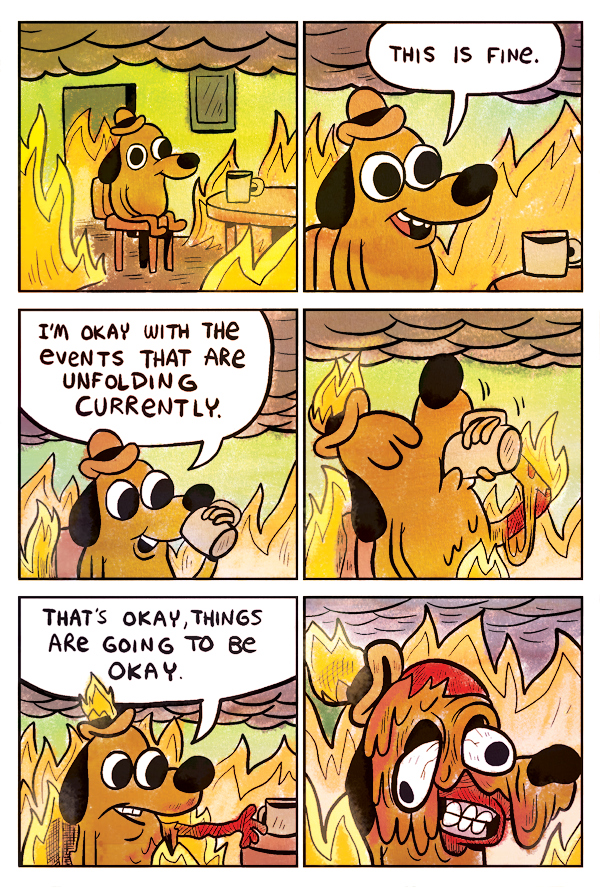
This Is Fine by KC Green
The first half of the book is devoted to alarming statistics about languishing, and how it is associated with worse outcomes across the lifespan, from teen suicide to broken marriages to listless careers and golden years cut prematurely short. There is some moderate crankiness about how anti-depressants don't really work (let's just say the biological underpinnings of mood are hard). Having thoroughly laid out the case for languishing as a problem, Keyes lays out his five "vitamins" for curing languishing.
Every day you should:
* Learn something
* Have a meaningful human connection
* Seek spirituality
* Find meaning in your labor
* Play!
Cool.
Cool cool cool.
Okay, I firmly believe that all of the above are good ideas, but have you tried being alive in 2024? I'll get right on not languishing once I deal with some other things.
This Is Fine by KC Green

The thing about getting BUFF and SWOLE is that there is a lot of bad advice out there, particularly from people trying to sell you something. Charles Poliquin was one of the first scientific weight lifting coaches, and someone who worked with a number of notable athletes and bodybuilders.
On the plus side, the principles are pretty clear. Big multi-muscle movements, like the traditional squat, deadlift, and benchpress, are the foundations of strength, along with chinups and crunches on a prop which lets you start below horizontal. The core of strength development is time under muscular tension, which builds both muscle and nerve strength. But to get there, a program should mix high-weight low-rep sets and lower-weight high-rep sets. You should know what weight you can do a given movement at for 3, 8, and 15 reps, and do that. Varying grip and tempo is also key.
And the plus side is that while world-class performance requires a lot of dedication, most people can get very good results for reasonable time commitments, like about an hour in the gym three times a week, if they are focusing on good form and some systemic work.
Unfortunately, there is a lot that is a disorganized. Jargon, like eccentric and concentric movements, is not explained before being used in key tempo notation (varying speed of motion is another component of building strength). The chatty writing style and praise for/jabs at other figures in the bodybuilding makes for a better read, but "studies say" without footnotes or endnotes is disappointing. And my ebook copy is notably awful, just a blurry black and white scan of the print version which I was only able to read on my tablet.
On the plus side, the principles are pretty clear. Big multi-muscle movements, like the traditional squat, deadlift, and benchpress, are the foundations of strength, along with chinups and crunches on a prop which lets you start below horizontal. The core of strength development is time under muscular tension, which builds both muscle and nerve strength. But to get there, a program should mix high-weight low-rep sets and lower-weight high-rep sets. You should know what weight you can do a given movement at for 3, 8, and 15 reps, and do that. Varying grip and tempo is also key.
And the plus side is that while world-class performance requires a lot of dedication, most people can get very good results for reasonable time commitments, like about an hour in the gym three times a week, if they are focusing on good form and some systemic work.
Unfortunately, there is a lot that is a disorganized. Jargon, like eccentric and concentric movements, is not explained before being used in key tempo notation (varying speed of motion is another component of building strength). The chatty writing style and praise for/jabs at other figures in the bodybuilding makes for a better read, but "studies say" without footnotes or endnotes is disappointing. And my ebook copy is notably awful, just a blurry black and white scan of the print version which I was only able to read on my tablet.

There are three eternal truths: death, taxes, and scifi written in the 1980s is going to get weird about Japan.
The Cybernetic Samurai is definitely weird, but in an oddly serious way. The world was seriously wounded but not destroyed in World War 3. Japan came out mostly unscathed, though energy shortages are now chronic, cultural has become increasingly rigid and traditional, and covert warfare between the Zaibatsus and various government agencies threatens peace and prosperity. In this tense environment, Yoshimitsu TeleCommunication has embarked on a secret project to create a truly artificial being lead by the heretical American scientist Elizabeth O'Neill.
The project succeeds, creating an nascent intelligence named TOKUGAWA, which O'Neill instructs in the values of bushido. Stricken with multiple sclerosis, the wheelchair bound O'Neill becomes TOKUGAWA's mother and then lover via a technology of neural synthesis. She works with the elderly CEO Akaji, and has an instant and intense dislike of both of his children: the dissipated son Shigeo and the exiled daughter Michiko, who is a brilliant physicist in her own right.
Whatever plan O'Neill had for TOKUGAWA is cut short, as the powerful Ministry of International Trade and Industry attacks via treachery. O'Neill dies in her lab. Akaji is cut done in his rooftop zen garden, after killing two attacking soldiers with a Muramasa katana. But TOKUGAWA returns Shigeo to power, get revenge on a lot of people, and then romances and serves Michiko, who also becomes a lover, before finally being offered dominion over Japan as the world lurches towards World War 4.
Big heavy topics weigh down this book like stones. Honor, duty, being Japanese, the nature of sentience, family, love. I just wish that there was something a little more interesting to say. The main conflict is between O'Neill and Michiko and their influence on TOKUGAWA, but it happens at a distance, without much interaction with the plot. While this novel is well-crafted, it feels surprisingly pro-forma. Except for the sex scenes. I sort of forgot how horny vintage scifi could get, given that modern scifi tends to gloss it over.
I had a pleasant enough few days, but I love this kind of pulp, and unfortunately The Cybernetic Samurai has gone rusty since it was written.
The Cybernetic Samurai is definitely weird, but in an oddly serious way. The world was seriously wounded but not destroyed in World War 3. Japan came out mostly unscathed, though energy shortages are now chronic, cultural has become increasingly rigid and traditional, and covert warfare between the Zaibatsus and various government agencies threatens peace and prosperity. In this tense environment, Yoshimitsu TeleCommunication has embarked on a secret project to create a truly artificial being lead by the heretical American scientist Elizabeth O'Neill.
The project succeeds, creating an nascent intelligence named TOKUGAWA, which O'Neill instructs in the values of bushido. Stricken with multiple sclerosis, the wheelchair bound O'Neill becomes TOKUGAWA's mother and then lover via a technology of neural synthesis. She works with the elderly CEO Akaji, and has an instant and intense dislike of both of his children: the dissipated son Shigeo and the exiled daughter Michiko, who is a brilliant physicist in her own right.
Whatever plan O'Neill had for TOKUGAWA is cut short, as the powerful Ministry of International Trade and Industry attacks via treachery. O'Neill dies in her lab. Akaji is cut done in his rooftop zen garden, after killing two attacking soldiers with a Muramasa katana. But TOKUGAWA returns Shigeo to power, get revenge on a lot of people, and then romances and serves Michiko, who also becomes a lover, before finally being offered dominion over Japan as the world lurches towards World War 4.
Big heavy topics weigh down this book like stones. Honor, duty, being Japanese, the nature of sentience, family, love. I just wish that there was something a little more interesting to say. The main conflict is between O'Neill and Michiko and their influence on TOKUGAWA, but it happens at a distance, without much interaction with the plot. While this novel is well-crafted, it feels surprisingly pro-forma. Except for the sex scenes. I sort of forgot how horny vintage scifi could get, given that modern scifi tends to gloss it over.
I had a pleasant enough few days, but I love this kind of pulp, and unfortunately The Cybernetic Samurai has gone rusty since it was written.

Orosz is a popular and serious technology influencer (do you read his substack?) and this book chronicles perhaps the most fraught move an engineer might make, from individual contributor to staff+ engineer or engineering manager.
Whatever the exact title is, it's the shift from when you can be expected to go from the guy who is good at solving problems with code, to the guy who is good at knowing which problems to solve with code. A lot of the lessons boil down to "hey you, did you know that you're a person working with other people?", something which may seem obvious but which a lot of programmers need a reminder of.
On the positive side, this book is well-organized, with a checklist-friendly structure that'll help you avoid making obvious mistakes. On the less positive side, well, a lot of the advice seems obvious, and I'm not sure what specific insights I took away from it.
Whatever the exact title is, it's the shift from when you can be expected to go from the guy who is good at solving problems with code, to the guy who is good at knowing which problems to solve with code. A lot of the lessons boil down to "hey you, did you know that you're a person working with other people?", something which may seem obvious but which a lot of programmers need a reminder of.
On the positive side, this book is well-organized, with a checklist-friendly structure that'll help you avoid making obvious mistakes. On the less positive side, well, a lot of the advice seems obvious, and I'm not sure what specific insights I took away from it.

When I heard about the premise of this book, I was immensely skeptical. Sure, Vo had written a perfect novella in The Empress of Salt and Fortune, but it's one thing to write a perfect novella and another thing to retell The Great Gatsby as a queer fantasy with a Vietnamese-American protagonist. This is the Great American Novel. Everybody is assigned it at some point. There is an entire academic journal devoted solely to F. Scott Fitzgerald, let alone all the other ways culture has embraced and adapted The Great Gatsby. If Vo thinks she can pull it off, she is welcome to try. Good luck, you're going to need it.

Leonardo DiCaprio as Gatsby
Well, gentle reader, Vo does pull it off. This is an incredibly lush, fun, weird, and hot novel about desire and its limits. I'll try to limit comparisons, because it is unfair, but the weakest point of Gatsby for me (and many others) is how much of a dud Nick Carraway is. Jordan Baker is very much not a dud, she's a firecracker cutting across New York society with beauty, wealth, and daring. She's very much aware of the knife edge that she dances across, with her "exotic" Asian face, and how she is at best a pet of the people who really matter, but while she is dancing and running she'll have a damn good time.
The basic plot is, well, Gatsby, but this has never been a story about plot. Rather this is one about the kinds of things people want, and the hollowness inside them. All the things that the characters want: glamour, excitement, romance, a drink, love, are what will destroy them. This endless desire, this void at the center of their selves, is surrounded by a shell of rigid high society customs. It's very cool, and very well done.
This is also a fantasy, though magic is more metaphorical than strictly necessary. Hell is real, and Gatsby may have sold his soul to get his mansion and his wealth. There are little charms and enchantments, though ultimately none of it matters more than illusion. It could be costumes and acrobats for all the impact it has. Jordan has a more significant magic, the ability to bring paper cuttings to life, which comes up in three pivotal scenes, though the nature and costs of this talent, which appear to be a Vietnamese specialty, are left undefined.
Ultimately, this book is super-stylish, character-driven, and well-researched. It's not Gatsby, not The Great American Novel in all its subtleties, but it's a lot more fun and stands on its own, which is perhaps a grander accomplishment.
Leonardo DiCaprio as Gatsby
Well, gentle reader, Vo does pull it off. This is an incredibly lush, fun, weird, and hot novel about desire and its limits. I'll try to limit comparisons, because it is unfair, but the weakest point of Gatsby for me (and many others) is how much of a dud Nick Carraway is. Jordan Baker is very much not a dud, she's a firecracker cutting across New York society with beauty, wealth, and daring. She's very much aware of the knife edge that she dances across, with her "exotic" Asian face, and how she is at best a pet of the people who really matter, but while she is dancing and running she'll have a damn good time.
The basic plot is, well, Gatsby, but this has never been a story about plot. Rather this is one about the kinds of things people want, and the hollowness inside them. All the things that the characters want: glamour, excitement, romance, a drink, love, are what will destroy them. This endless desire, this void at the center of their selves, is surrounded by a shell of rigid high society customs. It's very cool, and very well done.
This is also a fantasy, though magic is more metaphorical than strictly necessary. Hell is real, and Gatsby may have sold his soul to get his mansion and his wealth. There are little charms and enchantments, though ultimately none of it matters more than illusion. It could be costumes and acrobats for all the impact it has. Jordan has a more significant magic, the ability to bring paper cuttings to life, which comes up in three pivotal scenes, though the nature and costs of this talent, which appear to be a Vietnamese specialty, are left undefined.
Ultimately, this book is super-stylish, character-driven, and well-researched. It's not Gatsby, not The Great American Novel in all its subtleties, but it's a lot more fun and stands on its own, which is perhaps a grander accomplishment.