Take a photo of a barcode or cover
2.05k reviews by:
mburnamfink


Deadly Sky is a thematically organized oral history of (like the subtitle says) the American combat airman in World War 2. McManus draws from a vast repository of letters and memoirs to describe the men who fought, their living conditions, the dangers of their mission, and what they thought about the job. American combat airmen were compared to the rest of the military, physically and mentally on the high end of the bell-curve. Conditions at base were relatively good, and missions typically came every few days. For these "luxuries", they paid in dangerous and terrifying mission, enduring the frozen stratosphere, flak, and fighters to accomplish their mission. During the worst periods, combat air units suffered 80%+ attrition over the course of six months.
This book is weighted more towards the bomber pilots of the 8th Airforce, and could use a little more context around some of McManus's favorite sources, but it's a masterful summary of the men in their own words.
This book is weighted more towards the bomber pilots of the 8th Airforce, and could use a little more context around some of McManus's favorite sources, but it's a masterful summary of the men in their own words.

Forcyzk writes a relatively readable account of the first two years of Eastern Front, bulwarked by extensive documentary research and his own experience as an American tanker. There's a lot of the boring details of the form "Kampfgruppe Raus advanced 10 km towards Plotsk until stopped by blocking detachments from the 15th Tank Corps, which was defeated at 1800 with heavy losses, leaving the path clear for...", but Forcyzk has an eye for the big picture and patterns.
In particular, Nazi Panzer divisions had absolute tactical supremacy due to high levels of training, radios, and well-ordered command structures that enabled decisive attacks against key objectives and flexible retreats. Soviet forces were decimated in the opening days of Barbarossa and never really recovered as a strategic or operational arm, New T-34 and KV-1 tanks were dispatched in penny packets for infantry support. Even though the Soviet medium and heavy tanks were qualitatively superior to early war Panzer IIIs and IVs, Nazi combined arm tactics and the Flak 88 minimized the Soviet advantage. More than anything else, the tyranny of distance and supply problems stopped the blitzkrieg, as mighty Panzer spearheads were reduced to handfuls of exhausted tanks and infantry companies right at the edge of strategic objectives. The Soviets, though they took catastrophic losses, were bettered prepared for the industrial war of annihilation than the Nazis, and attrition evened out the experience gap, as veteran NCOs and officers on the Nazi side died, and a few surviving Soviets became more competent at their jobs.
More than gun size and armor weight, Forcyzk has a feel for the operational qualities of tanks as part of a combined arms team, and the ways in which complicated German engineering hindered the performance of the Panzers, or how the Soviet practice of fighting 'buttoned-up' reduced situational awareness and left. There are some oddities. Forcyzk has an almost personal hatred of a few generals who's (over-inflated) memoirs dictated conventional history (Guderian and Zhukov). He's astute in noting that many tanks were light tanks with minimal combat effectiveness, like the Czech-produced Panzer 38(t) or the pre-war BT-series, but doesn't quite figure out what light tanks were for, or if they had an impact on battle one way or another.
As long as this book is $2 on kindle, it's a vital purchase for anyone interested in WW2 or tanks. I'm not sure how it'd hold up at a higher price point.
In particular, Nazi Panzer divisions had absolute tactical supremacy due to high levels of training, radios, and well-ordered command structures that enabled decisive attacks against key objectives and flexible retreats. Soviet forces were decimated in the opening days of Barbarossa and never really recovered as a strategic or operational arm, New T-34 and KV-1 tanks were dispatched in penny packets for infantry support. Even though the Soviet medium and heavy tanks were qualitatively superior to early war Panzer IIIs and IVs, Nazi combined arm tactics and the Flak 88 minimized the Soviet advantage. More than anything else, the tyranny of distance and supply problems stopped the blitzkrieg, as mighty Panzer spearheads were reduced to handfuls of exhausted tanks and infantry companies right at the edge of strategic objectives. The Soviets, though they took catastrophic losses, were bettered prepared for the industrial war of annihilation than the Nazis, and attrition evened out the experience gap, as veteran NCOs and officers on the Nazi side died, and a few surviving Soviets became more competent at their jobs.
More than gun size and armor weight, Forcyzk has a feel for the operational qualities of tanks as part of a combined arms team, and the ways in which complicated German engineering hindered the performance of the Panzers, or how the Soviet practice of fighting 'buttoned-up' reduced situational awareness and left. There are some oddities. Forcyzk has an almost personal hatred of a few generals who's (over-inflated) memoirs dictated conventional history (Guderian and Zhukov). He's astute in noting that many tanks were light tanks with minimal combat effectiveness, like the Czech-produced Panzer 38(t) or the pre-war BT-series, but doesn't quite figure out what light tanks were for, or if they had an impact on battle one way or another.
As long as this book is $2 on kindle, it's a vital purchase for anyone interested in WW2 or tanks. I'm not sure how it'd hold up at a higher price point.

SPOILERS SPOILERS SPOILERS!!!
This was excellent! A delightfully creepy and twisty novella that hits on every page. Amy Starr is taking on a new job for a crime lord called the Widower. The Widower rules an immense mobile city with an iron fist. Starr's job involves caring for the Widower's obsession, a ghoulish dancer. In this world the undead are a dangerous blasphemy. Ghouls are fast, lethal, and mostly stupid. But it's possible for them to mimic human behavior, even to talk, and down that path lies something worse than mere death.
Starr's first twist is that ghoul handler is a cover for her real job. She's an undercover cop, and if the Widower is harboring a Tier III or higher ghoul, the full force of the law will descend with all it's fury, which seems to start with napalm airstrike and escalate from there. The second twist is that the ghoul is Tier VI at least. Not only can it talk, but it can think. It's name is Lucy and it remembers Amy from somewhere.
The Widower starts a war with another gangster named Charlie and wins due to superior organization and firepower. As part of the truce, she invites Charlie and his men to a show with a very special guest. The curtain drops, the protective wire netting falls, and Lucy chews her way through a hundred armed men without any effort.
The last act reveals a new set of twists. The Widower and Lucy were once married. Lucy was another undercover cop, and Amy Starr's partner. And she turned herself into a ghoul, because no mere human could take down the Widower. This desperate plan would never work, it's impossible. Except that Amy Starr isn't Amy. She's the final stage, Tier Omega, a ghoul who can control her appetites and is riding herd on human and ghoul alike.
Taught, suprising, fantastically stylish. This might be the best thing Muir has written since Gideon the Ninth.
This was excellent! A delightfully creepy and twisty novella that hits on every page. Amy Starr is taking on a new job for a crime lord called the Widower. The Widower rules an immense mobile city with an iron fist. Starr's job involves caring for the Widower's obsession, a ghoulish dancer. In this world the undead are a dangerous blasphemy. Ghouls are fast, lethal, and mostly stupid. But it's possible for them to mimic human behavior, even to talk, and down that path lies something worse than mere death.
Starr's first twist is that ghoul handler is a cover for her real job. She's an undercover cop, and if the Widower is harboring a Tier III or higher ghoul, the full force of the law will descend with all it's fury, which seems to start with napalm airstrike and escalate from there. The second twist is that the ghoul is Tier VI at least. Not only can it talk, but it can think. It's name is Lucy and it remembers Amy from somewhere.
The Widower starts a war with another gangster named Charlie and wins due to superior organization and firepower. As part of the truce, she invites Charlie and his men to a show with a very special guest. The curtain drops, the protective wire netting falls, and Lucy chews her way through a hundred armed men without any effort.
The last act reveals a new set of twists. The Widower and Lucy were once married. Lucy was another undercover cop, and Amy Starr's partner. And she turned herself into a ghoul, because no mere human could take down the Widower. This desperate plan would never work, it's impossible. Except that Amy Starr isn't Amy. She's the final stage, Tier Omega, a ghoul who can control her appetites and is riding herd on human and ghoul alike.
Taught, suprising, fantastically stylish. This might be the best thing Muir has written since Gideon the Ninth.

Justice Warriors is a dystopian satire about as blunt as a cop shouting "STOP RESISTING" while bringing down the billy club.

Remember kids, the A in ACAB means ALL
Frog-like Swamp Cop and his new partner Schitt (a living
Remember kids, the A in ACAB means ALL
Frog-like Swamp Cop and his new partner Schitt (a living

When you interact with anything but the simplest website these days, you're interacting with algorithmically presented content, the output of a class of machine learning techniques called recommender systems. When people complain about the evils of the Algorithm with a capital-A, they usually mean a recommender system which is malfunctioning in some way, whether it's Youtube, Twitter, and Facebook boosting extremist viewpoints, Amazon suggesting suicide kits via 'commonly bought together', or TikTok showing conservative legislators hot twinks.
Recommender systems are messy, complex objects, and Seaver provides a close study of streaming music. As an anthropologist, he focuses on the cultural aspects of music recommendation systems, but shorn of the heated political aspects of recommender systems in general, music becomes a kind of data drosophilia, enabling us to view the many complexities and intellectual assumptions behind recommender systems in a kind of model system. Seaver ably synthesizes a survey of relevant academic theories and ethnographic work at music recommendation companies and conferences to provide a deeper and more full understanding of algorithms not as a black monolith, but as an open framework of human effort.

I need a picture here, and this monolith seems good.
Seaver begins with the early web of the 1990s, and the then heady concept that computers + networking + digital audio files could create a kind of galactic jukebox, seamless access to every piece of recorded music ever. But with great music comes the problem of information overload. When you can listen to everything, how do you decide what to listen to? Even simple cataloging becomes a problem, as anyone who remembers the glory days of Napster knows. A college experiment in databasing my dorm's shared music library lead to a host of bad file names and random deletes.
Aside from technical issues, music is also deeply personal. We all have a favorite song, which probably hasn't changed much since we were 21. Music is mood, generation, and subculture defining. And traditionally, music has been defined by gatekeepers: label executives, radio DJs, what's available at the local record store, and the constantly shifting definitions of hipness. For music aficionados, finding what you like in the galaxy of everything becomes a burden, though actual information overload is much harder to pin down as a phenomena real people experience with music.
The first suite of techniques was based around collaborative filtering. Given users, items, and rankings, simple mathematical techniques can fill in the grid, producing lists of what each user would like. Collaborative filtering isn't actually very effective, and modern services have turned to captivation metrics to see what drives people to keep listening, and what drives them to stop listening.
Seaver's ethnography closes studies some of the key imaginaries of algorithmic recommendations, including idealized listeners, who are active or passive, and much more diverse than the overwhelmingly American, white, male, and hip developers who work for these companies. Developers describe their issues with wanting to play plunderphondics for listeners who prefer K-pop.
Computing Taste also provides a solid description of the Second Good Trick of Data Science, transforming messy objects into a dense vector space. A song which can be classified in many ways: human labeling, collaborative filtering, acoustic pattern matching, becomes described as a set of coordinates in a n-dimensional space. Coordinates which are close are similar songs, and a listening session becomes a journey through this space. Spatial metaphors can be deeply misleading, but are fundamental to machine learning.
As a data scientist and Science, Technology, and Society PhD with an avid interest in music recommendation systems (top 1% of Spotify listeners by time in 2022), this book could have been written specifically for me. Match between user and item aside, I'm serious in my recommendation that this provides a nicely grounded and well executed case study of a key branch of applied machine learning.
Seaver doesn't answer all the questions I have. Having tried a bunch of streaming music services, I qualitatively believe that Spotify's secret sauce, whatever it might be, is better than the competitors. There is a fine balance between familiarity and novelty in playlists, and I do wish Spotify provided better tools to tweak the algorithm for power-users. And while the harms of algorithmic misjudgment in the case of music are pretty minimal compared to other uses of recommender systems, there's still plenty left unsaid about pitifully low artist payments, the potential for payola, the dominance of old hits over new music, and the reshaping of performance around what triggers curiosity in a playlist, like ALLCAPS band names, and what won't cause a negative captivation interaction where the user shuts off the song, in terms of unchallenging styles. The dark side of the galactic jukebox might be a million songs all the same, running off of an engine of venture capitalist money, aiming towards monopoly abuses. But until the machine breaks breaks, I'm going to turn that song up.
(Disclosure notice: I received a free copy of this book from the author, and no other compensation)
Recommender systems are messy, complex objects, and Seaver provides a close study of streaming music. As an anthropologist, he focuses on the cultural aspects of music recommendation systems, but shorn of the heated political aspects of recommender systems in general, music becomes a kind of data drosophilia, enabling us to view the many complexities and intellectual assumptions behind recommender systems in a kind of model system. Seaver ably synthesizes a survey of relevant academic theories and ethnographic work at music recommendation companies and conferences to provide a deeper and more full understanding of algorithms not as a black monolith, but as an open framework of human effort.
I need a picture here, and this monolith seems good.
Seaver begins with the early web of the 1990s, and the then heady concept that computers + networking + digital audio files could create a kind of galactic jukebox, seamless access to every piece of recorded music ever. But with great music comes the problem of information overload. When you can listen to everything, how do you decide what to listen to? Even simple cataloging becomes a problem, as anyone who remembers the glory days of Napster knows. A college experiment in databasing my dorm's shared music library lead to a host of bad file names and random deletes.
Aside from technical issues, music is also deeply personal. We all have a favorite song, which probably hasn't changed much since we were 21. Music is mood, generation, and subculture defining. And traditionally, music has been defined by gatekeepers: label executives, radio DJs, what's available at the local record store, and the constantly shifting definitions of hipness. For music aficionados, finding what you like in the galaxy of everything becomes a burden, though actual information overload is much harder to pin down as a phenomena real people experience with music.
The first suite of techniques was based around collaborative filtering. Given users, items, and rankings, simple mathematical techniques can fill in the grid, producing lists of what each user would like. Collaborative filtering isn't actually very effective, and modern services have turned to captivation metrics to see what drives people to keep listening, and what drives them to stop listening.
Seaver's ethnography closes studies some of the key imaginaries of algorithmic recommendations, including idealized listeners, who are active or passive, and much more diverse than the overwhelmingly American, white, male, and hip developers who work for these companies. Developers describe their issues with wanting to play plunderphondics for listeners who prefer K-pop.
Computing Taste also provides a solid description of the Second Good Trick of Data Science, transforming messy objects into a dense vector space. A song which can be classified in many ways: human labeling, collaborative filtering, acoustic pattern matching, becomes described as a set of coordinates in a n-dimensional space. Coordinates which are close are similar songs, and a listening session becomes a journey through this space. Spatial metaphors can be deeply misleading, but are fundamental to machine learning.
As a data scientist and Science, Technology, and Society PhD with an avid interest in music recommendation systems (top 1% of Spotify listeners by time in 2022), this book could have been written specifically for me. Match between user and item aside, I'm serious in my recommendation that this provides a nicely grounded and well executed case study of a key branch of applied machine learning.
Seaver doesn't answer all the questions I have. Having tried a bunch of streaming music services, I qualitatively believe that Spotify's secret sauce, whatever it might be, is better than the competitors. There is a fine balance between familiarity and novelty in playlists, and I do wish Spotify provided better tools to tweak the algorithm for power-users. And while the harms of algorithmic misjudgment in the case of music are pretty minimal compared to other uses of recommender systems, there's still plenty left unsaid about pitifully low artist payments, the potential for payola, the dominance of old hits over new music, and the reshaping of performance around what triggers curiosity in a playlist, like ALLCAPS band names, and what won't cause a negative captivation interaction where the user shuts off the song, in terms of unchallenging styles. The dark side of the galactic jukebox might be a million songs all the same, running off of an engine of venture capitalist money, aiming towards monopoly abuses. But until the machine breaks breaks, I'm going to turn that song up.
(Disclosure notice: I received a free copy of this book from the author, and no other compensation)

I saw this recommended as one of the finest books of Reform Jewish theology around. And it is definitely inspiring and poetic. It is also not particularly Jewish, though someone with a wider theological background may disagree. Certainly, I think most members of Abrahamic faiths would find it generally applicable. But as a work of theology, I find it question begging, and not persuasive enough to oust me out of my secular materialism.
Heschel begins with the ineffable, the idea that there is something sublime out there that we can all feel at moments. This ineffable is the touch of God, that which created the universe, which penetrates everywhere. Man is not alone, because God created us out of love, desires us to be righteous, feels us passionately, and we can find piety in every moment of our life.
On the one hand, it is preposterous to say that the universe was created by chance, that chance lead to this moment of sentience on a tiny ball of rock hurling through space. But is it less preposterous to say that there exists an ineffable, insubstantial, omniscient and omnipotent being who created the universe and our souls, who we can commune with but only on a spiritual level and not in any pragmatic suffering-alleviating sense. I've felt a sense of divine communion a handful of times before, at the birth of my son and previously with hefty chemical enhancement. And while I don't need that same high constantly, Heschel has a point that it'd be nice to feel it more often.
Yet the path is also ineffable. Either you get it, or you don't. Heschel is a modern theologian, and by that I mean he wrote in the shadow of Auschwitz and the mushroom cloud. But while he advocates for communion, in practical terms I think he also advocates for retreat.
Heschel begins with the ineffable, the idea that there is something sublime out there that we can all feel at moments. This ineffable is the touch of God, that which created the universe, which penetrates everywhere. Man is not alone, because God created us out of love, desires us to be righteous, feels us passionately, and we can find piety in every moment of our life.
On the one hand, it is preposterous to say that the universe was created by chance, that chance lead to this moment of sentience on a tiny ball of rock hurling through space. But is it less preposterous to say that there exists an ineffable, insubstantial, omniscient and omnipotent being who created the universe and our souls, who we can commune with but only on a spiritual level and not in any pragmatic suffering-alleviating sense. I've felt a sense of divine communion a handful of times before, at the birth of my son and previously with hefty chemical enhancement. And while I don't need that same high constantly, Heschel has a point that it'd be nice to feel it more often.
Yet the path is also ineffable. Either you get it, or you don't. Heschel is a modern theologian, and by that I mean he wrote in the shadow of Auschwitz and the mushroom cloud. But while he advocates for communion, in practical terms I think he also advocates for retreat.

Trouble and Her Friends might be the last cyberpunk novel (at least according to Matthew Claxton), written in the final days when the internet was still the net, and not the world wide web, or worse a walled garden of apps and platforms. Trouble and Cerise are partners, romantic and criminal, two of the baddest hackers on the net, when Trouble disappears after a new anti-hacker law passes. Cerise goes legit and tries to forget her old partner, but three years later someone appears on the net using Trouble's handle and some of her programs. Cerise's company and the US Treasury want Trouble in custody, and the two of them reunite to find and take down the punk threatening Trouble's quiet retirement.
There is a lot that is good in this book, mostly tied up in this quote. “Maybe that was why it was almost always the underclasses, the women, the people of color, the gay people, the ones who were already stigmatized as being vulnerable, available, trapped by the body, who took the risk of the wire.” The cyberspace has a nice Gibsonian vibe, Trouble and her cadre of queer hacker friends are wonderfully drawn. This book is definitely about being gay and has some ambitions about doing crime. There are fantastic asides, like districts haunted by vicious dolly-gangs of wannabe corporate secretaries with network implants, stilettos heels, and switchblade knives.
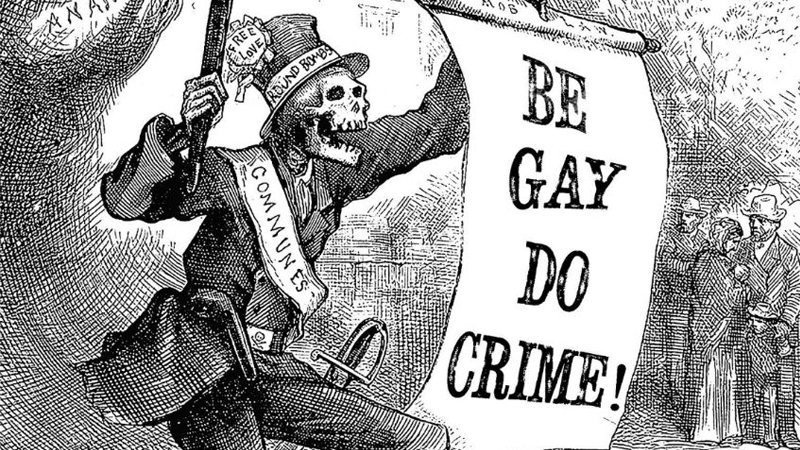
Good advice from mr skelly
Unfortunately, it also has some serious flaws. The pacing is on the languid side, with important plot threads like Cerise's boss's obsession with Trouble dropped aside. The conclusion centers around the real and virtual twin towns of Sea Haven, a gray zone useful to the shadows and bright lights of the net alike, abandoning the idea that what happens in cyberspace is about cyberspace for a physical confrontation. And while I was really hoping for a solid landing, the end is about outsiders coming inside, about crackers growing up into cops, rather than breaking down unjust systems of exploitation.
There is a lot that is good in this book, mostly tied up in this quote. “Maybe that was why it was almost always the underclasses, the women, the people of color, the gay people, the ones who were already stigmatized as being vulnerable, available, trapped by the body, who took the risk of the wire.” The cyberspace has a nice Gibsonian vibe, Trouble and her cadre of queer hacker friends are wonderfully drawn. This book is definitely about being gay and has some ambitions about doing crime. There are fantastic asides, like districts haunted by vicious dolly-gangs of wannabe corporate secretaries with network implants, stilettos heels, and switchblade knives.
Good advice from mr skelly
Unfortunately, it also has some serious flaws. The pacing is on the languid side, with important plot threads like Cerise's boss's obsession with Trouble dropped aside. The conclusion centers around the real and virtual twin towns of Sea Haven, a gray zone useful to the shadows and bright lights of the net alike, abandoning the idea that what happens in cyberspace is about cyberspace for a physical confrontation. And while I was really hoping for a solid landing, the end is about outsiders coming inside, about crackers growing up into cops, rather than breaking down unjust systems of exploitation.

Mom's House, Dad's House is a deserved classic of the divorce advice genre, which has become conventional wisdom.
The basic premise of the book is that the children of divorce deserve two homes where they feel secure, which can be provided by a professional relationship between co-parents. There are barriers to this ideal, both pragmatic, because splitting a household is inherently disruptive and finances are strained, but also largely emotional.
On the emotional front, the first trap is escaping from negative intimacy. In a marriage that is dissolving, previous closeness has been replaced by damage. You're still tied to your partner, but you don't like them, and the feeling is mutual. It's very unlikely to flip negative intimacy to positive intimacy, because life isn't an anime where you're dueling in prototype mecha and hooking up afterwards, but you can build a professional relationship based on clear expectations of doing best by your children, which can become a friendship after years.
A second trap is your own emotional instability, either caused by the stress of divorce, the opportunities of your new life, or flashbacks of intimacy relating to your own partner. Whatever you're feeling, you have to be there for your kids, and be stable and supportive, because they need you.
And finally, the third emotional harm is toxic language around visitation, custody, and exes, which treats one parent as less important, less involved, and the relationship between the two people are defined by common trauma rather than shared interest in their child.
The only mark against this book is a certain obsolescence. Originally written in the 1980s and updated in 1997, it assumes some heteronormativity, and offers technological solutions for problems which are trivially solved by smartphones.
The basic premise of the book is that the children of divorce deserve two homes where they feel secure, which can be provided by a professional relationship between co-parents. There are barriers to this ideal, both pragmatic, because splitting a household is inherently disruptive and finances are strained, but also largely emotional.
On the emotional front, the first trap is escaping from negative intimacy. In a marriage that is dissolving, previous closeness has been replaced by damage. You're still tied to your partner, but you don't like them, and the feeling is mutual. It's very unlikely to flip negative intimacy to positive intimacy, because life isn't an anime where you're dueling in prototype mecha and hooking up afterwards, but you can build a professional relationship based on clear expectations of doing best by your children, which can become a friendship after years.
A second trap is your own emotional instability, either caused by the stress of divorce, the opportunities of your new life, or flashbacks of intimacy relating to your own partner. Whatever you're feeling, you have to be there for your kids, and be stable and supportive, because they need you.
And finally, the third emotional harm is toxic language around visitation, custody, and exes, which treats one parent as less important, less involved, and the relationship between the two people are defined by common trauma rather than shared interest in their child.
The only mark against this book is a certain obsolescence. Originally written in the 1980s and updated in 1997, it assumes some heteronormativity, and offers technological solutions for problems which are trivially solved by smartphones.

Stop me if you've heard this story before. In 1960s America, an idealistic reform politician, a young operational technocrat, and the RAND corporation decide to manage a complex social issue via sophisticated data-driven models. For all their vaunted scientific objectivity, the effort collapses into a destructive quagmire that devastates an entire region, kills a whole bunch of non-white people, and wrecks the reputations of everyone involved.
No it's not the Vietnam War, JFK, Robert McNamara, and RAND. It's the South Bronx, Mayor John Lindsay, Fire Chief John O'Hagan, and RAND, and a microcosm of everything that the post-war technocratic liberal order did wrong. Flood orients the story around fire as a central actor in the destruction of the South Bronx, and places the story as part of a broader tide between ad hoc 'branch' approaches to governance which distribute power, and top down 'root' approaches which seek comprehensive theoretically driven explanations.
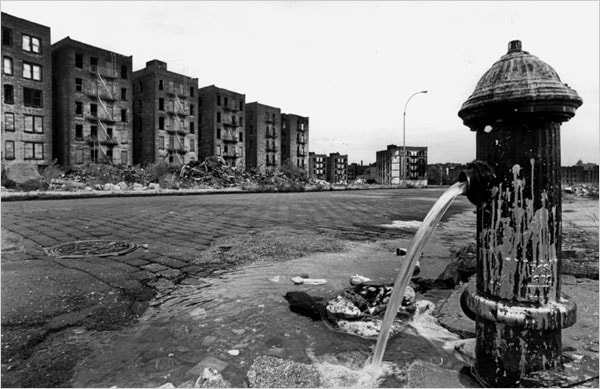
South Bronx, 1971
Lindsay and O'Hagan are the two protagonists of the story. Lindsay was an archetype common enough in New York City politics, the grand reformer, though the details of his liberal Republican to independent conversion are fairly unique. In Flood's analysis, New York City politics waxes in cycles of clubhouse corruption and reformist mayors. The clubhouse, the system of Tammany Hall ward bosses, is opaque, inefficient, unrepresentative, frequently mired in obvious criminality, but accountable to the ordinary people of the city. Reform programs have grand ambitions, but fail to deliver on their promises, prompting a backlash and return to the clubhouses.
O'Hagan was a bit more unusual. A paratrooper in the Pacific in WW2, he joined the NYFD and rose through the ranks, becoming the youngest fire chief in NYFD history, and later one of only two people to simultaneously be Fire Chief and Fire Commissioner. O'Hagan was a tough bastard, a tenacious analyst capable of breaking a problem down into elementary components and assembling a solution. His essay question on the chief's exam, about how to prepare fire safety for the upcoming 1964 World's Fair became the actual plan. O'Hagan introduced new technology, like self-contained breathers, bigger hoses, better ladders, and early version of the hydraulic jaws of life. He obsessed over architectural plans and how to fight fires in the new lightweight steel towers of Manhattan.
In Lindsay's first term, he and O'Hagan worked closely together to find new efficiencies in the fire department. O'Hagan was eager to prove his tough budget cutting credentials to his superiors, and Lindsay needed winds as his administration struggled though labor disputes, rising crime, and race riots. While the situation in the city was not great, much of the chaos was a media exaggeration. New York had almost always been crowded, noisy, chaotic, and with its fair share of crime and corrupt, though the actual numbers were better than the nation's average. The South Bronx was a concern, a mostly Black and Puerto Rican neighborhood with some alarming indicators, but nothing out of the ordinary.
New York had always been able to change with the times, but the difference in 1970 was an ideology of urban renewal which had gripped the city in the prior decades and rendered it extraordinarily fragile. Major commercial streets had been torn out in favor of Robert Moses' grand freeways, whisking people above rather than through neighborhoods. Various administrations deliberately pursued a policy of de-industrialization, eliminating hundreds of thousands of manufacturing jobs that had served as the first step on the ladder to prosperity for generations of immigrants, just as internal migrants from the Jim Crow South and Puerto Rico arrived. While the housing stock had often been crowded, racist red lining loan policies made it impossible to secure money for basic improvements to apartment buildings in the South Bronx, like a new furnace or roof repairs, and small landlords who lived in and invested in their buildings, a second step to the middle class (and one my family used at about this time) were barred from doing business, leaving housing to parasitic corporate landlords who saw buildings as a rapidly deprecating asset, and the grim public housing of the projects. Finally, one of Lindsay's labor deals had allowed city workers to live in the suburbs, transferring tax dollars out of the city and making fire, police, sanitation, and education a matter of "us vs them" rather than all of us together.
The hollowing out of New York City is complex and multifaceted, a long story with a lot of moving parts that Flood can only partially tell. But the spark was the clever idea to get RAND to find efficiencies in the fire service. RAND was looking to diversify from military contracts as the Vietnam War went sour, and O'Hagan had a suspicion that ordinary fire fighters were slacking off in bull session rather than doing their jobs. Or perhaps on an emotional level, O'Hagan wanted absolute control over the department, and sought to break the old boys networks and union leaders which served as alternative centers.
The situation was a tinderbox, and RAND provided the spark. In an absolute fiasco of applied social science, RAND decided that their primary measure of fire fighting effectiveness was response time between a call and the arrival of a truck on scene. And response time matters, but it isn't everything. A false alarm can be dealt with in minutes, or a simple fire in an up-to-code building with accurate plans. But the dangerous fires are the complex ones: old buildings retrofitted into mazes of room and hidden channels for fire without filed plans. Fire in high rises. Or fires in densely crowded apartment buildings, where hundreds of people might have to be rescued. Unable to quantify workload, RAND went with the simplest proxy.
Worse, their data methodology was horrendously flawed. 14 stop watches were distributed to the hundreds of fire companies, and most of those stop watches went to companies in Manhattan. The data was obviously fiddled with, as most fire fighters considered the whole effort a waste of time that could only harm them. Modelling the complexity of fires proved intractable, so RAND divided the city into seven classes of districts, and only considered adjusting stations in the same class of district. And then O'Hagan adjusted the final recommendation to save politically important stations, the ones near the home of a judge or a congressman.
The end result was that South Bronx lost fire companies just as the population increased and social pressures got worse. The people involved weren't racist per se,. Lindsay was in fact an ardent advocate for civil rights. But O'Hagan regarded apartment fires as technically uninteresting, fire fighters from the outer boroughs as unintelligent, and evaluated the inhabitants of the South Bronx as having the least political influence in the city. A law suit was brought over O'Hagan's closure of South Bronx stations, which was dismissed because the judge glanced at the RAND report and decided that anything with that much math was based on objective science rather than racism.
Fires served as both a leading indicator and a cause of social collapse. While landlord arson made headlines, the majority of fires started as ordinary domestic fires, amplified by the lack of maintenance. And fires in one building caused a rippling decline through the neighborhood. Inhabitants of the building were rendered homeless, and either went to the suburbs, public housing, or squeezing into other overcrowded buildings. Burned out apartments became shelter for junkies and gangs, putting pressure on the remaining honest residents. And junkies nodding off with cigarettes, various people starting fires to stay warm, or bored kids, all burnt semi-abandoned buildings repeatedly, until someone with a can of gasoline put the torched shell out of its misery. One census tract in the South Bronx suffered a 90% population decline between 1965 and 1975 as its housing stock was systematically destroyed.
Any chance that O'Hagan could have recognized the pattern and recovered was stalled by New York's financial crisis of the 1970s. Deficit spending in the previous decade had been covered up with bond measures, and worsening economic conditions finally made the bill due. While liberal welfare policies attracted much of the scorn, a larger share of the burden was tax breaks and developer incentives, such as the ones used to build the World Trade Center, which directly cost the city money through incentives, replaced stable manufacturing jobs with unstable financial services ones, and made existing office space and luxury apartments unprofitable without meaningfully decreasing rents for ordinary people. Every city department needed to make cuts, but O'Hagan had made his first. There was no fat to trim from the fire department, and scarcely any muscle. Any cuts started with bone.
So the South Bronx burned, becoming a byword for urban decay. Lindsay went from a presidential hopeful to one of the most despised mayors in America. O'Hagan resigned as chief and commissioner in 1978, his political ambitions dead, and became a technical consultant on fire fighting. RAND's New York-based urban issues branch was shut down, though RAND-style quantified systems analysis has become the parlance of planning.
The Fires is a persuasive and compelling history, verging onto the polemical. This is not just about New York in the 1970s. This is a valuable lesson about the limits of grand reforms and the dangers of complex models that hide asinine assumptions. Computers have only gotten faster, data more accessible, and many companies are working towards a vision of the smart city, centrally monitored and managed in real time from an urban command center, even if that managerial vision is a dangerous lie. And finally, I live in San Francisco, which feels a lot like New York in the mid 1960s, with a prosperity built on temporary conditions of tech and real estate that create a situation where the city is both too damn expensive and also empty, and where ordinary life flows around a quagmire of human misery the city is unable to fix and so prefers to ignore. And even if you don't live in the city America loves to hate, as the Strong Towns Project has extensively documented, low-density suburbs and exurbs cannot raise enough property taxes to fund infrastructure and services at a level residents expect, leading to a similar version of fragility.
Things haven't started burning yet, but if I smell smoke I'm not sticking around.
No it's not the Vietnam War, JFK, Robert McNamara, and RAND. It's the South Bronx, Mayor John Lindsay, Fire Chief John O'Hagan, and RAND, and a microcosm of everything that the post-war technocratic liberal order did wrong. Flood orients the story around fire as a central actor in the destruction of the South Bronx, and places the story as part of a broader tide between ad hoc 'branch' approaches to governance which distribute power, and top down 'root' approaches which seek comprehensive theoretically driven explanations.
South Bronx, 1971
Lindsay and O'Hagan are the two protagonists of the story. Lindsay was an archetype common enough in New York City politics, the grand reformer, though the details of his liberal Republican to independent conversion are fairly unique. In Flood's analysis, New York City politics waxes in cycles of clubhouse corruption and reformist mayors. The clubhouse, the system of Tammany Hall ward bosses, is opaque, inefficient, unrepresentative, frequently mired in obvious criminality, but accountable to the ordinary people of the city. Reform programs have grand ambitions, but fail to deliver on their promises, prompting a backlash and return to the clubhouses.
O'Hagan was a bit more unusual. A paratrooper in the Pacific in WW2, he joined the NYFD and rose through the ranks, becoming the youngest fire chief in NYFD history, and later one of only two people to simultaneously be Fire Chief and Fire Commissioner. O'Hagan was a tough bastard, a tenacious analyst capable of breaking a problem down into elementary components and assembling a solution. His essay question on the chief's exam, about how to prepare fire safety for the upcoming 1964 World's Fair became the actual plan. O'Hagan introduced new technology, like self-contained breathers, bigger hoses, better ladders, and early version of the hydraulic jaws of life. He obsessed over architectural plans and how to fight fires in the new lightweight steel towers of Manhattan.
In Lindsay's first term, he and O'Hagan worked closely together to find new efficiencies in the fire department. O'Hagan was eager to prove his tough budget cutting credentials to his superiors, and Lindsay needed winds as his administration struggled though labor disputes, rising crime, and race riots. While the situation in the city was not great, much of the chaos was a media exaggeration. New York had almost always been crowded, noisy, chaotic, and with its fair share of crime and corrupt, though the actual numbers were better than the nation's average. The South Bronx was a concern, a mostly Black and Puerto Rican neighborhood with some alarming indicators, but nothing out of the ordinary.
New York had always been able to change with the times, but the difference in 1970 was an ideology of urban renewal which had gripped the city in the prior decades and rendered it extraordinarily fragile. Major commercial streets had been torn out in favor of Robert Moses' grand freeways, whisking people above rather than through neighborhoods. Various administrations deliberately pursued a policy of de-industrialization, eliminating hundreds of thousands of manufacturing jobs that had served as the first step on the ladder to prosperity for generations of immigrants, just as internal migrants from the Jim Crow South and Puerto Rico arrived. While the housing stock had often been crowded, racist red lining loan policies made it impossible to secure money for basic improvements to apartment buildings in the South Bronx, like a new furnace or roof repairs, and small landlords who lived in and invested in their buildings, a second step to the middle class (and one my family used at about this time) were barred from doing business, leaving housing to parasitic corporate landlords who saw buildings as a rapidly deprecating asset, and the grim public housing of the projects. Finally, one of Lindsay's labor deals had allowed city workers to live in the suburbs, transferring tax dollars out of the city and making fire, police, sanitation, and education a matter of "us vs them" rather than all of us together.
The hollowing out of New York City is complex and multifaceted, a long story with a lot of moving parts that Flood can only partially tell. But the spark was the clever idea to get RAND to find efficiencies in the fire service. RAND was looking to diversify from military contracts as the Vietnam War went sour, and O'Hagan had a suspicion that ordinary fire fighters were slacking off in bull session rather than doing their jobs. Or perhaps on an emotional level, O'Hagan wanted absolute control over the department, and sought to break the old boys networks and union leaders which served as alternative centers.
The situation was a tinderbox, and RAND provided the spark. In an absolute fiasco of applied social science, RAND decided that their primary measure of fire fighting effectiveness was response time between a call and the arrival of a truck on scene. And response time matters, but it isn't everything. A false alarm can be dealt with in minutes, or a simple fire in an up-to-code building with accurate plans. But the dangerous fires are the complex ones: old buildings retrofitted into mazes of room and hidden channels for fire without filed plans. Fire in high rises. Or fires in densely crowded apartment buildings, where hundreds of people might have to be rescued. Unable to quantify workload, RAND went with the simplest proxy.
Worse, their data methodology was horrendously flawed. 14 stop watches were distributed to the hundreds of fire companies, and most of those stop watches went to companies in Manhattan. The data was obviously fiddled with, as most fire fighters considered the whole effort a waste of time that could only harm them. Modelling the complexity of fires proved intractable, so RAND divided the city into seven classes of districts, and only considered adjusting stations in the same class of district. And then O'Hagan adjusted the final recommendation to save politically important stations, the ones near the home of a judge or a congressman.
The end result was that South Bronx lost fire companies just as the population increased and social pressures got worse. The people involved weren't racist per se,. Lindsay was in fact an ardent advocate for civil rights. But O'Hagan regarded apartment fires as technically uninteresting, fire fighters from the outer boroughs as unintelligent, and evaluated the inhabitants of the South Bronx as having the least political influence in the city. A law suit was brought over O'Hagan's closure of South Bronx stations, which was dismissed because the judge glanced at the RAND report and decided that anything with that much math was based on objective science rather than racism.
Fires served as both a leading indicator and a cause of social collapse. While landlord arson made headlines, the majority of fires started as ordinary domestic fires, amplified by the lack of maintenance. And fires in one building caused a rippling decline through the neighborhood. Inhabitants of the building were rendered homeless, and either went to the suburbs, public housing, or squeezing into other overcrowded buildings. Burned out apartments became shelter for junkies and gangs, putting pressure on the remaining honest residents. And junkies nodding off with cigarettes, various people starting fires to stay warm, or bored kids, all burnt semi-abandoned buildings repeatedly, until someone with a can of gasoline put the torched shell out of its misery. One census tract in the South Bronx suffered a 90% population decline between 1965 and 1975 as its housing stock was systematically destroyed.
Any chance that O'Hagan could have recognized the pattern and recovered was stalled by New York's financial crisis of the 1970s. Deficit spending in the previous decade had been covered up with bond measures, and worsening economic conditions finally made the bill due. While liberal welfare policies attracted much of the scorn, a larger share of the burden was tax breaks and developer incentives, such as the ones used to build the World Trade Center, which directly cost the city money through incentives, replaced stable manufacturing jobs with unstable financial services ones, and made existing office space and luxury apartments unprofitable without meaningfully decreasing rents for ordinary people. Every city department needed to make cuts, but O'Hagan had made his first. There was no fat to trim from the fire department, and scarcely any muscle. Any cuts started with bone.
So the South Bronx burned, becoming a byword for urban decay. Lindsay went from a presidential hopeful to one of the most despised mayors in America. O'Hagan resigned as chief and commissioner in 1978, his political ambitions dead, and became a technical consultant on fire fighting. RAND's New York-based urban issues branch was shut down, though RAND-style quantified systems analysis has become the parlance of planning.
The Fires is a persuasive and compelling history, verging onto the polemical. This is not just about New York in the 1970s. This is a valuable lesson about the limits of grand reforms and the dangers of complex models that hide asinine assumptions. Computers have only gotten faster, data more accessible, and many companies are working towards a vision of the smart city, centrally monitored and managed in real time from an urban command center, even if that managerial vision is a dangerous lie. And finally, I live in San Francisco, which feels a lot like New York in the mid 1960s, with a prosperity built on temporary conditions of tech and real estate that create a situation where the city is both too damn expensive and also empty, and where ordinary life flows around a quagmire of human misery the city is unable to fix and so prefers to ignore. And even if you don't live in the city America loves to hate, as the Strong Towns Project has extensively documented, low-density suburbs and exurbs cannot raise enough property taxes to fund infrastructure and services at a level residents expect, leading to a similar version of fragility.
Things haven't started burning yet, but if I smell smoke I'm not sticking around.

Okay, so small talk sucks. There is nothing that inspires more dread in me than small talk, particularly with strangers at cocktail parties. Small talk is literally soul-killing, but is a necessary prelude to deeper conversations, which I do enjoy. I've read Carnegie a bunch, and screw that antiquated nonsense. King is a self-credentialed charisma coach, which can conceal a lot of sins, but his advice makes sense, and falls into three major categories.
First, small talk is a skill that can be practiced, so practice it on victims who can't flee, like co-workers or retail employees. Be reasonable here, but you can try and move beyond. "How are you? Fine. And you? Fine." You can also warm up on your own time with dramatic reading and free-association exercises.
Second, you should prepare a conversational resume, short answers to questions about yourself and current events using the 1:1:1 format of (1) one action, (2) one emotion to be evoked, and (3) a one-sentence summary, advice which is particularly useful to me because as a person with letters after my name, I am by nature very wordy.
Finally, study reporters doing after game interviews of athletes for a model of how to ask good structured questions. It's worth taking the extra time to lay out a question that invites the other person to respond with a detailed story about themselves or their opinion on an issue, because that makes them feel appreciated, and details give you something to continue the conversation with. A question that can be terminated with a simple yes or no is a bad one. After game questions are a great example, because athletes are exhausted, amped up, and typically not selected for their expressiveness, yet reporters get something out of them.
There is also some general advice about letting the conversation flow, using compliments to get people to open up, and appreciative listening. This book is part of a 20+ book series, and I'm deeply skeptical that there's enough in this model to sustain 20+ books, but it's reasonable for $4 and a couple of hours, and I might get the one on listening.
First, small talk is a skill that can be practiced, so practice it on victims who can't flee, like co-workers or retail employees. Be reasonable here, but you can try and move beyond. "How are you? Fine. And you? Fine." You can also warm up on your own time with dramatic reading and free-association exercises.
Second, you should prepare a conversational resume, short answers to questions about yourself and current events using the 1:1:1 format of (1) one action, (2) one emotion to be evoked, and (3) a one-sentence summary, advice which is particularly useful to me because as a person with letters after my name, I am by nature very wordy.
Finally, study reporters doing after game interviews of athletes for a model of how to ask good structured questions. It's worth taking the extra time to lay out a question that invites the other person to respond with a detailed story about themselves or their opinion on an issue, because that makes them feel appreciated, and details give you something to continue the conversation with. A question that can be terminated with a simple yes or no is a bad one. After game questions are a great example, because athletes are exhausted, amped up, and typically not selected for their expressiveness, yet reporters get something out of them.
There is also some general advice about letting the conversation flow, using compliments to get people to open up, and appreciative listening. This book is part of a 20+ book series, and I'm deeply skeptical that there's enough in this model to sustain 20+ books, but it's reasonable for $4 and a couple of hours, and I might get the one on listening.