Take a photo of a barcode or cover
2.05k reviews by:
mburnamfink


Hi, my name is Michael, I have a social sciences PhD, and I just started working in bank. I could use all the help I can get, so when I saw this book referenced in the abysmal Manufacturing Morals, and a used copy was a steal, I grabbed..
That said, this is Jackall's anthropology dissertation from 1973, so a few things have changed in the 46 years. Jackall took as his object of study clerks working for a major New York City based bank. His theoretical paradigm was the alienation of labor of white collar workers. While clerks may not be operating a machine as part of an assembly line, they do a regularized task that is one module of a larger financial scheme, they manipulate million dollar accounts for $400 a month (about $2300 in 2019 dollars), and their working lives are Taylorized to the nth degree.
With a paradigm like alienation of labor, there's not much to say except "yup, it's alienated." Jackall, almost parenthetically, manages to capture some interesting insights into the period. His interview subjects are 90% female, their managers 90% male, and this is the the first period where that is starting to change. There's a conflict between button-down financial culture and the more freewheeling counter-culture, or even just 70s fashion. And most interestingly, there's conflict between 'authoritarian managers' who use shouting and discipline to enforce order, and 'friendly managers' who cultivate a network of informers behind a smiling face.
Workers in a Labyrinth is obsolete and not particularly insight, but it is positive breezy for a monograph, and a moderate pleasure to read, at least for me. Your value may vary.
That said, this is Jackall's anthropology dissertation from 1973, so a few things have changed in the 46 years. Jackall took as his object of study clerks working for a major New York City based bank. His theoretical paradigm was the alienation of labor of white collar workers. While clerks may not be operating a machine as part of an assembly line, they do a regularized task that is one module of a larger financial scheme, they manipulate million dollar accounts for $400 a month (about $2300 in 2019 dollars), and their working lives are Taylorized to the nth degree.
With a paradigm like alienation of labor, there's not much to say except "yup, it's alienated." Jackall, almost parenthetically, manages to capture some interesting insights into the period. His interview subjects are 90% female, their managers 90% male, and this is the the first period where that is starting to change. There's a conflict between button-down financial culture and the more freewheeling counter-culture, or even just 70s fashion. And most interestingly, there's conflict between 'authoritarian managers' who use shouting and discipline to enforce order, and 'friendly managers' who cultivate a network of informers behind a smiling face.
Workers in a Labyrinth is obsolete and not particularly insight, but it is positive breezy for a monograph, and a moderate pleasure to read, at least for me. Your value may vary.
.jpg)
It's odd to think of libraries without rigorous systems of classification, but cataloging was a surprisingly recent addition to libraries. Well, perhaps not so surprising when a few hundred books in the same place was a substantial collection, and a few thousand an unprecedented hoard of wisdom. The Card Catalog is a light history of the Library of Congress, and the effort involves in filing and cataloging everything the right way.
I was familiar with the basic outlines, the core of the collection based around a donation from Thomas Jefferson, but I did not realize that the the Library of Congress was such a laggard in organization. Cards cataloging was basically formed during the French Revolution, with playing cards (cheap and universally accessible) used as a standard, but the Library of Congress didn't get its first cards until 1899. For much of the 19th century, the Library of Congress was opposed to Melvil Dewey and the emerging field of library science, but once it stepped in, it threw immense weight. With copyright registration allowing the library to hold copies of nearly every work published in the United States, the library embarked on a massive effort of making its catalog accessible to the public and smaller libraries. Finally, in 1980 the card catalog was 'frozen', in preparation for replacement by computer.
The cards themselves are surprising beautiful objects, especially the ones in elaborate 'library hand' script. And this book has lots of photos. It's not the deepest, but it's a fun read for any bibliophile.
I was familiar with the basic outlines, the core of the collection based around a donation from Thomas Jefferson, but I did not realize that the the Library of Congress was such a laggard in organization. Cards cataloging was basically formed during the French Revolution, with playing cards (cheap and universally accessible) used as a standard, but the Library of Congress didn't get its first cards until 1899. For much of the 19th century, the Library of Congress was opposed to Melvil Dewey and the emerging field of library science, but once it stepped in, it threw immense weight. With copyright registration allowing the library to hold copies of nearly every work published in the United States, the library embarked on a massive effort of making its catalog accessible to the public and smaller libraries. Finally, in 1980 the card catalog was 'frozen', in preparation for replacement by computer.
The cards themselves are surprising beautiful objects, especially the ones in elaborate 'library hand' script. And this book has lots of photos. It's not the deepest, but it's a fun read for any bibliophile.

Flying Circus is a heavily customized Powered by the Apocalypse game about being a dashing flying ace and also being queer as hell in a fantastic interwar Europe inspired by the soft apocalypse aesthetic of Studio Ghibli films. It's clearly a labor of love, with design, writing, and art almost entirely done by Erika Chappell (other artists did a handful of the pictures), and is physically a gorgeous book. I backed it on Kickstarter ages ago, and I'm quite happy with the final product. The game is fantastical, creative, and hits its themes square on. So how about we take our shirts off and play some volleyball, Iceman?
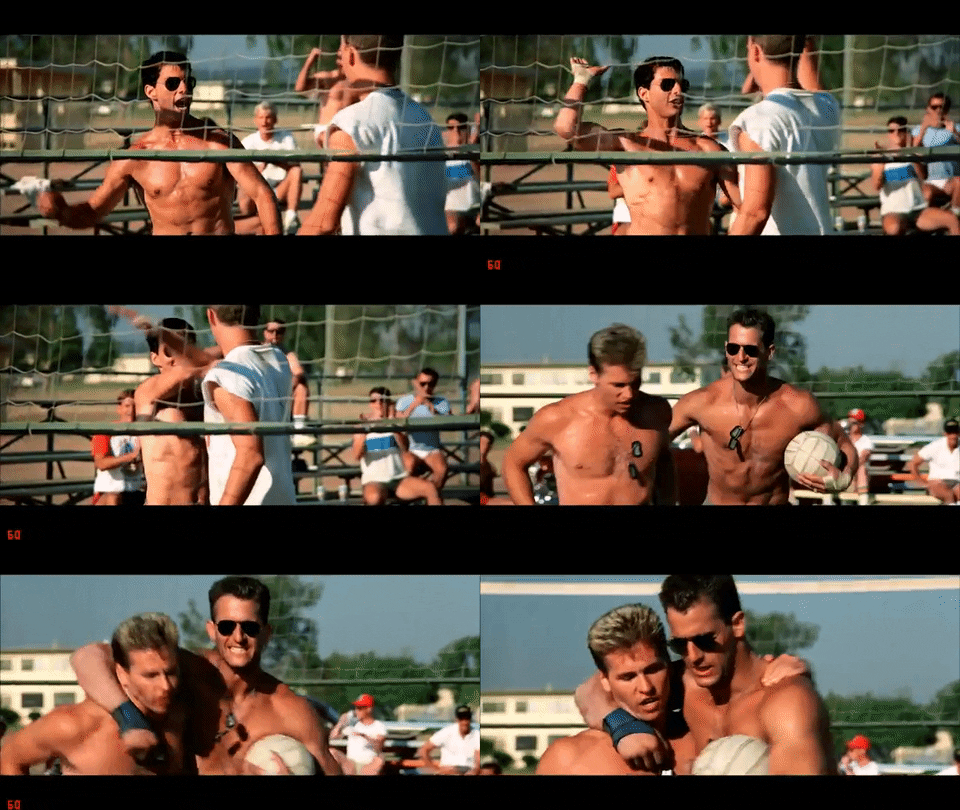
TOPGUN, a gay movie with a Navy subtext
There's a lot to love about this game. The art is great, the writing has a wonderful level of snark. One of my favorites is an aside that pilots, like babies, lack object permanence, so feel free to have threats disappear and reappear as needed. The setting is eminently playable, a hostile wilderness surrounding isolated towns in the wreckage of a Great War which smashed all the nations of the world with poison gas and autonomous superweapons. Magic is real, and fae ask for cruel bargains while dragons patrol the skies. The old is dead and discredited, and the young are picking of the pieces. Flying Circuses are mercenary bands who shoot trouble and carry out jobs of relative morality. The arc of the game is divided between flying missions and on the ground drama, blowing off stress with wild parties and brawls until they burn through the good will of the locals.
That said, this is also a solo project, and there is a little turbulence. To have an aside for a moment, my typology of RPG player motivations breaks down to Explorers, Masters, and Dramatists. Explorers want to experience a cool story, with plot twists, interesting characters, and fantastic vistas. Masters want to choose cleverly, picking the right options and tactics to crush their enemies and earn victory. And Dramatists want to experience emotional states which are risky or inaccessible in mundane life. Any pbtA game is heavy on Explore and Drama, and Flying Circus has enough new mechanics to make it at least medium on Mastery.
The twin beating hearts of the game are clearly Dogfight and Indulging in Vice. There is a whole detailed subsystem of altitude, speed, ordinance, maneuverability, and damage, but it mostly boils down to Dogfight and some ancillary moves around Dogfight. Tactical aerial combat is very hard to do well, and admittedly it might play better than it reads. I don't expect the game to break out a full X-Wing tactical dogfight subsystem, and while it seems like both maneuverability fighters and energy fighters are possible in the system, I was hoping for a little bit more depth along the lines of John Boyd's Aerial Attack Study. As with all narrative games, it comes down to the creativity and skill of the GM, which can be hard if combat is supposed to be a regular thing. The best escape from this trap are missions with a focus other than downing the other side.
Indulge Vice is one of those ideas which I have mixed feelings about. It's a core part of Blades in the Dark, where it's a d6 used to replenish a Stress track. Go over, and you overindulge with a consequence. In play with BitD, I tend to abstract out downtime more than I should, so Vice doesn't get centered properly. In Flying Circus, you get up to 5 chances to Indulge Vice, and each chance gives a flat 1d20 roll, where results above 10 remove stress, and 3 or more results below 10 results in a consequence. Removing stress gives you XP, which can be spent on advances. Since there's more involved mechanics on Vice, it's harder to skip (good), but it's also less reliable than BitD's Stress, and it's tied to advancement (bad). And from a historical note, the life expectancy of World War I pilots was measured in days. Your PCs are much more durable, in fact they won't die without explicit permission. While one of the ptbA Agendas here is to show that glory and tragedy are two sides of the same coin, mechanical support for that theme is on the lighter side.
One of the strengths of ptbA is the system's laser focus on the Conversation At The Table (caps intended). The 2d6+k system, and the outcomes for each move, structure how the game works and gets the system out of the way. Flying Circus uses 2d10+k, and there are a lot more Hold X Forwards and special cases than is typical in the genre. The system is definitely more; I'm not sure that it's better.
I had a ton of fun reading Flying Circus, and I'm definitely more likely to play it than Night Witches. If you're willing to buy into the premise, it's looks like a solid game. But there are spots where I look a little askance. And I recognize it's not entirely fair criticism, I Have Opinions About Game Mechanics and air power. My pilots are the jet-age dare devils of The Right Stuff and When Thunder Rolled, not the barnstormers of WW1. I wish I could say Flying Circus is perfect, but very good will have to suffice.
TOPGUN, a gay movie with a Navy subtext
There's a lot to love about this game. The art is great, the writing has a wonderful level of snark. One of my favorites is an aside that pilots, like babies, lack object permanence, so feel free to have threats disappear and reappear as needed. The setting is eminently playable, a hostile wilderness surrounding isolated towns in the wreckage of a Great War which smashed all the nations of the world with poison gas and autonomous superweapons. Magic is real, and fae ask for cruel bargains while dragons patrol the skies. The old is dead and discredited, and the young are picking of the pieces. Flying Circuses are mercenary bands who shoot trouble and carry out jobs of relative morality. The arc of the game is divided between flying missions and on the ground drama, blowing off stress with wild parties and brawls until they burn through the good will of the locals.
That said, this is also a solo project, and there is a little turbulence. To have an aside for a moment, my typology of RPG player motivations breaks down to Explorers, Masters, and Dramatists. Explorers want to experience a cool story, with plot twists, interesting characters, and fantastic vistas. Masters want to choose cleverly, picking the right options and tactics to crush their enemies and earn victory. And Dramatists want to experience emotional states which are risky or inaccessible in mundane life. Any pbtA game is heavy on Explore and Drama, and Flying Circus has enough new mechanics to make it at least medium on Mastery.
The twin beating hearts of the game are clearly Dogfight and Indulging in Vice. There is a whole detailed subsystem of altitude, speed, ordinance, maneuverability, and damage, but it mostly boils down to Dogfight and some ancillary moves around Dogfight. Tactical aerial combat is very hard to do well, and admittedly it might play better than it reads. I don't expect the game to break out a full X-Wing tactical dogfight subsystem, and while it seems like both maneuverability fighters and energy fighters are possible in the system, I was hoping for a little bit more depth along the lines of John Boyd's Aerial Attack Study. As with all narrative games, it comes down to the creativity and skill of the GM, which can be hard if combat is supposed to be a regular thing. The best escape from this trap are missions with a focus other than downing the other side.
Indulge Vice is one of those ideas which I have mixed feelings about. It's a core part of Blades in the Dark, where it's a d6 used to replenish a Stress track. Go over, and you overindulge with a consequence. In play with BitD, I tend to abstract out downtime more than I should, so Vice doesn't get centered properly. In Flying Circus, you get up to 5 chances to Indulge Vice, and each chance gives a flat 1d20 roll, where results above 10 remove stress, and 3 or more results below 10 results in a consequence. Removing stress gives you XP, which can be spent on advances. Since there's more involved mechanics on Vice, it's harder to skip (good), but it's also less reliable than BitD's Stress, and it's tied to advancement (bad). And from a historical note, the life expectancy of World War I pilots was measured in days. Your PCs are much more durable, in fact they won't die without explicit permission. While one of the ptbA Agendas here is to show that glory and tragedy are two sides of the same coin, mechanical support for that theme is on the lighter side.
One of the strengths of ptbA is the system's laser focus on the Conversation At The Table (caps intended). The 2d6+k system, and the outcomes for each move, structure how the game works and gets the system out of the way. Flying Circus uses 2d10+k, and there are a lot more Hold X Forwards and special cases than is typical in the genre. The system is definitely more; I'm not sure that it's better.
I had a ton of fun reading Flying Circus, and I'm definitely more likely to play it than Night Witches. If you're willing to buy into the premise, it's looks like a solid game. But there are spots where I look a little askance. And I recognize it's not entirely fair criticism, I Have Opinions About Game Mechanics and air power. My pilots are the jet-age dare devils of The Right Stuff and When Thunder Rolled, not the barnstormers of WW1. I wish I could say Flying Circus is perfect, but very good will have to suffice.

Neon City Overdrive is pretty much exactly what it says on the cover, a light and fast cyberpunk RPG. Make up a crew of runners and hit the dangerous streets. There's a basic d6 mechanic, where positive tags from traits and gear ("I'm an outlaw biker on a magdrive Ninja x7, so I'm going to evade these cops by driving straight up a building for +3d6) are balanced out by negative dice from the danger. Rolls on the danger dice cancel out matching positive rolls, and then it's a 6 for a clear success, 4-5 for a complication, 3 or less for a fail, and the potential for a botch. Players are pretty tough, able to spend Stunt metacurrency to avoid damage. The setting is mashup of cyberpunk tropes, with handy tables to help quickly reference. There's a nod towards long-term play with rules for Drives, a chance to either get out clean or never escape the mean streets, but I think the lightness of this system tilts NCO more towards one-shots or short campaigns, rather than epic marathons.
Neon City Overdrive doesn't really break new ground as a game or setting, and it expects familiarity with the tropes rather than having a full setting, but the presentation is great, and I think I could genuinely run a game with maybe 20 minutes of prep. Even compared to my favorite BitD style games, it's fast. I got a copy as part of a freebie day, but if you've got $10, a hankering to run some cyberpunk missions, and don't want to wade through Shadowrun or deal with the more focused ptbA games like The Sprawl, NCO is a solid choice.
Neon City Overdrive doesn't really break new ground as a game or setting, and it expects familiarity with the tropes rather than having a full setting, but the presentation is great, and I think I could genuinely run a game with maybe 20 minutes of prep. Even compared to my favorite BitD style games, it's fast. I got a copy as part of a freebie day, but if you've got $10, a hankering to run some cyberpunk missions, and don't want to wade through Shadowrun or deal with the more focused ptbA games like The Sprawl, NCO is a solid choice.

I've read quite a few WW2 histories lately, but not a comprehensive account of the Pacific theater. Toll's 3 volume, 1500 page epic seemed like a reasonable place to start. This book focuses on Pearl Harbor to Midway, with detours into the historical origins of major figures, the admirals Nimitz, King, Halsey, and Yamamoto. As expected, Toll is an incredibly engaging writer (I read this book at a gallop, long past a sensible bedtime), bringing the drama and history of the moment alive. He is the dean of naval historians, evocatively painting the scene while avoid the excesses of purple prose that Hornfischer sometimes falls victim to.
Midway to Pearl Harbor is such a well-trodden period that there's little new here, though I did appreciate having the timelines all in one place, which helped me understand the interplay of Japan's massive early victories, probing raids by American carriers in the Battle of the Coral sea and the Doolittle Raid, and the decisive victory at Midway. And the drama of early carrier fighting comes through. These were eggshells with sledgehammers. Interception and anti-air fire were not yet well developed sciences, and battles were tense games of blind man's bluff across hundreds of miles, with tense timing of strikes.
I enjoyed the framing, which was around Mahan's theory of sea power and the importance of concentration of force. Japan embraced Mahan wholeheartedly, using his theories to defeat Russia in 1906. The Kido Butai, the six striking carriers that hit Pearl Harbor and supported the wave of conquests, was a vindication of the theory of concentrating capital ships. At Midway, Yamamoto disregarded Mahan, scattering his forces and objectives while attempting strategic deception (rendered futile by American codebreakers), while Nimitz aimed solely to sink the Japanese carriers. While luck played a large role in the American victory, it was Nimitz's preparation that turned opportunity into victory.
Yet, the narrative choice was to jump almost directly from Mahan and 1900 to Pearl Harbor. I can see the reason why, the attack was a strategic surprise, a shocking blow to America. Yet it also came at the end of escalating tensions between the US and Japan, and decades of treaty-constrained warship design. Toll is good of a historian not to mention this, and while I can follow his reasoning, the effect seems forced. Still, an exceptional history. I'm excited for volumes 2 and 3.
Midway to Pearl Harbor is such a well-trodden period that there's little new here, though I did appreciate having the timelines all in one place, which helped me understand the interplay of Japan's massive early victories, probing raids by American carriers in the Battle of the Coral sea and the Doolittle Raid, and the decisive victory at Midway. And the drama of early carrier fighting comes through. These were eggshells with sledgehammers. Interception and anti-air fire were not yet well developed sciences, and battles were tense games of blind man's bluff across hundreds of miles, with tense timing of strikes.
I enjoyed the framing, which was around Mahan's theory of sea power and the importance of concentration of force. Japan embraced Mahan wholeheartedly, using his theories to defeat Russia in 1906. The Kido Butai, the six striking carriers that hit Pearl Harbor and supported the wave of conquests, was a vindication of the theory of concentrating capital ships. At Midway, Yamamoto disregarded Mahan, scattering his forces and objectives while attempting strategic deception (rendered futile by American codebreakers), while Nimitz aimed solely to sink the Japanese carriers. While luck played a large role in the American victory, it was Nimitz's preparation that turned opportunity into victory.
Yet, the narrative choice was to jump almost directly from Mahan and 1900 to Pearl Harbor. I can see the reason why, the attack was a strategic surprise, a shocking blow to America. Yet it also came at the end of escalating tensions between the US and Japan, and decades of treaty-constrained warship design. Toll is good of a historian not to mention this, and while I can follow his reasoning, the effect seems forced. Still, an exceptional history. I'm excited for volumes 2 and 3.

Vietnam: Journeys of Body, Mind, and Spirit is intended as an undergraduate textbook, a kind of consensus depiction of the ethnic and cultural diversity of Vietnam. And it's okay, if burdened with a lot of facile cruft, and making the tragic mistake of putting the best chapters at the end.
I'm not an anthropologist (though I am married to one), and a great ethnography is both a descriptive record and a bridge to a understanding different modes of being human. Not every book can be The Hold Life Has, but Journeys sidesteps some major issues. Working backwards from the present of 2003, when the book was published, Vietnam is a developing country dealing with emergence into global markets, especially competing with China on light industrial manufacturing, and undergoing market reform from a strictly Marxist planned economy of unified Vietnam. And before that, you have the decades long Indochina Wars, against France, the United States, China, and Cambodia, and then the period of colonial occupation, and the development of an independent, pre-modern Vietnam which exists in conversation with Chinese cultural hegemony and Indian influences, particularly Buddhism.
So the question, "What is Vietnam like now?" is inextricably tied up in the politics of globalization and Marxism, and since this is an official collaboration from the Vietnamese Museum of Ethnology, the researchers can't say anything particularly provocative. The early chapters are taken up with a tour through the lunisolar calendar and the major Tet and harvest festivals, along with tours of market towns developing as part of the tourist trade, and then a discussion of marriages and funerals.
The book only gets interesting towards the end, with a description of the Gia Festival, a mock battle commemorating a local hero from the 6th century named Ly Phuc Man, who has been elevated to the status of the god. Interestingly, the festival was suppressed due to war and official disapproval from 1944 to 1990, and was reconstructed based on an ethnography done in 1937. The last chapter, on shamanic guides, is also an interesting look at a unique practice, though I'm doubtful of the centrality of shamans to mainstream Vietnamese culture.
I'm not an anthropologist (though I am married to one), and a great ethnography is both a descriptive record and a bridge to a understanding different modes of being human. Not every book can be The Hold Life Has, but Journeys sidesteps some major issues. Working backwards from the present of 2003, when the book was published, Vietnam is a developing country dealing with emergence into global markets, especially competing with China on light industrial manufacturing, and undergoing market reform from a strictly Marxist planned economy of unified Vietnam. And before that, you have the decades long Indochina Wars, against France, the United States, China, and Cambodia, and then the period of colonial occupation, and the development of an independent, pre-modern Vietnam which exists in conversation with Chinese cultural hegemony and Indian influences, particularly Buddhism.
So the question, "What is Vietnam like now?" is inextricably tied up in the politics of globalization and Marxism, and since this is an official collaboration from the Vietnamese Museum of Ethnology, the researchers can't say anything particularly provocative. The early chapters are taken up with a tour through the lunisolar calendar and the major Tet and harvest festivals, along with tours of market towns developing as part of the tourist trade, and then a discussion of marriages and funerals.
The book only gets interesting towards the end, with a description of the Gia Festival, a mock battle commemorating a local hero from the 6th century named Ly Phuc Man, who has been elevated to the status of the god. Interestingly, the festival was suppressed due to war and official disapproval from 1944 to 1990, and was reconstructed based on an ethnography done in 1937. The last chapter, on shamanic guides, is also an interesting look at a unique practice, though I'm doubtful of the centrality of shamans to mainstream Vietnamese culture.

The stereotype of the Viet Cong is a rice farmer by day, guerrilla fighter by night. But this stereotype is only partially true. The Viet Cong had three levels; local, regional, and main force fighters. The last is the focus of this group, large units of up to divisional scale. These units were commanded by officers who had spent years in North Vietnamese command schools, and were supported with modern weapons along the Ho Chi Minh trail.
As South Vietnam tottered under the series of coups between the fall of Diem and the rise of Thieu and Ky, the Vietnamese politburo saw an opportunity to strike at the regime and comprehensively defeat them. The introduction of American combat troops in 1965, initially the Marines and Airborne units, did not, in the estimation of Viet Cong commanders, alter the strategic balance. American soldiers might fight more skillfully and with greater resources than ARVN, but they could be defeated as well.
The Viet Cong tactics were encapsulated by the slogan that is the title of this book, "Grab by their belts to fight them." American airpower and artillery were overwhelming, but American soldiers could be killed in close combat. The Viet Cong would neutralize their opponents by closing to point blank range, inside the protective ring of firepower.
As Wilkins explores in a series of major engagements, these tactics produced claimed 'victories' for both sides, but the Viet Cong experienced dramatically higher casualties, often more than 10 times the number they inflicted on the Americans. No American unit larger than a company was crushed in a battle of annihilation. Airmobility and airpower made American units incredibly resilient in defense. Conversely, the overriding political need to minimize causalities meant that Americans would (soundly) avoid frontal assaults into prepared defensive positions, preferring to set a perimeter and let firepower do the killing. This meant that neither side was capable of annihilating the other.
Ultimately, the Viet Cong abandoned their motto. The proponents of 'big unit' war were unable to overwhelm the combined arms skill of the American military. The 1968 Tet Offensive was a political gamble, one which wrecked the Viet Cong as political force, but which also shattered American resolve. This book serves as a surprising vindication of General Westmoreland. He may not have been able to win the political war, but he won the military war that was his most pressing problem. Of course, rather than the defend the integrity of that tarnished figure (see Sorley's entertaining assassination), Wilkins ends on a more anodyne tribute to the fighting ability of the ordinary American soldier.
As South Vietnam tottered under the series of coups between the fall of Diem and the rise of Thieu and Ky, the Vietnamese politburo saw an opportunity to strike at the regime and comprehensively defeat them. The introduction of American combat troops in 1965, initially the Marines and Airborne units, did not, in the estimation of Viet Cong commanders, alter the strategic balance. American soldiers might fight more skillfully and with greater resources than ARVN, but they could be defeated as well.
The Viet Cong tactics were encapsulated by the slogan that is the title of this book, "Grab by their belts to fight them." American airpower and artillery were overwhelming, but American soldiers could be killed in close combat. The Viet Cong would neutralize their opponents by closing to point blank range, inside the protective ring of firepower.
As Wilkins explores in a series of major engagements, these tactics produced claimed 'victories' for both sides, but the Viet Cong experienced dramatically higher casualties, often more than 10 times the number they inflicted on the Americans. No American unit larger than a company was crushed in a battle of annihilation. Airmobility and airpower made American units incredibly resilient in defense. Conversely, the overriding political need to minimize causalities meant that Americans would (soundly) avoid frontal assaults into prepared defensive positions, preferring to set a perimeter and let firepower do the killing. This meant that neither side was capable of annihilating the other.
Ultimately, the Viet Cong abandoned their motto. The proponents of 'big unit' war were unable to overwhelm the combined arms skill of the American military. The 1968 Tet Offensive was a political gamble, one which wrecked the Viet Cong as political force, but which also shattered American resolve. This book serves as a surprising vindication of General Westmoreland. He may not have been able to win the political war, but he won the military war that was his most pressing problem. Of course, rather than the defend the integrity of that tarnished figure (see Sorley's entertaining assassination), Wilkins ends on a more anodyne tribute to the fighting ability of the ordinary American soldier.

The PBY Catalina served two different and vital roles in the Pacific Theater. With their exceptional endurance, 12 hours in US service and pushed to 30 hours by the absolute mad lads in the Australia forces, and ability to land on anything calmer than a Beaufort Scale 4, the Cat or Dumbo served as a long-range scout and air-sea rescue plan.
Howard Miner, the author's father, flew in both missions in two tours in the South Pacific. Howard was also a talented journal-keeper and artist. Decades on, his children collected his papers, and Ron assembled these notes and sketches, along with interviews with surviving crew, into an account of time in the South Pacific. Some of the artwork is quite good, and this is a pleasant slice of life of young men at war in the exotic South Pacific, with friendly natives, food that varies between incredible and inedible depending on the vagaries of supply, and hijinks on base and R&R.
Combat is a definite secondary theme. Death in the air is sudden and mysterious, and the long-range PBYs don't get shot down so much as disappear, presumed lost. Bad weather and bad landings are more dangerous than the Japanese. As a rescue pilot, Lt. Miner could be justified in thinking that his war was morally pure. A handful of bombing runs, one a close support mission with napalm, are the exception to acting as an aerial savior.
I imagine this book is much better as a coffee table book. I read the kindle edition, with the art laid out on faux-stained pages. It works alright.
Howard Miner, the author's father, flew in both missions in two tours in the South Pacific. Howard was also a talented journal-keeper and artist. Decades on, his children collected his papers, and Ron assembled these notes and sketches, along with interviews with surviving crew, into an account of time in the South Pacific. Some of the artwork is quite good, and this is a pleasant slice of life of young men at war in the exotic South Pacific, with friendly natives, food that varies between incredible and inedible depending on the vagaries of supply, and hijinks on base and R&R.
Combat is a definite secondary theme. Death in the air is sudden and mysterious, and the long-range PBYs don't get shot down so much as disappear, presumed lost. Bad weather and bad landings are more dangerous than the Japanese. As a rescue pilot, Lt. Miner could be justified in thinking that his war was morally pure. A handful of bombing runs, one a close support mission with napalm, are the exception to acting as an aerial savior.
I imagine this book is much better as a coffee table book. I read the kindle edition, with the art laid out on faux-stained pages. It works alright.

Clashes of armored knights and chivalrous duels are the face of medieval warfare, but the heart was control of fortified places, castles, and walled cities which were the economic and military heart of the period. There's a lot that can be said about sieges, but this book isn't it. Rather than any kind of organized approach to the subject, it's a series of disconnected anecdotes across regions and centuries, with only the vaguest thematic link between retellings from medieval chronicles, and the most cursory analysis and synthesis. This book is just barely good enough for me to keep reading, which is not praise. At least it's short.
Serenade to the Big Bird is a literary memoir of life as a B-17 pilot. It's short, and somewhat digressive as Stiles wanders through his childhood, dames, leave on London, but the passages in the air are non-technical and electric. Flying is easy and beautiful. Flying in tight formation through flak and fighters is anything but. Death is a constant presence in the air over Germany, a swift and violent in any number of ways as vulnerable ships fall out of formation and get shredded.
After his tour in B-17s, Stiles transferred to fighters where he was shot down and killed in November, 1944. It was a waste, as all of war is, but I can't help but be reminded of Ed Rasimus' thoughts, "Flying fighters is simply an assignment, but being a fighter pilot isn’t. Being a fighter pilot is a state-of-mind. It’s an attitude toward your job, toward the mission, toward the way you live your life. You don’t have to fly fighters to be a fighter pilot. You’ve simply got to have the attitude."
After his tour in B-17s, Stiles transferred to fighters where he was shot down and killed in November, 1944. It was a waste, as all of war is, but I can't help but be reminded of Ed Rasimus' thoughts, "Flying fighters is simply an assignment, but being a fighter pilot isn’t. Being a fighter pilot is a state-of-mind. It’s an attitude toward your job, toward the mission, toward the way you live your life. You don’t have to fly fighters to be a fighter pilot. You’ve simply got to have the attitude."