Take a photo of a barcode or cover
2.05k reviews by:
mburnamfink


Borders of Infinity is nearly the perfect pocket-sized Vorkosigan story. Miles is dropped into a Cetagandan POW camp with orders to rescue one man and turn him into the nucleus of a future resistance. The target is already dead, and so Miles improvises, going from one religion fanatic to an army of 700 soldiers and unquestioned power in the hellish POW camp (24 hour light, enough food to meet Red Cross obligations, and a blank forcefield separating the camp from the outside world. No information, no hope, no escape). The plan comes together in a heart pounding rescue. Pretty much everything you'd want or expect, pressed into 100 pages.
The Mountains of Mourning is a rather traditional murder mystery, with Miles forced to confront the anti-mutant prejudices of rural Barrayar when a young woman seeks justice for her murdered baby. It's a fascinating look at where Barrayar came from, compared to where it's going.
Labyrinth is the weak link in the collection. While I was excited at first to see the criminal planet of Jackson's Whole, we mostly see receiving halls and laboratory corridors-pale imitations of Cetaganda and Beta Colony. The actual plot, concerning genetically modified super-soldier Nine and her and Miles's seduction/escape/recruitment just hit way too many of my squick buttons. I guess Nine/Taura matter, since she's on the cover of Miles Errant, but this is the only part of the series so far I *wanted* to put down.
*Bookrace 2014 notes: 3 Novellas counts as a book. I actually read these in a different set of collections, but they count. Didn't read the framing story.
The Mountains of Mourning is a rather traditional murder mystery, with Miles forced to confront the anti-mutant prejudices of rural Barrayar when a young woman seeks justice for her murdered baby. It's a fascinating look at where Barrayar came from, compared to where it's going.
Labyrinth is the weak link in the collection. While I was excited at first to see the criminal planet of Jackson's Whole, we mostly see receiving halls and laboratory corridors-pale imitations of Cetaganda and Beta Colony. The actual plot, concerning genetically modified super-soldier Nine and her and Miles's seduction/escape/recruitment just hit way too many of my squick buttons. I guess Nine/Taura matter, since she's on the cover of Miles Errant, but this is the only part of the series so far I *wanted* to put down.
*Bookrace 2014 notes: 3 Novellas counts as a book. I actually read these in a different set of collections, but they count. Didn't read the framing story.

The Tao that can be spoken of is not the true Tao.
Which makes a book about the Tao rather tricky. I'm not a scholar of Eastern religions, but a friend gave this to me as the best translation, and I can say that it is rather gorgeous, a series of elegant and self-contradictory parables into the nature of mastery, into an acceptance of the universe as it should be. I found some parts rather stunning in their clarity. Voids are more useful than existence. The walls and roof of a house, but we live inside the void. The nature of "doing" vs "done" is more challenging, as I face creative projects I am procrastinating on, as well as the more prosaic dishes that will not put themselves away.
Still, a great book.
Which makes a book about the Tao rather tricky. I'm not a scholar of Eastern religions, but a friend gave this to me as the best translation, and I can say that it is rather gorgeous, a series of elegant and self-contradictory parables into the nature of mastery, into an acceptance of the universe as it should be. I found some parts rather stunning in their clarity. Voids are more useful than existence. The walls and roof of a house, but we live inside the void. The nature of "doing" vs "done" is more challenging, as I face creative projects I am procrastinating on, as well as the more prosaic dishes that will not put themselves away.
Still, a great book.

Tales are five loosely linked short stories set in Le Guin's Earthsea, all circling around the origins and the necessity of the laws of magic which constrain and empower Ged and the other wizards.
Of the stories, the first, "The Finder", is by far the best. A prequel exploring the origins of the School of Roke, it follows a young sorcerer named Otter who has a gift for searching things out. He falls into the clutches of a mad wizard seeking the power of quicksilver, and then escapes into a resistance of honest women called The Hand, centered on the isolated island of Roke. The Otter makes his way to Roke, turning the resistance movement into a school for magic that blunts the cycles of piracy, small wars, and abuse of magic that Earthsea has entered into.
Yet, as it happens, much of what Ged regards as The Rules are arbitrary. Both men and women can wield the magic of true names. Avoiding emotional entanglements is likely wise for one who seeks to use their power for good, but celibacy is not necessary. And the Old Powers of the earth have knowledge the wizards have rejected out of hand.
The rest of the stories are fine for Le Guin, which means exceptional for anyone else, but don't really tell us more than we knew.
Of the stories, the first, "The Finder", is by far the best. A prequel exploring the origins of the School of Roke, it follows a young sorcerer named Otter who has a gift for searching things out. He falls into the clutches of a mad wizard seeking the power of quicksilver, and then escapes into a resistance of honest women called The Hand, centered on the isolated island of Roke. The Otter makes his way to Roke, turning the resistance movement into a school for magic that blunts the cycles of piracy, small wars, and abuse of magic that Earthsea has entered into.
Yet, as it happens, much of what Ged regards as The Rules are arbitrary. Both men and women can wield the magic of true names. Avoiding emotional entanglements is likely wise for one who seeks to use their power for good, but celibacy is not necessary. And the Old Powers of the earth have knowledge the wizards have rejected out of hand.
The rest of the stories are fine for Le Guin, which means exceptional for anyone else, but don't really tell us more than we knew.

"Amateurs study strategy. Experts study logistics"
--Some French Guy, probably"
Okay, that French guy was allegedly Napoleon, who might know a thing or two about war. And if you've been paying attention, you know that industrial warfare is in practice often a matter of logistics. Braver men and better equipment aren't much use if those men are starving and the guns have nothing to shoot. As difficult as a forced amphibious landing is, and the Allies had plenty of experience with them after Africa, Italy, and various islands in the Pacific, the initial assault is nothing without continued sustainment. Every port in France was surrounded by coastal fortifications and heavily mined. Conventional wisdom was that supplying an army over the beach was impossible. Ellsberg had a ringside role in showing that conventional wisdom was wrong.
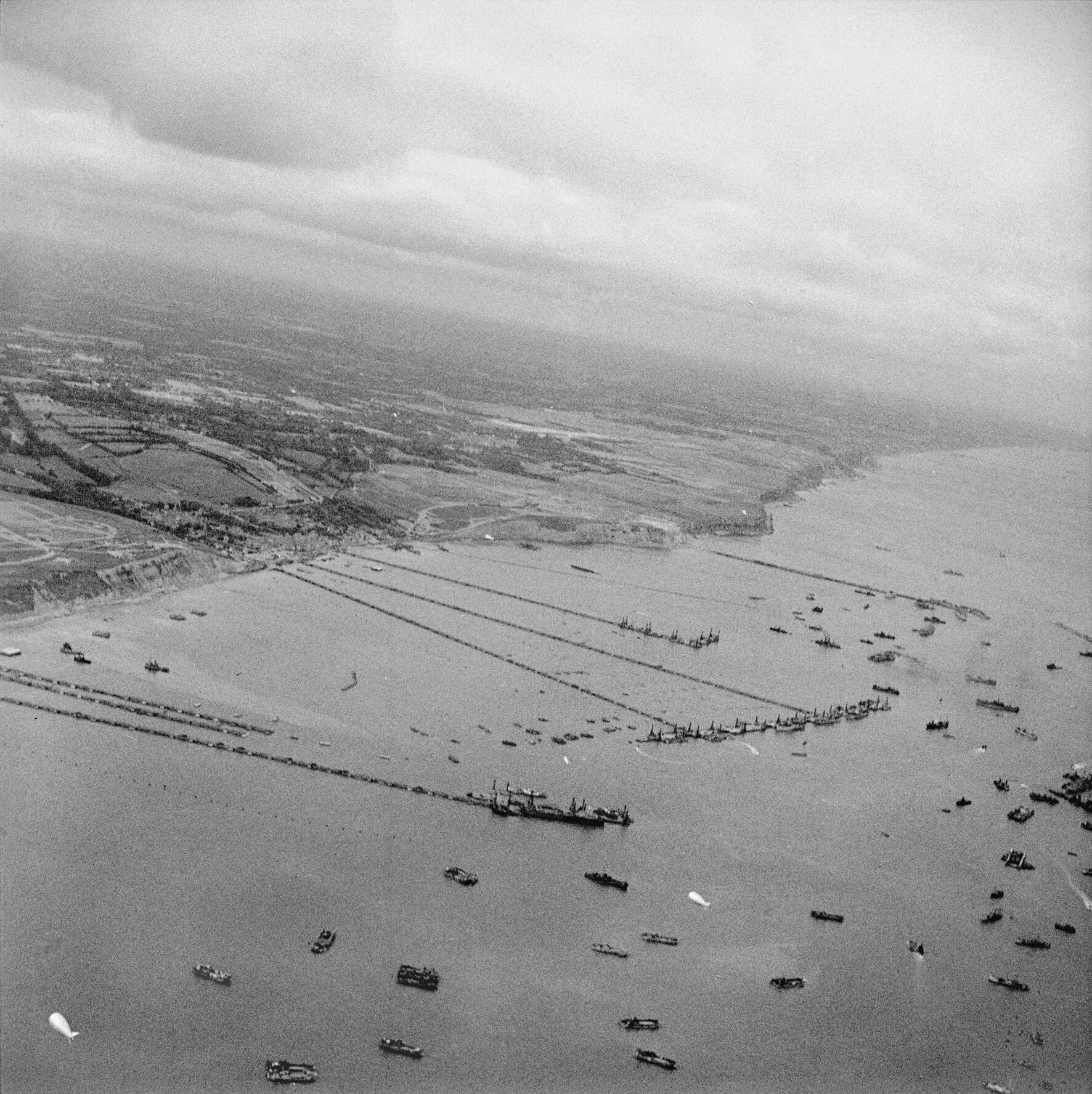
Mulberry artificial harbor, Wikimedia
I went into this book with some trepidation that it'd be bone dry, and was delighted to find that along with being a skilled naval salvage officer, Ellsberg was a commercially successful writer with 18 books. He's an engaging raconteur, who ably describes the organizational chaos attending the Phoenix caissons which formed a vital part of the Mulberry breakwater. The Phoenixes were floating sinkable concrete structures, and in the absence of anchors and chains to moor over a hundred of them, the British had stored them by sinking them in a harbor on their side of the channel. The British Royal Engineers, an Army unit, had a plan to refloat them in time for the landing which amounted to 'trust us, guys', and which to a naval officer was slapdash and technically infeasible because they were using the wrong kind of pumps. Ellsberg helped demonstrate that it wouldn't work, and then risked inter-allied political disaster by writing a memo saying the Royal Engineers would botch the job. The memo went to US Naval Commander Admiral Stark, who had been a US observer on the HMS Collingwood at Jutland with a junior officer with the unlikely name Albert Frederick Arthur George Windsor on the HMS Collingwood, currently King George VI, who told Winston Churchill that Operation Mulberry was doomed, and the PM himself should set it right. Churchill inspected the Phoenixes for two hours, asked not a single question, and assigned the chief salvage officer of the British Navy to get it done, with they did.
The middle chunk of the book is an action packed account of the landing at Omaha beach, with the US Army attacking into the teeth of the strongest defenses in the landing zone and triumphing with heavy casualties. Ellsberg writes well, but he wasn't at Omaha, and so this is just one of many secondary accounts. His own time around D-Day was hardly risk free. He feel down a ladder on a Phoenix, which nearly broke his leg and could have broken a lot more, fell into the English channel while crossing between ships where he could have easily drowned or been crushed between the hulls, and was nearly blown up by a mine on the beech on D-Day +3. Once on the Far Shore, Ellsberg assisted getting the Omaha Mulberry up, moving over 10,000 tons of supplies into the invasion zone daily before a freak storm destroyed the Omaha Mulberry, leaving the invasion dependent on the better protected British artificial harbor until better ports had been captured.
Ellsberg has written a thrilling account of what it felt like to be a vital, behind the scenes member of what Eisenhower called the Great Crusade, one which puts you in his shoes, showcases individual cleverness and energy in the face of bureaucratic confusion, and is just a damn good tale.
--Some French Guy, probably"
Okay, that French guy was allegedly Napoleon, who might know a thing or two about war. And if you've been paying attention, you know that industrial warfare is in practice often a matter of logistics. Braver men and better equipment aren't much use if those men are starving and the guns have nothing to shoot. As difficult as a forced amphibious landing is, and the Allies had plenty of experience with them after Africa, Italy, and various islands in the Pacific, the initial assault is nothing without continued sustainment. Every port in France was surrounded by coastal fortifications and heavily mined. Conventional wisdom was that supplying an army over the beach was impossible. Ellsberg had a ringside role in showing that conventional wisdom was wrong.
Mulberry artificial harbor, Wikimedia
I went into this book with some trepidation that it'd be bone dry, and was delighted to find that along with being a skilled naval salvage officer, Ellsberg was a commercially successful writer with 18 books. He's an engaging raconteur, who ably describes the organizational chaos attending the Phoenix caissons which formed a vital part of the Mulberry breakwater. The Phoenixes were floating sinkable concrete structures, and in the absence of anchors and chains to moor over a hundred of them, the British had stored them by sinking them in a harbor on their side of the channel. The British Royal Engineers, an Army unit, had a plan to refloat them in time for the landing which amounted to 'trust us, guys', and which to a naval officer was slapdash and technically infeasible because they were using the wrong kind of pumps. Ellsberg helped demonstrate that it wouldn't work, and then risked inter-allied political disaster by writing a memo saying the Royal Engineers would botch the job. The memo went to US Naval Commander Admiral Stark, who had been a US observer on the HMS Collingwood at Jutland with a junior officer with the unlikely name Albert Frederick Arthur George Windsor on the HMS Collingwood, currently King George VI, who told Winston Churchill that Operation Mulberry was doomed, and the PM himself should set it right. Churchill inspected the Phoenixes for two hours, asked not a single question, and assigned the chief salvage officer of the British Navy to get it done, with they did.
The middle chunk of the book is an action packed account of the landing at Omaha beach, with the US Army attacking into the teeth of the strongest defenses in the landing zone and triumphing with heavy casualties. Ellsberg writes well, but he wasn't at Omaha, and so this is just one of many secondary accounts. His own time around D-Day was hardly risk free. He feel down a ladder on a Phoenix, which nearly broke his leg and could have broken a lot more, fell into the English channel while crossing between ships where he could have easily drowned or been crushed between the hulls, and was nearly blown up by a mine on the beech on D-Day +3. Once on the Far Shore, Ellsberg assisted getting the Omaha Mulberry up, moving over 10,000 tons of supplies into the invasion zone daily before a freak storm destroyed the Omaha Mulberry, leaving the invasion dependent on the better protected British artificial harbor until better ports had been captured.
Ellsberg has written a thrilling account of what it felt like to be a vital, behind the scenes member of what Eisenhower called the Great Crusade, one which puts you in his shoes, showcases individual cleverness and energy in the face of bureaucratic confusion, and is just a damn good tale.

After working miracles at Massawa, Ellsberg's reward was a promotion and new posting as Chief Salvage Officer for the Mediterranean, supporting Operation Torch. If Massawa was an outer circle of hell, as documented in Under the Red Sea Sun, North Africa was pandemonium. On the positive side, Ellsberg would no longer be at the tail end of one of the longer supply chains of the war. On the negative side was an inter-allied diplomatic and command SNAFU. The Mediterranean was a British naval theater, and as an American Ellsberg had few friends and little pull with the Admiralty. American army officers were friendlier, but entirely unschooled about ships. And the whole territory was French, and the French were very much mixed on who they wanted to win.
The main work was much the same, fixing up ports that had been sabotaged, although more hastily than Massawa. Oran was Ellsberg's main focus, where the French commander had sunk all the floating dry docks and blocked the main channel with ships. The same man was still in command of the port, and on two occasions, just when Ellsberg's divers were ready to refloat and move one of the blockships, he ordered a cargo ship on an unnecessary movement, "accidentally" smashing up the ship and delaying the reopening of the port by months!
That is not to say that every Frenchman was a Nazi sympathizer. The French divers in Oran worked just as hard as anyone on the team, especially after Ellsberg got them new diving suits to replace the patches upon patches they had been diving in.
There was plenty of insanity across the entire Alliance. An American Air Force colonel stole one of Ellsberg's prized air compressors in transit. Later, one of Ellsberg's divers got temporary revenge, diverting a 100 ton floating crane to a salvage job en route to unloading Sherman tanks. When the American general in command of the armored regiment found out, he threatened everyone involved with a court-martial until Ellsberg mollified him by giving up his crane temporarily. Of course, Ellsberg only needed the second crane for another half hour, and the two cranes sat idle for four days while other cargo was unloaded.
A torpedoed British troop transport sat unmoving in a harbor where it would surely be bombed to pieces in a few days because the civilian captain refused to sail without a certificate of seaworthiness from Lloyd's, and the Lloyd's representative refused to grant one because "Look at the giant hole in the side!" The fact that the ship could sail now and would be sunk if it didn't, was irrelevant to paperwork which could see both civilians in trouble if they bent the rules. Ellsberg, of course, managed a technical solution.
More sadly, there was the matter of the Strathallan, another large liner which suffered a major, but not fatal torpedo hit. A botched and premature abandoned ship order saw a lifeboat full of American nurses drown. Then due to non-existent damage control, the Strathallan caught fire. Ellsberg and a token crew of fifty British salvage sailors managed to get a start on the fire at immense personal cost, but a second team from a British destroyer deemed the fire impossible to fight, though Ellsberg's men had been fighting it for two hours, and the Strathallan was lost due to cowardice and incompetence.
After another hair-raising rescue job on a torpedoed freighter, Ellsberg suffered a nervous breakdown. He went to a military hospital to ask for a sleeping pill, or something so he could get a good night's rest, and the medical staff promptly confined him to bed and concluded that he was on the brink of a complete cardiac failure due to overwork and exhaustion. Eisenhower had him reassigned stateside with gratitude, completing a 15 month African tour.
Having read all three of Ellsberg's World War 2 books, though in a cockamamie order, my favorite is Under the Red Sea Sun, which manages the tightest and most unique narrative. They're all worth reading for any fan of military history or technical triumphs.
The main work was much the same, fixing up ports that had been sabotaged, although more hastily than Massawa. Oran was Ellsberg's main focus, where the French commander had sunk all the floating dry docks and blocked the main channel with ships. The same man was still in command of the port, and on two occasions, just when Ellsberg's divers were ready to refloat and move one of the blockships, he ordered a cargo ship on an unnecessary movement, "accidentally" smashing up the ship and delaying the reopening of the port by months!
That is not to say that every Frenchman was a Nazi sympathizer. The French divers in Oran worked just as hard as anyone on the team, especially after Ellsberg got them new diving suits to replace the patches upon patches they had been diving in.
There was plenty of insanity across the entire Alliance. An American Air Force colonel stole one of Ellsberg's prized air compressors in transit. Later, one of Ellsberg's divers got temporary revenge, diverting a 100 ton floating crane to a salvage job en route to unloading Sherman tanks. When the American general in command of the armored regiment found out, he threatened everyone involved with a court-martial until Ellsberg mollified him by giving up his crane temporarily. Of course, Ellsberg only needed the second crane for another half hour, and the two cranes sat idle for four days while other cargo was unloaded.
A torpedoed British troop transport sat unmoving in a harbor where it would surely be bombed to pieces in a few days because the civilian captain refused to sail without a certificate of seaworthiness from Lloyd's, and the Lloyd's representative refused to grant one because "Look at the giant hole in the side!" The fact that the ship could sail now and would be sunk if it didn't, was irrelevant to paperwork which could see both civilians in trouble if they bent the rules. Ellsberg, of course, managed a technical solution.
More sadly, there was the matter of the Strathallan, another large liner which suffered a major, but not fatal torpedo hit. A botched and premature abandoned ship order saw a lifeboat full of American nurses drown. Then due to non-existent damage control, the Strathallan caught fire. Ellsberg and a token crew of fifty British salvage sailors managed to get a start on the fire at immense personal cost, but a second team from a British destroyer deemed the fire impossible to fight, though Ellsberg's men had been fighting it for two hours, and the Strathallan was lost due to cowardice and incompetence.
After another hair-raising rescue job on a torpedoed freighter, Ellsberg suffered a nervous breakdown. He went to a military hospital to ask for a sleeping pill, or something so he could get a good night's rest, and the medical staff promptly confined him to bed and concluded that he was on the brink of a complete cardiac failure due to overwork and exhaustion. Eisenhower had him reassigned stateside with gratitude, completing a 15 month African tour.
Having read all three of Ellsberg's World War 2 books, though in a cockamamie order, my favorite is Under the Red Sea Sun, which manages the tightest and most unique narrative. They're all worth reading for any fan of military history or technical triumphs.

No One Will Come Back For Us is an anthology that another review described as postcolonial Lovecraft, and that is apt but incomplete. This is a collection of stark and often understated fears, of confrontations between humanity and the unknown.
Mohamed shuffles her themes like cards. There is rational narrator, perhaps some kind of professional rational observer (literally in "The Evaluator" and "No One Will Come Back For Us" to pick two stories at random), sometimes a concerned parent or uncanny child, who is confronted with a situation of cosmic horror. The unknown threat balances between the Old Gods of the Land, spirits who demand respect, offering, and the occasional sacrifice, but who are basically beneficent, and Elder Things, extradimensional monsters entirely anathema to sanity and human existence. And of course, rationality and professionalism are thin shields against the true nature of the universe, and end up broken. Fortunately not in the histrionic prolixity of a Lovecraft protagonist, but more in the soft snap of despair and acceptance.
The collection suffers due to its format. If this had been about half the length, eight stories instead of seventeen, I would have had no hesitation rating it five stars. At a certain point, however, I started feeling like I was returning to The Complete Short Stories of J.G. Ballard, and its thematic repitition. "Okay, I get it. Let's move along." This is unfair, Mohamed is a much less nihilistic and hateful author than Ballard, and is on average a better storyteller, but the collection is a lot to take in. The good news is that I only disliked one story, which is a great hit rate.
To pick my eight: Instructions, The Evaluator, The General's Turn, Fortunato, Four Hours of a Revolution, No One Will Come Back For Us, Willing, and For Each of These Miseries.
Mohamed shuffles her themes like cards. There is rational narrator, perhaps some kind of professional rational observer (literally in "The Evaluator" and "No One Will Come Back For Us" to pick two stories at random), sometimes a concerned parent or uncanny child, who is confronted with a situation of cosmic horror. The unknown threat balances between the Old Gods of the Land, spirits who demand respect, offering, and the occasional sacrifice, but who are basically beneficent, and Elder Things, extradimensional monsters entirely anathema to sanity and human existence. And of course, rationality and professionalism are thin shields against the true nature of the universe, and end up broken. Fortunately not in the histrionic prolixity of a Lovecraft protagonist, but more in the soft snap of despair and acceptance.
The collection suffers due to its format. If this had been about half the length, eight stories instead of seventeen, I would have had no hesitation rating it five stars. At a certain point, however, I started feeling like I was returning to The Complete Short Stories of J.G. Ballard, and its thematic repitition. "Okay, I get it. Let's move along." This is unfair, Mohamed is a much less nihilistic and hateful author than Ballard, and is on average a better storyteller, but the collection is a lot to take in. The good news is that I only disliked one story, which is a great hit rate.
To pick my eight: Instructions, The Evaluator, The General's Turn, Fortunato, Four Hours of a Revolution, No One Will Come Back For Us, Willing, and For Each of These Miseries.

The Other Wind closes out the Earthsea cycle perfectly, in the way that one of the wizards at describes his life as "learning to choose when their are no alternatives."
Decades after the events of Tehanu, the world is at peace, but on the cusp of some dramatic change. Dragons have been seen flying in the west, threatening human islands. The Kargs have overthrown their God-Kings and returned to a conventional warlord, who may seek peace. Lebennen is a good king, yet without wife and heir. And a sorcerer, a common mender called Alder, journeys to Gont to seek Ged's advice on the topic of his troubling dreams.
Alder dreams about his dead wife, which is common enough, but he dreams of seeing her at the wall that separates the land of the living from the land of the dead. He dreams that she touched him. And since then, every night the dead appear and ask him to free them, with what consequence he does not know.
The plot ambles around Earthsea, mostly around Alder and Tenar, who has been asked for advice by King Lebennen on the myriad shadows falling over his kingdom. The tone is cozy, like a favorite pair of slippers. These characters are old friends and though we feel the chill winds of change, there is a fundamental agreement to accept it.
The end of the book lurches very suddenly towards unravelling the grand mysteries of the setting: magic, dragons, true names, and crimes so old they have almost passed out of myth. The pacing is uneven, but the ride is stately, thoughtful, heartbreaking.
Decades after the events of Tehanu, the world is at peace, but on the cusp of some dramatic change. Dragons have been seen flying in the west, threatening human islands. The Kargs have overthrown their God-Kings and returned to a conventional warlord, who may seek peace. Lebennen is a good king, yet without wife and heir. And a sorcerer, a common mender called Alder, journeys to Gont to seek Ged's advice on the topic of his troubling dreams.
Alder dreams about his dead wife, which is common enough, but he dreams of seeing her at the wall that separates the land of the living from the land of the dead. He dreams that she touched him. And since then, every night the dead appear and ask him to free them, with what consequence he does not know.
The plot ambles around Earthsea, mostly around Alder and Tenar, who has been asked for advice by King Lebennen on the myriad shadows falling over his kingdom. The tone is cozy, like a favorite pair of slippers. These characters are old friends and though we feel the chill winds of change, there is a fundamental agreement to accept it.
The end of the book lurches very suddenly towards unravelling the grand mysteries of the setting: magic, dragons, true names, and crimes so old they have almost passed out of myth. The pacing is uneven, but the ride is stately, thoughtful, heartbreaking.

These days, the US-Canada border is both the longest land border in the world, and one of the most peaceful. This was not always true, of course. The two countries had an actual shooting war in 1812, and nearly came to blows several more times. Most weirdly, in the 1920s and 1930s, the two countries developed very similar plans to invade each other.

This man is your FRIEND. He fights for FREEDOM
War Plan Red is a quick, Buzzfeed-ish guide to the military aspects of US-Canadian relations, focusing mostly on the various farces of US invasions in 1812, and the the Fenian raids around the Civil War, where Irish Americans tried to use military force to get Britain to release Ireland, to no avail.
The documentation is attached at the end of the book. The US War Plan Red is a rather dry geographic description of Canada, noting the lack of strategic depth, but also difficult conditions along the St. Lawrence river. The Canadian Defence Scheme No. 1, product of Lt. Col. "Buster" Brown, is more scattered (apparently most of it was destroyed), but includes some rather arch observations on the rural residents of Vermont, and argues for a rapid attack against the industrial North East to throw the American response off balance. For most of this time, Canada was part of the British Empire, and the war plans were both formed to shape circumstances by the time the Home Fleet arrived to put things right. Ironically, the British plan in the event of either circumstance was probably to do nothing. Canada wasn't worth a war with the US.
This man is your FRIEND. He fights for FREEDOM
War Plan Red is a quick, Buzzfeed-ish guide to the military aspects of US-Canadian relations, focusing mostly on the various farces of US invasions in 1812, and the the Fenian raids around the Civil War, where Irish Americans tried to use military force to get Britain to release Ireland, to no avail.
The documentation is attached at the end of the book. The US War Plan Red is a rather dry geographic description of Canada, noting the lack of strategic depth, but also difficult conditions along the St. Lawrence river. The Canadian Defence Scheme No. 1, product of Lt. Col. "Buster" Brown, is more scattered (apparently most of it was destroyed), but includes some rather arch observations on the rural residents of Vermont, and argues for a rapid attack against the industrial North East to throw the American response off balance. For most of this time, Canada was part of the British Empire, and the war plans were both formed to shape circumstances by the time the Home Fleet arrived to put things right. Ironically, the British plan in the event of either circumstance was probably to do nothing. Canada wasn't worth a war with the US.

Published in the distant days of 2018, War on Peace is an insider account of the collapse of American diplomacy by diplomat turned journalist Ronan Farrow. Before he brought down Harvey Weinstein, Farrow worked for Clinton alley and bureaucratic bulldozer Richard Holbrooke on the thorny issue of peace in Afghanistan during the first Obama administration. Farrow's job was coordination with NGOs, but what he really got was a front-row seat to the exercise of power. Through a series of vignettes, focusing mostly on Afghanistan, Pakistan, and the American diplomats who worked there, Farrow weaves a story about the ruin of soft power that reached a crescendo with the mass firings of senior State Department officials under Donald Trump, but reaches back decades earlier, possibly to the immediate aftermath of the highpoint of turning the WW2 Allies into the United Nations and founding NATO, and definitely to the Bush administration.
The basic problem that Farrow identifies is that State has allowed its bailiwick of diplomatic engagement to wither in favor of direct ties between the US military and foreign partners, the shadow wars of the CIA, the data-driven wiretapping of the NSA, and the presidential access of the National Security Advisor. Which means that when it comes time to talk, to trying and build consensus and 'win the peace', there's no one with the expertise and authority to do it.
Pakistan is Farrow's emblematic case. Pakistan has been an American client since the Soviet War in Afghanistan, where the CIA's covert aid was directed entirely through the Pakistani Inter-Services Intelligence. The ISI cultivated its own clients, who evolved into the Taliban. And when Pakistan became a crucial ally in the wake of 9/11, the relationship became fractally dysfunctional. As murky as American objectives were in Afghanistan, they were beholden to Pakistan's geographic grip on the ground lines of communication, and sovereignty over border regions that the mujahideen fighters used. Billions of dollars in aid flowed to Pakistan, and when American diplomats asked for progress on other issues, like democracy, human rights, and nuclear non-proliferation, the answer was a shrug: "Do you really care about those things, or do you care about your war?"
Repeatedly, American patronage of strongmen reversed the expected power dynamic. American policy could only advance through the actions of local leaders, who were often unpopular and sustained solely by American aid. Yet abandoning these strongmen, whatever their flaws, would mean chaos. And so America became identified with and reliant on warlords profoundly antithetical to stated American values in Pakistan, Afghanistan, Sudan, Egypt, Colombia, etc etc.
There are fair bureaucratic reasons for this. When the President gives an order to the military or the CIA, odds are something will happen. The same order given to State will result in a discussion. When the domestic 24 hour news cycle is what drives Washington, the slow and halting work of negotiation is both unsatisfying and presents the possibility for awkward news cycles. All recent administrations have participated in the process. Trump's Twitter driven foreign policy was novel more in its speed and random nature than it's uncoupling from the experts at State.
Broadly, I agree with Farrow's assessment that America should be more open in who it talks to, and exercise much more discretion in who it pays. There are hard questions to be asked about what level of past atrocities block an individual or organization from receiving American support, as well as what can be overlooked among America's friends in terms of corruption and violence, and this book doesn't really have the answers.
What I can say is that at a remove, American diplomacy is likely cooked. Since 9/11, we've lost or burnt out an entire generation of public servants. I don't think there's anyone like Holbrooke left at State, the kind of robust Kennedy-esque liberal who really did believe in "Asking what they could do for their country". Anyone with ideals and skills has either quit or gone into hiding, leaving the ticket-punchers and careerists.
What are the consequences? Well, I can only close with a quote from a Statecraft interview with DARPA officer Eric Van Gieson on Ebola response.
Cutting diplomacy is penny-wise, pound foolish. This is what it sounds like when an empire falls.
The basic problem that Farrow identifies is that State has allowed its bailiwick of diplomatic engagement to wither in favor of direct ties between the US military and foreign partners, the shadow wars of the CIA, the data-driven wiretapping of the NSA, and the presidential access of the National Security Advisor. Which means that when it comes time to talk, to trying and build consensus and 'win the peace', there's no one with the expertise and authority to do it.
Pakistan is Farrow's emblematic case. Pakistan has been an American client since the Soviet War in Afghanistan, where the CIA's covert aid was directed entirely through the Pakistani Inter-Services Intelligence. The ISI cultivated its own clients, who evolved into the Taliban. And when Pakistan became a crucial ally in the wake of 9/11, the relationship became fractally dysfunctional. As murky as American objectives were in Afghanistan, they were beholden to Pakistan's geographic grip on the ground lines of communication, and sovereignty over border regions that the mujahideen fighters used. Billions of dollars in aid flowed to Pakistan, and when American diplomats asked for progress on other issues, like democracy, human rights, and nuclear non-proliferation, the answer was a shrug: "Do you really care about those things, or do you care about your war?"
Repeatedly, American patronage of strongmen reversed the expected power dynamic. American policy could only advance through the actions of local leaders, who were often unpopular and sustained solely by American aid. Yet abandoning these strongmen, whatever their flaws, would mean chaos. And so America became identified with and reliant on warlords profoundly antithetical to stated American values in Pakistan, Afghanistan, Sudan, Egypt, Colombia, etc etc.
There are fair bureaucratic reasons for this. When the President gives an order to the military or the CIA, odds are something will happen. The same order given to State will result in a discussion. When the domestic 24 hour news cycle is what drives Washington, the slow and halting work of negotiation is both unsatisfying and presents the possibility for awkward news cycles. All recent administrations have participated in the process. Trump's Twitter driven foreign policy was novel more in its speed and random nature than it's uncoupling from the experts at State.
Broadly, I agree with Farrow's assessment that America should be more open in who it talks to, and exercise much more discretion in who it pays. There are hard questions to be asked about what level of past atrocities block an individual or organization from receiving American support, as well as what can be overlooked among America's friends in terms of corruption and violence, and this book doesn't really have the answers.
What I can say is that at a remove, American diplomacy is likely cooked. Since 9/11, we've lost or burnt out an entire generation of public servants. I don't think there's anyone like Holbrooke left at State, the kind of robust Kennedy-esque liberal who really did believe in "Asking what they could do for their country". Anyone with ideals and skills has either quit or gone into hiding, leaving the ticket-punchers and careerists.
What are the consequences? Well, I can only close with a quote from a Statecraft interview with DARPA officer Eric Van Gieson on Ebola response.
Q: When you were on the ground, how did our engagement in Africa stack up with Chinese and Russian engagement? Did you cross paths?
Yeah. There's an example of where we were waiting to go in to meet with an African delegation. I won't name the country, but our team was prepared to speak in French — we had translators. And we got half an hour with the delegation from their Ministry of Health. We walked out, and the Chinese delegation came in, but they went to the effort of not only knowing French, but also knowing a local language that none of us had ever heard, and they spoke in that language to their hosts. We were ushered out. The Chinese stayed for three hours.
Cutting diplomacy is penny-wise, pound foolish. This is what it sounds like when an empire falls.

Disaster Nationalism is so close to being an excellent analysis of the current political moment that its retreat into the hoary and well-trodden halls of Theory is all the more frustrating. Seymour's goal is to understand the failures of the liberal centrist consensus of the early 21st century and the rise of inchoate proto-fascist politicians across the world. Bolsonaro in Brazil, Duterte in the Philippines, Modi in India, and of course, America's own big orange multiply convicted twice-impeached fraudster rapist Donald Trump.
The core of Seymour's thesis is that these movements are all part of a broad disaster nationalist trend, which seeks the reinvigoration of the nation through a cataclysm of violence. Riven through with intellectual contradictions, the main binding tie of the movement is a division of the world into friends and enemies, and the urge and ability to do violence to enemies. Moreso than any coherent class analysis, this is rooted in a psychology of decline, especially white male decline, a basic Freudian penile anxiety that links individual setbacks to broad trends in a paranoid web.

Are you scared yet?
The frustrating thing about this book is that as a keen observer of current events over the past decade (Christ, almost 10 years since Trump came down his escalator in 2015, announced he was running for President, and called Mexicans rapists), it's basically correct. But rather than present a particularly well-organized account of a whole lot of shit that's happened, or novel social theory along the lines of Max Read's "Zynternet", it's more Freud and Marx, again.
A few key things I think are worth pay attention to in the book. The central goal of disaster nationalism is to do a pogrom. Everything else is window dressing. What is at the center of this movement is an escalatory cycle between elite leaders and followers on the street, heading towards mass lynchings of a despised group. In Modi's India, it's Muslims; in the Philippines, drug addicts; Europe targets migrants; and in America, it's bring your AR-15 to school day. Law enforcement will of course aid and abet the pogrom, since the police fundamentally approve.
A second useful point is the centrality of what Baudrillard called the simulacrum. Reality is no longer what you see and feel, but rather the mediated experience of the 24 hour news cycle and the constant feeds of social media, all optimized for attention. If Benedict Anderson's Imagined Community of the nation required the newspaper, and the break of time into then-now-tomorrow, disaster nationalism takes place in a single smear between nostalgia, future greatness, and present despair, an ever-flickering cascade of images.
Third is the rise of stochastic terrorism. Organized Brown Shirt groups are rather rare in disaster nationalism. Rather, the frontline fighters are alienated individuals polishing their manifestos, and then attempting to go out in a symbolic blaze of mass murder. Essentially impossible to stop (well, not that cops even try, but I imagine the false positive rate of reports would be very high), lone wolf shooters are both a symbol and a symptom of the disease of disaster nationalism, a reminder not to attract attention by protest or difference, unless you're willing to die.
As for the rest of us, the people who rely on government services, I am personally fond of air traffic control, well, we can get fucked. Welfare will be cut to the bone, and what remains privatized and run by incompetent ghouls. Disaster nationalists are utter failures at delivering real benefits, even to their supports. Yet somehow Duarte and Modi maintain exceptional approval ratings, and America decided to get back on the Trump train.
If there's any consolation, it's that through incompetence and incoherence disaster nationalists are not very effective at carrying out their proposal. However, each day they're in office or on TV is another day we as society slide towards barbarism. I also suspect that they're so vehemently against gender studies and critical race theory because those two academic disciplines tread on their space of linking personal barriers and violations to broad intangible social constructs (invert white supremacist patriarchy and you get globohomo, and vice versa).
The introduction to this book is sharp and fantastic, the rest is a trudge.
The core of Seymour's thesis is that these movements are all part of a broad disaster nationalist trend, which seeks the reinvigoration of the nation through a cataclysm of violence. Riven through with intellectual contradictions, the main binding tie of the movement is a division of the world into friends and enemies, and the urge and ability to do violence to enemies. Moreso than any coherent class analysis, this is rooted in a psychology of decline, especially white male decline, a basic Freudian penile anxiety that links individual setbacks to broad trends in a paranoid web.
Are you scared yet?
The frustrating thing about this book is that as a keen observer of current events over the past decade (Christ, almost 10 years since Trump came down his escalator in 2015, announced he was running for President, and called Mexicans rapists), it's basically correct. But rather than present a particularly well-organized account of a whole lot of shit that's happened, or novel social theory along the lines of Max Read's "Zynternet", it's more Freud and Marx, again.
A few key things I think are worth pay attention to in the book. The central goal of disaster nationalism is to do a pogrom. Everything else is window dressing. What is at the center of this movement is an escalatory cycle between elite leaders and followers on the street, heading towards mass lynchings of a despised group. In Modi's India, it's Muslims; in the Philippines, drug addicts; Europe targets migrants; and in America, it's bring your AR-15 to school day. Law enforcement will of course aid and abet the pogrom, since the police fundamentally approve.
A second useful point is the centrality of what Baudrillard called the simulacrum. Reality is no longer what you see and feel, but rather the mediated experience of the 24 hour news cycle and the constant feeds of social media, all optimized for attention. If Benedict Anderson's Imagined Community of the nation required the newspaper, and the break of time into then-now-tomorrow, disaster nationalism takes place in a single smear between nostalgia, future greatness, and present despair, an ever-flickering cascade of images.
Third is the rise of stochastic terrorism. Organized Brown Shirt groups are rather rare in disaster nationalism. Rather, the frontline fighters are alienated individuals polishing their manifestos, and then attempting to go out in a symbolic blaze of mass murder. Essentially impossible to stop (well, not that cops even try, but I imagine the false positive rate of reports would be very high), lone wolf shooters are both a symbol and a symptom of the disease of disaster nationalism, a reminder not to attract attention by protest or difference, unless you're willing to die.
As for the rest of us, the people who rely on government services, I am personally fond of air traffic control, well, we can get fucked. Welfare will be cut to the bone, and what remains privatized and run by incompetent ghouls. Disaster nationalists are utter failures at delivering real benefits, even to their supports. Yet somehow Duarte and Modi maintain exceptional approval ratings, and America decided to get back on the Trump train.
If there's any consolation, it's that through incompetence and incoherence disaster nationalists are not very effective at carrying out their proposal. However, each day they're in office or on TV is another day we as society slide towards barbarism. I also suspect that they're so vehemently against gender studies and critical race theory because those two academic disciplines tread on their space of linking personal barriers and violations to broad intangible social constructs (invert white supremacist patriarchy and you get globohomo, and vice versa).
The introduction to this book is sharp and fantastic, the rest is a trudge.