Take a photo of a barcode or cover
2.05k reviews by:
mburnamfink


Daniel Ellsberg will always be the patron saint of whistleblowers. He earned his place in history by leaking the Pentagon Papers, documenting that the American government knew the war in Vietnam was based on lies and going poorly long before it admitted anything of that sort to the public. Vietnam was the end of Ellsberg's official career. He real passion was nuclear war, and trying to make sure that one never occurred. In a twist of fate, the nuclear documents that Ellsberg also copied in the 1970s were lost in a landslide, but decades later much of that material has become available through FOIA and similar requests.
I thought I knew a fair bit about the Cold War and nuclear brinksmanship, and even so this book was astounding. The conventional wisdom is that nuclear war is MAD-Mutually Assured Destruction. Peace is preserved in a tense equilibrium where each side knows that any nuclear exchange will lead to annihilation of it's own population via a sure retaliation. The paradoxical credibility of peace by violence is restrained by the twin promises that nothing can stop the fire and that nukes will only be launched in response to a nuclear attack. The first point is true, the second point is a lie.
As Ellsberg points out, the American government has never disavowed the first use of nuclear weapons, or the potential of a nuclear first strike (First use is any unprovoked use. First strike is massive first use intended to prevent retaliation). Every American president since Truman has used the nuclear arsenal like a robber with a gun. That the gun has not been fired yet is secondary to the basic fact that it is loaded, aimed, and used to compel obedience.
This book is best when it hews closest to Ellsberg's work at RAND and in the White House. Coming out of the Marines and Harvard with a PhD in decision-making under uncertainty, he embarked on a survey of nuclear strategy in the Pacific in 1959 or so, and what he found was incredibly alarming. President Eisenhower had delegated the authority to launch a nuclear strike to CINCPAC in Honolulu, who had further devolved authority to theater commanders on Okinawa, Guam, Korea, and various ships. All of these commands were routinely out of contact with higher headquarters due to distance and poor radio communications. While there was in theory a 'two man rule' that prevented any single officer from broadcasting the order to launch a nuclear strike, in reality every ship and base had procedures for bypassing the two man rule.
Bases practiced alerts on a daily basis and were capable of launching aircraft on 10 minute notice, a stated objective of the attack plan. The attack plan was "fail-safe", in that if an aircraft had not received a go order by the time it reached bingo fuel and had to either commit to the attack or return to base, it would return to base. Strategic Air Command (SAC) practiced full alerts with armed bombers flying to their holding points. In the Pacific, Tactical Air Command merely taxied to the flightlines with bombs. This was both to save fuel and maintenance, and also because the bombs used were not one-point safe, and F-100s were difficult airplanes to flying, meaning there was a small but real chance a plane crash could lead to a nuclear detonation.
As Ellsberg pointed out, visiting a small airbase in the ass-end of Korea, a real alert would be the first time that these pilots had taken off with live bombs. There was also a non-zero chance that plane 8 of 12 would crash on take-off, and the remaining pilots would find themselves out of communications with command, their base enveloped in a mushroom cloud, and with the fate of their world in their hands.
Ellsberg asked the officer in command, a major, what would happen. Would the pilots returned to base as planned? "Yes they would. They're good boys. Well, probably... Hell, if one goes, they might as well all go!" The end of the world could be triggered by an honorable and dutiful officer at the very low rank of major, on his own orders, based on his own very partial understanding of the strategic situation. And there was nothing the entire chain of command, from the President on down, could do to stop it.
Worse than accidents was the actual proper plan. The effort involved in coordinating thousands of aircraft and bombs and avoiding mutual fratricide meant that there was only one plan, a massive all-out attack on the Soviet Union, Communist China, and the Warsaw Pact that would drop thousands of hydrogen bombs in a single spasm until nothing remained in the American arsenal. This plan was to be activated on the event of general war, a conflict with the Soviet Union larger than a skirmish. The plan itself, the Joint Strategic Capabilities Plan, was so secret that it was concealed from the President and the White House staff, the anodyne JSCP acronym also kept secret. It was a plan for genocide. The initial bombardment would kill hundreds of millions. Fire effects were too difficult to estimate, so they were assumed to cause zero casualties. Radioactive fallout would kill an estimated another five hundred million or so, wiping out allies and neutrals in Western Europe and South Asia. Plumes of fallout would drift around the globe, and ash lofted into the stratosphere would trigger a nuclear winter and years-long famine.
In one rather acid summary of his career, Ellsberg describes his life's mission as moving a piece of paper from one desk to a desk with higher authority. The truth about the Vietnam War shifted from the Pentagon to the public. JSCP from the Air Force to the President. Ellsberg joined the Kennedy administration on a part-time leave from RAND, and drafted a new nuclear war plan that proposed leaving cities untouched, hostages for a second round, and reducing the triggering events for nuclear war. There is a lot of canny bureaucratic knife fighting, and great descriptions of the proper deployment of informational memos around the Cuban missile crisis, for those who care about those sorts of things.
The latter half of the book weapons lags as Ellsberg discusses general nuclear strategy, rather than his own experience, but he makes an ironclad case that current nuclear policy in the United States is inherently unsafe and that the soft power gained by joining international arms controls norms would override the veiled, and not-so-veiled threats, made by American Presidents. We've been lucky that there have been no fatal technical glitches, and that at moments of maximum tension people who understood the consequences had the last word, but luck is not enough. Something has to change before the doomsday machine goes off.
As the motto of the Soviet Strategic Rocket Forces goes, "After us - silence".
I thought I knew a fair bit about the Cold War and nuclear brinksmanship, and even so this book was astounding. The conventional wisdom is that nuclear war is MAD-Mutually Assured Destruction. Peace is preserved in a tense equilibrium where each side knows that any nuclear exchange will lead to annihilation of it's own population via a sure retaliation. The paradoxical credibility of peace by violence is restrained by the twin promises that nothing can stop the fire and that nukes will only be launched in response to a nuclear attack. The first point is true, the second point is a lie.
As Ellsberg points out, the American government has never disavowed the first use of nuclear weapons, or the potential of a nuclear first strike (First use is any unprovoked use. First strike is massive first use intended to prevent retaliation). Every American president since Truman has used the nuclear arsenal like a robber with a gun. That the gun has not been fired yet is secondary to the basic fact that it is loaded, aimed, and used to compel obedience.
This book is best when it hews closest to Ellsberg's work at RAND and in the White House. Coming out of the Marines and Harvard with a PhD in decision-making under uncertainty, he embarked on a survey of nuclear strategy in the Pacific in 1959 or so, and what he found was incredibly alarming. President Eisenhower had delegated the authority to launch a nuclear strike to CINCPAC in Honolulu, who had further devolved authority to theater commanders on Okinawa, Guam, Korea, and various ships. All of these commands were routinely out of contact with higher headquarters due to distance and poor radio communications. While there was in theory a 'two man rule' that prevented any single officer from broadcasting the order to launch a nuclear strike, in reality every ship and base had procedures for bypassing the two man rule.
Bases practiced alerts on a daily basis and were capable of launching aircraft on 10 minute notice, a stated objective of the attack plan. The attack plan was "fail-safe", in that if an aircraft had not received a go order by the time it reached bingo fuel and had to either commit to the attack or return to base, it would return to base. Strategic Air Command (SAC) practiced full alerts with armed bombers flying to their holding points. In the Pacific, Tactical Air Command merely taxied to the flightlines with bombs. This was both to save fuel and maintenance, and also because the bombs used were not one-point safe, and F-100s were difficult airplanes to flying, meaning there was a small but real chance a plane crash could lead to a nuclear detonation.
As Ellsberg pointed out, visiting a small airbase in the ass-end of Korea, a real alert would be the first time that these pilots had taken off with live bombs. There was also a non-zero chance that plane 8 of 12 would crash on take-off, and the remaining pilots would find themselves out of communications with command, their base enveloped in a mushroom cloud, and with the fate of their world in their hands.
Ellsberg asked the officer in command, a major, what would happen. Would the pilots returned to base as planned? "Yes they would. They're good boys. Well, probably... Hell, if one goes, they might as well all go!" The end of the world could be triggered by an honorable and dutiful officer at the very low rank of major, on his own orders, based on his own very partial understanding of the strategic situation. And there was nothing the entire chain of command, from the President on down, could do to stop it.
Worse than accidents was the actual proper plan. The effort involved in coordinating thousands of aircraft and bombs and avoiding mutual fratricide meant that there was only one plan, a massive all-out attack on the Soviet Union, Communist China, and the Warsaw Pact that would drop thousands of hydrogen bombs in a single spasm until nothing remained in the American arsenal. This plan was to be activated on the event of general war, a conflict with the Soviet Union larger than a skirmish. The plan itself, the Joint Strategic Capabilities Plan, was so secret that it was concealed from the President and the White House staff, the anodyne JSCP acronym also kept secret. It was a plan for genocide. The initial bombardment would kill hundreds of millions. Fire effects were too difficult to estimate, so they were assumed to cause zero casualties. Radioactive fallout would kill an estimated another five hundred million or so, wiping out allies and neutrals in Western Europe and South Asia. Plumes of fallout would drift around the globe, and ash lofted into the stratosphere would trigger a nuclear winter and years-long famine.
In one rather acid summary of his career, Ellsberg describes his life's mission as moving a piece of paper from one desk to a desk with higher authority. The truth about the Vietnam War shifted from the Pentagon to the public. JSCP from the Air Force to the President. Ellsberg joined the Kennedy administration on a part-time leave from RAND, and drafted a new nuclear war plan that proposed leaving cities untouched, hostages for a second round, and reducing the triggering events for nuclear war. There is a lot of canny bureaucratic knife fighting, and great descriptions of the proper deployment of informational memos around the Cuban missile crisis, for those who care about those sorts of things.
The latter half of the book weapons lags as Ellsberg discusses general nuclear strategy, rather than his own experience, but he makes an ironclad case that current nuclear policy in the United States is inherently unsafe and that the soft power gained by joining international arms controls norms would override the veiled, and not-so-veiled threats, made by American Presidents. We've been lucky that there have been no fatal technical glitches, and that at moments of maximum tension people who understood the consequences had the last word, but luck is not enough. Something has to change before the doomsday machine goes off.
As the motto of the Soviet Strategic Rocket Forces goes, "After us - silence".

Something changed between when I read Vol 1 and now. This book is distinctly overegged, and while sweeping and comprehensive, still comes up as less than the sum of its parts. Schama structures the narrative roughly geographically and chronologically, beginning in Venice immediately after the expulsion of Jews from Spain and Portugal, and ending in Jerusalem with a diplomatic junket involving Zionist leader Theodor Herzl and Kaiser Wilhelm II. In between we visit most of Europe, the United States, and places as far afield as India and China.
Several themes reoccur. Good times turn to bad times, as rulers and populations repeatedly turn against Jews in their midst, ordering expulsions in the dead of winter and forced conversion. In almost all of Europe, Jews were barred from land ownership and craft guilds, and then punished for either being poor disease carriers, or becoming too suspiciously wealthy on commercial activity.
A second issue was one of community or integration. Jewish communities were often semi-autonomous from their Christian neighbors, accountable to their own laws and courts, with the caveat of being subject to gentile abuse with little recourse. Yet Jews often achieved some degree of integration with mainstream society. Amsterdam was tolerant enough to allow genuine pluralism, even in the 16th century. In England, once Jews were allowed to return after the restoration, some shaved their beards and baptized their children, becoming more or less indistinguishable from other English gentry. The story of Jewish boxer Daniel Mendoza is a rough and tumble counter to these smooth stories of integration.
Mystical redemption returns again and again. The Messiah is a recurrent theme in Jewish spiritual belief, and several people claimed to be the Messiah. In the 15th and 16th century, there were rumors of Jews at the ends of the Earth, the biblical Lost Tribes set to return as an army. In the 17th and 18, it was spiritual redemption through the Sabbateans (heretics), and the Hasids (more orthodox than thou). Internal Jewish belief was matched by a widespread Christian belief that mass conversion of the Jews, preferably by acclamation, but by force if necessary, would herald the Day of Judgment and the Kingdom of Christ.
The 19th century and the flourishing of the industrial revolution saw cultured, urbane Jews in France, Austria, and Germany, join their nations as engineers, artists, and bankers. Yet at the same time, antisemitism arose as a specific political ideology, which cast all the disruptions of modernity as the fault of conniving Jewish bankers and communist radicals, while also justifying nations rooted in racial and ethnic origins as unable to accommodate "rootless" Jewish communities.
Schama has an eye for the florid and unusual, tracing the dramatic histories of false prophets, wealthy 'court Jews' who were bankers to kings, and notable artists and the like. Yet I think the texture of everyday life isn't quite captured to the same extent as in the first book, which I missed. And Schama's innate Toryism comes through in weird ways, like overlooking the Jewish communities of the Muslim world almost entirely, merely taking a few pages to describe their systematic degradation, and then describing almost identical abuse dealt out by Christians as just part of life. Similarly, I don't think that Cossacks and pogroms need a historical reappraisal as 'not really that bad'.
Ultimately, Schama remains a charming and deeply knowledgeable writer, but this book was a slog for me.
Several themes reoccur. Good times turn to bad times, as rulers and populations repeatedly turn against Jews in their midst, ordering expulsions in the dead of winter and forced conversion. In almost all of Europe, Jews were barred from land ownership and craft guilds, and then punished for either being poor disease carriers, or becoming too suspiciously wealthy on commercial activity.
A second issue was one of community or integration. Jewish communities were often semi-autonomous from their Christian neighbors, accountable to their own laws and courts, with the caveat of being subject to gentile abuse with little recourse. Yet Jews often achieved some degree of integration with mainstream society. Amsterdam was tolerant enough to allow genuine pluralism, even in the 16th century. In England, once Jews were allowed to return after the restoration, some shaved their beards and baptized their children, becoming more or less indistinguishable from other English gentry. The story of Jewish boxer Daniel Mendoza is a rough and tumble counter to these smooth stories of integration.
Mystical redemption returns again and again. The Messiah is a recurrent theme in Jewish spiritual belief, and several people claimed to be the Messiah. In the 15th and 16th century, there were rumors of Jews at the ends of the Earth, the biblical Lost Tribes set to return as an army. In the 17th and 18, it was spiritual redemption through the Sabbateans (heretics), and the Hasids (more orthodox than thou). Internal Jewish belief was matched by a widespread Christian belief that mass conversion of the Jews, preferably by acclamation, but by force if necessary, would herald the Day of Judgment and the Kingdom of Christ.
The 19th century and the flourishing of the industrial revolution saw cultured, urbane Jews in France, Austria, and Germany, join their nations as engineers, artists, and bankers. Yet at the same time, antisemitism arose as a specific political ideology, which cast all the disruptions of modernity as the fault of conniving Jewish bankers and communist radicals, while also justifying nations rooted in racial and ethnic origins as unable to accommodate "rootless" Jewish communities.
Schama has an eye for the florid and unusual, tracing the dramatic histories of false prophets, wealthy 'court Jews' who were bankers to kings, and notable artists and the like. Yet I think the texture of everyday life isn't quite captured to the same extent as in the first book, which I missed. And Schama's innate Toryism comes through in weird ways, like overlooking the Jewish communities of the Muslim world almost entirely, merely taking a few pages to describe their systematic degradation, and then describing almost identical abuse dealt out by Christians as just part of life. Similarly, I don't think that Cossacks and pogroms need a historical reappraisal as 'not really that bad'.
Ultimately, Schama remains a charming and deeply knowledgeable writer, but this book was a slog for me.

It's not the notes that you play. It's the notes that you don't play that make the song. Empress is a stunning little puzzle box of a story. A cleric-historian named Chih visits a lake-side villa that has been declassified, removed from a sorcerous veil that blocked all interaction for decades. There she finds an elderly lady, Rabbit, once handmaiden to the titular Empress. The narrative plays out as Rabbit tells her memories, each prompted by an object found in the villa.
The story fragments are about a royalty, married into a foreign land and then cast aside once her husband's dynastic and diplomatic need are met. It's about two women from opposite ends of society, and their unlikely love. And it is about subterfuge, rebellion, and victory. Each page is a gem. And the setting, while inspired by Southeast Asia, floats on fantastic heights. I love the cruel northern mammoth cavalry of the Empress, the strange red glow of the lake, the way a broken-hearted person can become a kingfisher.
Vo draws immediate comparison to Aliette de Bodard, but this story impressed me far more. Read it.
***
Updates: Still perfect
The story fragments are about a royalty, married into a foreign land and then cast aside once her husband's dynastic and diplomatic need are met. It's about two women from opposite ends of society, and their unlikely love. And it is about subterfuge, rebellion, and victory. Each page is a gem. And the setting, while inspired by Southeast Asia, floats on fantastic heights. I love the cruel northern mammoth cavalry of the Empress, the strange red glow of the lake, the way a broken-hearted person can become a kingfisher.
Vo draws immediate comparison to Aliette de Bodard, but this story impressed me far more. Read it.
***
Updates: Still perfect

Into the Riverlands draws from wuxia tales, as cleric Chih journeys into a rugged landscape of steep valleys and rushing rivers which is home to legendary martial artists. Falling in with a young swordswoman named Wei Jintai and her more practical companion Mac Sang, and late-middle aged couple Lao Bingyi and Khanh, Chich and her bird companion share tales of various legendary fighters, and their long-ago victory over the Hollow Heart gang, a group of bandit-necromancers.
Except past is never entirely buried, and the Hollow Heart is coming back in a series of escalating threats: first a hanged traveler at a waystation, then an ambush on the road, and finally a climatic battle at the Betony Docks. This cuts two ways, because Bingyi and Khanh are far more than their exteriors tell, and the bandits rapidly find themselves in over their heads.
Vo has fun with the action without getting into the pornography of violence, and hints at even more fantastic aspects of her setting.
Except past is never entirely buried, and the Hollow Heart is coming back in a series of escalating threats: first a hanged traveler at a waystation, then an ambush on the road, and finally a climatic battle at the Betony Docks. This cuts two ways, because Bingyi and Khanh are far more than their exteriors tell, and the bandits rapidly find themselves in over their heads.
Vo has fun with the action without getting into the pornography of violence, and hints at even more fantastic aspects of her setting.

Mammoth at the Gates is the best book in The Singing Hills cycle since the first one. Cleric Chih returns to the monastery to find trouble. An elderly teacher has died, which is sad but expected in some sense. What is not expected is that two of his granddaughters have arrived with war mammoths and are demanding to take the body home for burial, or else. Normally, Singing Hills would be capable of handling a pair of angry soldiers diplomatically. Unfortunately, most of the clerics are off at an archeological site temporarily revealed by a drained reservoir, and the acting head, a contemporary of Chih named Cleric Ru, doesn't have the experience or moral authority to deploy soft power effectively.
The plot centers around grief. Chih's own grief at the loss of a mentor. The extreme sorrow of the man's niexin bird Myriad Virtues, and the difficulties of reconciling to a world with a man-shaped absence in it, while handling the mundane matters of all the stuff that accumulated. I found it wise and powerful and authentic, with one caveat.
Spoiler for domestic violence. SpoilerOne of the stories revealed about the deceased Cleric Thien is that he crippled his wife. One argument ended with a shove, and she tumbled down a long flight of stairs and broke her leg, such that she was unable to walk those stairs again. Thien never did it again, and was a good mentor to Chih and Ru, but it raises awkward questions about domestic violence, abuse, and how much one bad moment defines a life
The plot centers around grief. Chih's own grief at the loss of a mentor. The extreme sorrow of the man's niexin bird Myriad Virtues, and the difficulties of reconciling to a world with a man-shaped absence in it, while handling the mundane matters of all the stuff that accumulated. I found it wise and powerful and authentic, with one caveat.
Spoiler for domestic violence. SpoilerOne of the stories revealed about the deceased Cleric Thien is that he crippled his wife. One argument ended with a shove, and she tumbled down a long flight of stairs and broke her leg, such that she was unable to walk those stairs again. Thien never did it again, and was a good mentor to Chih and Ru, but it raises awkward questions about domestic violence, abuse, and how much one bad moment defines a life

ORA:CLE is a quirky little proto-cyberpunk novel with a retrofuturistic charm livened by rapid pacing and let down by uneven plotting and characterization. In the late 22nd century, humanity lives under a variety of oppressive threats. First are the Dacs, flying alien invaders who refuse to open negotiations, hunt anyone outdoors, and return attacks against them with massive retaliation. Second is the Coalition, the human umbrella government, which mostly exists to keep fanatics from launching a suicidal attack on the Dacs, and is willing to maintain order by any means necessary. And third is the ongoing climate crisis, which is being remediated by converting all streets into urban forests. Ordinary people spend their lives in giant apartment blocks with failing infrastructure, watching holo-TV, reading news out of computer databanks, tended by remotely operated drones, and surrounded by food and material goods delivered by matter transmitter.
In this world, our narrator ALL80 (Ale for short, there are no names, just 15 character ID codes) is tending his bonsai trees on his balcony when he's attacked by a Dac, despite his supposedly infallible DacWatch sensor. This is just the first of three attempts on Ale's life in about a half day, as the sabotaged sensor is followed by a malfunctioning household appliance turned into a laser rifle, and a sudden transmission of Jovian atmosphere to his apartment that nearly kills his wife Emdy.
Ale is apparently harmless, an expert on 15th-20th century Asia who makes his living as a Computer Linked Expert for the Opinions, Research, and Advice service, an expensive half-computerized, half-human anonymous research service. It turns out that for unexpected reasons, the Coalition wants Ale dead. Fortunately, Wef, the elderly storm refugee he's hosting from Miami is a legendary computer hacker, and just the man to help Ale unravel the mystery before it kills him.
There are plenty of computerized escapades, as Ale and CLEs go up against the Coalition and try and organize what comes next, but also a lot of just... odd writing. Much of the setting info is delivered via hourly top 10 news headlines. Ale barely leaves his apartment, the furthest he gets is the roof helipad, once. A lot of the characterization is at an "attempt was made level", and the political philosophy is ham-handed: Yes, censorship is bad, but it turns out to be good when it's protecting a longterm plot to liberate humanity from the Dacs. Democracy is a farce, and rule by bureaucrat-experts even more farcical. If this novel is intended as a satire, which it might be, it's rather blunt.
Yet there are some grace notes in the setting: two secondary characters are trans, which is marked as a mandatory part of their IDs, and then treated as entirely ordinary by the rest of the characters, which is pretty cool for a novel that came out in 1983. Emdy, Ale's wife, is sometimes frustrating in a a Skyler White 'standing in the way of the plot' sense, but she's definitely more on the ball with just everything compared to her husband (the exceptions being Ale's specialties of Asian history and bonsai), including making deals, solving problems, and scoping out the political situation. I admire the attempt to write a book of action and intrigue where the main character has trouble getting past his own front door. ORA:CLE is very much part of the midlist which sinks rather than rises, but if you like vintage scifi, you'll have a good time. It's mostly that Brunner's The Shockwave Rider handles everything this book does (bar alien invasion) with much more style and insight.
In this world, our narrator ALL80 (Ale for short, there are no names, just 15 character ID codes) is tending his bonsai trees on his balcony when he's attacked by a Dac, despite his supposedly infallible DacWatch sensor. This is just the first of three attempts on Ale's life in about a half day, as the sabotaged sensor is followed by a malfunctioning household appliance turned into a laser rifle, and a sudden transmission of Jovian atmosphere to his apartment that nearly kills his wife Emdy.
Ale is apparently harmless, an expert on 15th-20th century Asia who makes his living as a Computer Linked Expert for the Opinions, Research, and Advice service, an expensive half-computerized, half-human anonymous research service. It turns out that for unexpected reasons, the Coalition wants Ale dead. Fortunately, Wef, the elderly storm refugee he's hosting from Miami is a legendary computer hacker, and just the man to help Ale unravel the mystery before it kills him.
There are plenty of computerized escapades, as Ale and CLEs go up against the Coalition and try and organize what comes next, but also a lot of just... odd writing. Much of the setting info is delivered via hourly top 10 news headlines. Ale barely leaves his apartment, the furthest he gets is the roof helipad, once. A lot of the characterization is at an "attempt was made level", and the political philosophy is ham-handed: Yes, censorship is bad, but it turns out to be good when it's protecting a longterm plot to liberate humanity from the Dacs. Democracy is a farce, and rule by bureaucrat-experts even more farcical. If this novel is intended as a satire, which it might be, it's rather blunt.
Yet there are some grace notes in the setting: two secondary characters are trans, which is marked as a mandatory part of their IDs, and then treated as entirely ordinary by the rest of the characters, which is pretty cool for a novel that came out in 1983. Emdy, Ale's wife, is sometimes frustrating in a a Skyler White 'standing in the way of the plot' sense, but she's definitely more on the ball with just everything compared to her husband (the exceptions being Ale's specialties of Asian history and bonsai), including making deals, solving problems, and scoping out the political situation. I admire the attempt to write a book of action and intrigue where the main character has trouble getting past his own front door. ORA:CLE is very much part of the midlist which sinks rather than rises, but if you like vintage scifi, you'll have a good time. It's mostly that Brunner's The Shockwave Rider handles everything this book does (bar alien invasion) with much more style and insight.

Digital Apollo is the serious, sober, scholarly take on the golden age of the space program, the same basic ground as Tom Wolfe's classic account The Right Stuff, but with a unique and fascinating viewpoint on how Apollo drove innovation in human and computer interaction.

Lunar Excursion Module Eagle in orbit
Public Service Broadcasting - Go! a kicking rad song about the Apollo landing.
The basic conflict was one which stretched back to the dawn of flight, of airmen versus chauffeurs. Airmen preferred nimble, high performance machines, which represented a kind of macho challenge to be mastered. Chauffeurs were mere bus drivers, overseeing a complex machine. In the early 1960s, as the space program spun up, this was exemplified by conflict between astronaut/test pilot culture, which saw the human as both the pinnacle of precise control in the face of danger and an accurate engineering participant, and the rocket boys, who believed that rockets were too fast and complex for any human being to control, and that ICBMs provided a model for automated navigation.
The Apollo program that resulted was a synthesis, mediated by the key technologies of the Apollo Guidance Computer, the DSKY numeric input/display unit, and the MIT Instrument Laboratory as the primary contractor. Effectively, astronauts were flying a digital simulation of their own craft, with inputs being translated via various programs into thruster burns. The actual flight behavior of the lunar module was too unruly for even the best pilots to safely manage without computer controls. While it would have been theoretically possible to navigate to the moon via star sextant and sliderule, digital precision saved precious fuel and astronaut time.
While the Apollo Guidance Computer was woefully small and slow by modern standards (my microwave has higher specs), it was a wonder of engineering. Most computers in the 1960s were room sized mainframes that ran batches of punch cards. The Apollo computer was small and light, and ran in a novel asynchronous interactive mode, where many subprograms competed for resources, and functions could be changed on the fly by astronaut input. And unlike my microwave, it had to be absolutely reliable over hundreds of hours in the harshest conditions. Software in the 1960s was a new field, and unlike today with reasonable architecture, friendly syntax highlighting, test suites, and rapid deployment to production, AGC code was literally woven bit by bit into ropes of core memory at great effort and expense by 'Little Old Ladies'.
As Mindell closes by discussing, while the AGC was critical to every flight, astronauts flew the final approach by hand. While they mostly trusted the computer to handle the physics of descent, it couldn't distinguish a safe landing zone from a crater or house-sized boulders. Even as balky errors in Apollo 11 and Apollo 14 threatened safe landing, neither related to core computer functions, the AGC's robust architecture and ability to rapidly recover from faults saved the day. The AGC was the predecessor of all modern fly-by-wire technologies, used on anything with wings larger than a Cessna 172, as well as an entire paradigm that computers are something a human interacts with, rather than a tool for automating calculation.
I'll admit that Digital Apollo hits my tastes straight on, but it's truly a great work of scholarship.
Lunar Excursion Module Eagle in orbit
Public Service Broadcasting - Go! a kicking rad song about the Apollo landing.
The basic conflict was one which stretched back to the dawn of flight, of airmen versus chauffeurs. Airmen preferred nimble, high performance machines, which represented a kind of macho challenge to be mastered. Chauffeurs were mere bus drivers, overseeing a complex machine. In the early 1960s, as the space program spun up, this was exemplified by conflict between astronaut/test pilot culture, which saw the human as both the pinnacle of precise control in the face of danger and an accurate engineering participant, and the rocket boys, who believed that rockets were too fast and complex for any human being to control, and that ICBMs provided a model for automated navigation.
The Apollo program that resulted was a synthesis, mediated by the key technologies of the Apollo Guidance Computer, the DSKY numeric input/display unit, and the MIT Instrument Laboratory as the primary contractor. Effectively, astronauts were flying a digital simulation of their own craft, with inputs being translated via various programs into thruster burns. The actual flight behavior of the lunar module was too unruly for even the best pilots to safely manage without computer controls. While it would have been theoretically possible to navigate to the moon via star sextant and sliderule, digital precision saved precious fuel and astronaut time.
While the Apollo Guidance Computer was woefully small and slow by modern standards (my microwave has higher specs), it was a wonder of engineering. Most computers in the 1960s were room sized mainframes that ran batches of punch cards. The Apollo computer was small and light, and ran in a novel asynchronous interactive mode, where many subprograms competed for resources, and functions could be changed on the fly by astronaut input. And unlike my microwave, it had to be absolutely reliable over hundreds of hours in the harshest conditions. Software in the 1960s was a new field, and unlike today with reasonable architecture, friendly syntax highlighting, test suites, and rapid deployment to production, AGC code was literally woven bit by bit into ropes of core memory at great effort and expense by 'Little Old Ladies'.
As Mindell closes by discussing, while the AGC was critical to every flight, astronauts flew the final approach by hand. While they mostly trusted the computer to handle the physics of descent, it couldn't distinguish a safe landing zone from a crater or house-sized boulders. Even as balky errors in Apollo 11 and Apollo 14 threatened safe landing, neither related to core computer functions, the AGC's robust architecture and ability to rapidly recover from faults saved the day. The AGC was the predecessor of all modern fly-by-wire technologies, used on anything with wings larger than a Cessna 172, as well as an entire paradigm that computers are something a human interacts with, rather than a tool for automating calculation.
I'll admit that Digital Apollo hits my tastes straight on, but it's truly a great work of scholarship.

The story of the Vietnam War is inextricably linked with stories about the Vietnam War, and especially how the war was coverage at home. Walter Cronkite saying that "We are mired in stalemate" in the wake of the Tet Offensive is noted as a turning point in public opinion. General Westmoreland said "Vietnam was the first war ever fought without any censorship. Without censorship, things can get terribly confused in the public mind." And while words are one things, the immediacy of television in the 1960s brought the war into American living rooms. As a CBS television reporter, John Laurence was a key link in that chain. This book is his attempt to grapple with his experiences in Vietnam decades later.

Mỹ Tho, Vietnam, 5 April, 1968. A Viet Cong base camp being burned down.
--Wikimedia
Laurence served three tours in Vietnam with a combat reporter's tours having obvious analogs to military tours to a soldier's. The first was in 1965 and 1966, the start of the American phase of the war. Laurence was not at the Battle of Ia Drang, but he was with the cavalry both before and after, and with the Marines in Operation Masher. He returned to Vietnam in 1967, in time to catch the Tet Offensive and the Battle of Hue. And he went back once more with an ambitious project to do a focused study of a single unit, which became the award winning documentary The World of Charlie Company.
Two themes drive through this book. The first one is about a journalist's duty. Television producers were hungry for bang-bang footage, live combat on film which would get viewers on their channel. The US government as a whole wanted to keep everybody 'on the program', the informal understanding that the war was going well, and that the daily MACV press briefings called the five o'clock follies was relevant. Reporters were engaged in contests with each other to get better stories back home first. And finally there was some obligation to the truth, and the reporter's role as the intermediary between subjects of their reporting, American soldiers and Vietnamese civilians, and the people back home. There are no easy answers to this problem, but a good reporter has a sensitivity towards the construction of the story, and the ways in which images and text are always partial, always incomplete, always biased.
A second theme is coming of age in the Vietnam War. Laurence was just a few years older than the soldiers he covered, and barely more worldly at first. Reporters were not under military discipline, they could always just go home, and yet combat exerted a magnetic draw on some of them, even to the death. Laurence chronicles the strange and lovely scene at Frankie's House, a flophouse maintained by several reporters that was a rolling party of dope and rock and roll (sex is a little vaguer in this book, probably for the best). The attraction of the war proved fatal for some reporters. About 150 correspondents died covering the war. Laurence's friends Dana Stone and Sean Flynn disappeared in Cambodia, almost certainly killed by the Khmer Rouge. Tim Page was wounded four times, the last leaving him partially paralyzed. Laurence himself suffered from PTSD, which he self-medicated with booze, marijuana, and Valium. And yet the only regrets I think Laurence and his friends have is that they didn't record more, that technical glitches lost shots or luck had they away from the action.
A lot of Vietnam War memoirs are the same: Civvy life, bootcamp, one year tour, back to the states, and what the hell happened. Laurence's memoir fits the same space, but his story is both unique and well told.
Oh, and the cat. Laurence rescued a kitten during the battle of Hue, a white and orange cat named Mèo (Vietnamese for cat), which rapidly grew to a terrorizing king of wherever he surveyed, a beast which distrusted all Americans and would attack ruthlessly and without warning. I'm not a cat person, but there's some humor in Laurence and his friends describing Mèo as '100% Viet Cong, a hardcore warrior who'll never surrender and never break.'
Mỹ Tho, Vietnam, 5 April, 1968. A Viet Cong base camp being burned down.
--Wikimedia
Laurence served three tours in Vietnam with a combat reporter's tours having obvious analogs to military tours to a soldier's. The first was in 1965 and 1966, the start of the American phase of the war. Laurence was not at the Battle of Ia Drang, but he was with the cavalry both before and after, and with the Marines in Operation Masher. He returned to Vietnam in 1967, in time to catch the Tet Offensive and the Battle of Hue. And he went back once more with an ambitious project to do a focused study of a single unit, which became the award winning documentary The World of Charlie Company.
Two themes drive through this book. The first one is about a journalist's duty. Television producers were hungry for bang-bang footage, live combat on film which would get viewers on their channel. The US government as a whole wanted to keep everybody 'on the program', the informal understanding that the war was going well, and that the daily MACV press briefings called the five o'clock follies was relevant. Reporters were engaged in contests with each other to get better stories back home first. And finally there was some obligation to the truth, and the reporter's role as the intermediary between subjects of their reporting, American soldiers and Vietnamese civilians, and the people back home. There are no easy answers to this problem, but a good reporter has a sensitivity towards the construction of the story, and the ways in which images and text are always partial, always incomplete, always biased.
A second theme is coming of age in the Vietnam War. Laurence was just a few years older than the soldiers he covered, and barely more worldly at first. Reporters were not under military discipline, they could always just go home, and yet combat exerted a magnetic draw on some of them, even to the death. Laurence chronicles the strange and lovely scene at Frankie's House, a flophouse maintained by several reporters that was a rolling party of dope and rock and roll (sex is a little vaguer in this book, probably for the best). The attraction of the war proved fatal for some reporters. About 150 correspondents died covering the war. Laurence's friends Dana Stone and Sean Flynn disappeared in Cambodia, almost certainly killed by the Khmer Rouge. Tim Page was wounded four times, the last leaving him partially paralyzed. Laurence himself suffered from PTSD, which he self-medicated with booze, marijuana, and Valium. And yet the only regrets I think Laurence and his friends have is that they didn't record more, that technical glitches lost shots or luck had they away from the action.
A lot of Vietnam War memoirs are the same: Civvy life, bootcamp, one year tour, back to the states, and what the hell happened. Laurence's memoir fits the same space, but his story is both unique and well told.
Oh, and the cat. Laurence rescued a kitten during the battle of Hue, a white and orange cat named Mèo (Vietnamese for cat), which rapidly grew to a terrorizing king of wherever he surveyed, a beast which distrusted all Americans and would attack ruthlessly and without warning. I'm not a cat person, but there's some humor in Laurence and his friends describing Mèo as '100% Viet Cong, a hardcore warrior who'll never surrender and never break.'

Creativity is central to our conceptions of self and value, at least in the 21st century West. Creative people are valorized, creativity is something we encourage in our children and try to develop for ourselves, and organizations seek profit and the social good in creative solutions. Given how much weight is placed on creativity, you'd think that it is an ancient concept, or at least a clear one. And you'd be completely wrong.
A simple Google ngram shows 'creativity' as non-existent in usage in the early 20th century, gradually rising through the 1940s, and entering a sharp upwards curve in 1950 that plateaus in 2016. Statistics are the start, and as Franklin explains through comprehensive historical work, creativity was deliberately constructed and reified by an alliance of research psychologists, management consultants, and advertising men to resolve contradictions in early Cold War American society. And it worked.
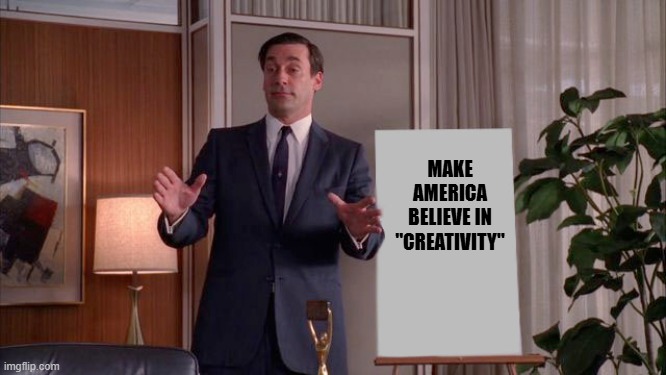
Don Draper is perhaps the perfect example of what creativity is all about.
That basic tension was between the social mass and the individual. Liberal democracy cast itself as liberating each person to pursue their own best life, as against the totalitarian systems of fascism and communism. Yet workers in America, whether in factories or offices, were an infinitesimal part of a much larger system they did not understand or control. In a strategic sense, American leaders did not know how to identify, support, and deploy talent to beat the Russians. And for the final social contradiction, if the victory of democracy required acts of supreme genius, where did that leave most people who were decidedly not geniuses.
The structure of the book alternates the between the empiricists and the practitioners. Taking the empiricists first, the book begins with J.P. Guilford and the Institute for Personality Assessment and Research at UC Berkeley, where a group of psychologists had gathered esteemed artists, scientists, and architects as research subjects to try and distill something that could be measured as creativity distinct from intelligence. This research grew out of pre-war psychometrics and the complex that had grown up around the IQ test, and could be reasonably described as effort to square the circle of psychology as a discipline which had become oriented towards behavioral experiments in research, and one which was asked to solve human problems in practice. IPAR's work was a mirror, one which showed that the most creative people were white males closer to middle age than adolescence, who were technically minded professionals with an amateur interest in abstract art and jazz.
The psychological story then moves to Abraham Maslow, and the idea that creativity was key to self-actualization and the highest goals of human life. Though what I did not realize is that Maslow was a decided sexist, and regarded intellectual creativity as a solely male province--women would have to be satisfied with merely having children. The final psychologist examined is Ellis Torrance, who set out to find creativity in children and recast rebellion against school as a good sign, rather than a bad one.
The practitioners cover from Alexander Osborn the father of brainstorming, a freeflowing analogical system called Synectics, which came out of the United Shoe Machinery Corporation, and finally the rebirth of Madison Avenue advertising agencies (including Draper Daniels, one of the real life inspirations for Don Draper), and how creativity was used to provide intellectual heft to bolder and much more expensive advertising campaigns.
The book closes with an intellectual confrontation with Richard Florida, and the orientation of modern work towards the "creative class". The idea that artists, work-for-hire designers, software developers, engineers, copywriters, and scientists are one unified thing with the generic spreadsheet jockey, and that they all work to express their soul rather than to increase shareholder value, is one of the load bearing ideologies of the past few decades.
I wish this review did more justice to the book. The Cult of Creativity is a fantastic intellectual history which delves into the contradictions of the past and shows that they are all necessary and productive. Further, creativity is not some fringe concept, it is a central organizing pillar of our current world. Franklin managed a masterpiece, a deeply thoughtful academic work which is also a joy to read.
A simple Google ngram shows 'creativity' as non-existent in usage in the early 20th century, gradually rising through the 1940s, and entering a sharp upwards curve in 1950 that plateaus in 2016. Statistics are the start, and as Franklin explains through comprehensive historical work, creativity was deliberately constructed and reified by an alliance of research psychologists, management consultants, and advertising men to resolve contradictions in early Cold War American society. And it worked.
Don Draper is perhaps the perfect example of what creativity is all about.
That basic tension was between the social mass and the individual. Liberal democracy cast itself as liberating each person to pursue their own best life, as against the totalitarian systems of fascism and communism. Yet workers in America, whether in factories or offices, were an infinitesimal part of a much larger system they did not understand or control. In a strategic sense, American leaders did not know how to identify, support, and deploy talent to beat the Russians. And for the final social contradiction, if the victory of democracy required acts of supreme genius, where did that leave most people who were decidedly not geniuses.
The structure of the book alternates the between the empiricists and the practitioners. Taking the empiricists first, the book begins with J.P. Guilford and the Institute for Personality Assessment and Research at UC Berkeley, where a group of psychologists had gathered esteemed artists, scientists, and architects as research subjects to try and distill something that could be measured as creativity distinct from intelligence. This research grew out of pre-war psychometrics and the complex that had grown up around the IQ test, and could be reasonably described as effort to square the circle of psychology as a discipline which had become oriented towards behavioral experiments in research, and one which was asked to solve human problems in practice. IPAR's work was a mirror, one which showed that the most creative people were white males closer to middle age than adolescence, who were technically minded professionals with an amateur interest in abstract art and jazz.
The psychological story then moves to Abraham Maslow, and the idea that creativity was key to self-actualization and the highest goals of human life. Though what I did not realize is that Maslow was a decided sexist, and regarded intellectual creativity as a solely male province--women would have to be satisfied with merely having children. The final psychologist examined is Ellis Torrance, who set out to find creativity in children and recast rebellion against school as a good sign, rather than a bad one.
The practitioners cover from Alexander Osborn the father of brainstorming, a freeflowing analogical system called Synectics, which came out of the United Shoe Machinery Corporation, and finally the rebirth of Madison Avenue advertising agencies (including Draper Daniels, one of the real life inspirations for Don Draper), and how creativity was used to provide intellectual heft to bolder and much more expensive advertising campaigns.
The book closes with an intellectual confrontation with Richard Florida, and the orientation of modern work towards the "creative class". The idea that artists, work-for-hire designers, software developers, engineers, copywriters, and scientists are one unified thing with the generic spreadsheet jockey, and that they all work to express their soul rather than to increase shareholder value, is one of the load bearing ideologies of the past few decades.
I wish this review did more justice to the book. The Cult of Creativity is a fantastic intellectual history which delves into the contradictions of the past and shows that they are all necessary and productive. Further, creativity is not some fringe concept, it is a central organizing pillar of our current world. Franklin managed a masterpiece, a deeply thoughtful academic work which is also a joy to read.

Lavinia is a story about grief, fate, the succession of generations, and the voices that linger. The "real" Lavinia is an object of Virgil's Aeneid, the daughter of the king Latinus who's betrothal to Aeneas rather the neighboring Turnus is the spark that ignites the bloody war of the second half of the Aeneid. In Virgil's account, Lavinia gets one stanza of description and zero lines of dialog. Le Guin expands this character to a worthy protagonist in her own right.
The story follows Lavinia from her beginning to end--not death, for her existence is too contingent to grant her life, and so without life she is without death. Very roughly, the first third is her childhood, a growing up a wild and free princess in the peaceful realm of her father Latinus. The only real discord in the kingdom is between Latinus and Lavinia's mother Amata, who has become maddened and embittered by grief after Lavinia's two brothers died of a childhood fever. As a maiden, Lavinia learns the rites and rituals of her station. She does not want to marry, ever.
But the fate of a princess is betrothal, and Turnus, handsome, strong, wealthy, reckless, greedy, is her most likely suitor and one she attempts to avoid. At a sacred spring, Lavinia encounters the shade of a dying poet centuries hence, and learns that she is part of a poem, and her husband is coming soon. In one rather riveting sequence, the poet describes the way to come in the matter of fact tone of death in the epics: who is speared, who has their throat cut, who has their skull shattered by a rock, who eats dirt with a bloody mouth.
And then Aeneas arrives, and all proceeds as foreseen. Turnus leads the local tribes in a hasty alliance against the Trojans that the old King Latinus is unable to stop. Mars, leaping Mars, Mars Mavors macte esto, takes all the men, and the slaughter becomes its own justification. Lavinia tends the wounded, and learns what the "glory" of war means.
And in the last third, Lavinia finds that peace is a process more than a state. She has three happy years and a son with Aeneas, and then her Trojan dies to a random spear thrown by a bandit at a ford. The fortunes of the kingdom wax and wane under Aeneas's older son Ascanius, and there is finally closure, and a sense that one days these little villages of Latium will become a great empire.
In many ways, Iron Age Italy is just as fantastic as Earthsea or Gethen, and Le Guin has a talent for the rock solidity of the lived experience of Lavinia and her peers, close to the earth and the trees and their cattle. The great powers of the land, the named gods like Vesta, Ceres, Venus, and Mars, and the domestic gods of the Lares and Penates, have an absolute reality in their assurance. Their oracles are unavoidable, fates perfectly bound and cut, even as mortals struggle and grieve. The family relationships that Lavinia has, and the way that rulership is the family writ large, makes the politics and emotions of this distant world come alive.
In the postscript, Le Guin decries that with the loss of the classical education focus on Latin and Greek, the Aeneid is no longer read as it should be. My own education definitely covered the Odyssey (I have Fagles' translation from 9th grade) and the Illiad, but I'm only vaguely familiar with Virgil's work. The question now is which translation. Nicolas Whyte makes a solid case for the classis Dryden over Fagles or Heaney, but apparently Fitzgerald's translation is considered the modern standard. Choices, choices!
The story follows Lavinia from her beginning to end--not death, for her existence is too contingent to grant her life, and so without life she is without death. Very roughly, the first third is her childhood, a growing up a wild and free princess in the peaceful realm of her father Latinus. The only real discord in the kingdom is between Latinus and Lavinia's mother Amata, who has become maddened and embittered by grief after Lavinia's two brothers died of a childhood fever. As a maiden, Lavinia learns the rites and rituals of her station. She does not want to marry, ever.
But the fate of a princess is betrothal, and Turnus, handsome, strong, wealthy, reckless, greedy, is her most likely suitor and one she attempts to avoid. At a sacred spring, Lavinia encounters the shade of a dying poet centuries hence, and learns that she is part of a poem, and her husband is coming soon. In one rather riveting sequence, the poet describes the way to come in the matter of fact tone of death in the epics: who is speared, who has their throat cut, who has their skull shattered by a rock, who eats dirt with a bloody mouth.
And then Aeneas arrives, and all proceeds as foreseen. Turnus leads the local tribes in a hasty alliance against the Trojans that the old King Latinus is unable to stop. Mars, leaping Mars, Mars Mavors macte esto, takes all the men, and the slaughter becomes its own justification. Lavinia tends the wounded, and learns what the "glory" of war means.
And in the last third, Lavinia finds that peace is a process more than a state. She has three happy years and a son with Aeneas, and then her Trojan dies to a random spear thrown by a bandit at a ford. The fortunes of the kingdom wax and wane under Aeneas's older son Ascanius, and there is finally closure, and a sense that one days these little villages of Latium will become a great empire.
In many ways, Iron Age Italy is just as fantastic as Earthsea or Gethen, and Le Guin has a talent for the rock solidity of the lived experience of Lavinia and her peers, close to the earth and the trees and their cattle. The great powers of the land, the named gods like Vesta, Ceres, Venus, and Mars, and the domestic gods of the Lares and Penates, have an absolute reality in their assurance. Their oracles are unavoidable, fates perfectly bound and cut, even as mortals struggle and grieve. The family relationships that Lavinia has, and the way that rulership is the family writ large, makes the politics and emotions of this distant world come alive.
In the postscript, Le Guin decries that with the loss of the classical education focus on Latin and Greek, the Aeneid is no longer read as it should be. My own education definitely covered the Odyssey (I have Fagles' translation from 9th grade) and the Illiad, but I'm only vaguely familiar with Virgil's work. The question now is which translation. Nicolas Whyte makes a solid case for the classis Dryden over Fagles or Heaney, but apparently Fitzgerald's translation is considered the modern standard. Choices, choices!