Take a photo of a barcode or cover
2.05k reviews by:
mburnamfink


Emotions are tricky. We learn how to handle, or not handle, emotions in our childhood, but what if your parents are abusive, neglectful, or simply busy handling their own lives at key moments. This is the second book in Webb's Childhood Emotional Neglect framework, where Webb argues that a lot of the trouble that you experience right now is due to how you were raised, and that you can consciously shift this dynamic and find meaning in your own life.
A lot of this hits home, as someone with two very Type A, problem solving parents, who were not great at their own emotions. But I also wonder what the practical takeway is, aside from being more deliberative and drawing boundaries with bad parents who won't correct their behavior.
A lot of this hits home, as someone with two very Type A, problem solving parents, who were not great at their own emotions. But I also wonder what the practical takeway is, aside from being more deliberative and drawing boundaries with bad parents who won't correct their behavior.

Velocity Weapon is a mystery-box of scifi tropes that trades development for frequent cliffhangers.
Sanda Reeve is a Prime gunnery sergeant and starship pilot who wakes up from cold sleep, the only living being on Bero, an AI starship built by her Icarion enemies. She's informed that it has been 230 years since her ship was destroyed in battle, that the two sides mutually annihilated each other shortly thereafter, and that not only is she the only living being on the ship, she's the only living being within lightyears. The good news is that the ship she's on has an experimental slower-than-light drive, and if she and the ship can survive the 75 year flight to the nearest inhabited system, it might be alright.
Meanwhile, Biran Reeve, Sanda's younger brother, is just being inducted into the ranks of the Prime Keepers, the central pillar of interstellar human government. Keepers have chips with the schematics of FTL gates implanted into their heads. Biran watches his sister's fleet being ambushed and destroyed, and is then plunged into political intrigues as a junior Keeper.
And elsewhere in the galaxy, a freelance thief and her crew running a job against some drug smugglers finds not just the drugs they were after, but also a dead smuggler and a secret lab full of high technology.
After the first few chapters, I was excited to see how all of these plotlines intersect, especially the 230 year gap between Sanda and Biran. Buuuut, it's a MYSTERY BOX and the contents are LIES. Turns out, everyone is in more or less the same timeframe. Bero has been lying its computer core off, and it is a traumatized relativistic bombardment weapon that has not yet blown up the Prime gate. The war between Icarion and the Primes is ostensibly over gate access, but really over a deeper philosophical issue that the gates are not human tech, but were built from plans recovered from a SETI transmission, and could be leading human civilization into a disastrous strategic place. For all that, the Icarions barely show up at all, with a North Korea-level of non-diplomacy with our Prime POV characters. And of course the whole thing is being manipulated by a shadowy senior Keeper who is very much not what he seems.
O'Keefe is a solid prose stylist who knows how to link together three or four chapters. But the plot and setting is all seat-of-pants improvisation, and I can feel it.
Sanda Reeve is a Prime gunnery sergeant and starship pilot who wakes up from cold sleep, the only living being on Bero, an AI starship built by her Icarion enemies. She's informed that it has been 230 years since her ship was destroyed in battle, that the two sides mutually annihilated each other shortly thereafter, and that not only is she the only living being on the ship, she's the only living being within lightyears. The good news is that the ship she's on has an experimental slower-than-light drive, and if she and the ship can survive the 75 year flight to the nearest inhabited system, it might be alright.
Meanwhile, Biran Reeve, Sanda's younger brother, is just being inducted into the ranks of the Prime Keepers, the central pillar of interstellar human government. Keepers have chips with the schematics of FTL gates implanted into their heads. Biran watches his sister's fleet being ambushed and destroyed, and is then plunged into political intrigues as a junior Keeper.
And elsewhere in the galaxy, a freelance thief and her crew running a job against some drug smugglers finds not just the drugs they were after, but also a dead smuggler and a secret lab full of high technology.
After the first few chapters, I was excited to see how all of these plotlines intersect, especially the 230 year gap between Sanda and Biran. Buuuut, it's a MYSTERY BOX and the contents are LIES. Turns out, everyone is in more or less the same timeframe. Bero has been lying its computer core off, and it is a traumatized relativistic bombardment weapon that has not yet blown up the Prime gate. The war between Icarion and the Primes is ostensibly over gate access, but really over a deeper philosophical issue that the gates are not human tech, but were built from plans recovered from a SETI transmission, and could be leading human civilization into a disastrous strategic place. For all that, the Icarions barely show up at all, with a North Korea-level of non-diplomacy with our Prime POV characters. And of course the whole thing is being manipulated by a shadowy senior Keeper who is very much not what he seems.
O'Keefe is a solid prose stylist who knows how to link together three or four chapters. But the plot and setting is all seat-of-pants improvisation, and I can feel it.

Useless psychological pablum from someone who has never really been an outsider.

For pufferfish, motherly love means slathering babies in deadly toxins
Let me give you the straight dope, courtesy of Chairman Bruce.
“Forget trying to pass for normal. Follow your geekdom. Embrace nerditude. In the immortal words of Lafcadio Hearn, a geek of incredible obscurity whose work is still in print after a hundred years, “Woo the muse of the odd.”
You may be a geek. You may have geek written all over you. You should aim to be one geek they'll never forget. Don't aim to be civilized. Don’t hope that straight people will keep you on as some sort of pet. To hell with them.
You should fully realize what society has made of you and take a terrible revenge. Get weird. Get way weird. Get dangerously weird. Get sophisticatedly, thoroughly weird, and don't do it halfway. Put every ounce of horsepower you have behind it.
Don't become a well-rounded person. Well-rounded people are smooth and dull. Become a thoroughly spiky person. Grow spikes from every angle. Stick in their throats like a pufferfish.”
For pufferfish, motherly love means slathering babies in deadly toxins
Let me give you the straight dope, courtesy of Chairman Bruce.
“Forget trying to pass for normal. Follow your geekdom. Embrace nerditude. In the immortal words of Lafcadio Hearn, a geek of incredible obscurity whose work is still in print after a hundred years, “Woo the muse of the odd.”
You may be a geek. You may have geek written all over you. You should aim to be one geek they'll never forget. Don't aim to be civilized. Don’t hope that straight people will keep you on as some sort of pet. To hell with them.
You should fully realize what society has made of you and take a terrible revenge. Get weird. Get way weird. Get dangerously weird. Get sophisticatedly, thoroughly weird, and don't do it halfway. Put every ounce of horsepower you have behind it.
Don't become a well-rounded person. Well-rounded people are smooth and dull. Become a thoroughly spiky person. Grow spikes from every angle. Stick in their throats like a pufferfish.”

As can be expected, Leckie delivers another wonderful space opera where the political and personal collide. A few years after the events of Ancillary Mercy, the issue facing humanish space is an update of the Treaty between the Radchaii Empire (divided and at war with itself under the immortal multiple Empress Anaander Mianaai) and the impossibly powerful and alien Presgr over the status of the AI cores which run Radchaii ships and stations.
Into this tinderbox are thrown the lives of three intersection people. Enae is on a make-work mission to look for a fugitive Presgr Translator. Reet is a orphan, going about his isolated life on a distant station. and Qven is an adolescent Translator, aiming towards the mysteries of adulthood and match, growing up in a creche where getting vivisected and eaten by the other children is just one of the hazards.
Reet gets drawn into ethnic political intrigues, Qven develops doubts about her future and attempts to flee, and most unexpectedly of all, Enae completes her mission, determining that Reet is a descendent of the missing Translator. All three plotlines converge at the Treaty Conclave, where the issue of where Reet and Qven belong, and if they are human or Translator, gets tossed like a ball between all the political agenda.
As always, words and worldbuilding are great. Non-Radch characters are a lot of fun, given that the Radchaii are repressed imperialists ruled by a schizophrenic Empress who never experience an emotion stronger than 'more tea', and while revealing more about Presgr Translators removes some mystery from the world, it is wonderfully weird. The plotting, however, is a little slapdash, and in particular Enae and Reet's encounter and Qven's motivation for escape feel like arbitrary gambits to keep the story on course, rather than natural evolutions of circumstance.
Into this tinderbox are thrown the lives of three intersection people. Enae is on a make-work mission to look for a fugitive Presgr Translator. Reet is a orphan, going about his isolated life on a distant station. and Qven is an adolescent Translator, aiming towards the mysteries of adulthood and match, growing up in a creche where getting vivisected and eaten by the other children is just one of the hazards.
Reet gets drawn into ethnic political intrigues, Qven develops doubts about her future and attempts to flee, and most unexpectedly of all, Enae completes her mission, determining that Reet is a descendent of the missing Translator. All three plotlines converge at the Treaty Conclave, where the issue of where Reet and Qven belong, and if they are human or Translator, gets tossed like a ball between all the political agenda.
As always, words and worldbuilding are great. Non-Radch characters are a lot of fun, given that the Radchaii are repressed imperialists ruled by a schizophrenic Empress who never experience an emotion stronger than 'more tea', and while revealing more about Presgr Translators removes some mystery from the world, it is wonderfully weird. The plotting, however, is a little slapdash, and in particular Enae and Reet's encounter and Qven's motivation for escape feel like arbitrary gambits to keep the story on course, rather than natural evolutions of circumstance.

Language delays are frustrating. My guy understands a lot, but when events move out the patterns he is used to, there's often a meltdown, and it's hard for him to express his desires and feelings, let along engage in imaginative play. He has some words, but doesn't much like combining them.
The Kanen method is built around a trio of key concepts. First is a 4-stage development trajectory, from Discoverer (very small children), Communicator (uses expressions, signs, and noises), First Words, and Combiners, each with their own developmental goals. Second are two acronyms, OWL and SPARK.
Owl is Observe, Wait, Listen. Get down to at your child's level and face-to-face, and really attentively follow what they are doing and saying. SPARK is a method to routine interactions. Start the same way, Plan your child's turn, Adjust the routine so you child can take his turn, Repeat exactly each time, and Keep the end the same. Turn taking and repetition is the basis of learning communication.
It's a firm basis, and wonderfully illustrated, but the book has little to say about children with Autism Spectrum Disorders and/or ADHD, who are likely a significant fraction of children with speech delays. And at $50, it's pricy for what it is (nothing is too much to help with my son, but man... I was hoping for something more extensive.)
The Kanen method is built around a trio of key concepts. First is a 4-stage development trajectory, from Discoverer (very small children), Communicator (uses expressions, signs, and noises), First Words, and Combiners, each with their own developmental goals. Second are two acronyms, OWL and SPARK.
Owl is Observe, Wait, Listen. Get down to at your child's level and face-to-face, and really attentively follow what they are doing and saying. SPARK is a method to routine interactions. Start the same way, Plan your child's turn, Adjust the routine so you child can take his turn, Repeat exactly each time, and Keep the end the same. Turn taking and repetition is the basis of learning communication.
It's a firm basis, and wonderfully illustrated, but the book has little to say about children with Autism Spectrum Disorders and/or ADHD, who are likely a significant fraction of children with speech delays. And at $50, it's pricy for what it is (nothing is too much to help with my son, but man... I was hoping for something more extensive.)

Lowndes is writing a more contemporary update of Dale Carnegie's classic How to Win Friends and Influence People , with more contemporary being a relative term since this book is very 1990s, full of travel agents and desk phones and with nary a mention of that new-fangled internet thing, which is probably just for hopeless geeks.
While a lot of other reviews have criticized this book for being insincere, I disagree. While there are 92 tricks, they fall into three big categories. The first is that everyone appreciates sustained attention, which you can signal that you are giving through sustained eye contact, slow and large smiles, and noticing and recalling little details about a person. Give people a chance to shine, and they'll like you.
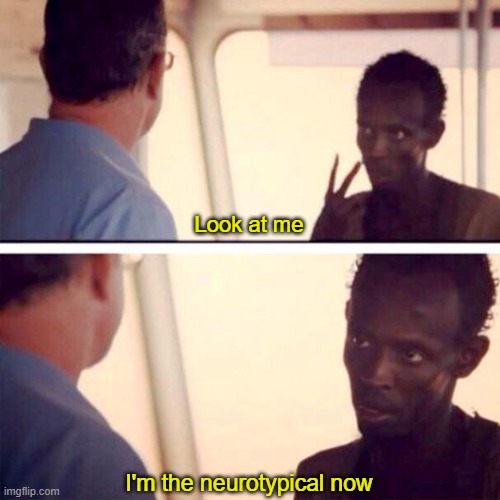
Although I worry I'm coming across more like this
The second category is to be considerate of people's time and emotions. Make sure that this is actually a good time to talk and sympathize with people's difficulties. One "oh duh" moment is that if you need someone to do something for you, let them empty their mind of complaints and problems first, and frame your offer as a solution to a problem they have.
The third category is how to act high-status. According to Lowndes, Big Cats are assured and confident; little pusses are hurried and worried. Don't put others down, ever. Don't jump to business before the end of a meal. Wait a decent interval before calling in a favor, and leave it unspoken that this is a tit-for-tat favor. Remember celebrities are people too so don't over-intrude, and be appreciative of recent work. And if someone abuses your trust, don't call it out, just never give them a second chance.
I really should go back and do a more systematic summary.
While a lot of other reviews have criticized this book for being insincere, I disagree. While there are 92 tricks, they fall into three big categories. The first is that everyone appreciates sustained attention, which you can signal that you are giving through sustained eye contact, slow and large smiles, and noticing and recalling little details about a person. Give people a chance to shine, and they'll like you.
Although I worry I'm coming across more like this
The second category is to be considerate of people's time and emotions. Make sure that this is actually a good time to talk and sympathize with people's difficulties. One "oh duh" moment is that if you need someone to do something for you, let them empty their mind of complaints and problems first, and frame your offer as a solution to a problem they have.
The third category is how to act high-status. According to Lowndes, Big Cats are assured and confident; little pusses are hurried and worried. Don't put others down, ever. Don't jump to business before the end of a meal. Wait a decent interval before calling in a favor, and leave it unspoken that this is a tit-for-tat favor. Remember celebrities are people too so don't over-intrude, and be appreciative of recent work. And if someone abuses your trust, don't call it out, just never give them a second chance.
I really should go back and do a more systematic summary.

challenging
dark
tense
medium-paced
Plot or Character Driven:
Plot
Strong character development:
Yes
Loveable characters:
No
Diverse cast of characters:
Yes
Flaws of characters a main focus:
Yes
You are a philosopher, asking abstract questions about the nature of Reality, and Good, and the relationship between cause and effect all the way back to Aristotle's Prime Mover, that which created the universe we live in.
You are standing at a switch next to train tracks with a unstoppable trolley barreling down towards you. Five people are tied down in the path of the trolley. You can pull a lever to save their lives at the cost of one person tied to the other track. Now it's your father and your brother and your place in the world on the alternative track. Did your answer change? Now the trolley is coming at the 8 billion people on Earth, all the humans who ever lived and ever will. Did your answer change?
You are a turtle basking in the sun on a rock in Central Park. An alien with eight adder-like heads picks you up with a pair of its eight elegant white-gloved hands, effortlessly cracks your ribs from your back shell and scoops out the bloody meat inside. You are delicious. You are dead.
You are standing at a switch next to train tracks with a unstoppable trolley barreling down towards you. Five people are tied down in the path of the trolley. You can pull a lever to save their lives at the cost of one person tied to the other track. Now it's your father and your brother and your place in the world on the alternative track. Did your answer change? Now the trolley is coming at the 8 billion people on Earth, all the humans who ever lived and ever will. Did your answer change?
You are a turtle basking in the sun on a rock in Central Park. An alien with eight adder-like heads picks you up with a pair of its eight elegant white-gloved hands, effortlessly cracks your ribs from your back shell and scoops out the bloody meat inside. You are delicious. You are dead.
We begin with Anna in New York in 2013, when she meets Ssrin, an alien eating turtles in the park. Anna is a 30-something Kurdish war orphan, a tough woman who doesn't fit into America and can't ever go home because she pulled that trolley problem lever when she was 7, shooting her father and brother and four other villagers in the head at the behest of a sadistic Baathist officer to save the rest of the village. Ssrin drops a bunch of truth bombs on Anna: Anna is special, her horrific past has bound the two of them together on a quest to save the universe. The quest matters because narrative has a privileged place in the universe. Souls are real, the afterlife is real, good and evil are objective truths.
Ssrin is a renegade from the Exordia, an empire which has used their mastery of technology and magic to pinion all significant species into a narrative framework in which successful rebellion is impossible. While humans are not significant (inbred apes who are decent persistent hunters and like to watch each other have sex), a powerful narrative is written on all our human souls, offering a way to break the Exordia. Ssrin is being hunted by Iruvage, a cop from her species, who's own version of the quest offers a chance for salvation for Ssrin and Iruvage and their entire species of khai, because uniquely among the galaxy's sentients, the khai are damned to hell from birth.
And then the situation goes off the rails entirely. Anna and Ssrin conjure from some hidden dimension a jetliner-sized starship, codenamed Blackbird, in the remote valley in Kurdistan that Anna hails from. Three days later, an Exordia cruiser arrives in-system and announces its presence with actual bombs, a grid of high-altitude nuclear detonations, causing a civilization destroying EMP. The shadowy intelligence apparatus of the US government activates its contingency plan, MAJESTIC, a first-contact effort lead by Deputy National Security Advisor Clayton Navarro Hunt, with its military XCOM contingent of special forces operators lead by Major Erik Wygaunt.
Clayton and Erik have a History with a capital H. They went to school together, they're in love with the same woman, Rosamaria, though Clayton was the one who married her, and they ran a blacker-than-black assassination program called Paladin. Erik used Paladin to bring to justice criminals who operated in the legal gaps of the war on terror: US military contractors who committed severe human rights abuses. Clayton took a bigger view, that there were bad people making the world worse, and utilitarian calculus required their deaths to bring about a better future. The two disagreed, they went to Rosamaria, she told them to go to hell for doing this and confessing it to her. Both men have a very clear idea of what the right thing to do is and an overriding need to convince the other before they die, most likely at each other's hands. Erik knows for certain that Clayton is itching for a pretext to sell out anyone and everything in the name of some nebulous greater good and his own power. Clayton is convinced that Erik's rigid deontology will doom them all, and that standing up for an illusion of justice is pointless if it everyone saved dies tomorrow anyway. Oh, and Clayton is working for Iruvage, in the same way that Anna is working for Ssrin.
If you've read The Traitor Baru Cormorant (why haven't you read Traitor?), you know the kind of tension that Dickinson is able to produce. So believe me when I say that everything I've covered in this review is merely the first 20% of the book, and it is as tense as the last 20% of Traitor. I read the whole novel in one compulsive gulp of a day, stopping only to swear under my breath and take a long walk in the sunshine to remind myself that it's just science-fiction.
The narrative does slacken slightly as the protagonists arrive at Blackbird to find the remains of the previous teams of investigators from Russia, China, Iran, and Uganda. The technothriller tropes of contamination suits, scientific investigation, gun-toting bad-asses, and quarantine by flame and bullet are entirely inadequate against an Outside Context Problem who's very existence is incompatible with the narrow range of environmental and ontological circumstances that allow humans to live. People die by the score, killed by each other, by the ways that Blackbird warps flesh and soul, and by Iruvage's willingness to expend human beings like we expend laboratory mice to achieve his agenda.
This book fires on all cylinders, with compelling characters, a provocative central conceit, thoughtful examination of the consequences of (American) imperial power, a propulsive plot, and crackling writing. I have to give particular kudos to the alienness of khai psychology and the nature of Blackbird's power and danger. Both of these things are very much not human, but this is no empty mystery box, and the book reveals clear reasons for why they are like they are, and why it matters.
Holy. Fucking. Shit.
This was incredible.
Seth, are you okay?
Cause I'm not sure I am.

Man's Search for Meaning is an account of an ending and a beginning. The ending is Frankl's survival of the Holocaust, a multiyear journey through the starkest horror of humanity. The beginning is a primer on logotherapy, Frankl's theoretical orientation that life is only worth living when imbued with meaning.
The first part asks and answers the question how anyone survived the camps (and indeed, 25 of any 26 people who walked through those gates did not). Among those who were not immediately chosen for death, those who still had bodies capable of work, or valuable skills there were still innumerable ways to die: disease, hunger, exhaustion, Nazis. Frankl's observation is that whatever the bodily cause, the penultimate cause was psychological collapse, an inability to keep going. Camp inmates would smoke their last cigarette and invariably die within 48 hours. What kept Frankl going was his love for his wife (she died in Auschwitz), and a desire to preserve his life's work for after the war (this manuscript).
Pragmatically, for those of us who merely live in late capitalism rather than the Holocaust, meaning still matters. The idea that life is meaningless and absurd* is a common cause and symptom of many mental illnesses. Frankl's gloss is that meaning can be found in achievement, in love, and in suffering. A proper orientation makes any pain bearable. Love is love, enough said, and while achievement is always conditional, it can provide structure.
Somewhat oddly, I've avoided a lot of classic Shoah literature. This might be the first book I've read in the genre. And while I don't have the moral authority to gainsay any survivor, there is an element of saintly self-delusion to Frankl's story. How could anything have been worth that?
*my favorite Pagliacci joke.
Man goes to doctor, says he is very depressed. Life is meaningless and absurd.
Doctor says, "Cure is easy. Famous clown Pagliacci is in town. He sucks shit! Compared to him, everyone is doing great."
Man says "But doctor..."
Doctor interrupts "I know who you are."
The first part asks and answers the question how anyone survived the camps (and indeed, 25 of any 26 people who walked through those gates did not). Among those who were not immediately chosen for death, those who still had bodies capable of work, or valuable skills there were still innumerable ways to die: disease, hunger, exhaustion, Nazis. Frankl's observation is that whatever the bodily cause, the penultimate cause was psychological collapse, an inability to keep going. Camp inmates would smoke their last cigarette and invariably die within 48 hours. What kept Frankl going was his love for his wife (she died in Auschwitz), and a desire to preserve his life's work for after the war (this manuscript).
Pragmatically, for those of us who merely live in late capitalism rather than the Holocaust, meaning still matters. The idea that life is meaningless and absurd* is a common cause and symptom of many mental illnesses. Frankl's gloss is that meaning can be found in achievement, in love, and in suffering. A proper orientation makes any pain bearable. Love is love, enough said, and while achievement is always conditional, it can provide structure.
Somewhat oddly, I've avoided a lot of classic Shoah literature. This might be the first book I've read in the genre. And while I don't have the moral authority to gainsay any survivor, there is an element of saintly self-delusion to Frankl's story. How could anything have been worth that?
*my favorite Pagliacci joke.
Man goes to doctor, says he is very depressed. Life is meaningless and absurd.
Doctor says, "Cure is easy. Famous clown Pagliacci is in town. He sucks shit! Compared to him, everyone is doing great."
Man says "But doctor..."
Doctor interrupts "I know who you are."

Dr. Kelly Weinersmith is an actual scientist, albeit a parasite biologist rather than a space specialist. And Zach Weinersmith is the artist behind Saturday Morning Breakfast Cereal, a nerd webcomic that I've reading for almost two decades now.
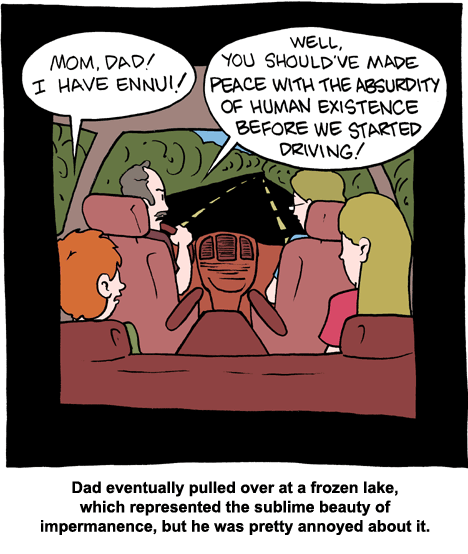
"Dad, I have ennui"
Space colonization has been a perennial topic of science fiction practically since there was science fiction, and a more or less serious policy proposal since the 1950s. With SpaceX and the dramatic reduction in the costs of reaching orbit, as well as it's CEO Elon Musk's well known desire to settle Mars, space colonization has gotten a second kick. So is it a good idea? The Weinersmiths went in as optimists, and came out with a "nah".
There are four main barriers to space settlement, two biological, one legal, one economic. As much progress has been made on rocketry, space medicine is still profoundly in its infancy. The longest single stay in space is 487 days. The longest total stay is 886 days (and counting, record holder Oleg Kononenko is still in orbit as of this review). We know that astronauts suffer many health effects, including bones density loss and mysterious changes in eyeball shape. We also know that even inside Earth's protective magnetosphere, astronauts are constantly irradiated, with a likely elevated risk of cancer. We have no idea if babies can be born in space, or if human beings can reach maturity without gravity. Answering these questions is not a priority for any space agency, and there are clear ethical issues for experimentation.
Second, we still don't know how to run a closed-cycle biosphere. The infamous Biosphere 2 experiment was a failure, and nothing has come close to its scale. A space settlement needs near total recycling of water, oxygen, nitrogen, carbon, and a host of other key elements. We know even less about living in close proximity to lunar dust, an abrasive that could likely cause silicosis and which one astronaut was allergic, or on Mars, where the soil is about 1% poisonous perchlorates.
Third, the legal environment is incredible hostile to the idea of space colonization. The Outer Space treaty is a vague framework, but one thing it is clear on is that national claims of a solar system body are illegal. A nation can claim a specific facility, but not the lunar land it is built on. And forget private efforts, because a station staffed with Americans, launched from a US facility, and commanded by an American CEO, would be under American jurisdiction, and pragmatically you are unlikely to find anyone to argue otherwise.
Finally, it would be immensely difficult to see any return from space colonization, given the distances, time, and expense involved. While the colonies of the age of imperialism were often money-losers for their governments, they were immensely profitable for many people involved. But who would accept life in an absolute company town where the boss controls everything down to the air? And who would fund a venture where getting anything there and back costs millions of dollars?
One of the better arguments for space colonization is the security of multiplanetary species, an argument which the Weinersmith's demolish. Any space colony would be highly dependent on Earth for decades, if not centuries. And while there is lots of room on the moon and Mars, there are far fewer reasonable options for settlement. Space colonies hardly aid national security if we're shooting each other over the very finite amounts of lunar ice. And while dinosaur killing asteroids are a risk, given human nature, space terrorists are going to crop up far sooner than another mega impact.

Marcos Inaros from The Expanse
"Every time we demand to be heard, they hold back our water, owkwa beltalowda, ration our air, ereluf beltalowda, until we crawl back into our holes, imbobo beltalowda, and do as we are told!
Another argument is a version of Turner's frontier thesis, that the harshness of space will inspire innovations both scientific and technological. The Weinersmiths offer an analogy to Earth biosphere, the Necrosphere, an immense expanse of vacuum surrounding a small hab, with very finite resources, more accessible with only the greatest difficult, and the whole thing bombarded with ionizing radiation. Would we expect advances from the inhabitants, or would we expect them to die?
Like the Weinersmiths, I've long been an idealistic if uncommitted proponent of space colonization. And after reading this book, I'm convinced that it's a scam. The outer solar system is best left to robots. And while we should continue to push space science, including closed cycle ecosystems, colonization is a matter of centuries, not decades.
"Dad, I have ennui"
Space colonization has been a perennial topic of science fiction practically since there was science fiction, and a more or less serious policy proposal since the 1950s. With SpaceX and the dramatic reduction in the costs of reaching orbit, as well as it's CEO Elon Musk's well known desire to settle Mars, space colonization has gotten a second kick. So is it a good idea? The Weinersmiths went in as optimists, and came out with a "nah".
There are four main barriers to space settlement, two biological, one legal, one economic. As much progress has been made on rocketry, space medicine is still profoundly in its infancy. The longest single stay in space is 487 days. The longest total stay is 886 days (and counting, record holder Oleg Kononenko is still in orbit as of this review). We know that astronauts suffer many health effects, including bones density loss and mysterious changes in eyeball shape. We also know that even inside Earth's protective magnetosphere, astronauts are constantly irradiated, with a likely elevated risk of cancer. We have no idea if babies can be born in space, or if human beings can reach maturity without gravity. Answering these questions is not a priority for any space agency, and there are clear ethical issues for experimentation.
Second, we still don't know how to run a closed-cycle biosphere. The infamous Biosphere 2 experiment was a failure, and nothing has come close to its scale. A space settlement needs near total recycling of water, oxygen, nitrogen, carbon, and a host of other key elements. We know even less about living in close proximity to lunar dust, an abrasive that could likely cause silicosis and which one astronaut was allergic, or on Mars, where the soil is about 1% poisonous perchlorates.
Third, the legal environment is incredible hostile to the idea of space colonization. The Outer Space treaty is a vague framework, but one thing it is clear on is that national claims of a solar system body are illegal. A nation can claim a specific facility, but not the lunar land it is built on. And forget private efforts, because a station staffed with Americans, launched from a US facility, and commanded by an American CEO, would be under American jurisdiction, and pragmatically you are unlikely to find anyone to argue otherwise.
Finally, it would be immensely difficult to see any return from space colonization, given the distances, time, and expense involved. While the colonies of the age of imperialism were often money-losers for their governments, they were immensely profitable for many people involved. But who would accept life in an absolute company town where the boss controls everything down to the air? And who would fund a venture where getting anything there and back costs millions of dollars?
One of the better arguments for space colonization is the security of multiplanetary species, an argument which the Weinersmith's demolish. Any space colony would be highly dependent on Earth for decades, if not centuries. And while there is lots of room on the moon and Mars, there are far fewer reasonable options for settlement. Space colonies hardly aid national security if we're shooting each other over the very finite amounts of lunar ice. And while dinosaur killing asteroids are a risk, given human nature, space terrorists are going to crop up far sooner than another mega impact.
Marcos Inaros from The Expanse
"Every time we demand to be heard, they hold back our water, owkwa beltalowda, ration our air, ereluf beltalowda, until we crawl back into our holes, imbobo beltalowda, and do as we are told!
Another argument is a version of Turner's frontier thesis, that the harshness of space will inspire innovations both scientific and technological. The Weinersmiths offer an analogy to Earth biosphere, the Necrosphere, an immense expanse of vacuum surrounding a small hab, with very finite resources, more accessible with only the greatest difficult, and the whole thing bombarded with ionizing radiation. Would we expect advances from the inhabitants, or would we expect them to die?
Like the Weinersmiths, I've long been an idealistic if uncommitted proponent of space colonization. And after reading this book, I'm convinced that it's a scam. The outer solar system is best left to robots. And while we should continue to push space science, including closed cycle ecosystems, colonization is a matter of centuries, not decades.

I haven't actually read much, if any Stephen King, but with a long drive, I figured the audiobook of The Gunslinger was a good place to start.
And a hell of a start it was. "The man in black fled across the desert, and the gunslinger followed" is an all time banger of an opening. Roland, the titular gunslinger, is a wanderer in a world that has moved on, in the echoing apocalyptic phrase that describes his world. He was once a kind of knight in a feudal land of green hills and harsh justice. Now he chases the man in black, seeking vengeance for his destroyed home, and the secrets of the Dark Tower, a kind of nexuses of universes which might hold the secret to healing the world and redeeming the gunslinger.
So what works is the tone. King is a master of atmosphere, of evoking the strange, dry, dying world. The characters Roland encounters, from the farmer Brown, the dead people of the town of Tull, and the uncanny boy Jake, refugee from our New York, are stark and haunting.
The plot, the prophecy, the doom of Gilead, all of that stuff figures, but I also figure it doesn't really matter. Just hang out and enjoy the way the words land.
And a hell of a start it was. "The man in black fled across the desert, and the gunslinger followed" is an all time banger of an opening. Roland, the titular gunslinger, is a wanderer in a world that has moved on, in the echoing apocalyptic phrase that describes his world. He was once a kind of knight in a feudal land of green hills and harsh justice. Now he chases the man in black, seeking vengeance for his destroyed home, and the secrets of the Dark Tower, a kind of nexuses of universes which might hold the secret to healing the world and redeeming the gunslinger.
So what works is the tone. King is a master of atmosphere, of evoking the strange, dry, dying world. The characters Roland encounters, from the farmer Brown, the dead people of the town of Tull, and the uncanny boy Jake, refugee from our New York, are stark and haunting.
The plot, the prophecy, the doom of Gilead, all of that stuff figures, but I also figure it doesn't really matter. Just hang out and enjoy the way the words land.