You need to sign in or sign up before continuing.
Take a photo of a barcode or cover
2.05k reviews by:
mburnamfink


I picked this up based on an absolutely glowing review from Tamsyn Muir, and I'll just say that while there is a lot that worked in this book, there's also a lot that didn't.
So what worked? Yat Jyn-Hok is bad cop in a weird city. She used to be a roof-rat, scavenging and stealing to survive, and somehow wound up a cop, where she thinks that she can apply a smidgen of mercy to help people who used to be like her (that's the bad cop part). Yat is also a Bisexual Disaster (TM) in a homophobic culture, pining over a lost love, and addicted to a hallucinogenic drug. Her city, Hainak of walls and gardens, runs on biological alchemy, with fungal houses, living tissue grafts, and guns that shoot neurotoxic borer grubs. Hainak has a troubled past, with revolution, war, and the bones of an old world of steel and brick beneath the flesh of the new.
So there's a really great low fantasy story there, with a morally ambiguous cop who stumbles onto a floating corpse and conspiracy bigger than she is, except that that's where the story abruptly shift into high fantasy, as Yat is shot in the head and brought back by the Trickster God Monkey. Along with a crew of similarly sorcerous pirates, she has to fight against other immortals and the mad Crane God and his cult. All of the delicious world-building and character work gets obliterated by yet another boring power fantasy.
So yeah, on a sentence to sentence level Stronach has a solid voice and clear talent, and he sets up something really cool, but I feel like this book is a gourmet meal that the waiter drops right as he gets to the table. And that promise betrayed is worse than a book that's clearly mediocre from the start.
So what worked? Yat Jyn-Hok is bad cop in a weird city. She used to be a roof-rat, scavenging and stealing to survive, and somehow wound up a cop, where she thinks that she can apply a smidgen of mercy to help people who used to be like her (that's the bad cop part). Yat is also a Bisexual Disaster (TM) in a homophobic culture, pining over a lost love, and addicted to a hallucinogenic drug. Her city, Hainak of walls and gardens, runs on biological alchemy, with fungal houses, living tissue grafts, and guns that shoot neurotoxic borer grubs. Hainak has a troubled past, with revolution, war, and the bones of an old world of steel and brick beneath the flesh of the new.
So there's a really great low fantasy story there, with a morally ambiguous cop who stumbles onto a floating corpse and conspiracy bigger than she is, except that that's where the story abruptly shift into high fantasy, as Yat is shot in the head and brought back by the Trickster God Monkey. Along with a crew of similarly sorcerous pirates, she has to fight against other immortals and the mad Crane God and his cult. All of the delicious world-building and character work gets obliterated by yet another boring power fantasy.
So yeah, on a sentence to sentence level Stronach has a solid voice and clear talent, and he sets up something really cool, but I feel like this book is a gourmet meal that the waiter drops right as he gets to the table. And that promise betrayed is worse than a book that's clearly mediocre from the start.

In reality, Isobel is an unemployed music publicist. But in VR, she's the Queen of the Sparkle Realm, all-time leaderboard champ of a series of dance-music themed action-RPGs. And then things get weird, as it turns out that Magic is Real, she's roped in as a junior researcher at a PR firm working with the creepy Governor of California and a legally-distinct-from-Scientology religious movement. But these earthly villains are obstacles before the Thundercloud, a multi-dimensional reality devouring monstrosity that only Isobel and her allies can stop.
Snow Crash runs through this book like a skeleton, and there's a lot of ways in which this is a kind of Gen-Z update of Stephenson's classic. Our real-life pauper/virtual hero protagonist, the idea that language can become a magic weapon, two shadowy cabals battling it our for the soul of California. The difference is that Battle goes cosmological in scope, hopping into alternate dimensions and across the universe chasing its quest, with the main character assuming literal godhood and cutting down skyscraper sized demons with her signature Blades Per Minute sword.
But the difference is that Snow Crash was built around a solid mythological/scientific core, and Battle runs entirely on vibes. And I gotta say, the vibes are real mid. The first time you cut down a gigantic horned reality eating demon, that's dope. Fifth time is a chore. The plot and characters just kind of float around, with vaguely anarchist politics that power is bad, mmkay, and those currently in power are least situated to wield it. The lack of limits erases any stakes, and the only part of the writing that's consistently enjoyable are the EDM-themed puns. Shame.
Snow Crash runs through this book like a skeleton, and there's a lot of ways in which this is a kind of Gen-Z update of Stephenson's classic. Our real-life pauper/virtual hero protagonist, the idea that language can become a magic weapon, two shadowy cabals battling it our for the soul of California. The difference is that Battle goes cosmological in scope, hopping into alternate dimensions and across the universe chasing its quest, with the main character assuming literal godhood and cutting down skyscraper sized demons with her signature Blades Per Minute sword.
But the difference is that Snow Crash was built around a solid mythological/scientific core, and Battle runs entirely on vibes. And I gotta say, the vibes are real mid. The first time you cut down a gigantic horned reality eating demon, that's dope. Fifth time is a chore. The plot and characters just kind of float around, with vaguely anarchist politics that power is bad, mmkay, and those currently in power are least situated to wield it. The lack of limits erases any stakes, and the only part of the writing that's consistently enjoyable are the EDM-themed puns. Shame.

The Tonkin Gulf Yacht Club is a somewhat scattered account of the role of naval air power in the Vietnam War. The book is at its best when it lets the pilots speak, telling the story of hair-raising dogfights, bombing runs, and rescue missions in their own words. However, these are a collection of highlights, and don't cover the day-to-day facts of life on a carrier, or the existence of beings less exalted than pilots.
The technical analysis is better than the historical analysis. The Navy went into Vietnam with a solid collection of planes, a large and diverse flight deck that was much better than the underpowered ensign killers available even a few years earlier. But decent planes were hampered by abysmal missiles: both the AIM-7 Sparrow and AIM-9 Sidewinder had hit rates of less than 10%, with a large percentage of missiles simply inoperative due to harsh combat conditions wholly unlike the test range. The F-4 lacked an internal gun, and the Colt Mk 12 cannons on the F-8 were prone to jamming after hard turns.
From a strategic perspective, air interdiction simply couldn't stop North Vietnamese operations into South Vietnam. But a bad objective was furthered hampered by the contradictory limits of the Rolling Thunder campaign, which placed airfields and SAM sites as off limits least an errant bomb further escalate the war. Sortie rates became the sole reason of the self-licking ice cream cone of the air war.
A second thread that is worthwhile is the cultural difference between the Navy and Air Force. Air Force pilots famously flew 100 combat sorties, while Navy pilots flew until their tours ended, which meant Navy pilots routinely lapped their Air Force comrades in mission counts. With very mixed results against MiGs in Rolling Thunder, the Navy embarked on a program to train a cadre of pilots skilled in air-to-air combat, not simply interception. Graduates of the Top Gun program were responsible for much more favorable kill rates against MiGs in Linebacker, though skill couldn't help against the random chance of AAA fire, or the limits of airpower in a political war.
The technical analysis is better than the historical analysis. The Navy went into Vietnam with a solid collection of planes, a large and diverse flight deck that was much better than the underpowered ensign killers available even a few years earlier. But decent planes were hampered by abysmal missiles: both the AIM-7 Sparrow and AIM-9 Sidewinder had hit rates of less than 10%, with a large percentage of missiles simply inoperative due to harsh combat conditions wholly unlike the test range. The F-4 lacked an internal gun, and the Colt Mk 12 cannons on the F-8 were prone to jamming after hard turns.
From a strategic perspective, air interdiction simply couldn't stop North Vietnamese operations into South Vietnam. But a bad objective was furthered hampered by the contradictory limits of the Rolling Thunder campaign, which placed airfields and SAM sites as off limits least an errant bomb further escalate the war. Sortie rates became the sole reason of the self-licking ice cream cone of the air war.
A second thread that is worthwhile is the cultural difference between the Navy and Air Force. Air Force pilots famously flew 100 combat sorties, while Navy pilots flew until their tours ended, which meant Navy pilots routinely lapped their Air Force comrades in mission counts. With very mixed results against MiGs in Rolling Thunder, the Navy embarked on a program to train a cadre of pilots skilled in air-to-air combat, not simply interception. Graduates of the Top Gun program were responsible for much more favorable kill rates against MiGs in Linebacker, though skill couldn't help against the random chance of AAA fire, or the limits of airpower in a political war.

The Quiet Americans is a fascinating look at the early Cold War through a close study of the careers of four CIA agents from 1944 to the 1956 Hungarian Revolt. The close study is used to examine the bigger picture, of how American foreign policy and the cause of anti-Communism became a bloody lie over a host of atrocities.
The subjects of the book; Frank Wisner, Peter Sichel, Edward Landsdale, and Michael Burke all wound up in the Office of Strategic Services in the Second World War, running the American side of the intelligence and sabotage efforts against the Axis powers. After victory, the OSS was disbanded and dramatically reduced in scope. Wisner and Sichel remained in occupied Europe, witnesses to the fall of what Churchill would soon term the Iron Curtain, as the Soviets disappeared political enemies and looted and pillaged their subjects. Their warnings, that while Stalin's USSR was a necessary wartime ally, it was no partner in peace, went mostly unheard for a few vital years.
But when the Truman administration realized that Something Had to be Done, something was done with a vengeance. Wisner became head of the Office of Policy Coordination, the anodyne title concealing a blacker-than-black agency with responsibility for unconventional warfare worldwide, and with a confused chain of command that left him accountable solely to himself. The OPC embarked on a variety of projects, two of which would fall under characteristic original sins. The first was a taste for covert commando teams, modeled on the Jedburghs of World War 2, which would parachute agents recruited from the mass of refugees across Europe into communist countries to collect intelligence and foment revolution. Hundreds if not thousands of agents were recruited and trained, and all of them were almost immediately captured by Communist security forces and either doubled or executed. Net intelligence effect was zero.
The second issue was that a lot of the committed anti-Communists floating around Europe in the late 1940s were also committed Nazis who had participated in the Holocaust. Sichel was actually a Jewish refugee himself who wound up working with Nazis under a strict policy of "I don't care what you did during the war." Working with Nazis and war criminals provided a propaganda victory to the Soviets, and also seems to have minimal intelligence value, as most of these assets traded off of stale historical insights from the war, and were more concerned about avoiding accountability for their past than producing good intelligence.
As the Cold War ground on, Eisenhower became president and the Dulles brothers took preeminent roles, the CIA moved into new battlefields. The first was against an old internal enemy, J. Edgar Hoover, who believed that the nations intelligence apparatus should rightfully report to him, and his catspaw in the Red Scare, Senator McCarthy. Second was the nations of the third world. Coups in Iran and Guatemala demonstrated the effectiveness of covert action, while Landsdale's work in the Philippines and Vietnam provided a model for counter-insurgency psychological warfare. But this expansion of the battlefield came at the expense of blowback, the coups showing that America was more a friend to multinational capitalism than democracy, with temporary gains leading to decades-long strategic setbacks for American values worldwide.
Events came to a head in 1956 with the Hungarian Revolt. The CIA had neither predicted nor instigated a protest march that grew into a national rebellion. But when the moment came to commit to rollback and liberation, the Eisenhower administration demurred, focusing instead on the Suez Crisis. The Red Army rolled in with tanks, Hungary was crushed, thousands killed, and the Cold War dragged on for another 35 years at immense cost. Each of the four principles burned out, drifting away from intelligence work. Wisner committed suicide, and the rest had decent second acts.
Anderson returns with two interesting bits of analysis on the CIA itself. The first is that the confused lines of authority set up with the Office of Policy Coordination and continuing until the present are deliberate, to make the CIA the fall-guy for anything the government wants to do and also disavow. Far from being a rogue agency, this CIA structure serves a vital political role. The second is that covert operations have a terrible momentum despite almost never working because they are so expensive and effortful. Handlers fall in love with their plans and agents, big budgets are easier to sell to Congress, and no one is every promoted for cancelling an operation.
There are a few warts here. The Landsdale chapters feel disconnected from the rest of the book, it's not a quick read, and really should be read in partnership with a book on the Dulles brothers (I recommend Kinzer) and one on the Red Scare for the domestic scene. But as a fan of spy histories, this one is at the top of the pack. Well recommended.
The subjects of the book; Frank Wisner, Peter Sichel, Edward Landsdale, and Michael Burke all wound up in the Office of Strategic Services in the Second World War, running the American side of the intelligence and sabotage efforts against the Axis powers. After victory, the OSS was disbanded and dramatically reduced in scope. Wisner and Sichel remained in occupied Europe, witnesses to the fall of what Churchill would soon term the Iron Curtain, as the Soviets disappeared political enemies and looted and pillaged their subjects. Their warnings, that while Stalin's USSR was a necessary wartime ally, it was no partner in peace, went mostly unheard for a few vital years.
But when the Truman administration realized that Something Had to be Done, something was done with a vengeance. Wisner became head of the Office of Policy Coordination, the anodyne title concealing a blacker-than-black agency with responsibility for unconventional warfare worldwide, and with a confused chain of command that left him accountable solely to himself. The OPC embarked on a variety of projects, two of which would fall under characteristic original sins. The first was a taste for covert commando teams, modeled on the Jedburghs of World War 2, which would parachute agents recruited from the mass of refugees across Europe into communist countries to collect intelligence and foment revolution. Hundreds if not thousands of agents were recruited and trained, and all of them were almost immediately captured by Communist security forces and either doubled or executed. Net intelligence effect was zero.
The second issue was that a lot of the committed anti-Communists floating around Europe in the late 1940s were also committed Nazis who had participated in the Holocaust. Sichel was actually a Jewish refugee himself who wound up working with Nazis under a strict policy of "I don't care what you did during the war." Working with Nazis and war criminals provided a propaganda victory to the Soviets, and also seems to have minimal intelligence value, as most of these assets traded off of stale historical insights from the war, and were more concerned about avoiding accountability for their past than producing good intelligence.
As the Cold War ground on, Eisenhower became president and the Dulles brothers took preeminent roles, the CIA moved into new battlefields. The first was against an old internal enemy, J. Edgar Hoover, who believed that the nations intelligence apparatus should rightfully report to him, and his catspaw in the Red Scare, Senator McCarthy. Second was the nations of the third world. Coups in Iran and Guatemala demonstrated the effectiveness of covert action, while Landsdale's work in the Philippines and Vietnam provided a model for counter-insurgency psychological warfare. But this expansion of the battlefield came at the expense of blowback, the coups showing that America was more a friend to multinational capitalism than democracy, with temporary gains leading to decades-long strategic setbacks for American values worldwide.
Events came to a head in 1956 with the Hungarian Revolt. The CIA had neither predicted nor instigated a protest march that grew into a national rebellion. But when the moment came to commit to rollback and liberation, the Eisenhower administration demurred, focusing instead on the Suez Crisis. The Red Army rolled in with tanks, Hungary was crushed, thousands killed, and the Cold War dragged on for another 35 years at immense cost. Each of the four principles burned out, drifting away from intelligence work. Wisner committed suicide, and the rest had decent second acts.
Anderson returns with two interesting bits of analysis on the CIA itself. The first is that the confused lines of authority set up with the Office of Policy Coordination and continuing until the present are deliberate, to make the CIA the fall-guy for anything the government wants to do and also disavow. Far from being a rogue agency, this CIA structure serves a vital political role. The second is that covert operations have a terrible momentum despite almost never working because they are so expensive and effortful. Handlers fall in love with their plans and agents, big budgets are easier to sell to Congress, and no one is every promoted for cancelling an operation.
There are a few warts here. The Landsdale chapters feel disconnected from the rest of the book, it's not a quick read, and really should be read in partnership with a book on the Dulles brothers (I recommend Kinzer) and one on the Red Scare for the domestic scene. But as a fan of spy histories, this one is at the top of the pack. Well recommended.

Everything at the Scholomance builds towards graduation. Not in an ordinary finals and grades sense. Graduation for a wizard means fighting your way across a room full of monsters to reach the exit portal. Survival depends on the quality of your spells, your allies, and your gear, and almost all the rich kids from the Enclaves will make it. People like Galadriel mostly don't. Life's a bitch and then you spend eternity going mad in the belly of something called a Maw Mouth.
Except she's coming into her own power as a walking weapon of mass destruction, she had a valuable spellbook, some allies, and her sort-of boyfriend Orion Lake is a once-in-a-generation monster slaying prodigy (that her mother used her one letter to warn against Orion at the end of the last book is a problem for Future Gal). The only problem is that as the last year starts out, the Scholomance seems to take a personal interest in making her die, with a truly insane schedule.
The first 80% of the book is pleasant enough, workmanlike retreads of the points of the first book. The real joy comes in the last 20%, when Galadriel realizes that she doesn't have to play by the rules she hates, she can remake those rules. I'm not going to spoil the ending, because it's worth the price of admission alone, but wow! If the last book ended with a bomb, this one ends by diving out a window as the entire building explodes, and I pretty much have to read book three next.
Except she's coming into her own power as a walking weapon of mass destruction, she had a valuable spellbook, some allies, and her sort-of boyfriend Orion Lake is a once-in-a-generation monster slaying prodigy (that her mother used her one letter to warn against Orion at the end of the last book is a problem for Future Gal). The only problem is that as the last year starts out, the Scholomance seems to take a personal interest in making her die, with a truly insane schedule.
The first 80% of the book is pleasant enough, workmanlike retreads of the points of the first book. The real joy comes in the last 20%, when Galadriel realizes that she doesn't have to play by the rules she hates, she can remake those rules. I'm not going to spoil the ending, because it's worth the price of admission alone, but wow! If the last book ended with a bomb, this one ends by diving out a window as the entire building explodes, and I pretty much have to read book three next.

Time for the Stars is one of the lesser Heinlein juveniles, with much of the good and bad that comes with that micro-genre. It's a fine read that would be much better if it ended two pages sooner. Pat is a twin, growing up in an overcrowded and poor family on an overcrowded and poor Earth. In the initiating drama, it turns out that Pat and his twin Tom have a telepathic link, and this rare link is absolutely instantaneous. Telepathic twins are the key to space exploration via near-lightspeed torchships, while also serving as a neat illustration of the twin paradox caused by time dilation. The twin who undergoes acceleration will appear not to age against the one who stays behind.
So the good news is that it's a Heinlein juvenile. It's quick, it's fun, it does a solid job explaining the scientific conceit at the heart of the story and having an optimistic attitude. Space exploration is cool and full of father figures, but it's also incredibly dangerous, and every planet the crew lands on takes a toll. Pat is also slightly deeper than the psychological puddle that narrates most of these stories, even if it's literally lampshaded in a psychoanalysis session. And while there are creaky 1950s gender roles, lots of women show up as competent experts. It's a far cry from the active misogyny of some period fiction.
The bad news is that the story is too quick. Things that should sting a little more, like a plague that wipes out half the crew, or an attack by aquatic aliens which halves the crew again, don't land with much impact. The story undercuts its theme of heroic sacrifice, and a near mutiny lead by Pat, by having the torchship rescued by a next-generation FTL cruiser. They're returned to a world which has passed them by, less than a footnote rather than the grand explorers they expected to become, even if FTL telepathy inspired the breakthrough to FTL drives.
And then there is the final turd in the punchbowl. To quote Erika Chappell, "Robert A. Heinlein [is] the father of hard science fiction, weirdo libertarian nonsense in science fiction, and putting your kinks directly into science fiction. 2 outta 3 ain't bad." So when the redhead twins showed up on page 15, I chuckled. When the story ended with our narrator's busty great-grand niece, who he'd been telepathically communicating with since she was a kid, proposing marriage to him, I about tossed the book out a window. I can think of at least three Heinlein stories off the top of my head, which conclude by using technology to transform the perfect little girl into the perfect wife in a way that is not technically incest, but definitely morally feels like incest. And I really didn't need that in my light science-adventure story.

So the good news is that it's a Heinlein juvenile. It's quick, it's fun, it does a solid job explaining the scientific conceit at the heart of the story and having an optimistic attitude. Space exploration is cool and full of father figures, but it's also incredibly dangerous, and every planet the crew lands on takes a toll. Pat is also slightly deeper than the psychological puddle that narrates most of these stories, even if it's literally lampshaded in a psychoanalysis session. And while there are creaky 1950s gender roles, lots of women show up as competent experts. It's a far cry from the active misogyny of some period fiction.
The bad news is that the story is too quick. Things that should sting a little more, like a plague that wipes out half the crew, or an attack by aquatic aliens which halves the crew again, don't land with much impact. The story undercuts its theme of heroic sacrifice, and a near mutiny lead by Pat, by having the torchship rescued by a next-generation FTL cruiser. They're returned to a world which has passed them by, less than a footnote rather than the grand explorers they expected to become, even if FTL telepathy inspired the breakthrough to FTL drives.
And then there is the final turd in the punchbowl. To quote Erika Chappell, "Robert A. Heinlein [is] the father of hard science fiction, weirdo libertarian nonsense in science fiction, and putting your kinks directly into science fiction. 2 outta 3 ain't bad." So when the redhead twins showed up on page 15, I chuckled. When the story ended with our narrator's busty great-grand niece, who he'd been telepathically communicating with since she was a kid, proposing marriage to him, I about tossed the book out a window. I can think of at least three Heinlein stories off the top of my head, which conclude by using technology to transform the perfect little girl into the perfect wife in a way that is not technically incest, but definitely morally feels like incest. And I really didn't need that in my light science-adventure story.

Winged Victory is a novel about fighter pilots in the First World War, written by a surviving pilot. The odds against pilots were grim, life expectancy measured in weeks. This is not about glory, for war in the air is bloody murder rather than chivalric duels, but there's a certain grandeur in flight.
Yeats has two themes, communicated through his narrator Tom Cundall. The first is the sublime joy of flight in these primitive, first practical aeroplanes. There is an immense pleasure in playing among the clouds, contour chasing over Flanders Fields, throwing his Sopwith Camel around the sky and running at the brass hats' British staff cars.
But this is still war, and there are Huns, little black dots in the sky that alternate scamper away from Cundalls' flight, or come slashing down in diving attacks when they have superiority of position and numbers. There's Archie, mostly ineffective bursts of early flak, there's faulty engines and bad landings, and the hated fearful work of ground attacks, a deadly game of roulette on every patrol. The second theme is the declining state of Cundall's nerves, as the stress of months of war against the odds grinds him down, and seeking momentary pleasures in alcohol, wardroom banter, and French mademoiselles. Reading this is, appropriately enough, also exhausting. The book drones on about the other pilots, their mayfly lives, the stupidity of the war, the repetitive carousing, and says nothing.
Part of this might be time and cultural distance. I've read a lot of similar books about young Americans in Vietnam in the 1960s, and there the brief allusions are enough to work. English culture of the 1910s alien enough the allusions simply don't connect. Though I was glad to see their version of 'Ok Boomer' is 'Victorian sentimentality', the more things change etc. There's a really good 200 page book in here. Unfortunately my copy is twice that length. I can recognize Winged Victory as important without much liking it.
Yeats has two themes, communicated through his narrator Tom Cundall. The first is the sublime joy of flight in these primitive, first practical aeroplanes. There is an immense pleasure in playing among the clouds, contour chasing over Flanders Fields, throwing his Sopwith Camel around the sky and running at the brass hats' British staff cars.
But this is still war, and there are Huns, little black dots in the sky that alternate scamper away from Cundalls' flight, or come slashing down in diving attacks when they have superiority of position and numbers. There's Archie, mostly ineffective bursts of early flak, there's faulty engines and bad landings, and the hated fearful work of ground attacks, a deadly game of roulette on every patrol. The second theme is the declining state of Cundall's nerves, as the stress of months of war against the odds grinds him down, and seeking momentary pleasures in alcohol, wardroom banter, and French mademoiselles. Reading this is, appropriately enough, also exhausting. The book drones on about the other pilots, their mayfly lives, the stupidity of the war, the repetitive carousing, and says nothing.
Part of this might be time and cultural distance. I've read a lot of similar books about young Americans in Vietnam in the 1960s, and there the brief allusions are enough to work. English culture of the 1910s alien enough the allusions simply don't connect. Though I was glad to see their version of 'Ok Boomer' is 'Victorian sentimentality', the more things change etc. There's a really good 200 page book in here. Unfortunately my copy is twice that length. I can recognize Winged Victory as important without much liking it.

There's a lot of pressure on the college years. It's the best four years of your life, where you meet valuable friends and partners and make the relationships that'll impact the rest of your life. You'll learn ancient wisdom, postmodern theory, difficult math, and the latest scientific break-throughs. We expect a lot from colleges, especially elite ones. They should admit the best students, without compromising the diversity that is America's strength. The system should be fair, but also allow for human imperfection and holistic assessment. Oh, but what we really want is the assurance that our Precious Child Will Go To The College of Their Dreams, and all those other loud, ugly, stupid teenagers won't knock them out of a slot at Harvard.
The decision about where to go to college is one of the most consequential in a person's life. And that admission decision will be made in less than eight minutes by two poorly paid bureaucrats.
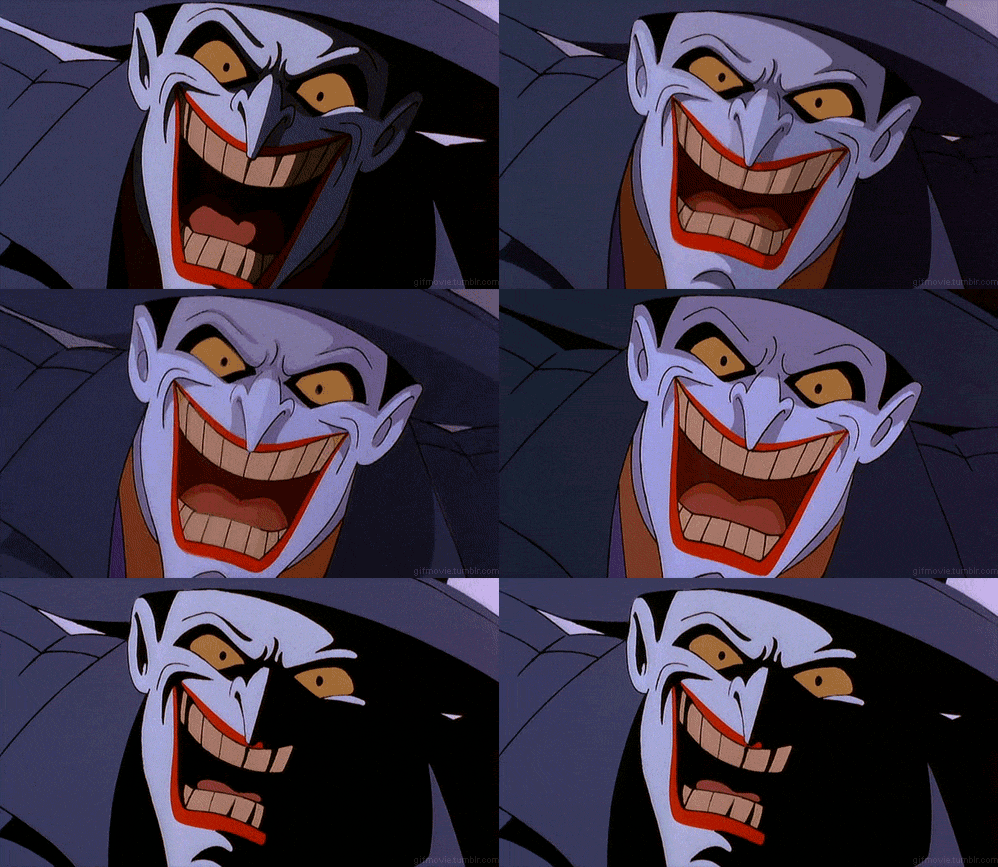
Excuse me. This is the part where if I were closer to the admission process than a decade in any direction I would start laughing until I became the JONKLER.
Selingo is a journalist and editor with the Chronicle of Higher Education (my source for all the news fit for a Vice-Chancellor of Innovation Practices), and he combines his deep knowledge of the field with an insider's study at three schools: University of Washington, Davidson, and Emory. Admissions is a fraught topic, with the Varsity Blues cheating scandal where wealthy B-list celebrities hired a con artist to gin up athletic admits for their fail children, and the ongoing saga of Students for Fair Admissions v. Harvard, which argues that Harvard is discriminating against highly qualified Asian-American applicants in favor of white legacies (something like a third of Harvard is a legacy admit).
Selingo categorizes colleges into sellers, the big name-brand schools that you've heard of, and buyers, which are everybody else. Sellers get too many applicants and have to be incredibly selective, while buyers get too few and have to figure out to fill their classes. There's a similar divide in applicants, with drivers applying to over ten schools, having high parental involvement, and a whole industry of college counseling against passengers, who don't understand the unspoken rules of the game and apply to just a few schools, often with mediocre grades and test scores.
Most of the anxiety is on the part of drivers trying to get into seller schools, and the simple fact that there are too many straight-A students with perfect SATs for all the spaces at Harvard and Stanford. What is mixed good news is that colleges attempt to weigh students against the opportunities available to them at high school, and also that all that high school CV building pays off. The kid from an inner city or rural high school with minimal extracurriculars and APs has a chance to catch the eye of an admissions officer where that exact same file from a wealthy suburban school district would get an instant rejection. Conversely, while you can't buy a seat at an Ivy League school, all that prep does work, and something like just 20% of high schools supply most of the students to elite colleges.
The most important part of the application is the high school transcript. The good news is that 9th grade doesn't really matter, but colleges want to see students taking a hard course load and doing well at it. Take as much calculus as you can, and don't neglect physics and chemistry if you're pre-med. Poor grades or an easy cruising course load can sink an application.
There are a few side doors. Athletics can be one, since coaches have limited discretion to offer slots to otherwise qualified candidates. Amherst (1,855 students) has more college athletes than University of Alabama (31,670 undergraduates, and football as religion). Contrary to what March Madness and Bowl Season would have you believe, student athletes are overwhelmingly rich white kids in sports that no one watches. The impact of student athletics is mixed, some studies say that they have lower grades and are otherwise uninvolved with campus life, while others say athletics is valuable. As a chubby nerd myself, I'd say cancel them all and let god sort it out, but they jocks may disagree.
For the data driven, college rankings like those produced by US News and World Reports are key, but the rankings have introduced their own perverse incentives. Selectivity, the percentage of students who apply that are admitted, and yield, the percentage admitted that say yes, are key parts of most metrics. So colleges attempt to lock in students with early decision, which requires a student to agree to attend a college in December before most applications close. This boosts yields, and helps the college increase selectivity for the general admission cohort. While admissions officers interviewed talk an idealistic game about shaping the class and holistic diversity, at the end of the day a college is a business, and the goal is to figure out who can pay increasingly steep tuition. One secret that Selingo reveals is that for the typical upper-middle class student, merit financial aid is available, but likely only at a "buyer" school, and not the "sellers" that they've applied to.
But the part that makes me want to start injecting Joker venom into random passersby and taunting the Dark Knight is that college is likely the most expensive purchase that a person will make, with the exception of buying a home, and it's done on almost no information! We check reviews when we buy a phone or car, we get houses inspected, but 18 year-olds sign up for hundreds of thousands of dollars of expensive educational debt based on gut feeling and reputation. It is essentially impossible to figure out what college costs, until you're well into April and the end of the decision period. Bad ideas driven by college marketing and teenage emotions, like a desire for distance from family or a classic red brick campus experience, may blind families to better and cheaper schools.
The hard truth is that most colleges will be just fine for most students. Systematic surveys show that while high school grades and SATs are a decent predictor of life-time earnings, where you go to college has no effect. The true elite, Fortune 500 CEOs, bankable talent, national politicians, have their own networks of privilege and influence which overlap with elite universities, but which can't be cracked simply by going to Yale. And as much as these schools compete on US News and World Reports rankings, undergraduate education is a tertiary concern, after the endowment, research, and the professional graduate schools. What you do as a student, an attitude of flexible exploration while also committing to a mastering a distinct field of knowledge, matters far more than where you do it.
Just for the love of all that is holy turn you assignments in.
The decision about where to go to college is one of the most consequential in a person's life. And that admission decision will be made in less than eight minutes by two poorly paid bureaucrats.
Excuse me. This is the part where if I were closer to the admission process than a decade in any direction I would start laughing until I became the JONKLER.
Selingo is a journalist and editor with the Chronicle of Higher Education (my source for all the news fit for a Vice-Chancellor of Innovation Practices), and he combines his deep knowledge of the field with an insider's study at three schools: University of Washington, Davidson, and Emory. Admissions is a fraught topic, with the Varsity Blues cheating scandal where wealthy B-list celebrities hired a con artist to gin up athletic admits for their fail children, and the ongoing saga of Students for Fair Admissions v. Harvard, which argues that Harvard is discriminating against highly qualified Asian-American applicants in favor of white legacies (something like a third of Harvard is a legacy admit).
Selingo categorizes colleges into sellers, the big name-brand schools that you've heard of, and buyers, which are everybody else. Sellers get too many applicants and have to be incredibly selective, while buyers get too few and have to figure out to fill their classes. There's a similar divide in applicants, with drivers applying to over ten schools, having high parental involvement, and a whole industry of college counseling against passengers, who don't understand the unspoken rules of the game and apply to just a few schools, often with mediocre grades and test scores.
Most of the anxiety is on the part of drivers trying to get into seller schools, and the simple fact that there are too many straight-A students with perfect SATs for all the spaces at Harvard and Stanford. What is mixed good news is that colleges attempt to weigh students against the opportunities available to them at high school, and also that all that high school CV building pays off. The kid from an inner city or rural high school with minimal extracurriculars and APs has a chance to catch the eye of an admissions officer where that exact same file from a wealthy suburban school district would get an instant rejection. Conversely, while you can't buy a seat at an Ivy League school, all that prep does work, and something like just 20% of high schools supply most of the students to elite colleges.
The most important part of the application is the high school transcript. The good news is that 9th grade doesn't really matter, but colleges want to see students taking a hard course load and doing well at it. Take as much calculus as you can, and don't neglect physics and chemistry if you're pre-med. Poor grades or an easy cruising course load can sink an application.
There are a few side doors. Athletics can be one, since coaches have limited discretion to offer slots to otherwise qualified candidates. Amherst (1,855 students) has more college athletes than University of Alabama (31,670 undergraduates, and football as religion). Contrary to what March Madness and Bowl Season would have you believe, student athletes are overwhelmingly rich white kids in sports that no one watches. The impact of student athletics is mixed, some studies say that they have lower grades and are otherwise uninvolved with campus life, while others say athletics is valuable. As a chubby nerd myself, I'd say cancel them all and let god sort it out, but they jocks may disagree.
For the data driven, college rankings like those produced by US News and World Reports are key, but the rankings have introduced their own perverse incentives. Selectivity, the percentage of students who apply that are admitted, and yield, the percentage admitted that say yes, are key parts of most metrics. So colleges attempt to lock in students with early decision, which requires a student to agree to attend a college in December before most applications close. This boosts yields, and helps the college increase selectivity for the general admission cohort. While admissions officers interviewed talk an idealistic game about shaping the class and holistic diversity, at the end of the day a college is a business, and the goal is to figure out who can pay increasingly steep tuition. One secret that Selingo reveals is that for the typical upper-middle class student, merit financial aid is available, but likely only at a "buyer" school, and not the "sellers" that they've applied to.
But the part that makes me want to start injecting Joker venom into random passersby and taunting the Dark Knight is that college is likely the most expensive purchase that a person will make, with the exception of buying a home, and it's done on almost no information! We check reviews when we buy a phone or car, we get houses inspected, but 18 year-olds sign up for hundreds of thousands of dollars of expensive educational debt based on gut feeling and reputation. It is essentially impossible to figure out what college costs, until you're well into April and the end of the decision period. Bad ideas driven by college marketing and teenage emotions, like a desire for distance from family or a classic red brick campus experience, may blind families to better and cheaper schools.
The hard truth is that most colleges will be just fine for most students. Systematic surveys show that while high school grades and SATs are a decent predictor of life-time earnings, where you go to college has no effect. The true elite, Fortune 500 CEOs, bankable talent, national politicians, have their own networks of privilege and influence which overlap with elite universities, but which can't be cracked simply by going to Yale. And as much as these schools compete on US News and World Reports rankings, undergraduate education is a tertiary concern, after the endowment, research, and the professional graduate schools. What you do as a student, an attitude of flexible exploration while also committing to a mastering a distinct field of knowledge, matters far more than where you do it.
Just for the love of all that is holy turn you assignments in.

Rising Sun and Tumbling Bear is a conventional military history of divisions and generals covering the 1904 Russo-Japanese War. This war was a fascinating transition, the last display of Napoleonic close order and the first recognizably modern war with bolt-action rifles, machine guns, and quick-firing artillery.
The two empires came to blows over competing claims in Korea and Manchuria, with leadership on both sides believing that a 'short victorious war' would be just the thing for public consumption. Both sides were wrong, as the campaign degenerated into a bloody and expensive shambles, but by that time the war had its own logic.
On the naval side, Japan had a major stroke of luck when the Russian battleship Poltava hit a mine in the early days of the war, taking with it the active Admiral Makarov. The Russian fleet did not seriously threaten Japanese supply lines for the rest of the war. The Pacific Fleet was sunk in harbor once Japanese siege line closed in on Port Arthur, and the Baltic Fleet was sunk in the Battle of Tsushima after sailing around the world.
The land campaign also saw repeated reversals for the Russians, as they were outflanked and outfought. Defense had a tactical advantage over attack in this time, but the Russians squandered their advantage by anxiously shuffling brigades across their entire front, rather than properly digging in on key terrain. Japanese attacks tended to commit everything, providing a razor thin margin of victory that prevent them from following up and smashing the Russian army, but Russia lost battles with entire divisions uncommitted, an elementary error.
Russian senior commanders were defeatist, uncooperative, and often both elderly and inexperienced. While Connaughton punctures some myths of Japanese brilliance, the Japanese held to basic Clausewitzian doctrine of identifying the key objective of the battle and fully committing their forces to taking it. While this lead to bloody assaults on the siege lines of Port Arthur, it also gave them victories. In what was a pattern, while winning all the battles the Japanese lost the peace, coming off worse in treaty negotiations. This diplomatic defeat would inspire an ideology of total victory that lead to Pearl Harbor, and the eventual destruction of Imperial Japan.
The two empires came to blows over competing claims in Korea and Manchuria, with leadership on both sides believing that a 'short victorious war' would be just the thing for public consumption. Both sides were wrong, as the campaign degenerated into a bloody and expensive shambles, but by that time the war had its own logic.
On the naval side, Japan had a major stroke of luck when the Russian battleship Poltava hit a mine in the early days of the war, taking with it the active Admiral Makarov. The Russian fleet did not seriously threaten Japanese supply lines for the rest of the war. The Pacific Fleet was sunk in harbor once Japanese siege line closed in on Port Arthur, and the Baltic Fleet was sunk in the Battle of Tsushima after sailing around the world.
The land campaign also saw repeated reversals for the Russians, as they were outflanked and outfought. Defense had a tactical advantage over attack in this time, but the Russians squandered their advantage by anxiously shuffling brigades across their entire front, rather than properly digging in on key terrain. Japanese attacks tended to commit everything, providing a razor thin margin of victory that prevent them from following up and smashing the Russian army, but Russia lost battles with entire divisions uncommitted, an elementary error.
Russian senior commanders were defeatist, uncooperative, and often both elderly and inexperienced. While Connaughton punctures some myths of Japanese brilliance, the Japanese held to basic Clausewitzian doctrine of identifying the key objective of the battle and fully committing their forces to taking it. While this lead to bloody assaults on the siege lines of Port Arthur, it also gave them victories. In what was a pattern, while winning all the battles the Japanese lost the peace, coming off worse in treaty negotiations. This diplomatic defeat would inspire an ideology of total victory that lead to Pearl Harbor, and the eventual destruction of Imperial Japan.

J.G. Ballard was one of the most distinctive penetrating voices of 20th century fiction. This book, the complete stories is a monument. And in true Ballardian fashion, it takes the form of a grotesque Brutalist labyrinth, and endless transit from reality into a psychosis of non-space and non-time. In some sense, this review is also a review of my own failure. I began this book in October 2017, nearly five years ago, with the plan of reading one story a day, paired with a brief reaction in words and images. My expectations for the project, formed by reading The Best Short Stories of J.G. Ballard as well as several of his novels, was inadequate preparation for The Complete Stories. Indeed, I am uncertain if anything could have prepared me for The Complete Stories.
Ballard's major theme is the implosion of modernity. His early stories play with crowded, stimulated, commercialized societies reaching points of parodic collapse with grim irony for his protagonists. The overt science-fiction themes ebb in the mid 1960s (coincident with the death of his wife), and the stories focus on alienated individuals undergoing a destructive final psychological crisis, often a collapse of time perception with fugues and blackouts, or perhaps a novel relation to space. The central image here is the beach, a sun-burnt strip of sand between the vast unchanging ocean and the detritus strewn land.
Ballard wrote some truly impressive stories. "Thirteen to Centaurus" is a first rank story in any form. "The Cage of Sand" was written at the height of the space race and imagines Cape Canaveral as a toxic desert haunted by obsessives maintaining a vigil on the orbiting capsules of dead astronauts. The deconstructed stories like "Answers to a Questionnaire" and "The Assassination of John Fitzgerald Kennedy Considered As a Downhill Motor Race" do clever and ambitious things with form. Ballard wrote at least a dozen fascinating and provocative stories.
The problem is that there are about 100 stories in the book, and after those top dozen the quality begins to fall fast. I can't bring myself to care about the dissipated artists and aristocrats of the Vermillion Sands cycle. There are far too many meditations on how space flight was a cosmic sin which will be punished by eliminating time. The general misanthropy of these stories is a key part of the theme and tone, a cosmological realization that our present mode of life is a brief blip between an animal past and a dead future. But there's also a very particular and ugly misogyny, with story after story of unfaithful wives and the kamikaze husbands who destroy them.
Should you read Ballard? Absolutely. Should you read The Complete Stories? Only if you have a specific desire for literary exhaustion.
Ballard's major theme is the implosion of modernity. His early stories play with crowded, stimulated, commercialized societies reaching points of parodic collapse with grim irony for his protagonists. The overt science-fiction themes ebb in the mid 1960s (coincident with the death of his wife), and the stories focus on alienated individuals undergoing a destructive final psychological crisis, often a collapse of time perception with fugues and blackouts, or perhaps a novel relation to space. The central image here is the beach, a sun-burnt strip of sand between the vast unchanging ocean and the detritus strewn land.
Ballard wrote some truly impressive stories. "Thirteen to Centaurus" is a first rank story in any form. "The Cage of Sand" was written at the height of the space race and imagines Cape Canaveral as a toxic desert haunted by obsessives maintaining a vigil on the orbiting capsules of dead astronauts. The deconstructed stories like "Answers to a Questionnaire" and "The Assassination of John Fitzgerald Kennedy Considered As a Downhill Motor Race" do clever and ambitious things with form. Ballard wrote at least a dozen fascinating and provocative stories.
The problem is that there are about 100 stories in the book, and after those top dozen the quality begins to fall fast. I can't bring myself to care about the dissipated artists and aristocrats of the Vermillion Sands cycle. There are far too many meditations on how space flight was a cosmic sin which will be punished by eliminating time. The general misanthropy of these stories is a key part of the theme and tone, a cosmological realization that our present mode of life is a brief blip between an animal past and a dead future. But there's also a very particular and ugly misogyny, with story after story of unfaithful wives and the kamikaze husbands who destroy them.
Should you read Ballard? Absolutely. Should you read The Complete Stories? Only if you have a specific desire for literary exhaustion.