Take a photo of a barcode or cover
2.05k reviews by:
mburnamfink


There's some famous veterinary advice about how to treat cats. DON'T FIGHT A CAT. USE YOUR BRAIN. USE DRUGS. It's also decent parenting advice.
The basic premise of How to Talk so Little Kids Will Listen is that your urge to discipline and punish, to control you little chaos monkey, may make you feel like you have a handle on things in that moment, but it won't solve your parenting challenge. Instead, you set up an escalating series of boundary testing challenges, and a little kid has more energy and creativity than you do.
Instead, the axiom of this book is that kids won't act right if they don't feel right, and the first step is to label and validate the bad feelings, because kids lack the skills to do so themselves. And while you can't USE DRUGS, you can use verbal judo technique such as fantasy, offering a choice between options which are fine to you, and pointing to external controls like lists and timers to neutralize hard choices like having to get dressed and go to school.
It's all very touchy-feely, and my own kid is too young for me to give first-hand approval and that last star. But I can say, having witnessed the exact opposite of this book's recommendations first hand, it's not like this can be worse.
The basic premise of How to Talk so Little Kids Will Listen is that your urge to discipline and punish, to control you little chaos monkey, may make you feel like you have a handle on things in that moment, but it won't solve your parenting challenge. Instead, you set up an escalating series of boundary testing challenges, and a little kid has more energy and creativity than you do.
Instead, the axiom of this book is that kids won't act right if they don't feel right, and the first step is to label and validate the bad feelings, because kids lack the skills to do so themselves. And while you can't USE DRUGS, you can use verbal judo technique such as fantasy, offering a choice between options which are fine to you, and pointing to external controls like lists and timers to neutralize hard choices like having to get dressed and go to school.
It's all very touchy-feely, and my own kid is too young for me to give first-hand approval and that last star. But I can say, having witnessed the exact opposite of this book's recommendations first hand, it's not like this can be worse.

Steven Levy is the dean of Silicon Valley journalists, and this is the acme of access journalism, based on multiple interviews with Mark Zuckerberg and Sheryl Sandberg, and hundreds of interviews with key Facebook employees.
Levy moves through the conventional history of a tech start-up. Mark the Harvard wunderkind, who ignored his classes to focus on making cool things. He captured lightning in a bottle with thefacebook, a social networking site focused on Harvard and other Ivy League schools.
If I might personally digress for a moment, I'm the prototypical Facebook user. HS class of 2005, elite colleges immediately thereafter. I spent my teenage years on AIM and forums, but didn't use MySpace. To 19 year old me, with my old social network scattered across the country, and overwhelmed by the size of my colleges, Facebook felt profoundly real in a way that little else did. It was easy to use. The interface was a calming blue, unlike the teenage bedroom chaos of MySpace. It was a blank space where a profoundly immature person could shed the skin of childhood and become an adult. Zuckerberg had some good ideas and coding chops, but he also got lucky with a technological moment where wifi and laptops became good enough that it was normal for college students to spend hours a day on or near a computer. I have slightly older friends who only used library/lab computers to write papers. Facebook would have never caught on in that environment. But not only did Facebook catch on, it caught the most valuable demographic in America at the most critical time of their life.
On the backs of users just like me, Zuckerberg built the company from a frathouse pack of coders, literally, everyone working and sleeping out of rented Silicon Valley houses at first, into a multi-billion dollar tech titan. He scaled relentlessly, adding new features to handle photos, the Newsfeed, chat, and a revenue stream in the form of demographically targeted advertising. Possibly guided by the Roman conquerors he so admires, Zuckerberg avoided getting acquired himself while making key acquisitions in Instagram and Whatsapp. There's a shocking confidence to the financial and technological decisions he made.
At the same time, Facebook made engineering choices which would come to haunt them. An initiative called Platform opened Facebook's trove of data to developers, which came with spammy games (remember Farmville?), and unscrupulous actors who harvested deep 'friend-of-friend' data without even the basic pretense of an EULA. Relentlessly focused on Growth (caps intended, it's the name of a key FB division), Facebook dropped other priorities.
The volcano erupted in 2016 with the election of Donald Trump and revelations that Russian intelligence had used Facebook advertising to try and influence the election. It's unclear how much effectiveness Russian intelligence had. But it's definitely true that Trump's digital operation massively outmaneuvered the Clinton campaign on Facebook, using rapidly iterating A-B testing to find the exact issues to swing specific voters and suppress Clinton supporters. Facebook offered the same support to both campaigns, but the Clinton campaign declined and lost. The bad news just kept coming, with the evil data analytics of Facebook partner Cambridge Analytica and their 50+ million shadily obtained profiles, a content moderation policy that manages to be arbitrary, inhumane, and feckless, bruising Congressional testimony, and host of former executives quitting and speaking out against the company.
Facebook has spent the past few years in a very dark place, with Zuckerberg declaring himself a "wartime CEO" and replacing internal skeptics with friends and loyalists. Growth of the main "Blue" app has been basically flat, and it is deeply uncool with teenagers. Having burnt so much trust, any action by Facebook is seen in the worst possible light, with real effects like the scuttling of proposed internet currency Libra. Every political faction has reason to hate Facebook. Facebook rebranded to Meta in 2021, after this book was published, and is focusing on smaller conversation via Groups, and next-generation platforms like the virtual reality Metaverse.
I began this book by talking about "access journalism", and the reason is that even though he speaks candidly of the company's flaws, Levy buys into Zuckerberg's essentially idealistic framing. Connecting everyone in the world is essentially good, and the spate of conspiracy theories and social dislocation are minor unforeseeable consequences. Sure, Facebook has made mistakes, but they're learning and improving. Maybe they're worth trusting, just a little bit. Really bad people wouldn't be so candid.
I don't know. This is a fascinating book, but when the history is finally settled, algorithmically enhanced social media platforms might fall in the "THIS IS NOT A PLACE OF HONOR" category of technologies, along with leaded gasoline and the hydrogen bomb.
Levy moves through the conventional history of a tech start-up. Mark the Harvard wunderkind, who ignored his classes to focus on making cool things. He captured lightning in a bottle with thefacebook, a social networking site focused on Harvard and other Ivy League schools.
If I might personally digress for a moment, I'm the prototypical Facebook user. HS class of 2005, elite colleges immediately thereafter. I spent my teenage years on AIM and forums, but didn't use MySpace. To 19 year old me, with my old social network scattered across the country, and overwhelmed by the size of my colleges, Facebook felt profoundly real in a way that little else did. It was easy to use. The interface was a calming blue, unlike the teenage bedroom chaos of MySpace. It was a blank space where a profoundly immature person could shed the skin of childhood and become an adult. Zuckerberg had some good ideas and coding chops, but he also got lucky with a technological moment where wifi and laptops became good enough that it was normal for college students to spend hours a day on or near a computer. I have slightly older friends who only used library/lab computers to write papers. Facebook would have never caught on in that environment. But not only did Facebook catch on, it caught the most valuable demographic in America at the most critical time of their life.
On the backs of users just like me, Zuckerberg built the company from a frathouse pack of coders, literally, everyone working and sleeping out of rented Silicon Valley houses at first, into a multi-billion dollar tech titan. He scaled relentlessly, adding new features to handle photos, the Newsfeed, chat, and a revenue stream in the form of demographically targeted advertising. Possibly guided by the Roman conquerors he so admires, Zuckerberg avoided getting acquired himself while making key acquisitions in Instagram and Whatsapp. There's a shocking confidence to the financial and technological decisions he made.
At the same time, Facebook made engineering choices which would come to haunt them. An initiative called Platform opened Facebook's trove of data to developers, which came with spammy games (remember Farmville?), and unscrupulous actors who harvested deep 'friend-of-friend' data without even the basic pretense of an EULA. Relentlessly focused on Growth (caps intended, it's the name of a key FB division), Facebook dropped other priorities.
The volcano erupted in 2016 with the election of Donald Trump and revelations that Russian intelligence had used Facebook advertising to try and influence the election. It's unclear how much effectiveness Russian intelligence had. But it's definitely true that Trump's digital operation massively outmaneuvered the Clinton campaign on Facebook, using rapidly iterating A-B testing to find the exact issues to swing specific voters and suppress Clinton supporters. Facebook offered the same support to both campaigns, but the Clinton campaign declined and lost. The bad news just kept coming, with the evil data analytics of Facebook partner Cambridge Analytica and their 50+ million shadily obtained profiles, a content moderation policy that manages to be arbitrary, inhumane, and feckless, bruising Congressional testimony, and host of former executives quitting and speaking out against the company.
Facebook has spent the past few years in a very dark place, with Zuckerberg declaring himself a "wartime CEO" and replacing internal skeptics with friends and loyalists. Growth of the main "Blue" app has been basically flat, and it is deeply uncool with teenagers. Having burnt so much trust, any action by Facebook is seen in the worst possible light, with real effects like the scuttling of proposed internet currency Libra. Every political faction has reason to hate Facebook. Facebook rebranded to Meta in 2021, after this book was published, and is focusing on smaller conversation via Groups, and next-generation platforms like the virtual reality Metaverse.
I began this book by talking about "access journalism", and the reason is that even though he speaks candidly of the company's flaws, Levy buys into Zuckerberg's essentially idealistic framing. Connecting everyone in the world is essentially good, and the spate of conspiracy theories and social dislocation are minor unforeseeable consequences. Sure, Facebook has made mistakes, but they're learning and improving. Maybe they're worth trusting, just a little bit. Really bad people wouldn't be so candid.
I don't know. This is a fascinating book, but when the history is finally settled, algorithmically enhanced social media platforms might fall in the "THIS IS NOT A PLACE OF HONOR" category of technologies, along with leaded gasoline and the hydrogen bomb.

Madame Nhu is one of the more fascinating characters of the Vietnam War. She was the most visible figure of the Diem regime, far more colorful than the shrouds of secrecy around her husband Ngo Dinh Nhu, or the strident moralizing of President Diem himself. Nhu was always ready to defend her family and her government, the two being one and the same. Madame Nhu was universally despised by American government officials for reasons both good and bad. She was undoubtedly a proud and difficult person who's abrasiveness worked against her cause. Her comment on the Buddhist monks' self-immolation, that if they wished to throw a barbeque, she would bring the gas and a match, was an entirely self-inflicted wound, and one infamous enough to permanently stain her reputation. But at the same time, the sexist and racist world that she lived in couldn't accept a Vietnamese woman who sought to wield power.
Demery was fascinated by Madame Nhu, who had essentially disappeared from history following the coup that killed her husband and brother-in-law. A chance interview on a Vietnamese blog mentioned that Madame Nhu was still alive, living in an 11th floor apartment in Paris with a view of the Eiffel tower. There are few enough apartment buildings that meet that description that Demery was able to confirm Nhu's address and give the old woman her card via old fashioned leg work. What followed was five years of frustratingly evasive phone calls and an odd sort of friendship, as Demery became Nhu's biographer, and the means of her last statement to the world.
Madame Nhu was born into an aristocratic family in colonial Vietnam. Her father was the foremost Vietnamese lawyer under the colonial government, her mother a royal princess. However, she was an unwanted female middle child, and no one expected much of her marriage to an older Catholic man with an unimpressive library degree. That man, Ngo Dinh Nhu, was often absent from their house in the fraught years of the Japanese occupation and the First Indochinese War between the Viet Minh and the French, organizing a covert anti-Communist party that would put his brother Diem in charge of government.
Diem was handed a bad set of cards from the start. The French, bitter after their defeat, worked covertly against him. Ho Chi Minh and the Communists were genuinely more popular with the people, and thousands of dedicated cadres had stayed behind in the south. Gangsters and staunchly independent sects were lumps of opposition. A million refugees from North Vietnam had to be integrated into society. American aid was a double edge sword, enabling infrastructure and security projects, but also casting the new government as colonial puppets. In this environment, it's not surprising that Diem turned to his religion and his family for support. Not surprising, but a fatal flaw.
While Nhu had a backbone, she was profoundly disconnected from the people. She was an internal voice for a hardline stance against opponents of the government, which worked in the battle against gangsters and coup plotters, but also made her many enemies. As an elected official, Madame Nhu pushed for moral reform laws which were broadly unpopular. In perhaps a microcosm of her views on politics and family, she initiated a national ban on divorce to prevent an embarrassing breach of decorum from a sister-in-law seeking to leave an unhappy marriage.
As the Buddhist crisis escalated in 1963, Madame Nhu made an American tour to shore up support for her government. This probably saved her life, since she was in Los Angeles recovering from minor surgery when the coup occurred, and her husband and Diem were murdered by an American-backed conspiracy. She and the children fled to Europe, living mundane existences in Paris and Rome as history passed them by.
Demery paints a fascinating picture of Madame Nhu's life, including ordinary days at the top of the South Vietnamese government, and the messianic purpose which drove her.
Demery was fascinated by Madame Nhu, who had essentially disappeared from history following the coup that killed her husband and brother-in-law. A chance interview on a Vietnamese blog mentioned that Madame Nhu was still alive, living in an 11th floor apartment in Paris with a view of the Eiffel tower. There are few enough apartment buildings that meet that description that Demery was able to confirm Nhu's address and give the old woman her card via old fashioned leg work. What followed was five years of frustratingly evasive phone calls and an odd sort of friendship, as Demery became Nhu's biographer, and the means of her last statement to the world.
Madame Nhu was born into an aristocratic family in colonial Vietnam. Her father was the foremost Vietnamese lawyer under the colonial government, her mother a royal princess. However, she was an unwanted female middle child, and no one expected much of her marriage to an older Catholic man with an unimpressive library degree. That man, Ngo Dinh Nhu, was often absent from their house in the fraught years of the Japanese occupation and the First Indochinese War between the Viet Minh and the French, organizing a covert anti-Communist party that would put his brother Diem in charge of government.
Diem was handed a bad set of cards from the start. The French, bitter after their defeat, worked covertly against him. Ho Chi Minh and the Communists were genuinely more popular with the people, and thousands of dedicated cadres had stayed behind in the south. Gangsters and staunchly independent sects were lumps of opposition. A million refugees from North Vietnam had to be integrated into society. American aid was a double edge sword, enabling infrastructure and security projects, but also casting the new government as colonial puppets. In this environment, it's not surprising that Diem turned to his religion and his family for support. Not surprising, but a fatal flaw.
While Nhu had a backbone, she was profoundly disconnected from the people. She was an internal voice for a hardline stance against opponents of the government, which worked in the battle against gangsters and coup plotters, but also made her many enemies. As an elected official, Madame Nhu pushed for moral reform laws which were broadly unpopular. In perhaps a microcosm of her views on politics and family, she initiated a national ban on divorce to prevent an embarrassing breach of decorum from a sister-in-law seeking to leave an unhappy marriage.
As the Buddhist crisis escalated in 1963, Madame Nhu made an American tour to shore up support for her government. This probably saved her life, since she was in Los Angeles recovering from minor surgery when the coup occurred, and her husband and Diem were murdered by an American-backed conspiracy. She and the children fled to Europe, living mundane existences in Paris and Rome as history passed them by.
Demery paints a fascinating picture of Madame Nhu's life, including ordinary days at the top of the South Vietnamese government, and the messianic purpose which drove her.

Season of the Witch is a scattered collection of essays and factoids that fails to come together; it feels like a 5 page term paper that's been expanded to 10 pages, circling around its points again and again.
The first chapter opens with promise, on the link between rhythm and blues as an African-American musical form and the reinterpretation of African religions under slavery. Rumors that talented musicians made a dark pact with Legba, syncretized with Satan, dogged the early blues. When white people took over the music in the 1950s, rock and roll became a new Dionysian rite. Rock and roll was about teenagers having sex, anathema to the conservative culture of the times.
The story than skips a beat between Elvis and the Beatles, those years a wasteland of pop nonsense in Bebergal's read. The Beatles used their status as new-found celebrities to promote transcendental meditation. Meanwhile, Led Zeppelin was off writing songs about hobbits and heroic quests, while getting into Crowley and magick.
If anything can be gleaned from this mess of a book, it's that the 60s counter-culture tried out many alternatives to conventional mainstream Christian/scientific thought, whipping up a blend of Eastern religious traditions, psychedelic exploration via LSD, a Western magical tradition mostly grounded in Theosophy, and speculative literature about both wizards and spaceships to create a show that was part of ecstatic rite, part esoteric community, and part commercial venture.
But the subtitle is "how the occult saved rock and roll", and from my vantage, the occult mostly inspired talented musicians to make long, boring, elaborate prog concept albums. Rock is more than a 3 minute song you can dance to, but a triple album about some D&D campaign is worse than danceable pap about how your baby makes you feel.
This reads like a rehash of other books, and fails to prove its thesis to boot. At least it's short.
The first chapter opens with promise, on the link between rhythm and blues as an African-American musical form and the reinterpretation of African religions under slavery. Rumors that talented musicians made a dark pact with Legba, syncretized with Satan, dogged the early blues. When white people took over the music in the 1950s, rock and roll became a new Dionysian rite. Rock and roll was about teenagers having sex, anathema to the conservative culture of the times.
The story than skips a beat between Elvis and the Beatles, those years a wasteland of pop nonsense in Bebergal's read. The Beatles used their status as new-found celebrities to promote transcendental meditation. Meanwhile, Led Zeppelin was off writing songs about hobbits and heroic quests, while getting into Crowley and magick.
If anything can be gleaned from this mess of a book, it's that the 60s counter-culture tried out many alternatives to conventional mainstream Christian/scientific thought, whipping up a blend of Eastern religious traditions, psychedelic exploration via LSD, a Western magical tradition mostly grounded in Theosophy, and speculative literature about both wizards and spaceships to create a show that was part of ecstatic rite, part esoteric community, and part commercial venture.
But the subtitle is "how the occult saved rock and roll", and from my vantage, the occult mostly inspired talented musicians to make long, boring, elaborate prog concept albums. Rock is more than a 3 minute song you can dance to, but a triple album about some D&D campaign is worse than danceable pap about how your baby makes you feel.
This reads like a rehash of other books, and fails to prove its thesis to boot. At least it's short.

The Verge is popular history by a popular podcaster, with the strengths and weaknesses that the format entails. Wyman focuses on the pivotal decades between 1490 and 1530, when Europe went from an impoverished footnote in the global economy to the cradle of empires and much of what we consider modernity. The events which bookend this period are Columbus' famous expedition which discovered the Americas, and the 1527 Sack of Rome, when an army consisting of unpaid German mercenaries under the nominal command of Holy Roman Emperor Charles V sacked and looted Rome, the holiest site in Christendom.
The book is structured around biographies. Some of the subjects are famous: Columbus and Martin Luther foremost among them, with banker Jakob Fugger rounding out the trio. Three monarchs are included: Isabella of Spain, Charles V, and Ottoman Sultan Suleiman I. I found most fascinating the ordinary men, Man-at-arms Gotz von Berlichlingen, wool merchant John Heritage, and printer Aldus Manutius. Wyman has a talent for making the past come alive, and he hooks you with short fiction reconstructing what he subjects likely felt as they approached their pivotal events, before going into the context of their lives.
Where this book falls short is in the larger thesis. Wyman wants to say something about the institutions of capitalism and credit, but whether from an dislike of Marxist theory (a fair dislike), or an attempt to avoid alienating the reader, he repeatedly hammers the idea of the institution of credit and an attitude of venture as the key points that mark this great divergence. The two major elements of Europe's poverty through the 15th century was the aftermath of the demographic catastrophe of the Black Death, and more subtle effects of the bullion famine. There simple wasn't enough precious metal in Europe to enable the economy to function, and what little there was was sent East to purchases spices and other luxuries.
In the absence of specie, Europeans developed a system of credit where upfront cash could be repaid over years through incomes. On a mundane sense, this let woll merchant John Heritage take delivery of goods with a small payment where the total would be paid through the year, only after he had sold on to major exporters. Or a printer could have the money and time needed to invest in cases of type. Money could be invested in ships, in trade, and in war. This last bit, the alliance between kings and bankers, was needed to sustain an increasingly expensive and technological war machine. It's also where the thesis breaks down, because war is and was profoundly destructive, the opposite of investments in prudent capital.
The aim of The Verge is to describe the shift from a medieval mindset, one focused on tradition, personal ties, and martial honor, towards a modern world of innovation, profit, and credit worthiness. But where a serious book would get into the details, Wyman unfortunately gets cloudy and points towards a shared sense of how trade worked, rather than the specific mechanisms and relationships, and how they are both continuous and different from our 21st century versions. It's a shame, because the late David Graeber put it all much better in Debt, when he described these people as heavily indebted murderers who reduced everything around them to ready cash to stave off their financial day of reckoning a little bit further.
The book is structured around biographies. Some of the subjects are famous: Columbus and Martin Luther foremost among them, with banker Jakob Fugger rounding out the trio. Three monarchs are included: Isabella of Spain, Charles V, and Ottoman Sultan Suleiman I. I found most fascinating the ordinary men, Man-at-arms Gotz von Berlichlingen, wool merchant John Heritage, and printer Aldus Manutius. Wyman has a talent for making the past come alive, and he hooks you with short fiction reconstructing what he subjects likely felt as they approached their pivotal events, before going into the context of their lives.
Where this book falls short is in the larger thesis. Wyman wants to say something about the institutions of capitalism and credit, but whether from an dislike of Marxist theory (a fair dislike), or an attempt to avoid alienating the reader, he repeatedly hammers the idea of the institution of credit and an attitude of venture as the key points that mark this great divergence. The two major elements of Europe's poverty through the 15th century was the aftermath of the demographic catastrophe of the Black Death, and more subtle effects of the bullion famine. There simple wasn't enough precious metal in Europe to enable the economy to function, and what little there was was sent East to purchases spices and other luxuries.
In the absence of specie, Europeans developed a system of credit where upfront cash could be repaid over years through incomes. On a mundane sense, this let woll merchant John Heritage take delivery of goods with a small payment where the total would be paid through the year, only after he had sold on to major exporters. Or a printer could have the money and time needed to invest in cases of type. Money could be invested in ships, in trade, and in war. This last bit, the alliance between kings and bankers, was needed to sustain an increasingly expensive and technological war machine. It's also where the thesis breaks down, because war is and was profoundly destructive, the opposite of investments in prudent capital.
The aim of The Verge is to describe the shift from a medieval mindset, one focused on tradition, personal ties, and martial honor, towards a modern world of innovation, profit, and credit worthiness. But where a serious book would get into the details, Wyman unfortunately gets cloudy and points towards a shared sense of how trade worked, rather than the specific mechanisms and relationships, and how they are both continuous and different from our 21st century versions. It's a shame, because the late David Graeber put it all much better in Debt, when he described these people as heavily indebted murderers who reduced everything around them to ready cash to stave off their financial day of reckoning a little bit further.

Skiena is incredible!
I'll be upfront that I'm a pragmatist as a programmer. I some actual training in data science and machine learning, which is arcane enough on it's own, and a few years experience to call myself Good With Pandas, but the thing about being an autodidact solving a limited set of business problems in Python is that you miss the big picture. In a mature ecosystem like Python, a lot of the time the right answer is just "pip install magiclib. from magiclib import incantation. bar = incantation(foo)" Except sometimes magiclib doesn't exist yet. At the end of the day, computers are all Turing machines, they all solve the same sets of problems, but some approaches are algorithmically tractable, and some will leave you lost in the Swamp of Sadness.
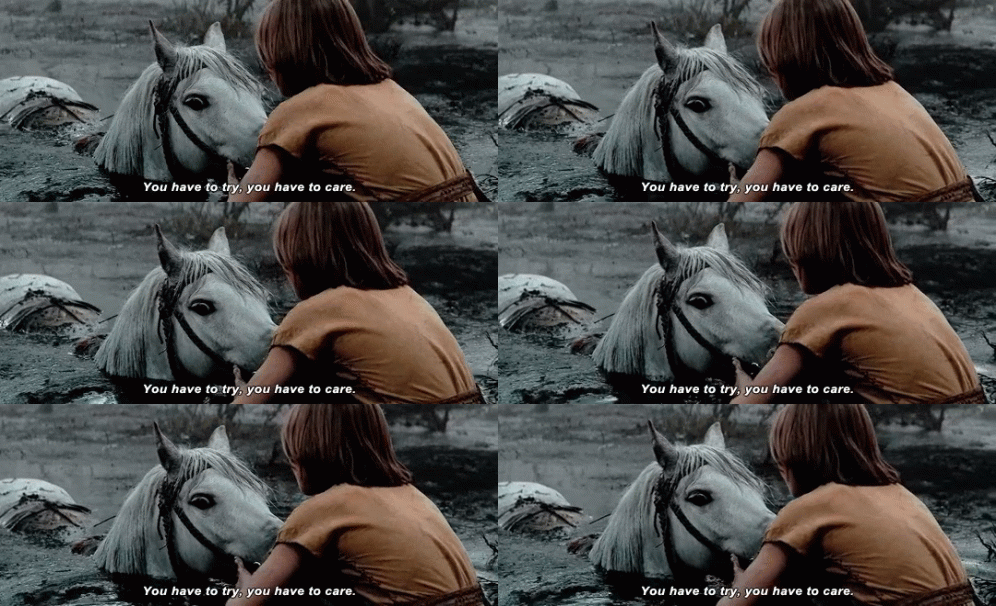
Artax has been asked to solve a large NP complete problem
For someone who's never taken CS101, this book an eye-opener into the hows and whys of basic data structures like linked lists, trees, hash tables, and arrays, as well as sorting techniques and more advanced practices like dynamic programming. Clear explainers are interspersed with practical war stories, where Skiena explains how he applied the technique just discussed to solve a previously intractable problem.
Cracking the Coding interview is a series of dog tricks. The Algorithm Design Manual is actual knowledge. It's been a great guide to actually thinking like a professional, even if most of the day job is data plumbing.
I'll be upfront that I'm a pragmatist as a programmer. I some actual training in data science and machine learning, which is arcane enough on it's own, and a few years experience to call myself Good With Pandas, but the thing about being an autodidact solving a limited set of business problems in Python is that you miss the big picture. In a mature ecosystem like Python, a lot of the time the right answer is just "pip install magiclib. from magiclib import incantation. bar = incantation(foo)" Except sometimes magiclib doesn't exist yet. At the end of the day, computers are all Turing machines, they all solve the same sets of problems, but some approaches are algorithmically tractable, and some will leave you lost in the Swamp of Sadness.
Artax has been asked to solve a large NP complete problem
For someone who's never taken CS101, this book an eye-opener into the hows and whys of basic data structures like linked lists, trees, hash tables, and arrays, as well as sorting techniques and more advanced practices like dynamic programming. Clear explainers are interspersed with practical war stories, where Skiena explains how he applied the technique just discussed to solve a previously intractable problem.
Cracking the Coding interview is a series of dog tricks. The Algorithm Design Manual is actual knowledge. It's been a great guide to actually thinking like a professional, even if most of the day job is data plumbing.

The Dream of Reason takes a human, popular view at philosophy from the ancient Greeks forward to the Renaissance, treating this conversation as one of wise, fallible, and occasionally funny humans through the ages. These were people grappling with Big Questions, namely what is the universe made of, how did it come to be, and how do people lead meaningful lives, and while their answers do not match modern understandings, they are foundational. For someone with a fairly weak background in philosophy, especially the older stuff, it's a good supplement to a missed classical education.
The first few chapters, on the pre-Socratics, are necessarily weaker, given that the surviving works of these authors is measured in a few hundred lines, and sometimes even a handful of direct words and a maze of quotations and commentaries. The book fully arrives with Socrates, who's method of systematic questioning set the form for much of what follows. Plato and Aristotle get detailed overviews as well, with their foundational works on ethics, metaphysics, as well as more practical topics like logic and biology.
What follows after the big three is less good. Gottlieb has less sympathy for the efforts of the stoics, epicureans, and skeptics to flesh out frameworks in the wake of Aristotle. Medieval theology, and the effort to synthesize non-heretical Christian theology with neoplatonist mysticism is mostly a dead end. One thing which I learned was that the scientific reaction against Aristotle was more rhetoric than reality. Aristotle couldn't have been the stifling authority on Western learning during the Middle Ages, because he was almost lost entirely, only being preserved by Arab philosophers (a sadly absent chapter). The abstruse commentary style of the scholastics has little in common with Aristotle, who can be tedious, but is generally a model of clarity. While Aristotle's physics lack the tools of quantified measurement which make modern physics work, he was a dedicated empiricist.
Fun and informative, and not exactly unbiased, The Dream of Reason is a solid introduction and overview.
The first few chapters, on the pre-Socratics, are necessarily weaker, given that the surviving works of these authors is measured in a few hundred lines, and sometimes even a handful of direct words and a maze of quotations and commentaries. The book fully arrives with Socrates, who's method of systematic questioning set the form for much of what follows. Plato and Aristotle get detailed overviews as well, with their foundational works on ethics, metaphysics, as well as more practical topics like logic and biology.
What follows after the big three is less good. Gottlieb has less sympathy for the efforts of the stoics, epicureans, and skeptics to flesh out frameworks in the wake of Aristotle. Medieval theology, and the effort to synthesize non-heretical Christian theology with neoplatonist mysticism is mostly a dead end. One thing which I learned was that the scientific reaction against Aristotle was more rhetoric than reality. Aristotle couldn't have been the stifling authority on Western learning during the Middle Ages, because he was almost lost entirely, only being preserved by Arab philosophers (a sadly absent chapter). The abstruse commentary style of the scholastics has little in common with Aristotle, who can be tedious, but is generally a model of clarity. While Aristotle's physics lack the tools of quantified measurement which make modern physics work, he was a dedicated empiricist.
Fun and informative, and not exactly unbiased, The Dream of Reason is a solid introduction and overview.

At times it seems like every Vietnam War platoon leader has written a memoir. Tripp has written a better than average one, elevated by literary ambitions and simultaneously expanded and tangled up by an attempt to link this peak experience of his life to his father and his son.
When this book is on, it is extremely on. Tripp writes about the feeling of being plugged into the war with an electric vividness, of the organic wholeness of his 'Mike Division' platoon moving like a superorganism through the jungle, alive with vibrations and hiding signs, trying to tune in on the Viet Cong and knowing they were trying to do the same to you, and that failing in this ESP test meant ambush and death. He get almost as close describing the waste and brutality of the American war, the armored and flying death machines, bulldozers, arbitrary destructiveness, top to bottom hypocrisy, the cowardice of the REMFs, and the secret separate peace the Michelin company cut with the Viet Cong to keep their rubber plantations safe. But Tripp's main emotion is love, even love for his enemies, and the necessary hatred is just out of his reach. The stories are true war stories, as poet-laureate of the war Tim O'Brien would put it, and while there is little actual combat, there is lots of slipstream weirdness around combat, a kind of nightmare-turned-real aspect that really works.
Tripp also tries to place himself in some kind of chain of being, from his harsh Yankee patriarch of a grandfather, to his half-mad failure of a father, and to the hope for peace for his own children. The psychodrama doesn't quite hold together, too reserved and too open at once, though a passage on coming to grips with the trauma of war with his fellow veterans did.
This is a solid memoir, with parts that rise to greatness, but it lacks the unitary perfection of a classic.
When this book is on, it is extremely on. Tripp writes about the feeling of being plugged into the war with an electric vividness, of the organic wholeness of his 'Mike Division' platoon moving like a superorganism through the jungle, alive with vibrations and hiding signs, trying to tune in on the Viet Cong and knowing they were trying to do the same to you, and that failing in this ESP test meant ambush and death. He get almost as close describing the waste and brutality of the American war, the armored and flying death machines, bulldozers, arbitrary destructiveness, top to bottom hypocrisy, the cowardice of the REMFs, and the secret separate peace the Michelin company cut with the Viet Cong to keep their rubber plantations safe. But Tripp's main emotion is love, even love for his enemies, and the necessary hatred is just out of his reach. The stories are true war stories, as poet-laureate of the war Tim O'Brien would put it, and while there is little actual combat, there is lots of slipstream weirdness around combat, a kind of nightmare-turned-real aspect that really works.
Tripp also tries to place himself in some kind of chain of being, from his harsh Yankee patriarch of a grandfather, to his half-mad failure of a father, and to the hope for peace for his own children. The psychodrama doesn't quite hold together, too reserved and too open at once, though a passage on coming to grips with the trauma of war with his fellow veterans did.
This is a solid memoir, with parts that rise to greatness, but it lacks the unitary perfection of a classic.

In his second book in this biographical series on philosophy, Gottlieb focuses on the thinkers of the Enlightenment from Descartes to Voltaire. There's a special focus on undercutting misguided conventional wisdom. For example, while Descartes took cogito, ergo sum as his first axiom, he believed that soul and body were deeply connected, even if he couldn't quite articulate how, as opposed to the strict divide that has garnered the name "Cartesian dualism". Hobbes, while valuing political stability, was hardly a totalitarian. Locke's treatises were more conservative than liberal, Rosseau rather a misanthrope and critic of the whole project, etc.
As before, Gottlieb blends a solid summary of these thinkers lives with these thoughts, though he doesn't quite manage to synthesize what the Enlightenment was, or why the cumulative efforts of all these thinkers deserve to be called the Enlightenment. Still, an interesting and informative book.
As before, Gottlieb blends a solid summary of these thinkers lives with these thoughts, though he doesn't quite manage to synthesize what the Enlightenment was, or why the cumulative efforts of all these thinkers deserve to be called the Enlightenment. Still, an interesting and informative book.
Rational Action is an often fascinating, frequently frustrating, close history of operations research from 1940 to 1960. Operations research is a fascinating branch of applied interdisciplinary mathematics, using clever and often counterintuitive logic and statistics to reveal useful facts. This history traces many applications of operations research, and attempts to formalize it as a field of knowledge bridging science, policy, and strategy. However, the micro-narratives, approximately 30 very short chapters, are only belated brought into conversation with the larger issues in science and technology studies.

This picture seems to get a lot of positive attention whenever it's posted.
Operations research has its origins in attempts to figure out the new form of technologically mediated warfare in the opening exchanges of World War 2. British policy-makers, reeling from the defeat of the Battle of France, realized that this war of radar intercepts and submarine hunts worked differently from traditional military virtues. While heroism still mattered, efficient application of a system of military technologies was the surest path to victory. In a bright spot in British policy-making, a rather ad hoc scientific advisory structure managed to extract useful lessons from operations and transmit new best practices to units in the field. American operations research had a different bureaucratic structure, with particular embeddings in bomber wings, but managed similar feats of efficient mission planning.
With victory in 1945, operations researchers faced the challenges of peace. British Marxists J.D. Bernal and J.B.S. Haldane saw their work as prelude to scientific management of the economy. Their less ideological American counterparts saw operations research as a way to rationalize an unruly consumer economy and inter-service debates over strategy.
In the years following the war, RAND would become the center of gravity of operations research, using Air Force funding to develop a style of systems analysis and game-theoretic approaches to nuclear war that proved publically influential. 1960 is as good of end as any, but in some respects the story is cut short before it gets really interesting, with the triple whammy of Eisenhower's Farewell Address warning of capture by a scientific-military elite, the installation of McNamara's Whiz Kids in the Pentagon, and the absurdist failure of operations research in the political warfare of Vietnam.
The coda links back to the social studies of science movement, Shapin, Latour, and Jasanoff, which is in many way a reaction to the perceived universal objectivity of the operations researchers, and the collapse of the High Modernist project in the 1960s. Thomas avoids the simple oppositional narrative by showing the successes of operations research as contingent, based on personal connections with decision-makers and presenting reasonable options in a wartime environment of great uncertainty, rather than a synoptic mathematical authority. But I think this project gets too lost in the weeds, chasing the complex mathematical theories of operations research without making enough connection to their project of rationalizing policy via mathematical models.
This picture seems to get a lot of positive attention whenever it's posted.
Operations research has its origins in attempts to figure out the new form of technologically mediated warfare in the opening exchanges of World War 2. British policy-makers, reeling from the defeat of the Battle of France, realized that this war of radar intercepts and submarine hunts worked differently from traditional military virtues. While heroism still mattered, efficient application of a system of military technologies was the surest path to victory. In a bright spot in British policy-making, a rather ad hoc scientific advisory structure managed to extract useful lessons from operations and transmit new best practices to units in the field. American operations research had a different bureaucratic structure, with particular embeddings in bomber wings, but managed similar feats of efficient mission planning.
With victory in 1945, operations researchers faced the challenges of peace. British Marxists J.D. Bernal and J.B.S. Haldane saw their work as prelude to scientific management of the economy. Their less ideological American counterparts saw operations research as a way to rationalize an unruly consumer economy and inter-service debates over strategy.
In the years following the war, RAND would become the center of gravity of operations research, using Air Force funding to develop a style of systems analysis and game-theoretic approaches to nuclear war that proved publically influential. 1960 is as good of end as any, but in some respects the story is cut short before it gets really interesting, with the triple whammy of Eisenhower's Farewell Address warning of capture by a scientific-military elite, the installation of McNamara's Whiz Kids in the Pentagon, and the absurdist failure of operations research in the political warfare of Vietnam.
The coda links back to the social studies of science movement, Shapin, Latour, and Jasanoff, which is in many way a reaction to the perceived universal objectivity of the operations researchers, and the collapse of the High Modernist project in the 1960s. Thomas avoids the simple oppositional narrative by showing the successes of operations research as contingent, based on personal connections with decision-makers and presenting reasonable options in a wartime environment of great uncertainty, rather than a synoptic mathematical authority. But I think this project gets too lost in the weeds, chasing the complex mathematical theories of operations research without making enough connection to their project of rationalizing policy via mathematical models.