Take a photo of a barcode or cover
2.05k reviews by:
mburnamfink


The City of Brass is a dashing Arabian themed fantasy novel that spices up the usual characters and plots with exotic setting details and complex webs of intrigue. Nahri, our narrator, is a fortune-teller, thief, healer, and scoundrel living in Cairo in the 18th century. When an exorcism turns out to actually work, calling a powerful djinn warrior to her side, Nahri is pulled into a world of strange magic and deadly threats. She may be the last surviving heir of a powerful and sacred bloodline, her new companion Dara is an incredibly deadly warrior with a dark past, and they're being hunted by vicious renegade killers and slavers. The only sanctuary is Daevabad, the legendary City of Brass.
The other half of the story is told from the perspective of Ali, second son of the ruling sultan of Daevabad, an intelligent and empathic young soldier with a reputation for fanaticism, and his own developing sense of duty and honor. Ali wants to help the half-human inhabitant of the city, to serve his brother the future sultan, and to maintain some kind of ordered life. The arrival of Nahri is just the first step in a plot that might topple the entire city.
In some sense, we've seen these characters before. The hidden heir, the honorable man in a city of scoundrels. If this book were about elves, I doubt I'd care, but Chakraborty has spun 1001 Arabian Nights into a unique fantasy setting. And what really elevates this book is that so many fantasy novels have a protagonist side and antagonist side, and it's clear where the lines are. Nahri and Ali have very different priorities and worldviews, but they're both valid, and neither are obviously wrong. Chakraborty has taken to heart the adage that no one sees themselves as evil. Lots of fun, and I'm looking forward to the next book.
The other half of the story is told from the perspective of Ali, second son of the ruling sultan of Daevabad, an intelligent and empathic young soldier with a reputation for fanaticism, and his own developing sense of duty and honor. Ali wants to help the half-human inhabitant of the city, to serve his brother the future sultan, and to maintain some kind of ordered life. The arrival of Nahri is just the first step in a plot that might topple the entire city.
In some sense, we've seen these characters before. The hidden heir, the honorable man in a city of scoundrels. If this book were about elves, I doubt I'd care, but Chakraborty has spun 1001 Arabian Nights into a unique fantasy setting. And what really elevates this book is that so many fantasy novels have a protagonist side and antagonist side, and it's clear where the lines are. Nahri and Ali have very different priorities and worldviews, but they're both valid, and neither are obviously wrong. Chakraborty has taken to heart the adage that no one sees themselves as evil. Lots of fun, and I'm looking forward to the next book.

The Bear Went Over the Mountain: Soviet Combat Tactics in Afghanistan
Lester W. Grau, David M. Glantz
The Bear Went Over The Mountain is about as niche as books get. It's an account of 49 tactical engagements by Soviet forces in Afghanistan, as collected by the Russian Frunze Military Academy, and then translated and commentary added by Dr. Grau.
Each of the vignettes is short, accompanies by a tactical map and stripped of irrelevant information by the multiple layers of translation. What's interesting is seeing what lessons the General Staff at Frunze drew, and Grau's commentary on those lessons. Soviet doctrine and equipment was oriented for maneuver warfare on the irradiated plains of Central Europe. Infantry was an adjunct to the armored arm, and tactics were stripped to simple plans that would enable higher commander to rapidly concentrate mass and fire against NATO forces as cities vanished under mushroom clouds. Afghanistan was a classic counter-insurgency nightmare, with mountain terrain restricting the use of armor, and years of bloody attritional warfare against agile mujaheddin fighters. Generally, small groups of Soviet infantry lacked initiative and aggression, especially in night fighting and patrolling. Cordons for sweep and clear operations were leaky, convoy security an ongoing problem, and even the poor Russian loadbearing gear worked against success, as troops were tied to road-bound infantry fighting vehicles for resupply.
Agressive helicopter insertions showed some success, but airpower cannot control the ground or protect the population. Expensive helicopters were always in short supply, and rarely worked at their best in the mountains. Grau criticize the Russians for inadequate reconnaissance, using reconnaissance troops as combat infantry, and ad hoc special units for missions, rather than establishing proper combined infantry and support units for the ongoing counter-insurgency warfare.
I grabbed this book and the sequel from the Afghan side for $3 apiece, which was a steal. I see they're back up to $40 now, which is a lot (unless you can get the DOD to buy it for you). Still a cool bit of history.
Each of the vignettes is short, accompanies by a tactical map and stripped of irrelevant information by the multiple layers of translation. What's interesting is seeing what lessons the General Staff at Frunze drew, and Grau's commentary on those lessons. Soviet doctrine and equipment was oriented for maneuver warfare on the irradiated plains of Central Europe. Infantry was an adjunct to the armored arm, and tactics were stripped to simple plans that would enable higher commander to rapidly concentrate mass and fire against NATO forces as cities vanished under mushroom clouds. Afghanistan was a classic counter-insurgency nightmare, with mountain terrain restricting the use of armor, and years of bloody attritional warfare against agile mujaheddin fighters. Generally, small groups of Soviet infantry lacked initiative and aggression, especially in night fighting and patrolling. Cordons for sweep and clear operations were leaky, convoy security an ongoing problem, and even the poor Russian loadbearing gear worked against success, as troops were tied to road-bound infantry fighting vehicles for resupply.
Agressive helicopter insertions showed some success, but airpower cannot control the ground or protect the population. Expensive helicopters were always in short supply, and rarely worked at their best in the mountains. Grau criticize the Russians for inadequate reconnaissance, using reconnaissance troops as combat infantry, and ad hoc special units for missions, rather than establishing proper combined infantry and support units for the ongoing counter-insurgency warfare.
I grabbed this book and the sequel from the Afghan side for $3 apiece, which was a steal. I see they're back up to $40 now, which is a lot (unless you can get the DOD to buy it for you). Still a cool bit of history.

Thirty Seconds Over Tokyo is a tightly focused yarn about Ted Lawson's participation in the Doolittle Raid. In the darkest days of 1942, with fascism on the march everywhere, a handful of pilots flying B-25s from the USS Hornet made a bee-sting raid on Japan. The raid had negligible material impact, but was an import moral boost.
Lawson's memoir moves swiftly through pilot training, to the raid itself, and then the meat of the book, the long journey home. Severely wounded while ditching his bomber, Lawson's leg was amputated in China, and he was carried to safety on vehicles ranging from stretchers to trucks.
This book was written for a popular audience, and published in the middle of the war. So it's limited in scope, but it's fun and its quick.
Lawson's memoir moves swiftly through pilot training, to the raid itself, and then the meat of the book, the long journey home. Severely wounded while ditching his bomber, Lawson's leg was amputated in China, and he was carried to safety on vehicles ranging from stretchers to trucks.
This book was written for a popular audience, and published in the middle of the war. So it's limited in scope, but it's fun and its quick.

Le Guin is rightly famous for her incredible novels, but she's also a master of short fiction. This collection focuses on her early career, start with her first published stories and ending with "The Day Before the Revolution". Each story has introductory remarks be Le Guin, which provide lovely guidance to the themes and what she was thinking about as she was writing the story.
There are many acknowledged classics in here, but I particularly enjoyed two smaller stories, "April in Paris" and "The Rule of Names", which demonstrated Le Guin's deft touch with language and mood. The only miss was "The Good Trip", a nothing piece of psychedelic ephemera.
There are many acknowledged classics in here, but I particularly enjoyed two smaller stories, "April in Paris" and "The Rule of Names", which demonstrated Le Guin's deft touch with language and mood. The only miss was "The Good Trip", a nothing piece of psychedelic ephemera.

Space themed milSF with an exceptionally competent young woman protagonist is practically its own sub-genre. Trading in Danger is a solid entry in that tradition, with the strengths of a great deal of psychological realism, but also a grander plot that steals agency from its main character.
We meet Ky Vatta on the worst day of her life so far. She's being summarily expelled from the Space Navy Academy as a scapegoat when a good deed blows up into a public relations catastrophe. Plan B for Ky isn't so bad, as her family runs a major interstellar shipping company, and she's handed the captain's slot on an elderly freighter sent for decommissioning.
It's a milk run, but Ky has the Vatta legacy to live up to, and when she hears about a profitable gig moving agricultural machiney, she decides to go off route and freelancer. Ship trouble leaves her stranded in a system as a war kicks off, and local ansible relay is destroyed (the kind of attack that attracts serious retaliation by the ansible monopoly) and her ship is contracted by mercenaries to act as floating prison for senior officers of other civilian ships. Nothing illegal, just keeping potential troublemakers from causing trouble all over the system.
Of course, that means that they cause trouble on Ky's ship. Some of the senior officers turn out to be behind the attack, and they attempt to hijacker her ship. Ky shoots the attempted hijackers down and loses a respected crewman in the process. But her ship is disabled, out of fuel, and with no beacon, and it's down to starvation rations before they're rescued.
So I'm torn about this book. Ky is a fun protagonist, and while she's good under pressure, she's not an uncanny prodigy like Miles Vorkosigan, Honor Harrington, or Alexis Carew. The problem is that even at her worst moment, Vatta has immense privilege. On phone call to Daddy could unlock all the credits she'd ever need. Mentors shower her with mysteriously useful items. And finally, and I know this is griping complaint, but the premise is 'space truckers', and I never got much sense of the economics of the setting, aside from a lovely monologue from the ansible monopoly company's rep about how they are entirely apolitical, because they own politics. Peter F. Hamilton's Night's Dawn series nails the economics and politics of space shipping so well (even if the plot and characters are... so awful in places), that I'm just disappointed.
Ky is clearly being set up for some kind of unconventional war, and I have a hold placed on the next book, but while a lot of fun, this is just okay.
We meet Ky Vatta on the worst day of her life so far. She's being summarily expelled from the Space Navy Academy as a scapegoat when a good deed blows up into a public relations catastrophe. Plan B for Ky isn't so bad, as her family runs a major interstellar shipping company, and she's handed the captain's slot on an elderly freighter sent for decommissioning.
It's a milk run, but Ky has the Vatta legacy to live up to, and when she hears about a profitable gig moving agricultural machiney, she decides to go off route and freelancer. Ship trouble leaves her stranded in a system as a war kicks off, and local ansible relay is destroyed (the kind of attack that attracts serious retaliation by the ansible monopoly) and her ship is contracted by mercenaries to act as floating prison for senior officers of other civilian ships. Nothing illegal, just keeping potential troublemakers from causing trouble all over the system.
Of course, that means that they cause trouble on Ky's ship. Some of the senior officers turn out to be behind the attack, and they attempt to hijacker her ship. Ky shoots the attempted hijackers down and loses a respected crewman in the process. But her ship is disabled, out of fuel, and with no beacon, and it's down to starvation rations before they're rescued.
So I'm torn about this book. Ky is a fun protagonist, and while she's good under pressure, she's not an uncanny prodigy like Miles Vorkosigan, Honor Harrington, or Alexis Carew. The problem is that even at her worst moment, Vatta has immense privilege. On phone call to Daddy could unlock all the credits she'd ever need. Mentors shower her with mysteriously useful items. And finally, and I know this is griping complaint, but the premise is 'space truckers', and I never got much sense of the economics of the setting, aside from a lovely monologue from the ansible monopoly company's rep about how they are entirely apolitical, because they own politics. Peter F. Hamilton's Night's Dawn series nails the economics and politics of space shipping so well (even if the plot and characters are... so awful in places), that I'm just disappointed.
Ky is clearly being set up for some kind of unconventional war, and I have a hold placed on the next book, but while a lot of fun, this is just okay.

Crisis in Command advances a singular and bold thesis, that the Vietnam War was lost because the American military prior to the war abandoned the moral principles of combat leadership, but then shies away from the full force of the accusation, and loses itself in a mass of generalities about war and morality that fail to link the two.
The basic thesis is that small-unit cohesion is vital for winning battles. And while logistics and strategy may win wars, it is also hard to win a war while losing all the battles. Small-unit cohesion is maintained by skilled leaders at the company and platoon level, who share the risks of the men and inspire them to risk their lives in pursuit of victory. This requires a commitment to what is somewhat confusingly referred to in the book as 'corporate values', a commitment to a common cause even at great risk to the self. The opposite moral framework are 'entrepreneurial values', a businessman's ethic of efficiently allocating resources. Entrepreneurial values are well and good, but no one is expected to die for General Motors. To summarize the book in an epigram, soldiers are either lead to victory, or managed to death.
Entrepreneurialism took over the Army during the Second World War, starting with General Marshall's industrial total war, escalating through the whizbang techno-centrism of the early Cold War, and reaching it's apogee with Defense Secretary McNamara, who literally came from Ford Motors. These values were represented by careerism and hypocrisy, the fraudulent inflation of body counts and awards for valor, and the use of troops as means to the end of ensure the promotion of the Colonel to General, rather than moral actors in their own right. Troops resisted by desertion, drug use, mutiny, and fragging their officers. And if there was a war to be won, it'd have to be done mostly by airpower and artillery.
It's an interesting thesis, and the authors back it up by showing that as the number of officers inflated during Vietnam, their proportion of casualties declined. Removing helicopter crashes as a combat cause of death (and a helicopter is 10,000 parts flying in close formation around an oil leak, which lusts to end its existence by killing all aboard), and the numbers get even worse. The higher in rank you are, the more you're protected from death. Officers did not share the burden of combat fairly, and worse, career officers and NCOs could manipulate the personnel system so that they got safe rear echelon jobs. The actual fighting was done by draftees lead by amateurs.
Over 40 years on, the American Army has rebuilt itself as a formidable all-volunteer fighting force. Whatever went wrong in Iraq and Afghanistan, it was not a lack of lethality and commitment to aggressive action on the part of the infantry. But some recommendations, like a moral code to replace a Korean War era holdover, an empowered Investigator General, and a more morally aware Army, seem to have gone nowhere. The authors continually discuss how Britain, Israel, France, and Nazi Germany created effective armies from cultural heritages broadly comparable to 20th century America, but lack specific details.
And ultimately, war is about killing people. Morally, it should be a crime, but because it's done in uniform by nations, it's alright. There's a single distinct word for the syndrome identified in Crisis in Command, and that word is "COWARDICE". Not of men, but of organizations. This book might have been cutting edge in 1978, but at the present I highly recommend Achilles in Vietnam and Dereliction of Duty for the actual details of how the men in charge of the American Army during the Vietnam War managed it into disintegration.
The basic thesis is that small-unit cohesion is vital for winning battles. And while logistics and strategy may win wars, it is also hard to win a war while losing all the battles. Small-unit cohesion is maintained by skilled leaders at the company and platoon level, who share the risks of the men and inspire them to risk their lives in pursuit of victory. This requires a commitment to what is somewhat confusingly referred to in the book as 'corporate values', a commitment to a common cause even at great risk to the self. The opposite moral framework are 'entrepreneurial values', a businessman's ethic of efficiently allocating resources. Entrepreneurial values are well and good, but no one is expected to die for General Motors. To summarize the book in an epigram, soldiers are either lead to victory, or managed to death.
Entrepreneurialism took over the Army during the Second World War, starting with General Marshall's industrial total war, escalating through the whizbang techno-centrism of the early Cold War, and reaching it's apogee with Defense Secretary McNamara, who literally came from Ford Motors. These values were represented by careerism and hypocrisy, the fraudulent inflation of body counts and awards for valor, and the use of troops as means to the end of ensure the promotion of the Colonel to General, rather than moral actors in their own right. Troops resisted by desertion, drug use, mutiny, and fragging their officers. And if there was a war to be won, it'd have to be done mostly by airpower and artillery.
It's an interesting thesis, and the authors back it up by showing that as the number of officers inflated during Vietnam, their proportion of casualties declined. Removing helicopter crashes as a combat cause of death (and a helicopter is 10,000 parts flying in close formation around an oil leak, which lusts to end its existence by killing all aboard), and the numbers get even worse. The higher in rank you are, the more you're protected from death. Officers did not share the burden of combat fairly, and worse, career officers and NCOs could manipulate the personnel system so that they got safe rear echelon jobs. The actual fighting was done by draftees lead by amateurs.
Over 40 years on, the American Army has rebuilt itself as a formidable all-volunteer fighting force. Whatever went wrong in Iraq and Afghanistan, it was not a lack of lethality and commitment to aggressive action on the part of the infantry. But some recommendations, like a moral code to replace a Korean War era holdover, an empowered Investigator General, and a more morally aware Army, seem to have gone nowhere. The authors continually discuss how Britain, Israel, France, and Nazi Germany created effective armies from cultural heritages broadly comparable to 20th century America, but lack specific details.
And ultimately, war is about killing people. Morally, it should be a crime, but because it's done in uniform by nations, it's alright. There's a single distinct word for the syndrome identified in Crisis in Command, and that word is "COWARDICE". Not of men, but of organizations. This book might have been cutting edge in 1978, but at the present I highly recommend Achilles in Vietnam and Dereliction of Duty for the actual details of how the men in charge of the American Army during the Vietnam War managed it into disintegration.

Summer 2019 should be a great time to release a novel about the Soviet space program. After all, you have the Apollo anniversary and Chernobyl to spark interest. Unfortunately, First Cosmic Velocity is not that great of a novel. At best, it might appeal to the most basic of slavaboos.

First Cosmic Velocity takes a kind of magic realism approach to the topic. The Soviet space program of 1964 is an elaborate sham. Every capsule has burnt up on reentry. To preserve the illusion, cosmonauts are twins, one sent to space to die and one left alive to maintain the illusion. The story follows one of this twinned cosmonauts, Leonid in 1964, dealing with an upcoming launch, Leonid in 1950 as a child in a famine stricken Ukrainian village, and the Chief Designer in 1964, managing the Potemkim rocket program. The novel has all the tropes of the post-Iowa Writer's Workshop literary novel, a tendency to string words together in a pleasing way that is utterly devoid of meaning, with characters who suffer from middle-class ennui and post-ironic detachment.
And it's a shame, because the subject of space, totalitarian societies, and sacrifice is so rife for exploration. Adam Johnson's The Orphan Master's Son has the same 'American white guy writing about totalitarian communism' problem, but Johnson weaves a thrilling fantasy. J.G. Ballard made the alienation of space his own subject in the "The Dead Astronaut" and "Memories of the Space Age". And Victor Pelevin wrote this exact novel but better in his masterful Omon Ra, which is an authentic and utterly compelling modern classic of Russian literature!
Read Omon Ra instead.
First Cosmic Velocity takes a kind of magic realism approach to the topic. The Soviet space program of 1964 is an elaborate sham. Every capsule has burnt up on reentry. To preserve the illusion, cosmonauts are twins, one sent to space to die and one left alive to maintain the illusion. The story follows one of this twinned cosmonauts, Leonid in 1964, dealing with an upcoming launch, Leonid in 1950 as a child in a famine stricken Ukrainian village, and the Chief Designer in 1964, managing the Potemkim rocket program. The novel has all the tropes of the post-Iowa Writer's Workshop literary novel, a tendency to string words together in a pleasing way that is utterly devoid of meaning, with characters who suffer from middle-class ennui and post-ironic detachment.
And it's a shame, because the subject of space, totalitarian societies, and sacrifice is so rife for exploration. Adam Johnson's The Orphan Master's Son has the same 'American white guy writing about totalitarian communism' problem, but Johnson weaves a thrilling fantasy. J.G. Ballard made the alienation of space his own subject in the "The Dead Astronaut" and "Memories of the Space Age". And Victor Pelevin wrote this exact novel but better in his masterful Omon Ra, which is an authentic and utterly compelling modern classic of Russian literature!
Read Omon Ra instead.

Snake Pilot is exactly what it says on the cover, a memoir of one year flying Cobras in Vietnam. Growing up outside Los Angeles, Zahn always want to fly. Air Force pilots were officers and gentlemen, which meant they had a college degree 19 year old Zahn had no patience to get, but the Army would put anybody in helicopters if they could make the cut. Zahn was something of a natural, scoring in the top 10% of his training cohorts, which meant he got Cobras, and the 1st of the 9th, Air Cavalry.
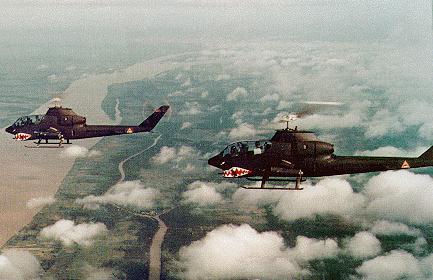
Early in his tour, Zahn bought a portable tape recorder and used it to send audio tapes to his parents, who saved all of them, the archive forming the raw material for this book. The emotional focus is on the friendships he made with his peers, and conflicts with his immediate superiors, paper-pushing careerists who didn't understand the skill it took to fight and survive in the combat zone.
Cobras mostly worked as the red part of a Pink Team. The Loach scout would fly low and slow, looking for trouble, and when they found it, the Cobra would roll in with rockets and miniguns. Cobras had an important job, protecting, guiding, and killing on behalf of their scouts, and hunting down any other trouble that might come in. The sense of battle is carried by reconstructed dialog; radio calls punctuated with rocket runs and cries for help.
Zahn is a professional helicopter pilot, not a writer, but this memoir has more literary merit than most, with a clear writing style and deep personal honesty about what he felt, and what he fought for. It's interesting to note that Zahn claims first hand accounts of what I've long considered to be urban legends of the Vietnam War, including Russian 'advisers' fighting as infantry in South Vietnam, and NVA anti-aircraft gunners chained to their weapons. As far as helicopter pilot memoirs go, Snake Pilot is behind Mills' Low Level Hell on Loaches, and the incredible Chickenhawk by Robert Mason about Hueys, but it's a solid read and worth your time.
Early in his tour, Zahn bought a portable tape recorder and used it to send audio tapes to his parents, who saved all of them, the archive forming the raw material for this book. The emotional focus is on the friendships he made with his peers, and conflicts with his immediate superiors, paper-pushing careerists who didn't understand the skill it took to fight and survive in the combat zone.
Cobras mostly worked as the red part of a Pink Team. The Loach scout would fly low and slow, looking for trouble, and when they found it, the Cobra would roll in with rockets and miniguns. Cobras had an important job, protecting, guiding, and killing on behalf of their scouts, and hunting down any other trouble that might come in. The sense of battle is carried by reconstructed dialog; radio calls punctuated with rocket runs and cries for help.
Zahn is a professional helicopter pilot, not a writer, but this memoir has more literary merit than most, with a clear writing style and deep personal honesty about what he felt, and what he fought for. It's interesting to note that Zahn claims first hand accounts of what I've long considered to be urban legends of the Vietnam War, including Russian 'advisers' fighting as infantry in South Vietnam, and NVA anti-aircraft gunners chained to their weapons. As far as helicopter pilot memoirs go, Snake Pilot is behind Mills' Low Level Hell on Loaches, and the incredible Chickenhawk by Robert Mason about Hueys, but it's a solid read and worth your time.

There is a great romanticism to the Battle of Britain. In the summer of 1940, at the height of Nazi power, all that stood between England and invasion were the pilots of RAF Fighter Command. Contrails traced labyrinths in the blue summer sky miles above the Earth as Spitfire and Messerschmidt tangled. The war fell from the sky on picnickers; shell casings, flaming wreckage, men, bombs. And of course, the good guys won. "This was their finest hour." Roll credits.
The real story is more complicated, of course, and Korda centers the battle as conflict between Air Marshall Hugh Dowding of the RAF, and Herman Goering for the Luftwaffe. Dowding is cast as a visionary. In the 1930s, when prevailing wisdom was that 'the bomber would always get through', Dowding pushed for the creation of the world's first integrated air defense network, a combination of radar, spotters, hardened telephones lines, centralized dispatch rooms where maps and indicator lights which enabled command of an air battle in real time, and fast and powerful monoplane fighters to do the killing. This was not going to be a random brawl, but a carefully planned battle of attrition. In the 21st century, with NASA Mission Control, the Star Trek bridge, and network-centric warfare, this is common stuff, but Dowding invented it all.
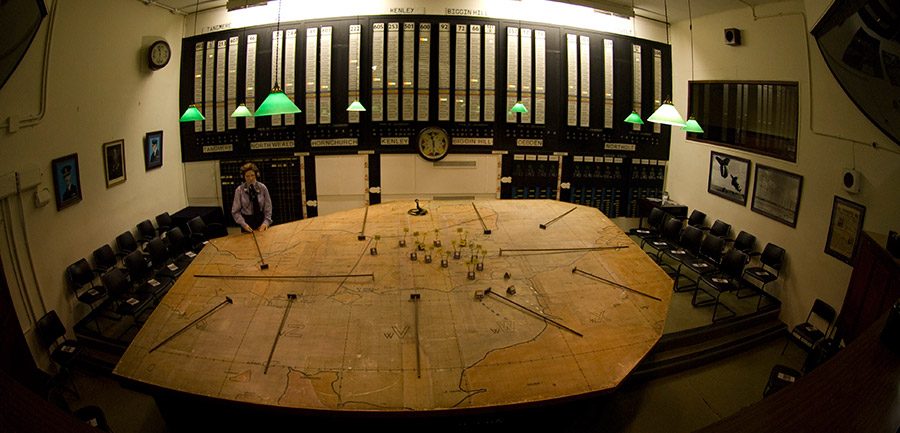
The Churchill Bunker, with the big board
Against this, Goering's Luftwaffe was the most powerful airforce in the world at the time. But the Bf-109 had the range to stay over England for mere minutes, the medium bombers lacked accuracy and destructive power, and the Stuka and Me-110 were sitting ducks for modern fighters. The Nazis were also hampered by terrible intelligence, that continually predicted the RAF was at the breaking point, and political problems, when a retaliatory strike on Berlin lead to bombers being pulled off of airfields and factories to punish Berlin.
In one sense, the outcome was never in doubt. Dowding just had to contest control of the air through the first week of October, after which storms would make Operation Sea Lion impossible. On the other hand, RAF fighter command sacrificed immensely, taking tremendous casualties in the process of bleeding the Luftwaffe white. Dowding himself was never a political player, and had to turn over his command in November 1940. But Britain had been saved. As Churchill put it, "Never in the history of mankind has so much been owed by so many to so few."
With Wings Like Eagles is an erudite popular history that rises above the pack through a novel, and well-founded thesis around the command of Air Marshall Dowding.
The real story is more complicated, of course, and Korda centers the battle as conflict between Air Marshall Hugh Dowding of the RAF, and Herman Goering for the Luftwaffe. Dowding is cast as a visionary. In the 1930s, when prevailing wisdom was that 'the bomber would always get through', Dowding pushed for the creation of the world's first integrated air defense network, a combination of radar, spotters, hardened telephones lines, centralized dispatch rooms where maps and indicator lights which enabled command of an air battle in real time, and fast and powerful monoplane fighters to do the killing. This was not going to be a random brawl, but a carefully planned battle of attrition. In the 21st century, with NASA Mission Control, the Star Trek bridge, and network-centric warfare, this is common stuff, but Dowding invented it all.
The Churchill Bunker, with the big board
Against this, Goering's Luftwaffe was the most powerful airforce in the world at the time. But the Bf-109 had the range to stay over England for mere minutes, the medium bombers lacked accuracy and destructive power, and the Stuka and Me-110 were sitting ducks for modern fighters. The Nazis were also hampered by terrible intelligence, that continually predicted the RAF was at the breaking point, and political problems, when a retaliatory strike on Berlin lead to bombers being pulled off of airfields and factories to punish Berlin.
In one sense, the outcome was never in doubt. Dowding just had to contest control of the air through the first week of October, after which storms would make Operation Sea Lion impossible. On the other hand, RAF fighter command sacrificed immensely, taking tremendous casualties in the process of bleeding the Luftwaffe white. Dowding himself was never a political player, and had to turn over his command in November 1940. But Britain had been saved. As Churchill put it, "Never in the history of mankind has so much been owed by so many to so few."
With Wings Like Eagles is an erudite popular history that rises above the pack through a novel, and well-founded thesis around the command of Air Marshall Dowding.

I picked this up staying in the O. Henry Hotel, and what do you know, it's pretty good? O. Henry stories rarely advance beyond melodrama, but they also rarely outstay their welcome, and they can be quite moving at times, and frequently funny. I especially enjoyed "The Last Leaf", which was one of the best examples of his use of ironic coincidence.
This is a solid collection by a classic author.
This is a solid collection by a classic author.