Take a photo of a barcode or cover
1.04k reviews by:
leahrosereads


Justice League of America, Vol. 3: The Injustice League
Dwayne McDuffie, Joe Benítez, Mike McKone, Ed Benes
Well this was my first read of 2015, and although it was a third volume, I don’t think I missed a lot by reading this first. Maybe I did, but I felt like THE INJUSTICE LEAGUE was fine on its own.
So we have Lex being Lex Luthor in all his evil-y goodness, and because I watched the TV show, I felt like I knew where this was going...but this comic was so much more darker than the TV show ever could be, and I was very happy about that.
He’s bringing all the bad guys back together to take over the [political] world, but like in the TV show, he seems to have issues controlling that much evil when they’re all together. Somehow Lex manages it enough to really mess with with Justice League’s day.
But, the Justice League has Batman...so, I knew that Luthor was going to lose. It felt really close though. I think it’s because Luthor had the Joker, and that freaking fucker is always causing Batman bad days.
Now, with my newness to this universe, there were a lot of heroes and villains that I didn’t know by name or even recognize. I tried, but there were some that I just couldn’t place at all. Hopefully after reading more comics, these colorful characters will all become more developed, so I’m excited about delving further into DC’s world.
Oh, my favorite Green Lantern was in this comic. I love John. He’s wonderful. And the best.
This review isn’t very good, but the comic was, and I’m definitely going to look into the other volumes to see what I’ve missed and what’s to come.
So we have Lex being Lex Luthor in all his evil-y goodness, and because I watched the TV show, I felt like I knew where this was going...but this comic was so much more darker than the TV show ever could be, and I was very happy about that.
He’s bringing all the bad guys back together to take over the [political] world, but like in the TV show, he seems to have issues controlling that much evil when they’re all together. Somehow Lex manages it enough to really mess with with Justice League’s day.
But, the Justice League has Batman...so, I knew that Luthor was going to lose. It felt really close though. I think it’s because Luthor had the Joker, and that freaking fucker is always causing Batman bad days.
Now, with my newness to this universe, there were a lot of heroes and villains that I didn’t know by name or even recognize. I tried, but there were some that I just couldn’t place at all. Hopefully after reading more comics, these colorful characters will all become more developed, so I’m excited about delving further into DC’s world.
Oh, my favorite Green Lantern was in this comic. I love John. He’s wonderful. And the best.
This review isn’t very good, but the comic was, and I’m definitely going to look into the other volumes to see what I’ve missed and what’s to come.

Batman/Superman, Volume 1: Cross World
Netho Diaz, Greg Pak, Norm Rapmund, Yildiray Cinar, Paulo Siqueira, Ben Oliver, Jae Lee, Brett Booth
3.5 Stars.
Review to come.
Review to come.

I never knew that the Hulk’s back story was so heartbreaking.
This entire comic story is Bruce talking to his friend and doctor, Leonard Samson, and it timelines the Hulk’s first days. While I don’t know if this is a slightly altered story line or anything like that, I will say that it was a wonderful read. I found it completely fascinating, and I flew through the pages.
And boy did this story just hit my feels hard. While I didn’t full on cry, there were times that I teared up for the Hulk, Bruce, Betty, and just all of the clusterfucks they faced in this beginning.
For the Hulk, I damn near cried during the bunny panels, because the gentle giant had no idea what had happened, and that was really haunting (and telling).
For Bruce and Betty, I got kind of emotional because this ended really depressingly. I don’t know if that’s normal for Hulk comics or Marvel comics, but I didn’t feel like there was a winner or hero of this story.
And for Bruce, I just felt for him, for the memories he has to bear as both the man and the monster, and he was just really easy to empathize with and to root for.
I’m sure there are better, more interesting, more action packed Hulk comics out there, but I’m really happy I started with HULK: GRAY. I’m definitely looking forward to trying out other comics featuring the Hulk, and delving further into Marvel’s universe.
This entire comic story is Bruce talking to his friend and doctor, Leonard Samson, and it timelines the Hulk’s first days. While I don’t know if this is a slightly altered story line or anything like that, I will say that it was a wonderful read. I found it completely fascinating, and I flew through the pages.
And boy did this story just hit my feels hard. While I didn’t full on cry, there were times that I teared up for the Hulk, Bruce, Betty, and just all of the clusterfucks they faced in this beginning.
For the Hulk, I damn near cried during the bunny panels, because the gentle giant had no idea what had happened, and that was really haunting (and telling).
For Bruce and Betty, I got kind of emotional because this ended really depressingly. I don’t know if that’s normal for Hulk comics or Marvel comics, but I didn’t feel like there was a winner or hero of this story.
And for Bruce, I just felt for him, for the memories he has to bear as both the man and the monster, and he was just really easy to empathize with and to root for.
I’m sure there are better, more interesting, more action packed Hulk comics out there, but I’m really happy I started with HULK: GRAY. I’m definitely looking forward to trying out other comics featuring the Hulk, and delving further into Marvel’s universe.

aama 1. The Smell of Warm Dust
Written and illustrated by: Frederik Peeters
Translated by: Edward Gauvin
First, before the review, I believe this is the first graphic novel I have read where the author and the illustrator are the same person. I think that Frederik Peeters has done a really decent job at both parts of this book. The art isn't as pretty as some of the comics I'm currently reading, but it's nice nonetheless. The writing was exceptional though, and I think that Peeters has done a great job telling this story.
The Cast of Characters:
Verloc Nim - Main character, addict, will not win father of the year.
Conrad Nim - Verloc’s baby brother, works for giant evil corporation (Muy-Tang) as a communications liaison.
Churchill - Robotic ape bodyguard. BAMF award goes to him (probably always).
Professor Woland - Not really here, but seems extremely important. The creator of the AAMA experiment.
Professor Kaplan - Lady seems to have gone a bit crazy. Master Manipulator.
Fulmine - Biorobotics Researcher. Kaplan’s right hand man.
Pilgrimm - The colony’s math and computer whizz.
Myo - Biotech professor. Also a manipulative lady (by choice or necessity, hope to find out in #2).
Dr. Frienko - Colony’s physician.
The mysterious little girl - Mute. Looks identical to Lilja, Verloc’s daughter.
Silika - Verloc’s wife (they’re separated). Her boyfriend is the one that helped her to keep Verloc from Lilja (Silika and Verloc’s daughter).
Lilja - Mute, daughter, kept from her father.
aama takes place in a distant future, and it starts with Verloc already on another planet - Ona(ji). The story is told through his memories, by him reading entries in his journal.
We see Verloc as this really depressing main character, and honestly, not a character I would ever see as a hero. He wallows in his self loathing and despair, drinking his loneliness away. That is, until his brother comes along, and give Verloc an adventure he didn’t really want, but decided to go on, nonetheless. After all, he didn’t have much going for him in his current situation anyway.
Conrad had been tasked by his company, Muy-Tang, to visit an uninhabited planet, Ona(ji) and to contact a colony that had settled there for the research and experiment conclusions of the colony’s leader, Professor Woland. The colony had shipped out to this isolated planet five years ago, and prior to the Great Crisis (some type of economical collapse).
Verloc, Conrad, and Churchill make their way to Ona(ji), and that’s really where the story begins to unfold, both in plot developments and setting. When they reach Woland’s colony, they discover a lot has happened in the Colony’s five years of isolation on this lonely planet.
The biggest discovery is that the Colony’s leader, Woland, is no longer there. She had taken her project (AAMA) and left.
Why? Well, no freaking clue. The Smell of Warm Dust is definitely a book filled with world building and plot build-ups, and character developments. It should have been a boring book to me, but the artwork, and the writing really kept the story very engaging. I was truly consumed with wanting to know more about the characters and where the story was going, and when I reached the end, I really wanted to just pick up the next one and get back into this world ASAP.
However, I knew if I did that, I wouldn’t end up writing out this review, and I really wanted to. This book is definitely worth looking into, but be prepared that it does take a little bit to get going, and with only 88 pages, I think some of the build-up was unnecessary.
But, who knows? I’m hoping that a lot of this build-up gets used in Book 2, and if that’s the case, then of course, it was important.
I’m really looking forward to continuing Verloc’s story. I think he’s going to end up being an unlikely hero, a character that redeems himself, and becomes someone that I will admire and respect. I hope so anyway.
Written and illustrated by: Frederik Peeters
Translated by: Edward Gauvin
First, before the review, I believe this is the first graphic novel I have read where the author and the illustrator are the same person. I think that Frederik Peeters has done a really decent job at both parts of this book. The art isn't as pretty as some of the comics I'm currently reading, but it's nice nonetheless. The writing was exceptional though, and I think that Peeters has done a great job telling this story.
The Cast of Characters:
Verloc Nim - Main character, addict, will not win father of the year.
Conrad Nim - Verloc’s baby brother, works for giant evil corporation (Muy-Tang) as a communications liaison.
Churchill - Robotic ape bodyguard. BAMF award goes to him (probably always).
Professor Woland - Not really here, but seems extremely important. The creator of the AAMA experiment.
Professor Kaplan - Lady seems to have gone a bit crazy. Master Manipulator.
Fulmine - Biorobotics Researcher. Kaplan’s right hand man.
Pilgrimm - The colony’s math and computer whizz.
Myo - Biotech professor. Also a manipulative lady (by choice or necessity, hope to find out in #2).
Dr. Frienko - Colony’s physician.
The mysterious little girl - Mute. Looks identical to Lilja, Verloc’s daughter.
Silika - Verloc’s wife (they’re separated). Her boyfriend is the one that helped her to keep Verloc from Lilja (Silika and Verloc’s daughter).
Lilja - Mute, daughter, kept from her father.
aama takes place in a distant future, and it starts with Verloc already on another planet - Ona(ji). The story is told through his memories, by him reading entries in his journal.
We see Verloc as this really depressing main character, and honestly, not a character I would ever see as a hero. He wallows in his self loathing and despair, drinking his loneliness away. That is, until his brother comes along, and give Verloc an adventure he didn’t really want, but decided to go on, nonetheless. After all, he didn’t have much going for him in his current situation anyway.
Conrad had been tasked by his company, Muy-Tang, to visit an uninhabited planet, Ona(ji) and to contact a colony that had settled there for the research and experiment conclusions of the colony’s leader, Professor Woland. The colony had shipped out to this isolated planet five years ago, and prior to the Great Crisis (some type of economical collapse).
Verloc, Conrad, and Churchill make their way to Ona(ji), and that’s really where the story begins to unfold, both in plot developments and setting. When they reach Woland’s colony, they discover a lot has happened in the Colony’s five years of isolation on this lonely planet.
The biggest discovery is that the Colony’s leader, Woland, is no longer there. She had taken her project (AAMA) and left.
Why? Well, no freaking clue. The Smell of Warm Dust is definitely a book filled with world building and plot build-ups, and character developments. It should have been a boring book to me, but the artwork, and the writing really kept the story very engaging. I was truly consumed with wanting to know more about the characters and where the story was going, and when I reached the end, I really wanted to just pick up the next one and get back into this world ASAP.
However, I knew if I did that, I wouldn’t end up writing out this review, and I really wanted to. This book is definitely worth looking into, but be prepared that it does take a little bit to get going, and with only 88 pages, I think some of the build-up was unnecessary.
But, who knows? I’m hoping that a lot of this build-up gets used in Book 2, and if that’s the case, then of course, it was important.
I’m really looking forward to continuing Verloc’s story. I think he’s going to end up being an unlikely hero, a character that redeems himself, and becomes someone that I will admire and respect. I hope so anyway.

This was a pretty decent follow-up to the first book in this series. Where the first book was pretty much world building and info dumping, THE INVISIBLE THRONG really expanded on Peeters world.
We see Verloc and the others begin to explore Ona(ji) and all its desolation. Until it’s not. Until its vibrant and alive with extremely strange plant life and creatures. This planet can send it’s thanks to AAMA, which we also find out a lot more about.
It’s a substance that can rewrite itself into creatures/plants/technology, and it’s rewritten itself so incredibly, that the researchers are terrified, and they should be.
Peeters has done another decent job with the writing and driving this story forward. I’m definitely intrigued where aama is going to go next.
And then there is his art. The world Peeters has visually created, namely the bizzaro new planet life on Ona(ji) is strange, stunning, and mindblowing. Even if the writing wasn’t as good as it is, I’d come back to this story for the art alone.

We see Verloc and the others begin to explore Ona(ji) and all its desolation. Until it’s not. Until its vibrant and alive with extremely strange plant life and creatures. This planet can send it’s thanks to AAMA, which we also find out a lot more about.
It’s a substance that can rewrite itself into creatures/plants/technology, and it’s rewritten itself so incredibly, that the researchers are terrified, and they should be.
Peeters has done another decent job with the writing and driving this story forward. I’m definitely intrigued where aama is going to go next.
And then there is his art. The world Peeters has visually created, namely the bizzaro new planet life on Ona(ji) is strange, stunning, and mindblowing. Even if the writing wasn’t as good as it is, I’d come back to this story for the art alone.

I'm going to preface this review by stating that I have no idea if the science or the facts in this graphic novel are right. I'm assuming they are, and if it's all accurate, I could see NEUROCOMIC being added to the curriculum as a possible visual learning aid.
There's a lot of science, history, facts, etc. given in very few pages, and I really enjoyed reading about all the brainy goodness this book had to offer.
The art is simple, but it kept me in the story. There was quite a bit of information, that it was nice to have visuals to go along with it. The writing was very factual, and although there was some fun personality to the characters, the science and facts overshadowed that constantly.
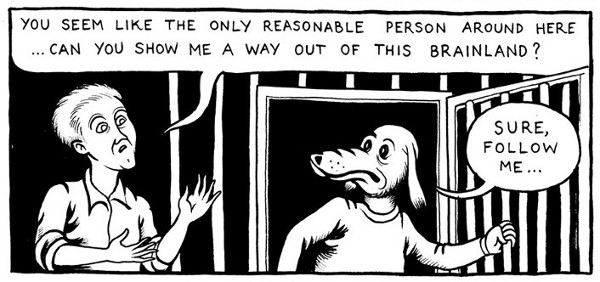
The ending was awesome and a bit mind-blowing to me. I appreciated how Hana Ros chose to end this, and I thought it worked very well for the book and for the subject matter.
NEUROCOMIC isn't going to be for everyone. It has it faults, namely the one real woman being an object for the Protagonist to chase. When the book gets to the mental disorders of the brain, it makes sense and works, but even still, it was a bit frustrating that the only woman of the story wasn't really a part of the story. Looking past that though, I thought the subject was fascinating, and I'd be willing to try out other work by both of these doctors.
OK honestly, only if they do something creative with the subject matter like they did here.
Also, a giant squid attacks!

There's a lot of science, history, facts, etc. given in very few pages, and I really enjoyed reading about all the brainy goodness this book had to offer.
The art is simple, but it kept me in the story. There was quite a bit of information, that it was nice to have visuals to go along with it. The writing was very factual, and although there was some fun personality to the characters, the science and facts overshadowed that constantly.
The ending was awesome and a bit mind-blowing to me. I appreciated how Hana Ros chose to end this, and I thought it worked very well for the book and for the subject matter.
NEUROCOMIC isn't going to be for everyone. It has it faults, namely the one real woman being an object for the Protagonist to chase. When the book gets to the mental disorders of the brain, it makes sense and works, but even still, it was a bit frustrating that the only woman of the story wasn't really a part of the story. Looking past that though, I thought the subject was fascinating, and I'd be willing to try out other work by both of these doctors.
OK honestly, only if they do something creative with the subject matter like they did here.
Also, a giant squid attacks!

THE COMPLETE MAUS is, to date, the hardest, most emotionally draining novel I have read in my adult life. It was a heart-wrenching, but really necessary read for me, and I’m proud of myself for deciding to read something so far outside my comfort zone (I tend to shy away from both history and memoir/true story novels).
The book is a story within a story. Art shows himself interviewing his father, Vladek, and his time spent with his father for part of this book, and the rest of the story is Vladek's experiences and survival of Auschwitz and how he survived throughout all of the invasion of Poland by Germany and the Nazis. Both sides shown in this felt completely honest and real.
The art, while definitely not my favorite style, worked incredibly well for this story. There were times where it was just the art in panels, and I really felt like those were some of the stronger panels. The art was black and white, thick lines, and just overall felt really heavy. Most of the time, the panels felt really cramped, but I have a feeling this was intentional.
I absolutely loved Art Spiegelman’s decision to depict the different people within this story as animals (Mice=the Jewish people, Pigs=the Polish people, and Cats=the Germans/Nazis).
Also intentional, and something I really appreciated, was how honest and true to Vladek’s narration Art Spiegelman seemed to stay. In the book, you find out that Art recorded his father’s story, and I think he wrote Vladek’s words verbatim. There were times where the sentence structures were just a little off, and I could hear Vladek's voice so strongly during those times. It just really added another depth to this book.
I wasn’t able to read this in one sitting and I also wasn’t able to pick up another book while taking a break from THE COMPLETE MAUS. But I’m really OK with that. I was able to really digest and contemplate on what I was reading, and I think taking my time helped me understand and fully immerse myself in Vladek’s experiences.
If you decide to read this, just know that it didn’t seem like Vladek held back telling Art anything that he experienced. All the pain and loss that he went through at the hands of the Nazis was extremely haunting to read about.
Vladek’s story will definitely stick with me for the rest of my life.
The book is a story within a story. Art shows himself interviewing his father, Vladek, and his time spent with his father for part of this book, and the rest of the story is Vladek's experiences and survival of Auschwitz and how he survived throughout all of the invasion of Poland by Germany and the Nazis. Both sides shown in this felt completely honest and real.
The art, while definitely not my favorite style, worked incredibly well for this story. There were times where it was just the art in panels, and I really felt like those were some of the stronger panels. The art was black and white, thick lines, and just overall felt really heavy. Most of the time, the panels felt really cramped, but I have a feeling this was intentional.
I absolutely loved Art Spiegelman’s decision to depict the different people within this story as animals (Mice=the Jewish people, Pigs=the Polish people, and Cats=the Germans/Nazis).
Also intentional, and something I really appreciated, was how honest and true to Vladek’s narration Art Spiegelman seemed to stay. In the book, you find out that Art recorded his father’s story, and I think he wrote Vladek’s words verbatim. There were times where the sentence structures were just a little off, and I could hear Vladek's voice so strongly during those times. It just really added another depth to this book.
I wasn’t able to read this in one sitting and I also wasn’t able to pick up another book while taking a break from THE COMPLETE MAUS. But I’m really OK with that. I was able to really digest and contemplate on what I was reading, and I think taking my time helped me understand and fully immerse myself in Vladek’s experiences.
If you decide to read this, just know that it didn’t seem like Vladek held back telling Art anything that he experienced. All the pain and loss that he went through at the hands of the Nazis was extremely haunting to read about.
Vladek’s story will definitely stick with me for the rest of my life.


"You're not stupid, are you? Just evil." Woden in a couple of sentences. Maybe my least favorite of the gods this time around. So this issue kinda sucked, but we got some behind the scenes on some very necessary plot, so yay!
Also McKelvie is back bringing the art we've all come to love.
Also McKelvie is back bringing the art we've all come to love.

Enjoyed revisiting Amaterasu's backstory but the infighting...why can't they see it's fucking Ananke stirring the pot?