Take a photo of a barcode or cover
1.44k reviews by:
emberology


English Translation Studies


Oh wow. I didn't even realize how much I had missed Thompson. I read a few of his short stories a while ago (they were mostly not that great), but it's been ages since I've gobbled up one of his novels. He really does handle noir well, the punch-in-the-stomach kind that leaves you gasping for air, but also simultaneously tickles you a bit with splashes of great writing.
The Grifters isn't the blackest or the craziest Thompson, and probably not even his best (despite the amazing rating on Goodreads that kind of confuses me), but it's a solid story with great characters. Sure, Carol is a bit of an oddball, because it turns out that the revelation about her past has no purpose whatsoever, but in a way that's a very familiar Thompson strategy. He just throws some off-kilter things in the mix, and it still works somehow.
You don't necessarily get that many surprises in classic noir, and The Grifters isn't an exception in that regard. It doesn't offer major plot twists, but one of the reasons why I like the genre in the first place is that the novels are like mood pieces of a cynical world, and that it's achieved in simple and no-frill terms (Well, ok... Who am I kidding? It's also entirely possible that I'm easy when it comes to noir). I can always rely on some crazy character getting all wacky or neurotic. Throw in a murder or two, and we have an excellent weekend read there. Thompson, on the other hand, decides to go further by making the relationship between mother and son seem very wrong and vile.
Another thing about Thompson is how well he handles his endings. They leave you hanging and wondering what will happen in the next chapter, until you realize there's no next chapter in this life. The Grifters is a classic storyline of a man who starts balancing between different worlds. There's a lot of foreshadowing going on, but Thompson executes it delicately and ambiguously. Then you start to get this very bad feeling that something's about to go down, and it's too late for anyone to turn back. A glass is teetering on the edge of the table, and just when you think it's going to stay where it is and survive, someone comes and smashes it to smithereens.
The Grifters isn't the blackest or the craziest Thompson, and probably not even his best (despite the amazing rating on Goodreads that kind of confuses me), but it's a solid story with great characters. Sure, Carol is a bit of an oddball, because it turns out that the revelation about her past has no purpose whatsoever, but in a way that's a very familiar Thompson strategy. He just throws some off-kilter things in the mix, and it still works somehow.
You don't necessarily get that many surprises in classic noir, and The Grifters isn't an exception in that regard. It doesn't offer major plot twists, but one of the reasons why I like the genre in the first place is that the novels are like mood pieces of a cynical world, and that it's achieved in simple and no-frill terms (Well, ok... Who am I kidding? It's also entirely possible that I'm easy when it comes to noir). I can always rely on some crazy character getting all wacky or neurotic. Throw in a murder or two, and we have an excellent weekend read there. Thompson, on the other hand, decides to go further by making the relationship between mother and son seem very wrong and vile.
Another thing about Thompson is how well he handles his endings. They leave you hanging and wondering what will happen in the next chapter, until you realize there's no next chapter in this life. The Grifters is a classic storyline of a man who starts balancing between different worlds. There's a lot of foreshadowing going on, but Thompson executes it delicately and ambiguously. Then you start to get this very bad feeling that something's about to go down, and it's too late for anyone to turn back. A glass is teetering on the edge of the table, and just when you think it's going to stay where it is and survive, someone comes and smashes it to smithereens.

This is one of those classic children's books that sprinkle golden fairy dust on their reader, and charm everyone with their magical story of faraway kingdoms full of strange creatures and mysterious places. Or, at least I presume this was supposed to do that. Unfortunately, I wasn't particularly charmed or impressed. The Neverending Story isn't bad, it just left me pretty much indifferent. I'm not a fan of fantasy (at least the typical high fantasy that usually springs to mind when the genre is mentioned), but in children's books it usually works. I've seen the movie adaptation, but I basically only remember the horse scene and the cute dragon, so I don't have any nostalgia problems preventing me from liking the book on its own.
Here we have the usual quest that requires some apparently very special individual, or otherwise Fantastica is destroyed. There's an interesting story-within-a-story structure and inventive world building, but unlike in Narnia for instance, I never got invested in the heros' journey, nor was I excited to see how everything would be solved.
Obviously, as we all probably guessed, the hero from our world grows in the process and the story is wrapped neatly, but everything happening before that is the issue. The first part is ok and understandably the one that got made into a movie, but the second part was an even bigger chore. It's just an aimless and meanderingly slow build-up to the hero's life change. The styles of the two parts keep them too separate. There is a point to why we first have to read about the first journey, that much I understood, but it doesn't work that well.
All in all, as much as I appreciate the effort to deal with the fine line between fantasy and reality, the reminder how the real world needs a hint of magic (but also how losing yourself entirely in the world of fantasy is also detrimental), the praise of the power of imagination and storytelling, and the concept of Nothing, I started to miss my old favorites again.
Here we have the usual quest that requires some apparently very special individual, or otherwise Fantastica is destroyed. There's an interesting story-within-a-story structure and inventive world building, but unlike in Narnia for instance, I never got invested in the heros' journey, nor was I excited to see how everything would be solved.
Obviously, as we all probably guessed, the hero from our world grows in the process and the story is wrapped neatly, but everything happening before that is the issue. The first part is ok and understandably the one that got made into a movie, but the second part was an even bigger chore. It's just an aimless and meanderingly slow build-up to the hero's life change. The styles of the two parts keep them too separate. There is a point to why we first have to read about the first journey, that much I understood, but it doesn't work that well.
All in all, as much as I appreciate the effort to deal with the fine line between fantasy and reality, the reminder how the real world needs a hint of magic (but also how losing yourself entirely in the world of fantasy is also detrimental), the praise of the power of imagination and storytelling, and the concept of Nothing, I started to miss my old favorites again.
Human passions have mysterious ways, in children as well as grown-ups. Those affected by them can’t explain them, and those who haven’t known them have no understanding of them at all. Some people risk their lives to conquer a mountain peak. No one, not even they themselves, can really explain why. Others ruin themselves trying to win the heart of a certain person who wants nothing to do with them. Still others are destroyed by their devotion to the pleasures of the table. Some are so bent on winning a game of chance that they lose everything they own, and some sacrifice every thing for a dream that can never come true. Some think their only hope of happiness lies in being somewhere else, and spend their whole lives traveling from place to place. And some find no rest until they have become powerful. In short, there are as many different passions as there are people. Bastian Balthazar Bux’s passion was books

The movie has a special place in my heart. There was a time in my childhood when there was still cool stuff on TV, and one afternoon I noticed an interesting movie in the schedule. What I saw stayed with me forever. My mom had just baked buns topped with butter, so while I was gobbling up about a seven of those and drinking cold cocoa, I was completely sucked into this odd world of puppet trolls and a strange Goblin king with a seductive voice.
Rewind to year 2016, when the news of David Bowie's death flooded over me like a tidal wave. I decided to slowly go through a list of his favorite books as a tribute to him and to learn more about who he was. Then I found out there's a novelization of Labyrinth. When I read E.T., I realized novelizations of movies can be good, too. In the best case scenario they can deepen the world and make you understand the characters a bit better (plus, reading E.T. meant I didn't have to suffer through the sentimental style of Spielberg).
Labyrinth, while not being bad, wasn't that special either. I think it just comes down to the world working better in visual form and with the songs. A nice read overall, but I'd rather watch the movie for the umpteenth time. Maybe this would work better if you haven't seen the movie first?
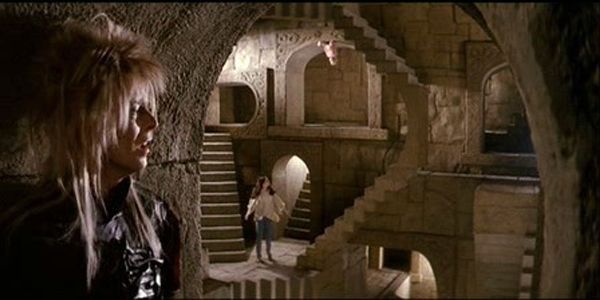
Rewind to year 2016, when the news of David Bowie's death flooded over me like a tidal wave. I decided to slowly go through a list of his favorite books as a tribute to him and to learn more about who he was. Then I found out there's a novelization of Labyrinth. When I read E.T., I realized novelizations of movies can be good, too. In the best case scenario they can deepen the world and make you understand the characters a bit better (plus, reading E.T. meant I didn't have to suffer through the sentimental style of Spielberg).
Labyrinth, while not being bad, wasn't that special either. I think it just comes down to the world working better in visual form and with the songs. A nice read overall, but I'd rather watch the movie for the umpteenth time. Maybe this would work better if you haven't seen the movie first?

The Princess Bride (1987) is another childhood favorite of mine. Someone recorded it from TV into a VHS tape, so the picture quality was grainy and less than ideal, but I tore through it a million times. If it was raining and there was nothing better to do, I watched it. When I felt gloomy, I watched it. When I was home alone, I watched it and acted scenes from it. I fell in love with Wesley and the charming pirate, marvelled the adorable giant rodents, and each time I was scared for the main couple. When I recently watched it again after many years and read the book, I realized how brilliantly the conventions of traditional swashbuckling adventure stories mixed with zany humor and various genres. It's that odd tone, I think, that allows each person to love different aspects of it. It's original and I don't know if there's anything like it.
Naturally, I was overjoyed to find out that Elwes had written a book about the making of the movie. The tone of the book is unabashedly positive and warm, and although I'd normally consider it annoying, I feel so extremely nostalgic about the movie itself that it just doesn't matter. The quotes from the actors are kind of awkwardly positioned, disrupting the narrative at strange places, and there's an entire chapter dedicated to how awesome Robin Wright is, but the positive aspects outweigh the negative ones. I don't feel the need to read this again, but it was nice to dive into my memories for a couple of nights and feel all warm and fuzzy inside.

Naturally, I was overjoyed to find out that Elwes had written a book about the making of the movie. The tone of the book is unabashedly positive and warm, and although I'd normally consider it annoying, I feel so extremely nostalgic about the movie itself that it just doesn't matter. The quotes from the actors are kind of awkwardly positioned, disrupting the narrative at strange places, and there's an entire chapter dedicated to how awesome Robin Wright is, but the positive aspects outweigh the negative ones. I don't feel the need to read this again, but it was nice to dive into my memories for a couple of nights and feel all warm and fuzzy inside.
Rob Reiner
I have had many encounters with many people from all walks of life who love the movie. But the strangest had to be this one: One night Nora Ephron and her husband, Nick Pileggi, who wrote the screenplay to the movie Goodfellas, wanted to take me to a restaurant in New York where the mobster John Gotti liked to eat. So we went, and sure enough, at the end of dinner in walks Gotti with six wiseguys. After we finished the meal I walk outside and there’s one of these goodfellas standing in front of a huge limo who looked just like Luca Brasi from The Godfather. He looks down at me and he goes, “Hey! You killed my father. Prepare to die!” And I just froze. Then he starts laughing and says: “The Princess Bride! I love that movie!” I almost fell over right in the street!

Not the best writing or dialogue, but the pulpiness and the engrossing story are enough to keep one interested. I might be a bit partial though, because I like The Thing (1982) (watched The Thing from Another World (1951) yesterday, but wasn't that impressed). Nevertheless, an isolated research station in Antarctica as the setting creates a slightly claustrophobic atmosphere, when the alien starts to wreak havoc and paranoia ensues.