Take a photo of a barcode or cover
1.44k reviews by:
emberology


Private detectives Nick and Nora Charles are the ultimate power couple of classic cinema, but for me they're the best couple of all time and of every single medium there is. They're witty, raunchy, intelligent, fun, and classy (but not stuffy), and William Powell and Myrna Loy portray them perfectly. The sequels aren't as good as the first one, but overall it's a perfect series for a rainy day, when you just want to kick back with cookies and a mug of tea (or a martini, I don't judge). The best aspects of screwball comedy and detective stories is a winning combination. When the repeal of Prohibition was accomplished in the United States in 1933, the freedom to deal with alcohol was fully taken advantage of, and Nick and Nora really are sipping drinks in every imaginable situation. A drinking game would actually be lethal.
Although The Thin Man is a detective novel by one of the most famous hard-boiled writers, it's much more lighter in tone than others of its ilk. The thing about it, though, is that the mystery wasn't that great, the comedy stuff is stronger in the movie and works better in it, and there's very little description of New York. If there hadn't been Nick and Nora, I probably would have abandoned this halfway through, because as much I hate to say it, the book was kind of boring and more flat in tone than I expected (again, I don't expect every author of hard-boiled novels to go all out like Raymond Chandler in the description department, but it would've made the story a bit more livelier). Felt more like a tribute to Hammett's and Lillian Hellman's relationship than anything else. And what the hell was that cannibal sequence!? Since this was the last novel Hammett wrote, he might have also been sick of writing and tried to experiment with a different style.
But, without The Thin Man we wouldn't have the movie nor all the great characters who were inspired by Nick and Nora, like Maddie Hayes and David Addison.


Although The Thin Man is a detective novel by one of the most famous hard-boiled writers, it's much more lighter in tone than others of its ilk. The thing about it, though, is that the mystery wasn't that great, the comedy stuff is stronger in the movie and works better in it, and there's very little description of New York. If there hadn't been Nick and Nora, I probably would have abandoned this halfway through, because as much I hate to say it, the book was kind of boring and more flat in tone than I expected (again, I don't expect every author of hard-boiled novels to go all out like Raymond Chandler in the description department, but it would've made the story a bit more livelier). Felt more like a tribute to Hammett's and Lillian Hellman's relationship than anything else. And what the hell was that cannibal sequence!? Since this was the last novel Hammett wrote, he might have also been sick of writing and tried to experiment with a different style.
We found a table. Nora said: "She's pretty."
"If you like them like that."
She grinned at me. "You got types?"
"Only you, darling - lanky brunettes with wicked jaws."
"And how about the red-head you wandered off with at Quinns' last night?"
"That's silly," I said. "She just wanted to show me some French etchings.
But, without The Thin Man we wouldn't have the movie nor all the great characters who were inspired by Nick and Nora, like Maddie Hayes and David Addison.

In the middle of blood, guts, and strange encounters of the spirit world, I thought I'd take a break from my usual Halloween diet and read something light. The Little Vampire series has been my favorite since I was a kid, and I figured October would be the perfect month to continue with the series.
Rüdiger, a vampire who's scared of the dark and loves reading vampire stories, has settled back into the vault he was banished from in the previous installment, but now he's once again gotten himself into a bit of a jam. He needs to avoid a guest who's been invited for a visit in his family vault, but luckily reluctant Anton is going to the countryside for a holiday with his parents, and Anton invites Rüdiger to keep him company.
For me, the appeal of the series is seeing how differently vampires live compared to humans, and the little sparks of suspense when the friends face difficulties. Here, Anton gets to spend a so called vampire day by jumping on coffins and drinking spoilt cocoa. Before the holiday begins, though, he and Rüdiger take Rüdiger's coffin to the cottage by train, but they need to keep an eye on the old lady who shares their compartment, in case she finds her glasses and sees she's sitting opposite a real vampire. Again, Anton's parents are oblivious to what their son is up to when they're out of the house or when they're sleeping!
Aunt Dorothee, on the other hand, is again a constant danger to Anton. Even when she doesn't appear in the flesh, she's still usually mentioned several times in passing in the books and gets to be a kind of villain who might jump (or fly) out of the shadows at any given moment. This makes the nightly excursions slightly creepy, so despite there being cute or funny stuff happening, you won't forget these are vampires who feed on humans. Then again, it never gets too scary, so Aunt Dorothee feeding on drunk people and getting an alcohol poisoning is just a source of amusement.
Rüdiger, a vampire who's scared of the dark and loves reading vampire stories, has settled back into the vault he was banished from in the previous installment, but now he's once again gotten himself into a bit of a jam. He needs to avoid a guest who's been invited for a visit in his family vault, but luckily reluctant Anton is going to the countryside for a holiday with his parents, and Anton invites Rüdiger to keep him company.
For me, the appeal of the series is seeing how differently vampires live compared to humans, and the little sparks of suspense when the friends face difficulties. Here, Anton gets to spend a so called vampire day by jumping on coffins and drinking spoilt cocoa. Before the holiday begins, though, he and Rüdiger take Rüdiger's coffin to the cottage by train, but they need to keep an eye on the old lady who shares their compartment, in case she finds her glasses and sees she's sitting opposite a real vampire. Again, Anton's parents are oblivious to what their son is up to when they're out of the house or when they're sleeping!
Aunt Dorothee, on the other hand, is again a constant danger to Anton. Even when she doesn't appear in the flesh, she's still usually mentioned several times in passing in the books and gets to be a kind of villain who might jump (or fly) out of the shadows at any given moment. This makes the nightly excursions slightly creepy, so despite there being cute or funny stuff happening, you won't forget these are vampires who feed on humans. Then again, it never gets too scary, so Aunt Dorothee feeding on drunk people and getting an alcohol poisoning is just a source of amusement.
.jpg)


Hanna Frankenstein, disappointed in her nephew's antics, decides to restore the Frankenstein name by sprucing up the castle. The task gets easier when she finds something from the cellar, but the villagers become increasingly alarmed when they start seeing signs of activity in the crumbled castle. Can Aunt Frankenstein really make up for her nephew's past mistakes?
Monster mashes can sometimes be problematic, because introducing several classic horror characters in one story can seem overwhelming. Pettersson keeps it fairly well together, though, and the characters don't come across as glued on despite not having that much use in the story overall. The lack of a major plot, where each of the character would have a more sensible part, is the one weakness of Frankenstein's Aunt.
However, Pettersson's vivid use of language and sense of humour are a delight, the latter which is most evident in the suggestive scene between Aunt Frankenstein and Dracula. Dracula would rather stand because of his circulation, and Aunt comments how she's the type of old lady who doesn't have much money in the bank. Dracula's bloody toy boy aspirations quickly come to an end, though.
Frankenstein's Aunt is the type of novel I imagine wouldn't be published today, and not just because of Aunt's addiction to cigars and sherry. It's easy to make monsters caricatures in novels aimed at a young audience. Pettersson avoids that trap and doesn't treat the monsters like clichés, but comes up with something at least a little bit new for each without them coming across like out of character. Like in the very best monster mashes, it's enjoyable to see the creatures interacting. The Fearless Vampire Killers ending is pretty great as well.
Monster mashes can sometimes be problematic, because introducing several classic horror characters in one story can seem overwhelming. Pettersson keeps it fairly well together, though, and the characters don't come across as glued on despite not having that much use in the story overall. The lack of a major plot, where each of the character would have a more sensible part, is the one weakness of Frankenstein's Aunt.
However, Pettersson's vivid use of language and sense of humour are a delight, the latter which is most evident in the suggestive scene between Aunt Frankenstein and Dracula. Dracula would rather stand because of his circulation, and Aunt comments how she's the type of old lady who doesn't have much money in the bank. Dracula's bloody toy boy aspirations quickly come to an end, though.
Frankenstein's Aunt is the type of novel I imagine wouldn't be published today, and not just because of Aunt's addiction to cigars and sherry. It's easy to make monsters caricatures in novels aimed at a young audience. Pettersson avoids that trap and doesn't treat the monsters like clichés, but comes up with something at least a little bit new for each without them coming across like out of character. Like in the very best monster mashes, it's enjoyable to see the creatures interacting. The Fearless Vampire Killers ending is pretty great as well.


Before my last year's trip to London, I somehow failed to check the theater schedule, and on a bus tour I had an incredible sinking feeling when I spotted the theater with The Elephant Man sign. That feeling worsened when after the tour I checked the show dates at a ticket booth and noticed the play had closed just on the previous day. The most interesting story in the whole world, one that I've been obsessed about for years, and just a few months before I was disappointed I couldn't see Pomerance's play on Broadway, where it got rave reviews. As an effort to console myself and because the next best thing is to read the play, I loaned it from archive.org.
"[T]he most disgusting specimen of humanity". "[A] perverted object". These are the words Frederick Treves used to describe Joseph Merrick (sometimes mistakenly named as John), one of the most famous figures of the Victorian era, in The Elephant Man and Other Reminiscences (1923). Showing symptoms at a young age, Merrick ended up severely deformed, and had to sleep sitting up to make sure he wouldn't die because of the weight of his head. His deformities also prevented him from working in regular jobs, and after a few years in the workhouse he decided to try his luck in a travelling sideshow. It was when he ended up in London on display at a Whitechapel shop that he first met Frederick Treves. After an unsuccessful stint in Brussels, Merrick returned to London and was eventually allowed to stay at the London Hospital for the remainder of his life.
Fiction about real people is in many ways problematic. As in David Lynch's The Elephant Man (1980) (whose production company ended up being sued because of the similar plot to Pomerance's play), Pomerance's The Elephant Man shows Merrick as the victim of patronizing Treves, and as the center of attention of his high society acquaintances who lavish him with gifts, but don't seem to be interested in him as a person. They all see something of themselves in Merrick, making him a blank canvas where others can project their fears and desires.
It's troubling, because victimizing Merrick more than is necessary turns him into a mere object of pity. It might make it easier to explore the themes associated with his life story, but it's a questionable strategy. In Pomerance's retelling, Merrick is physically abused in Brussels, although despite his reluctance of speaking about his years in the freak show, there's no reason to presume there was any misconduct. According to the newest research, Treves embellished some aspects in his memoir (he didn't realize the freak show was Merrick's way of earning a living), but unless evidence to the contrary is found, I'd rather see Merrick being remembered as a sensitive theatre-loving young man, who spent time reading books and constructing models of buildings. He did have difficulties, but he tried his best to survive.
If one tries to forget the discrepancies and unfortunate interpretations of Merrick's character, Pomerance's play is absolutely an interesting piece of fringe theatre. With only 21 short scenes (including a striking dream sequence), it offers a different perspective to Merrick's story. He was under good care until his untimely death at the age of 27, but Pomerance challenges to think about the notion of being on display. How many donators and high society members actually cared about Merrick as a human being instead of as a charity case? Was Treves a real friend, or just someone who considered him as an interesting medical anomaly, and who tried to change him into something more normal?
"[T]he most disgusting specimen of humanity". "[A] perverted object". These are the words Frederick Treves used to describe Joseph Merrick (sometimes mistakenly named as John), one of the most famous figures of the Victorian era, in The Elephant Man and Other Reminiscences (1923). Showing symptoms at a young age, Merrick ended up severely deformed, and had to sleep sitting up to make sure he wouldn't die because of the weight of his head. His deformities also prevented him from working in regular jobs, and after a few years in the workhouse he decided to try his luck in a travelling sideshow. It was when he ended up in London on display at a Whitechapel shop that he first met Frederick Treves. After an unsuccessful stint in Brussels, Merrick returned to London and was eventually allowed to stay at the London Hospital for the remainder of his life.
Fiction about real people is in many ways problematic. As in David Lynch's The Elephant Man (1980) (whose production company ended up being sued because of the similar plot to Pomerance's play), Pomerance's The Elephant Man shows Merrick as the victim of patronizing Treves, and as the center of attention of his high society acquaintances who lavish him with gifts, but don't seem to be interested in him as a person. They all see something of themselves in Merrick, making him a blank canvas where others can project their fears and desires.
It's troubling, because victimizing Merrick more than is necessary turns him into a mere object of pity. It might make it easier to explore the themes associated with his life story, but it's a questionable strategy. In Pomerance's retelling, Merrick is physically abused in Brussels, although despite his reluctance of speaking about his years in the freak show, there's no reason to presume there was any misconduct. According to the newest research, Treves embellished some aspects in his memoir (he didn't realize the freak show was Merrick's way of earning a living), but unless evidence to the contrary is found, I'd rather see Merrick being remembered as a sensitive theatre-loving young man, who spent time reading books and constructing models of buildings. He did have difficulties, but he tried his best to survive.
If one tries to forget the discrepancies and unfortunate interpretations of Merrick's character, Pomerance's play is absolutely an interesting piece of fringe theatre. With only 21 short scenes (including a striking dream sequence), it offers a different perspective to Merrick's story. He was under good care until his untimely death at the age of 27, but Pomerance challenges to think about the notion of being on display. How many donators and high society members actually cared about Merrick as a human being instead of as a charity case? Was Treves a real friend, or just someone who considered him as an interesting medical anomaly, and who tried to change him into something more normal?
TREVES: Have we nothing to say, John?
MERRICK: If all that'd stared at me'd been sacked - there'd be whole towns out of work.
TREVES: I meant, "Thank you, sir."
MERRICK: "Thank you, sir."
TREVES: We always do say please and thank you, don't we?
MERRICK: Yes, sir. Thank you.
TREVES: If we want to properly be like others.

The song Who's Afraid of the Big Bad Wolf? was featured in the Disney short film Three Little Pigs (1933), where two of the pigs are convinced they're safe from the wolf in their straw and twig houses.
In Who's Afraid of Virginia Woolf?, George and Martha return home from a party with a younger couple, Nick and Honey, and end up downing a drink or two or ten during the night. Nick and Honey can't seem to drag themselves away from the revelling that seems more like a surreal nightmare of funhouse distortion mirrors. The guests are dragged into the endless pit of hell that is the marriage of George and Martha, who poke each other in soft spots, rave and scream, and act like 5-year-olds or like they're possessed with demons.
The night is a mud-slinging disaster you can't look away from. Filled with pitch black humor, Albee's play ploughs all the stuffy 1950s social conventions and delusions about the American nuclear family dream, and plays with its characters by shaking them to the core and spitting them out. Long before the shock revelation at the end, the mood becomes increasingly oppressive, and the ominous hints thrown here and there confirm that George and Martha aren't just a middle-aged couple who want to drive each other insane for the heck of it.
With all their spiteful screeching, they turn into a big gust of wind that blows the straw and twig house down. When George gives the ruins the final tap, the rest of the structure falls, and Martha is forced to face the reality that follows her breaking the rule of their game, and they both need to figure out how to survive in the open air. The raving has been reduced to emptiness, and the guilt and disappointment have turned into exhaustion. The future remains uncertain, but it's entirely possible that George and Martha can't handle a brick house, because that would remind them of their misery and hatred. Martha certainly isn't ready to live without illusion, and the couple's weaknesses might just lead them to harboring their wolf again.
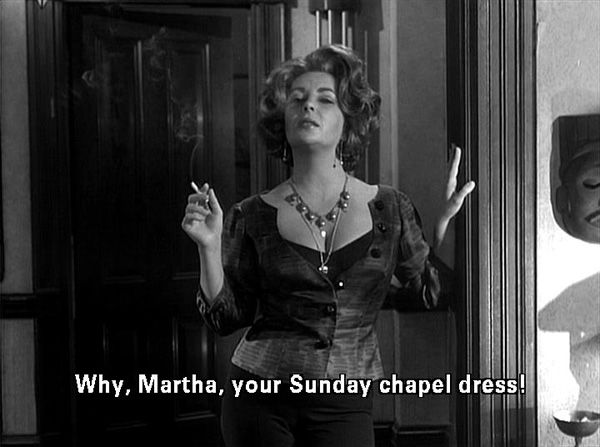
Finally, I feel like I need to address the 1966 movie. I saw it a couple of years ago, and... Well, could there be any more perfect George and Martha than Richard Burton and Elizabeth Taylor? She claws her way through the movie and he's seething with disappointment, and together they form one big firecracker that might at any moment explode on your face, but you still can't turn away.
In Who's Afraid of Virginia Woolf?, George and Martha return home from a party with a younger couple, Nick and Honey, and end up downing a drink or two or ten during the night. Nick and Honey can't seem to drag themselves away from the revelling that seems more like a surreal nightmare of funhouse distortion mirrors. The guests are dragged into the endless pit of hell that is the marriage of George and Martha, who poke each other in soft spots, rave and scream, and act like 5-year-olds or like they're possessed with demons.
The night is a mud-slinging disaster you can't look away from. Filled with pitch black humor, Albee's play ploughs all the stuffy 1950s social conventions and delusions about the American nuclear family dream, and plays with its characters by shaking them to the core and spitting them out. Long before the shock revelation at the end, the mood becomes increasingly oppressive, and the ominous hints thrown here and there confirm that George and Martha aren't just a middle-aged couple who want to drive each other insane for the heck of it.
With all their spiteful screeching, they turn into a big gust of wind that blows the straw and twig house down. When George gives the ruins the final tap, the rest of the structure falls, and Martha is forced to face the reality that follows her breaking the rule of their game, and they both need to figure out how to survive in the open air. The raving has been reduced to emptiness, and the guilt and disappointment have turned into exhaustion. The future remains uncertain, but it's entirely possible that George and Martha can't handle a brick house, because that would remind them of their misery and hatred. Martha certainly isn't ready to live without illusion, and the couple's weaknesses might just lead them to harboring their wolf again.
Finally, I feel like I need to address the 1966 movie. I saw it a couple of years ago, and... Well, could there be any more perfect George and Martha than Richard Burton and Elizabeth Taylor? She claws her way through the movie and he's seething with disappointment, and together they form one big firecracker that might at any moment explode on your face, but you still can't turn away.
MARTHA: I can't even see you... I haven't been able to see you for years...
GEORGE: ... if you pass out, or throw up, or something...
MARTHA: ... I mean, you're a blank,a cipher...
GEORGE: ... and try to keep your clothes on, too. There aren't many more sickening sights than you with a couple of drinks in you and your skirt up over your head, you know...