Take a photo of a barcode or cover


My faceless neighbor spoke up: “Don't be deluded. Hitler has made it clear that he will annihilate all Jews before the clock strikes twelve.”the sheer bleak helplessness in this short memoir is fucking devastating.
I exploded: “What do you care what he said? Would you want us to consider him a prophet?”
His cold eyes stared at me. At last, he said wearily: “I have more faith in Hitler than in anyone else. He alone has kept his promises, all his promises, to the Jewish people."


3.5 stars.
She remembered then that Harry was dead. I remember that I remember that, she thought. Thank God that fact was sticky enough; she wanted to honour it. Every future minute announced itself, broad and without Harry. And then her life, her whole past, crowded up against this minute—entirely filled this minute, it was over so quickly.

"This idea undermining [the film] Girlhood, that saying I feel for you to a woman unlike yourself means you somehow share in her experience, is one of the pitfalls that plagues mainstream feminism. It signals to women of color that their stories are only worth telling if a white person can understand them, and therefore that a white person’s emotions and responses are of greater importance than the stories themselves. We cannot come together if we do not recognize our differences first. These differences are best articulated when women of color occupy the center of the discourse while white women remain silent, actively listen, and do not try to reinforce supremacy by inserting themselves in the middle of the discussion."

There's something very androgynous about Flynn's female characters - I noticed this in her short The Grown-Up as well. Despite being very obviously about cis-women, despite the fact that Sharp Object's protagonist thinks she has a beautiful face, this is still written with much less gender-coded language than I am used to.
Camille is working for a second-rate newspaper out of Chicago when she is reluctantly sent back to her old hometown to cover a possible serial killer; a little girl is dead and another has gone missing a year later. Camille has a precarious relationship with her mother, a mysterious dead sister, a stepfather and a much younger half-sister she's never bothered to meet. (Sidebar: the description of her stepfather is one of my favorite lines, oddly enough: "Alan was, if anything, thinner than my mother with cheekbones that jutted out of his face so high ... overdressed as always, even for an evening of sweet drinks with my mother. [...] He sweated not at all. Alan is the opposite of moist .")
Her mother is a high-maintenance woman in all respects. As soon as her fluttering hands and attacks of nerves became apparent, I suspectedMunchausen Syndrome by Proxy as the cause of death for Camille's much mourned younger sister. After all, it's much easier to get to the root of motivations in narrative fiction than in real life, which is the biggest block to both diagnosis and legal sentencing of MSbP. "People whispered comfort about Marian being called back to heaven, but my mother would not be distracted from her grief. To this day it remains a hobby."
"[Adora] looked more comfortable in the Nash house than Mrs. Nash did. It was a natural gift for Adora, making other women feel incidental."
The behavior of the pack of housewives, the pack of preteen girls and all those ladies in between makes me feel as if Flynn is bludgeoning me with commentary on how society has shaped women into being sharp, caustic beings with one another. We cannot be friendly, because we must Compete.
Camille holds some gross opinions about women; she's not entirely wrong about "sometimes drunk women aren't raped", because their partners are equally or more drunk and therefore both sides have consent issues. She seems to have issues seeing rape culture for what it is, likely due to defensiveness about her own past promiscuity and what led her down that path (spoiler alert, it's not just "liking sex"). Just a page after her annoyed commentary to the Chicago detective about "liberal lefty men practicing sexual discrimination under the guise of protecting women against sexual discrimination" she thinks of a past event in her teens: "... my first blow job, at age thirteen. A senior on the baseball team took me under his wing, then took me into the woods. He wouldn't kiss me until I serviced him. Then he wouldn't kiss me because of where my mouth had been. Young love."
The complex relationship she has with her mother and the burgeoning one with her much younger half-sister Amma are so delicately fucked up, it's amazingly believable. The mystery of the dead girls is almost incidental to finding out what the hell is even going on in her family. Once the murderer is revealed once and for all, the only surprise is my complete and utter lack of it. Not because it was oh-so obvious, but becauseyeah, fucking Amma is a sociopath. Of course? Anyone who knew her was aware, they just never made the jump from "cruel thirteen year old girl" to "murderer and tooth collector of other small girls", likely due to the general consensus of serial killing being an exclusively male phenomenon. Come on girls, we can do anything we put our minds to!
Gillian Flynn writes some fucked up people and it is excellent.
Camille is working for a second-rate newspaper out of Chicago when she is reluctantly sent back to her old hometown to cover a possible serial killer; a little girl is dead and another has gone missing a year later. Camille has a precarious relationship with her mother, a mysterious dead sister, a stepfather and a much younger half-sister she's never bothered to meet. (Sidebar: the description of her stepfather is one of my favorite lines, oddly enough: "Alan was, if anything, thinner than my mother with cheekbones that jutted out of his face so high ... overdressed as always, even for an evening of sweet drinks with my mother. [...] He sweated not at all. Alan is the opposite of moist .")
Her mother is a high-maintenance woman in all respects. As soon as her fluttering hands and attacks of nerves became apparent, I suspected
"[Adora] looked more comfortable in the Nash house than Mrs. Nash did. It was a natural gift for Adora, making other women feel incidental."
The behavior of the pack of housewives, the pack of preteen girls and all those ladies in between makes me feel as if Flynn is bludgeoning me with commentary on how society has shaped women into being sharp, caustic beings with one another. We cannot be friendly, because we must Compete.
Camille holds some gross opinions about women; she's not entirely wrong about "sometimes drunk women aren't raped", because their partners are equally or more drunk and therefore both sides have consent issues. She seems to have issues seeing rape culture for what it is, likely due to defensiveness about her own past promiscuity and what led her down that path (spoiler alert, it's not just "liking sex"). Just a page after her annoyed commentary to the Chicago detective about "liberal lefty men practicing sexual discrimination under the guise of protecting women against sexual discrimination" she thinks of a past event in her teens: "... my first blow job, at age thirteen. A senior on the baseball team took me under his wing, then took me into the woods. He wouldn't kiss me until I serviced him. Then he wouldn't kiss me because of where my mouth had been. Young love."
The complex relationship she has with her mother and the burgeoning one with her much younger half-sister Amma are so delicately fucked up, it's amazingly believable. The mystery of the dead girls is almost incidental to finding out what the hell is even going on in her family. Once the murderer is revealed once and for all, the only surprise is my complete and utter lack of it. Not because it was oh-so obvious, but because
Gillian Flynn writes some fucked up people and it is excellent.

"I wonder if I could eat a child if I had the chance.”Review to come.
“I doubt if I could cook one,” said Constance.
"Poor strangers,” I said. “They have so much to be afraid of."

I was sold on Discworld with the first novel I picked up (Mort). Instead of continuing on with that series within a series, I moved onto Equal Rites where I met my love Granny Weatherwax and now I'm here, with the Ankh-Morpork City Watch. Pratchett was an amazing satirist and humor writer and the world is significantly poorer now that he has passed. It's a shame it took me so long to see this.
Carrot volunteers for the City Watch, determined to do as his father asks: to live among "his people" and find his place in the world. The Watch, unfortunately, has fallen into laziness and vague corruption under Ankh-Morpork's dictator's venerable gaze (he likes it better that way). Guards! Guards! is a new-old take on a surprisingly talented rookie (Carrot) paired with the alcoholic, cynical veteran (Vimes). The plot revolves around unregistered magic being utilized by the world's Most Pathetic Cult, resulting in a big ass Traditional Dragon popping up to terrify (almost everyone) or delight (Lady Ramkin, a purveyor of designer pet swamp dragons). Captain of the Watch, Sam Vimes, is in the thick of it, bewildered and staggering towards answers.
In the night time streets of Ankh-Morpork caution is an absolute. There is no such thing as moderately cautious. You are either very cautious, or you are dead. You might be walking around and breathing, but you’re dead, just the same.I think that I know the most about the City Watch series through word-of-mouth. It's not even featured in this book, but the Vimes "boots theory of socioeconomic unfairness" is a popular description of how much money it costs to be poor. It's true and he should say it. Because of this, I'm predisposed to like him as a character before opening the book at all. And I did! But it turns out that Carrot is the one to surprise me in the end.
It’s a terrible thing to be nearly sixteen and the wrong species.Carrot is a Big Boy trying to be a Good Man, whatever that is, considering he thought for sixteen years that he was just an overly large dwarf. I love when authors work with characters whose cultures do not employ metaphors or sarcasm, because it brings such joyful shenanigans when they interact with other people.
“We didn’t like to say so before, son,” said his father. “We thought you’d grow out of it, see.”
“Grow out of what?” said Carrot.
“Growing."
Carrot volunteers for the City Watch, determined to do as his father asks: to live among "his people" and find his place in the world. The Watch, unfortunately, has fallen into laziness and vague corruption under Ankh-Morpork's dictator's venerable gaze (he likes it better that way). Guards! Guards! is a new-old take on a surprisingly talented rookie (Carrot) paired with the alcoholic, cynical veteran (Vimes). The plot revolves around unregistered magic being utilized by the world's Most Pathetic Cult, resulting in a big ass Traditional Dragon popping up to terrify (almost everyone) or delight (Lady Ramkin, a purveyor of designer pet swamp dragons). Captain of the Watch, Sam Vimes, is in the thick of it, bewildered and staggering towards answers.
"Listen, if anyone ever sets fire to this city, it’s going to be me."Vimes solves the case almost in spite of himself, though a series of shenanigans including a dragon king, the Librarian and philosophical discussions of human sacrifices. But in the end, there's a triumph of sorts and Vimes is relieved from his history of being Brought Low By a Woman by realizing how high the right woman could take him.
And then it arose and struck Vimes that, in her own special category, she was quite beautiful; this was the category of all the women, in his entire life, who had ever thought he was worth smiling at. She couldn’t do worse, but then, he couldn’t do better. So maybe it balanced out. She wasn’t getting any younger but then, who was? And she had style and money and common-sense and self-assurance and all the things that he didn’t, and she had opened her heart, and if you let her she could engulf you; the woman was a city.
And eventually, under siege, you did what Ankh-Morpork had always done—unbar the gates, let the conquerors in, and make them your own.

3.5 stars.
"It happens at times that men can outlive themselves and persevere, like wraiths, by carrying out the actions they have always carried out; their souls are mute but not their voices, and their hands and feet do not stop moving."
Review to come.
"It happens at times that men can outlive themselves and persevere, like wraiths, by carrying out the actions they have always carried out; their souls are mute but not their voices, and their hands and feet do not stop moving."
Review to come.

3.75 stars, including my scholarly notes:
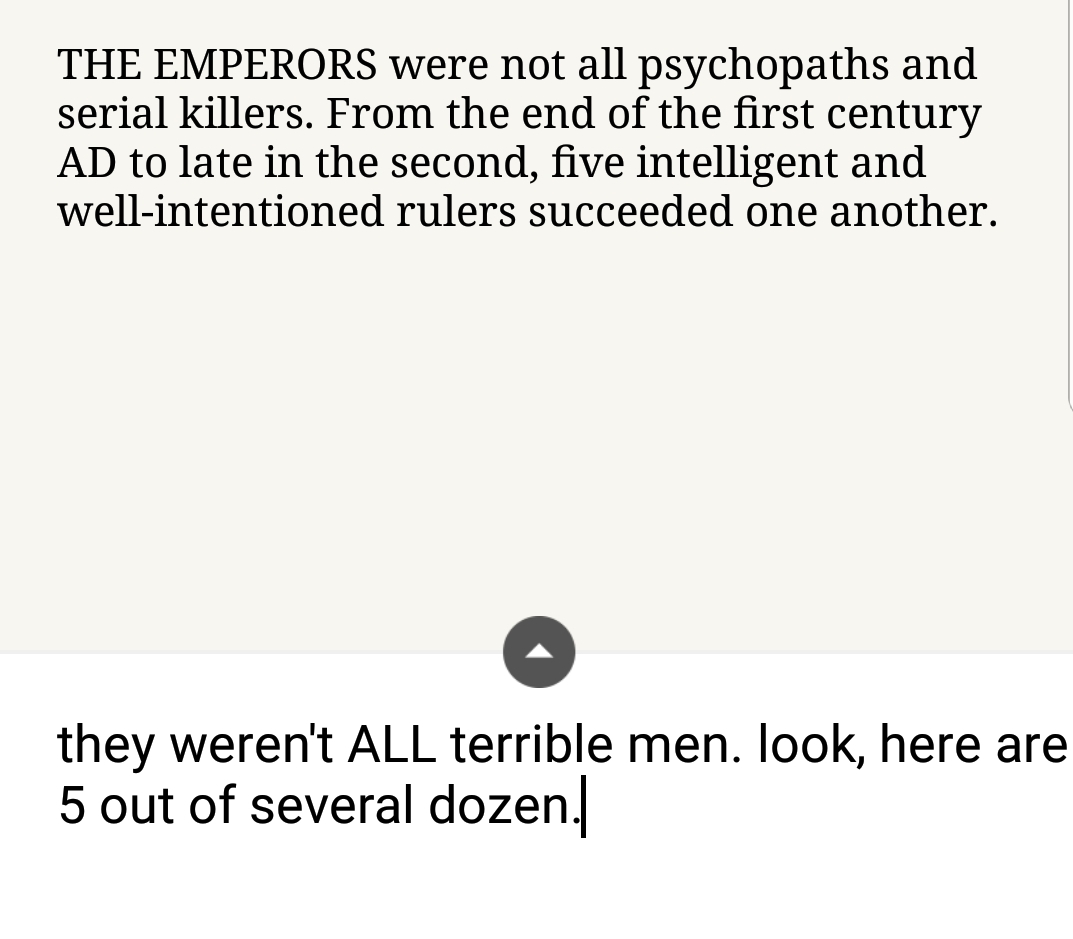
SPQR is broken up by topics rather than chronology, which made it easy to pick up and put down as I had time, but also impeded my ability to create a coherent image of when things where happening. The Roman Empire was around for a long ass time, my dudes. Everitt does also provide an abbreviated timeline at the end, but ain't nobody got time for flip-flopping back and forth.
SPQR is broken up by topics rather than chronology, which made it easy to pick up and put down as I had time, but also impeded my ability to create a coherent image of when things where happening. The Roman Empire was around for a long ass time, my dudes. Everitt does also provide an abbreviated timeline at the end, but ain't nobody got time for flip-flopping back and forth.

This was a book I chose for last year's POPSUGAR challenge: "a book tied to your ancestry". As a white American with an incredibly muddled background, I can't think of anything more relevant than a history of the anger, frustration, cruelty and privilege we've kinda spread all over everyone up to this very day. I didn't make the time to read it last year, but I made a point to choose it now.
What a very different nation we would be if all the enormous legal and political efforts that went into subverting and undermining the right to education had actually been used to uphold and ensure that right.Review to come, if I can swallow my anger and disgust and put together words on the history my country likes to pretend doesn't exist.