Take a photo of a barcode or cover
1.77k reviews by:
theanitaalvarez


Let's face, we need more women who are able to talk about their bodies and struggles with passion and honesty. Which is precisely what this amazing woman is doing in her book. I particularly loved when she discussed her abortion in a raw and sincere manner, without ever regretting it and rejecting the narrative that makes women who had abortions be eternally regretful. It was the right choice for her at that moment, it was not a particulary traumatic experience and it was good for her. My own views on abortion are somewhat complicated (I was raised in a Catholic household, and I do believe, even if I'm slightly lapsed right now: mostly because the way women and LGBT people are treated by religious people).
Another part I loved was how her husband proposed in a public way. Why? Because once, while drunk, Lindy told him that if he ever proposed, she wanted what skinny girls got: the chance to be a price, instead of being hidden from the world. Lindy West is a catch, and her husband knows it. Society will tell her that she's not, because she's fat and not traditionally attractive. Her weight and shape had nothing to do with it, but her intelligence and bravery make her so. And it's clear throughout her book. She's not "smart but fat"; she's "smart AND fat". And damn proud of both.
Also, I loved how she highlight how shitty is to be a woman in the internet (seriously, it's hard not to get abuse when you dare to express any feeling that differentiate you from a plant). Lindy has been trolled (the worst one used her dead father's name, and he ended up apologized for being a shit person. I had heard that story on This American Life, and it was one of my favorites ever in the show. It's raw and powerful. And shows that people can be better, even if they do crappy things.
Lindy, you're awesome. Keep doing you and keeping it real. The world really needs you.
Another part I loved was how her husband proposed in a public way. Why? Because once, while drunk, Lindy told him that if he ever proposed, she wanted what skinny girls got: the chance to be a price, instead of being hidden from the world. Lindy West is a catch, and her husband knows it. Society will tell her that she's not, because she's fat and not traditionally attractive. Her weight and shape had nothing to do with it, but her intelligence and bravery make her so. And it's clear throughout her book. She's not "smart but fat"; she's "smart AND fat". And damn proud of both.
Also, I loved how she highlight how shitty is to be a woman in the internet (seriously, it's hard not to get abuse when you dare to express any feeling that differentiate you from a plant). Lindy has been trolled (the worst one used her dead father's name, and he ended up apologized for being a shit person. I had heard that story on This American Life, and it was one of my favorites ever in the show. It's raw and powerful. And shows that people can be better, even if they do crappy things.
Lindy, you're awesome. Keep doing you and keeping it real. The world really needs you.

It's funny that this book and Little Women are set in the same time period. Finding similarities between Scarlett and Jo is pretty much an impossible task. And yes, the two girls are indeed completely different, even if they both are around the same age (actually, she's Meg's age). Anyway, both books are amazing in their own way. And Scarlett is a very impressive character, all in all.
When it comes to book adaptations, I usually prefer to read the source material beforehand (and then spend the entire movie complaining about how they changed everything and now it sucks). In the case of Gone with the Wind, I watched the film before. Mom decided to watch it one day, so she took over the only TV we had (we still have only one TV, but with computers and so on, watching films doesn't imply paralizing the entire house). I complained because I was a twelve-year-old and that's what girls that age do. But I did watch some of the scenes and became curious. So one night, after everyone had gone to bed, I put the DVD in the player and began watching it (it took me two nights to watch the whole thing. It lasts four hours, for God's sake!). I was immediately captured by it.
Some years later, I found the first part of the novel in one of my best friend's house (I'm annoying and like to examine people's bookshelves when I'm visiting). She didn't have the second part, but I borrowed it anyway. I'm an awful bookworm and even half a book was a good option. So I read it, but never discovered the end of Scarlett's life. I knew that from the movie, so it didn't bother me much.
So, last year I found a good edition for my beloved Kindle and decided to finally read the whole thing. I enjoyed the whole time.
Scarlett is indeed a brat. She only thinks about herself and cannot care at all for others. There are only two persons in the entire novel who manage to make her stop thinking about herself: Ashley and little Bonnie. But her feelings for him are still obsessive. She may think she loves him, but he seems more like a caprice than anything else.
But she's not merely a capricious brat. She does have an incredible strenght and a will that cannot be broken. She is determined, whether about staying close to her beloved Ashley (I still don't get what she sees in him. He's rather boring, if I may say so), or to never be hungry again. She is the kind of person who doesn't let anything get in her way. Yes, she can be brutal and ruthless, but she does what she has to do. Even if it includes marrying her sister's beau (shame on you, Scarlett).
If I had been in Scarlett's place, I'd never paid any attention to boring Ashley. Specially when there's Rhett to fall in love with. Oh, dear. Rhett is brilliant. From their very first meeting, when she throws something (it escapes my mind right now). He sees that Scarlett's fiery temper is not matched in her ladylike attire and how she tries to act. He can see right through her and he likes what he sees.
From that moment on, I cheered and fangirled everytime Mr. Butler appeared in the book (he's forever tied to Clark Gable's looks in my head). He's just great. I loved the way in which he played around with Scarlett, to make her do whatever he wanted her to. He manipulates everyone, to be fair. During the war and the time after it, he showed everyone he didn't care whate they thought about him. But with Bonnie's birth, he decides that his child would only move in the best society, so he tried really hard to fit there. And of course, he charmed the pants (and petticoats) out of all Atlanta. Rhett always get whatever he wants.
My favorite parts are those that show his love for his daughter. He's willing to spoil her with literally everything. And he cared for her in a way that was sweet.
Of course, I'll mention the infamous rape scene. It was rape, even if they were married and she says she enjoyed it. I will no excuse Rhett's conduct, obviously. Even if I fangirled over him the entire book, he did rape his wife. But again, it shows that he get what he wants and that he ca be as ruthless as Scarlett is.
It's amzing how Mitchell managed to portray the old South's views. It's usually challenged because there are a lot of racist remarks (and there's no way to deny it). But the whole novel is about people who were racist, had slaves and thought they were going to last forever. It's the story of the end of an epoch, the fall of an Empire. And it's a hard fall.
When it comes to book adaptations, I usually prefer to read the source material beforehand (and then spend the entire movie complaining about how they changed everything and now it sucks). In the case of Gone with the Wind, I watched the film before. Mom decided to watch it one day, so she took over the only TV we had (we still have only one TV, but with computers and so on, watching films doesn't imply paralizing the entire house). I complained because I was a twelve-year-old and that's what girls that age do. But I did watch some of the scenes and became curious. So one night, after everyone had gone to bed, I put the DVD in the player and began watching it (it took me two nights to watch the whole thing. It lasts four hours, for God's sake!). I was immediately captured by it.
Some years later, I found the first part of the novel in one of my best friend's house (I'm annoying and like to examine people's bookshelves when I'm visiting). She didn't have the second part, but I borrowed it anyway. I'm an awful bookworm and even half a book was a good option. So I read it, but never discovered the end of Scarlett's life. I knew that from the movie, so it didn't bother me much.
So, last year I found a good edition for my beloved Kindle and decided to finally read the whole thing. I enjoyed the whole time.
Scarlett is indeed a brat. She only thinks about herself and cannot care at all for others. There are only two persons in the entire novel who manage to make her stop thinking about herself: Ashley and little Bonnie. But her feelings for him are still obsessive. She may think she loves him, but he seems more like a caprice than anything else.
But she's not merely a capricious brat. She does have an incredible strenght and a will that cannot be broken. She is determined, whether about staying close to her beloved Ashley (I still don't get what she sees in him. He's rather boring, if I may say so), or to never be hungry again. She is the kind of person who doesn't let anything get in her way. Yes, she can be brutal and ruthless, but she does what she has to do. Even if it includes marrying her sister's beau (shame on you, Scarlett).
If I had been in Scarlett's place, I'd never paid any attention to boring Ashley. Specially when there's Rhett to fall in love with. Oh, dear. Rhett is brilliant. From their very first meeting, when she throws something (it escapes my mind right now). He sees that Scarlett's fiery temper is not matched in her ladylike attire and how she tries to act. He can see right through her and he likes what he sees.
From that moment on, I cheered and fangirled everytime Mr. Butler appeared in the book (he's forever tied to Clark Gable's looks in my head). He's just great. I loved the way in which he played around with Scarlett, to make her do whatever he wanted her to. He manipulates everyone, to be fair. During the war and the time after it, he showed everyone he didn't care whate they thought about him. But with Bonnie's birth, he decides that his child would only move in the best society, so he tried really hard to fit there. And of course, he charmed the pants (and petticoats) out of all Atlanta. Rhett always get whatever he wants.
My favorite parts are those that show his love for his daughter. He's willing to spoil her with literally everything. And he cared for her in a way that was sweet.
Of course, I'll mention the infamous rape scene. It was rape, even if they were married and she says she enjoyed it. I will no excuse Rhett's conduct, obviously. Even if I fangirled over him the entire book, he did rape his wife. But again, it shows that he get what he wants and that he ca be as ruthless as Scarlett is.
It's amzing how Mitchell managed to portray the old South's views. It's usually challenged because there are a lot of racist remarks (and there's no way to deny it). But the whole novel is about people who were racist, had slaves and thought they were going to last forever. It's the story of the end of an epoch, the fall of an Empire. And it's a hard fall.

The Nutcracker: The Classic Christmas Fantasy - The Original Tale In Two Versions
E.T.A. Hoffmann, Alexandre Dumas
This is one of the classic Christmas stories (along with A Christmas Carol by Dickens, there's a new version every year for Christmas)and the edition ilustrated by Scott Gustafson is beautiful.
I got this book as a gift (for Christmas, obviously), because at that point I was pretty much in love with ballet. Reading the story that I've seen so many times in movies and the stage (it is somewhat traditional that the National Ballet of my country performs this ballet for Christmas and my parents had taken me to see it) was amazing. The story itself is gorgeous and the illustrations made it even better.
One of the gifts I remember most fondly.
I got this book as a gift (for Christmas, obviously), because at that point I was pretty much in love with ballet. Reading the story that I've seen so many times in movies and the stage (it is somewhat traditional that the National Ballet of my country performs this ballet for Christmas and my parents had taken me to see it) was amazing. The story itself is gorgeous and the illustrations made it even better.
One of the gifts I remember most fondly.

WARNING: In this review there will be spoilers. As far as you can spoil a 200-year-old book, though. Why has anyone NOT read this book? I also have to tell you that there also will be fair amounts of fangirling. Sorry about that.
And thus the most amazing love story in the world begins.
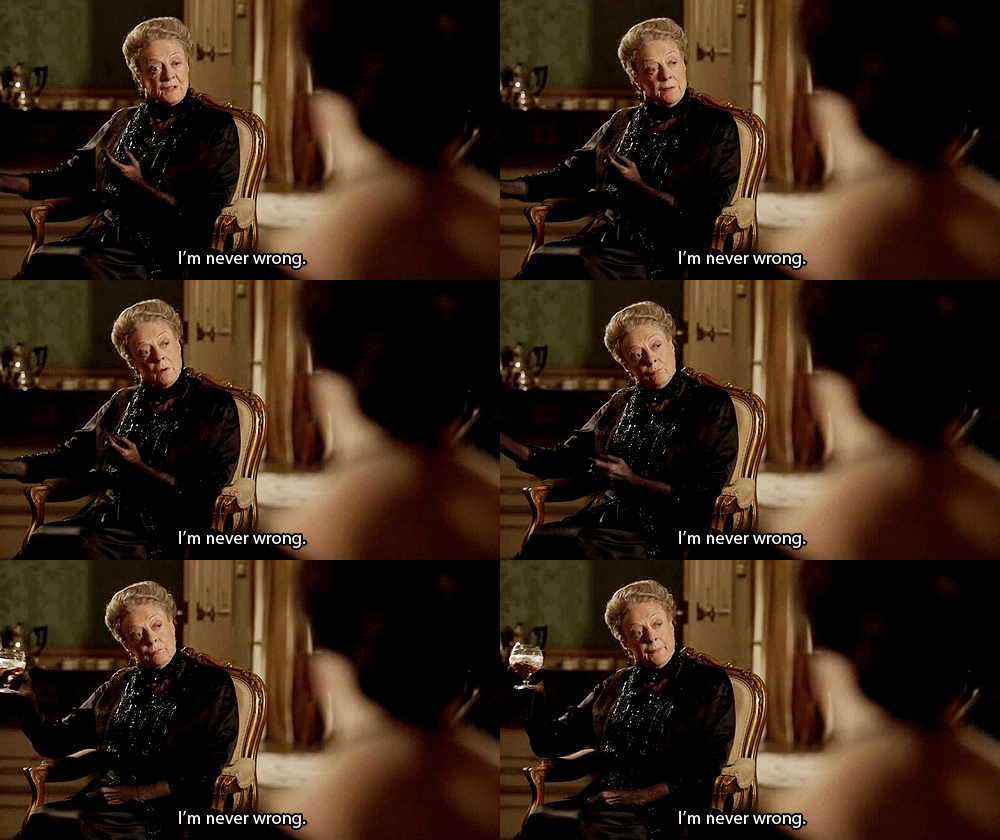
And we get to one of the things I absolutely adore about Pride and Prejudice: its narrator. Oh, the narrator. After Downton Abbey I can’t avoid thinking of this novel’s narrator as the ancestor of the Dowager Countess, so I’ll refer to it as a she. We all know the narrator is a sassy old lady, and she rocks.
Just in that first sentence, we get the tone of the book. Somewhat self-mocking, acid and critic of the society it is inserted. Of course young, single men have nothing better to with their time and money than get a bride. Basically, it is so because young ladies had nothing better to do than look for a husband.
Self-deprecation much?
Then we get to meet the family around which the story is centered: welcome to the the Bennet household, population: an overbearing mother, a somewhat disinterested father and five lovely daughters. Jane, practically perfect in every way; Lizzie, witty and cynic; Mary, pretentious; Kitty, silly; and Lydia, even sillier. I love how the dynamics play in the family.
Mrs. Bennet is crazy, and spoils her two youngest daughters. Mr. Bennet hides from his wife’s craziness and makes fun of her at every chance he’s got (seriously, his comments are the best!). Lizzy mocks everyone, but she kinds of loves them anyway, crazy and all. Mary tries to moralize, though nobody marks her. And Jane just is nice at everyone.

Of course, I identified with Lizzy. I’ve also have a big, crazy family. And I usually make fun of everyone and their own special brand of crazy, but I cannot help but love them anyway. Even if they annoy the heck out of me (they do pretty often), they’re still family.
The event that sets everything into motion is the arrival of a mysterious Mr. Bingley to a house in the neighborhood. He’s young, single and (most importantly) RICH. And Mrs. Bennet decides that he must have one of her five daughters, of course. No one cares what the rich dude wants.
So, anyway, they finally get to meet him and his sisters, one of them is married, the other one is a mean girl. Well, both of them are. And there’s also Darcy, Bingley’s friend. He’s dark, handsome and even richer than Mr. Bingley.
How did people at that time get all that financial information about people they meet at a party? My guess is as good as yours. But the important thing here is that we have not only one, but two young, single, and rich dudes hanging around the neighborhood.

Oh, and there’s also Mr. Hurst, Bingley’s brother-in-law. But he spends all his time slightly drunk or sleeping (okay, I’m kidding here. But I’ve always thought he was drunk most of the time).
And here is when the plot finally takes off.
You see, Lizzy Bennet and our rich and mysterious Mr. Darcy don’t like each other at first sight. Well, to be fair, he actually says that she is “tolerable”, which infuriates Lizzy. But the point is that they aren’t each other’s favorite person to hang around. At least from Lizzy’s side of the question.
You see, most of the book is narrated through Lizzy’s eyes. We get her impressions on Mr. Darcy’s behavior, and everyone’s attitude. It’s only in the second part where we get other people’s side of the story, as they explain their situations to Lizzie.
I almost forgot to mention dear Mr. Collins. He’s a cousin that (for some legal reason) is going to inherit the Bennet’s state. He’s a priest and decides to visit his long-stranded family because he wishes to show his parishioners a good example. That could be a good thing, except this dude is probably the most infuriating and pompous character ever. He sucks it up to people more powerful and rich than him (basically, he kisses Lady de Bourgh’s butt way too many times), he makes annoying compliments and… he wants to get married.
(I’ll admit Collins is one of my favorite characters, just because he makes me laugh too much.)
And the chosen one is none other than poor Lizzy. She gets to receive all these unwanted attentions from Mr. Collins, who is the perfect definition of “a pain in the ass”. But she’s very lucky, because she has a friend who has a lot more patience than her, and is a lot more desperate about her spinsterhood (Charlotte is said to be twenty-seven). So, after failing to snatch his cousin, Mr. Collins settles for an older and less pretty girl, but who is also willing to settle for him. In my opinion, that is a higher sacrifice than his. Lizzy is outraged because she thinks her friend is throwing her life away, as Mr. Collins is the worst husband a Regency girl can hope for. But Charlotte really wants to stop being a spinster, so she doesn’t really care that much about whom the lucky guy was.
The two friends stop talking to each other because of this, but they later make up and go back to being friends, though Lizzie notes that their relation appears to be somewhat changed. But Charlotte is a good sport and invites Lizzie to visit her and Collins in the countryside. There, Lizzie gets to meet Collin’s patroness, Lady Catherine Du Bourgh. Who is this illustrious woman? The owner of a huge house (Rosings), constant giver of never-asked-for advice, and Darcy’s aunt. And yes, he appears again.
And yes, Lizzie keeps finding him annoying and pompous. But things are beginning to get weird here, because he keeps popping up wherever she happens to be. She also becomes a good friend of Captain Fitzwilliam, Darcy’s cousin and second son of an Earl. He’s a nicer dude than his cousin, and tries to show her a different side of his cousin. However, he fails miserably when he is the one who tells her why Bingley left. Apparently, Darcy was trying to protect his friend of an unsuitable marriage, to Jane (though Captain Fitzwilliam didn’t know that part of the story). Of course it corroborates Lizzie’s idea of him: he’s mean and awful and hates her because she’s poorer than him.
But here you get one of the most brilliant points in Austen’s work: how information is presented to the readers throughout the whole novel. At first, you get one side of the affair and the whole story builds up to match Lizzy’s point of view. But then, you get a sudden revelation, and the story turns completely around.
Of course, I’m talking here about the famous declaration (which is a hundred times more awkward in the book than in the film, but the point gets across). Darcy surprised Lizzy by asking her to marry him (the reader is not as surprised, because we have read what he said about her eyes. The ship sails itself).
By that point, Lizzy is pretty much convinced that Darcy somehow managed to break up Jane and Bingley, who liked each other at the ball and appeared to be very close for some time afterwards. But then, Bingley & co. left without telling anybody, so Jane was (understandably) heartbroken. And Lizzy was sure that Darcy and Caroline Bingley had more to do in the affair than Bingley himself.
Oh, and there’s also another young and handsome (but no rich) man lurking around. George Wickham, a soldier in the militia that decides to spend a few months making young Meryton girls (namely, the two younger Bennet sisters) go crazy for their red coats. But Wickham takes a fancy to Lizzy, who is always playing it cool. But he finally gets to her by revealing that of course Darcy is the bastard Lizzy thought him to be. According to this charming soldier, Darcy’s father had promised him a handsome amount so he could join the clergy. He also omits to tell her a series of very unflattering things about himself, but that’s a later concern.
So, Darcy proposes to Lizzy, and she confronts him about Jane and Wickham. Of course, Darcy is shocked by Lizzy’s rejection (dude, you need to work on your social skills. They’re worse than mine), and they end up fighting.
Darcy leaves and writes her a letter explaining the whole situation. And Lizzy, after reading it, realizes that she might not be right about everything. In the letter (which is gorgeous)he explains that Wickham asked him for the money Darcy's father had promised him, but spend it all in not-very-studenty activities, and that he almos got Georgiana, Darcy's baby sister, to elope with him to get her money. So yeah, Wickham is very much not the charming young man he makes himself to be.
I really like this about this book. It’s not like Lizzy is an infallible character who can only do things and is always right. Not at all. She’s easily charmed by Wickham’s charms, she makes hasty (to put it mildly) judgments about everyone, and forgets to listen to other people’s opinion. And her attitude is not only destructive to herself, but she also endangers her own family.
And even if they annoy her to no end, they’re still family. She makes a point about that.
Lizzy’s uncle and aunt invite her to tag along as they travel north. More precisely, they go to the county where the Darcy family humongous mansion is. And yes, they meet him there. But he appears to be more relaxed in his own environment, and Lizzy finds herself discovering that the horrible dude who dared to call her “tolerable” is actually quite nice (that is, when you get to know him). He’s not even bitter about her earlier rejection and eventually introduces her to his own little sister, Georgiana.
But disaster strikes again. This time, it comes from Lizzie’s younger, fun-loving sister, Lydia. She elopes with Wickham. At first, everyone believes that they plan to cross to Scotland and get married there (due to the different laws for marriage in both countries). However, they soon realize that the couple of love birds are not going North, precisely. When Lizzie finds out, the first person she runs into is Darcy, and she ends up telling him the whole story. He’s nice enough to calm her down and call for her relatives, which decide that the logic step is to go home.
There, as you can imagine, Mrs. Bennet’s nerves are breaking havoc. Mr. Bennet and his brother-in-law go to London (they have evidence to believe Lydia and Wickham are there), but they cannot find her. Mr. Bennet returns defeated, and the whole family is shocked by what happened, when they get a letter from their relatives in London: Lydia has been found, with Wickham, and they are willing to get married ASAP.
But our brilliant Lizzie is smelling something rotten there. Nobody in their sane mind would marry Lydia for the little money their uncle says is being promised to the guy. So when Lydia makes a comment about Darcy being present at her wedding, Lizzie is utterly surprised. Didn’t this guy hate her?
So she asks her aunt about it, and she confirms what Lydia has said. It was Darcy the one who found Lydia and Wickham and that made him a huge offer for him to marry the foolish girl.
Talk about true love! I mean, that was a truly big gesture, and more meaningful for her than flowers or chocolates (I’m not sure whether chocolates were the thing in Regency England, but I think not, which is a shame). Ladies, when a man is willing to clean up after your little sister’s messes, it means he’s the right guy.
And then, Bingley comes back! (with Darcy, of course) He has learned Jane’s true feelings for him and he’s going to see if they remain the same (spoiler alert: they do). After a few visits (and Mrs. Bennet cunning plans to leave them alone), they become engaged.
At this point, Darcy’s lovely aunt appears. This time, she’s there to confront Lizzie about her engagement to Darcy. Lady de Bourgh is outraged at the idea that her nephew would ever think of marrying a girl from an inferior social class, as Lizzie. And she demands that Lizzie ceases the inexistent engagement at once. After a heated argument, Lizzie ends up telling her to go to hell (but very politely, of course).
But what has happened with Lizzie and our beloved Mr. Darcy? NOTHING. They share a few awkward moments, but they never get to talk to each other. I think I was so frustrated at this point of the book that I wanted to get into it and shove them both into a closet or something.
Thank goodness, Mrs. Bennet (who else?) did that for me. Well, she didn’t shove them into a closet (not very proper in Regency England, I guess), but she did force them to go walking to accompany Jane and Bingley. After losing Kitty (she felt awkward being around Darcy), Lizzie tries to tell Darcy how thankful she is for all what he has done for the family.
Darcy’s answer?
That he did it for her!
*Dies of pure fangirlish joy*

I’m sorry, but anyone who hasn’t lost their panties at this point for our hero, is probably missing the whole point of the business. I’m sorry, but a dude who’s capable to doing such a thing out of love and generosity is just… amazing. (Reason #1 why Mr. Darcy can kick Edward Cullen’s ass). He then asks her if she feels any differently about him and the rest is history.
This is one of my favorite books of all times (it’s in the top 5). And it is so because all that is in the novel, besides the amazing love story. It’s a novel that has imperfect characters that get better as the plot goes on, shows a real family (not an ideal one) and has one great hero to top it all. Darcy and Lizzie’s relationship throughout the book is based on respect, besides the obvious attraction between the parties (you’re not fooling anyone, guys). At no point does Darcy act as if Lizzie is silly and needs to be protected, but when he does help her he does it because he wants to, not because she’s weak and defenseless.
I don’t know, they are my favorite couple ever and I adore this book way more than I can actually explain.
It is a truth universally acknowledged that a single man in possession of a great fortune, must be in want of a wife.
And thus the most amazing love story in the world begins.
And we get to one of the things I absolutely adore about Pride and Prejudice: its narrator. Oh, the narrator. After Downton Abbey I can’t avoid thinking of this novel’s narrator as the ancestor of the Dowager Countess, so I’ll refer to it as a she. We all know the narrator is a sassy old lady, and she rocks.
Just in that first sentence, we get the tone of the book. Somewhat self-mocking, acid and critic of the society it is inserted. Of course young, single men have nothing better to with their time and money than get a bride. Basically, it is so because young ladies had nothing better to do than look for a husband.
Self-deprecation much?
Then we get to meet the family around which the story is centered: welcome to the the Bennet household, population: an overbearing mother, a somewhat disinterested father and five lovely daughters. Jane, practically perfect in every way; Lizzie, witty and cynic; Mary, pretentious; Kitty, silly; and Lydia, even sillier. I love how the dynamics play in the family.
Mrs. Bennet is crazy, and spoils her two youngest daughters. Mr. Bennet hides from his wife’s craziness and makes fun of her at every chance he’s got (seriously, his comments are the best!). Lizzy mocks everyone, but she kinds of loves them anyway, crazy and all. Mary tries to moralize, though nobody marks her. And Jane just is nice at everyone.
Of course, I identified with Lizzy. I’ve also have a big, crazy family. And I usually make fun of everyone and their own special brand of crazy, but I cannot help but love them anyway. Even if they annoy the heck out of me (they do pretty often), they’re still family.
The event that sets everything into motion is the arrival of a mysterious Mr. Bingley to a house in the neighborhood. He’s young, single and (most importantly) RICH. And Mrs. Bennet decides that he must have one of her five daughters, of course. No one cares what the rich dude wants.
So, anyway, they finally get to meet him and his sisters, one of them is married, the other one is a mean girl. Well, both of them are. And there’s also Darcy, Bingley’s friend. He’s dark, handsome and even richer than Mr. Bingley.
How did people at that time get all that financial information about people they meet at a party? My guess is as good as yours. But the important thing here is that we have not only one, but two young, single, and rich dudes hanging around the neighborhood.
Oh, and there’s also Mr. Hurst, Bingley’s brother-in-law. But he spends all his time slightly drunk or sleeping (okay, I’m kidding here. But I’ve always thought he was drunk most of the time).
And here is when the plot finally takes off.
You see, Lizzy Bennet and our rich and mysterious Mr. Darcy don’t like each other at first sight. Well, to be fair, he actually says that she is “tolerable”, which infuriates Lizzy. But the point is that they aren’t each other’s favorite person to hang around. At least from Lizzy’s side of the question.
You see, most of the book is narrated through Lizzy’s eyes. We get her impressions on Mr. Darcy’s behavior, and everyone’s attitude. It’s only in the second part where we get other people’s side of the story, as they explain their situations to Lizzie.
I almost forgot to mention dear Mr. Collins. He’s a cousin that (for some legal reason) is going to inherit the Bennet’s state. He’s a priest and decides to visit his long-stranded family because he wishes to show his parishioners a good example. That could be a good thing, except this dude is probably the most infuriating and pompous character ever. He sucks it up to people more powerful and rich than him (basically, he kisses Lady de Bourgh’s butt way too many times), he makes annoying compliments and… he wants to get married.
(I’ll admit Collins is one of my favorite characters, just because he makes me laugh too much.)
And the chosen one is none other than poor Lizzy. She gets to receive all these unwanted attentions from Mr. Collins, who is the perfect definition of “a pain in the ass”. But she’s very lucky, because she has a friend who has a lot more patience than her, and is a lot more desperate about her spinsterhood (Charlotte is said to be twenty-seven). So, after failing to snatch his cousin, Mr. Collins settles for an older and less pretty girl, but who is also willing to settle for him. In my opinion, that is a higher sacrifice than his. Lizzy is outraged because she thinks her friend is throwing her life away, as Mr. Collins is the worst husband a Regency girl can hope for. But Charlotte really wants to stop being a spinster, so she doesn’t really care that much about whom the lucky guy was.
The two friends stop talking to each other because of this, but they later make up and go back to being friends, though Lizzie notes that their relation appears to be somewhat changed. But Charlotte is a good sport and invites Lizzie to visit her and Collins in the countryside. There, Lizzie gets to meet Collin’s patroness, Lady Catherine Du Bourgh. Who is this illustrious woman? The owner of a huge house (Rosings), constant giver of never-asked-for advice, and Darcy’s aunt. And yes, he appears again.
And yes, Lizzie keeps finding him annoying and pompous. But things are beginning to get weird here, because he keeps popping up wherever she happens to be. She also becomes a good friend of Captain Fitzwilliam, Darcy’s cousin and second son of an Earl. He’s a nicer dude than his cousin, and tries to show her a different side of his cousin. However, he fails miserably when he is the one who tells her why Bingley left. Apparently, Darcy was trying to protect his friend of an unsuitable marriage, to Jane (though Captain Fitzwilliam didn’t know that part of the story). Of course it corroborates Lizzie’s idea of him: he’s mean and awful and hates her because she’s poorer than him.
But here you get one of the most brilliant points in Austen’s work: how information is presented to the readers throughout the whole novel. At first, you get one side of the affair and the whole story builds up to match Lizzy’s point of view. But then, you get a sudden revelation, and the story turns completely around.
Of course, I’m talking here about the famous declaration (which is a hundred times more awkward in the book than in the film, but the point gets across). Darcy surprised Lizzy by asking her to marry him (the reader is not as surprised, because we have read what he said about her eyes. The ship sails itself).
By that point, Lizzy is pretty much convinced that Darcy somehow managed to break up Jane and Bingley, who liked each other at the ball and appeared to be very close for some time afterwards. But then, Bingley & co. left without telling anybody, so Jane was (understandably) heartbroken. And Lizzy was sure that Darcy and Caroline Bingley had more to do in the affair than Bingley himself.
Oh, and there’s also another young and handsome (but no rich) man lurking around. George Wickham, a soldier in the militia that decides to spend a few months making young Meryton girls (namely, the two younger Bennet sisters) go crazy for their red coats. But Wickham takes a fancy to Lizzy, who is always playing it cool. But he finally gets to her by revealing that of course Darcy is the bastard Lizzy thought him to be. According to this charming soldier, Darcy’s father had promised him a handsome amount so he could join the clergy. He also omits to tell her a series of very unflattering things about himself, but that’s a later concern.
So, Darcy proposes to Lizzy, and she confronts him about Jane and Wickham. Of course, Darcy is shocked by Lizzy’s rejection (dude, you need to work on your social skills. They’re worse than mine), and they end up fighting.
Darcy leaves and writes her a letter explaining the whole situation. And Lizzy, after reading it, realizes that she might not be right about everything. In the letter (which is gorgeous)he explains that Wickham asked him for the money Darcy's father had promised him, but spend it all in not-very-studenty activities, and that he almos got Georgiana, Darcy's baby sister, to elope with him to get her money. So yeah, Wickham is very much not the charming young man he makes himself to be.
I really like this about this book. It’s not like Lizzy is an infallible character who can only do things and is always right. Not at all. She’s easily charmed by Wickham’s charms, she makes hasty (to put it mildly) judgments about everyone, and forgets to listen to other people’s opinion. And her attitude is not only destructive to herself, but she also endangers her own family.
And even if they annoy her to no end, they’re still family. She makes a point about that.
Lizzy’s uncle and aunt invite her to tag along as they travel north. More precisely, they go to the county where the Darcy family humongous mansion is. And yes, they meet him there. But he appears to be more relaxed in his own environment, and Lizzy finds herself discovering that the horrible dude who dared to call her “tolerable” is actually quite nice (that is, when you get to know him). He’s not even bitter about her earlier rejection and eventually introduces her to his own little sister, Georgiana.
But disaster strikes again. This time, it comes from Lizzie’s younger, fun-loving sister, Lydia. She elopes with Wickham. At first, everyone believes that they plan to cross to Scotland and get married there (due to the different laws for marriage in both countries). However, they soon realize that the couple of love birds are not going North, precisely. When Lizzie finds out, the first person she runs into is Darcy, and she ends up telling him the whole story. He’s nice enough to calm her down and call for her relatives, which decide that the logic step is to go home.
There, as you can imagine, Mrs. Bennet’s nerves are breaking havoc. Mr. Bennet and his brother-in-law go to London (they have evidence to believe Lydia and Wickham are there), but they cannot find her. Mr. Bennet returns defeated, and the whole family is shocked by what happened, when they get a letter from their relatives in London: Lydia has been found, with Wickham, and they are willing to get married ASAP.
But our brilliant Lizzie is smelling something rotten there. Nobody in their sane mind would marry Lydia for the little money their uncle says is being promised to the guy. So when Lydia makes a comment about Darcy being present at her wedding, Lizzie is utterly surprised. Didn’t this guy hate her?
So she asks her aunt about it, and she confirms what Lydia has said. It was Darcy the one who found Lydia and Wickham and that made him a huge offer for him to marry the foolish girl.
Talk about true love! I mean, that was a truly big gesture, and more meaningful for her than flowers or chocolates (I’m not sure whether chocolates were the thing in Regency England, but I think not, which is a shame). Ladies, when a man is willing to clean up after your little sister’s messes, it means he’s the right guy.
And then, Bingley comes back! (with Darcy, of course) He has learned Jane’s true feelings for him and he’s going to see if they remain the same (spoiler alert: they do). After a few visits (and Mrs. Bennet cunning plans to leave them alone), they become engaged.
At this point, Darcy’s lovely aunt appears. This time, she’s there to confront Lizzie about her engagement to Darcy. Lady de Bourgh is outraged at the idea that her nephew would ever think of marrying a girl from an inferior social class, as Lizzie. And she demands that Lizzie ceases the inexistent engagement at once. After a heated argument, Lizzie ends up telling her to go to hell (but very politely, of course).
But what has happened with Lizzie and our beloved Mr. Darcy? NOTHING. They share a few awkward moments, but they never get to talk to each other. I think I was so frustrated at this point of the book that I wanted to get into it and shove them both into a closet or something.
Thank goodness, Mrs. Bennet (who else?) did that for me. Well, she didn’t shove them into a closet (not very proper in Regency England, I guess), but she did force them to go walking to accompany Jane and Bingley. After losing Kitty (she felt awkward being around Darcy), Lizzie tries to tell Darcy how thankful she is for all what he has done for the family.
Darcy’s answer?
That he did it for her!
*Dies of pure fangirlish joy*
I’m sorry, but anyone who hasn’t lost their panties at this point for our hero, is probably missing the whole point of the business. I’m sorry, but a dude who’s capable to doing such a thing out of love and generosity is just… amazing. (Reason #1 why Mr. Darcy can kick Edward Cullen’s ass). He then asks her if she feels any differently about him and the rest is history.
This is one of my favorite books of all times (it’s in the top 5). And it is so because all that is in the novel, besides the amazing love story. It’s a novel that has imperfect characters that get better as the plot goes on, shows a real family (not an ideal one) and has one great hero to top it all. Darcy and Lizzie’s relationship throughout the book is based on respect, besides the obvious attraction between the parties (you’re not fooling anyone, guys). At no point does Darcy act as if Lizzie is silly and needs to be protected, but when he does help her he does it because he wants to, not because she’s weak and defenseless.
I don’t know, they are my favorite couple ever and I adore this book way more than I can actually explain.
.jpg)
I have a great problem with this book. But as it has next to nothing to do with the plot and the events, I’ll leave it for the end of this review.
When the story begins, we get to learn that a crazy South American dictator (this was written in 1979, so dictators were a common thing around this place) is threatening the US with a nuclear missile (don’t think too much about this). So Charles Wallace’s mission is to travel back in time and discover how to solve this whole mess. He’s called to this by Meg’s mother-in-law, Mrs. O’Keefe (I TOTALLY KNEW IT!!!), who recites a magical rune that has been in her family for centuries.
When I say “time travel” I don’t mean like, two month before, I mean centuries ago. Charles Wallace travels to medieval Wales and North America to follow a magician/prince who fled from Wales to America to escape his evil brother. The brother finds him and they have an epic confrontation, after which the evil brother flees to South America. Then he travels to Puritan-time NA, and 19th century New England and Patagonia, all in order to solve the whole mess and change Branzillo’s ascendency.
Charles is sent within different people in these different times and has to influence the events in their times. And these events always involve one descendant from the good Welsh prince, and a descendant from the evil one. The ultimate goal is to make Branzillo a descendent of the former, rather than of the latter.
As the previous novels in this series, one of the main topics is how people can influence the whole world. And even before Charles Wallace begins his journey, we have Mrs. O’Keefe acting on her own to defend the world. It’s a very powerful moment, because all that we’ve learnt from Calvin previously is that she sucks as a mother. In this book we learn why, and it’s heartbreaking.
The thing I didn’t like about this book was how Meg acted. In previous books, she’s always the heroine (she kicks ass), but now she’s married (to Calvin, of course) and heavily pregnant. Of course, that forbids her from joining her brother in this adventure, and she can only participate in it by kything, their telepathic-like form of communication. I know that it’s because of her pregnancy, but I wished she had been more active, instead of changing to a nurturing mother-figure.
Still… Calvin and Meg are a thing. My fangirl heart exploded and died.
Overall, a good book, though it doesn’t get quite to the same level of the other books. It’s still a nice read and very entertaining. And there’s the point of the Welsh settlement in Patagonia that was pretty cool. I’m not sure about if there were settlements like that in there, but I do know that some Welsh (and Welsh-descendant) explorers did explore this area. My mother’s family comes from Wales and a lot of her ancestors travelled through the south in the 19th century.
So, here’s my big, huge, enormous, great complaint about this book.
There’s a moment in which the characters mention that Patagonia is warmer than New England, where the Murrys live.
I know that this book is supposed to be fantastic, and the fact that there’s no country between Chile and Argentina also points to different geography. But the Patagonia I know is closer to the South Pole than to the Equator. So, unless we get upside-down geography (and Brazil gets to be closer to the Antartica), I don't see how this'd work.
I’m really sorry to blow up the bubble of you, Northern Hemisphere People: there’s more in Latin America than just beaches and bananas. There’s actually a lot of variety regarding climates, vegetations and cultures. This is what Patagonia looks like in reality.

Totally the place for a daiquiri and beach volleyball, isn’t it?
I grew up in a place that’s not really that far away from the Chilean Patagonia (a little to the North, actually, but the touristic merchandising usually adds the word “Patagonia” to our town’s name). You can imagine that reading that it was “warmer” than New England made me suspend my suspension of disbelief for a moment. My town is usually very cold, we get long winters and lots of rain. Imagine how it's further South.
I’m addressing this here, because it’s not the first time it has happened. There was a movie with Hilary Swanks some years ago that began with the caption: “Concepción, Chile”. And the city showed had coconut trees and people wearing colorful hawaian shirts (the police, for some strange reason wore blue instead of green, as well). And it was incredibly sunny!
This is how Concepción actually looks like:

When you see the coconuts, please let me know.
My complaint here is directed to how people in other countries do not even bother to investigate a little about other places, especially if you’re writing about them. Instead of assuming that all South American countries look like Colombia or Brazil (or assuming that those countries look as their fictional versions), try to get information. It’s not that hard, actually.
And what L’Engle does here is what in my major is called “othering”. She’s not bothering with us, but she adds this country and invents a climate that does not exist for the sole reason that is sound exotic. And the fact that this is here, in a series that repeatedly says that everyone is important and matters to the world is just odd.
I won’t say anything about the plot of the South American dictator, because when this was written (1979), it was kind of the truth. I wonder how Branzillo, Videla and Pinochet got on, actually.
When the story begins, we get to learn that a crazy South American dictator (this was written in 1979, so dictators were a common thing around this place) is threatening the US with a nuclear missile (don’t think too much about this). So Charles Wallace’s mission is to travel back in time and discover how to solve this whole mess. He’s called to this by Meg’s mother-in-law, Mrs. O’Keefe (I TOTALLY KNEW IT!!!), who recites a magical rune that has been in her family for centuries.
When I say “time travel” I don’t mean like, two month before, I mean centuries ago. Charles Wallace travels to medieval Wales and North America to follow a magician/prince who fled from Wales to America to escape his evil brother. The brother finds him and they have an epic confrontation, after which the evil brother flees to South America. Then he travels to Puritan-time NA, and 19th century New England and Patagonia, all in order to solve the whole mess and change Branzillo’s ascendency.
Charles is sent within different people in these different times and has to influence the events in their times. And these events always involve one descendant from the good Welsh prince, and a descendant from the evil one. The ultimate goal is to make Branzillo a descendent of the former, rather than of the latter.
As the previous novels in this series, one of the main topics is how people can influence the whole world. And even before Charles Wallace begins his journey, we have Mrs. O’Keefe acting on her own to defend the world. It’s a very powerful moment, because all that we’ve learnt from Calvin previously is that she sucks as a mother. In this book we learn why, and it’s heartbreaking.
The thing I didn’t like about this book was how Meg acted. In previous books, she’s always the heroine (she kicks ass), but now she’s married (to Calvin, of course) and heavily pregnant. Of course, that forbids her from joining her brother in this adventure, and she can only participate in it by kything, their telepathic-like form of communication. I know that it’s because of her pregnancy, but I wished she had been more active, instead of changing to a nurturing mother-figure.
Still… Calvin and Meg are a thing. My fangirl heart exploded and died.
Overall, a good book, though it doesn’t get quite to the same level of the other books. It’s still a nice read and very entertaining. And there’s the point of the Welsh settlement in Patagonia that was pretty cool. I’m not sure about if there were settlements like that in there, but I do know that some Welsh (and Welsh-descendant) explorers did explore this area. My mother’s family comes from Wales and a lot of her ancestors travelled through the south in the 19th century.
So, here’s my big, huge, enormous, great complaint about this book.
There’s a moment in which the characters mention that Patagonia is warmer than New England, where the Murrys live.
I know that this book is supposed to be fantastic, and the fact that there’s no country between Chile and Argentina also points to different geography. But the Patagonia I know is closer to the South Pole than to the Equator. So, unless we get upside-down geography (and Brazil gets to be closer to the Antartica), I don't see how this'd work.
I’m really sorry to blow up the bubble of you, Northern Hemisphere People: there’s more in Latin America than just beaches and bananas. There’s actually a lot of variety regarding climates, vegetations and cultures. This is what Patagonia looks like in reality.
Totally the place for a daiquiri and beach volleyball, isn’t it?
I grew up in a place that’s not really that far away from the Chilean Patagonia (a little to the North, actually, but the touristic merchandising usually adds the word “Patagonia” to our town’s name). You can imagine that reading that it was “warmer” than New England made me suspend my suspension of disbelief for a moment. My town is usually very cold, we get long winters and lots of rain. Imagine how it's further South.
I’m addressing this here, because it’s not the first time it has happened. There was a movie with Hilary Swanks some years ago that began with the caption: “Concepción, Chile”. And the city showed had coconut trees and people wearing colorful hawaian shirts (the police, for some strange reason wore blue instead of green, as well). And it was incredibly sunny!
This is how Concepción actually looks like:
When you see the coconuts, please let me know.
My complaint here is directed to how people in other countries do not even bother to investigate a little about other places, especially if you’re writing about them. Instead of assuming that all South American countries look like Colombia or Brazil (or assuming that those countries look as their fictional versions), try to get information. It’s not that hard, actually.
And what L’Engle does here is what in my major is called “othering”. She’s not bothering with us, but she adds this country and invents a climate that does not exist for the sole reason that is sound exotic. And the fact that this is here, in a series that repeatedly says that everyone is important and matters to the world is just odd.
I won’t say anything about the plot of the South American dictator, because when this was written (1979), it was kind of the truth. I wonder how Branzillo, Videla and Pinochet got on, actually.
