Take a photo of a barcode or cover
2.05k reviews by:
tachyondecay


Despite its rather rambling plot, I actually have a soft spot for All Families are Psychotic. It has something to do with the zaniness of the characters being so realistic. And the ending always chokes me up.
As the title implies, the book's about family and the tribulations one's family undergoes as the wheel turns and one generation supplants another. Yet it's also about all the motifs surrounding family: growing up, maturity, dealing with mortality, and realizing how screwed up the world actually is. Douglas Coupland doesn't pull any punches when he depicts the Drummond family, but I won't try to summarize each character with a one-line description. I'd just end up making them sound like stereotypes, and they aren't.
Where All Families Are Psychotic excels, more so than some of Coupland's other books, is sandwiching pithy observations about life in between the actions of the book's characters and the consequences of those actions. [b:The Gum Thief|386043|The Gum Thief A Novel|Douglas Coupland|http://ecx.images-amazon.com/images/I/41eDV6HjO4L._SL75_.jpg|2037794] didn't do nearly as well in this respect. Coupland has some very valid observations about life, and by having two generations of adults in this novel, he can explore the shift in attitudes toward life between the 1950s and the 21st century. Janet Drummond, past middle age and wondering what the hell she's done with her life, is finally breaking free of her housewife shell and becoming a person. Her children, on the other hand, are all discovering they're unhappy with who they are right now, that their identities have been subsumed in favour of their roles in society.
Chronic and terminal conditions play a large role in All Families Are Psychotic, as almost every member of the Drummond family has one. Janet and Wade (and later, Wade's stepmother, Nickie) have HIV/AIDS. Ted has liver cancer (although we don't learn that until the very end). Sarah was born without a left hand as a result of Janet's use of thalidomide. Interestingly enough, the third Drummond child, Bryan, lacks any sort of outright condition. This is fitting for Bryan's character, however, since he lacks any sort of life. As Janet observes, Bryan, even as an adult, is still a child.
These chronic conditions help define the Drummonds but don't encapsulate them. The struggle to determine an identity beyond one's medical condition is a huge part of the book, but unlike some "inspirational" literature, Coupland never tries to make it sappy. There's a twist near the end concerning Janet, Wade, and Nickie's HIV status, but this is, after all, a work of fiction. Coupland uses the twist to ask questions we don't always ask ourselves.
All Families Are Psychotic is nothing if character-driven, yet almost all of the characters are actually devices rather than people. Take Florian, for example, a Wizard-type whose money and affluence allows him to do anything he wants. Coupland has a habit of introducing such omnipotent characters into his novels--take Kam Fong or even Douglas Coupland, both from [b:JPod|221059|JPod A Novel|Douglas Coupland|http://photo.goodreads.com/books/1172821182s/221059.jpg|820439], as an example. He does this for two reasons: firstly, because everyone loves an omnipotent badass; and secondly, because they let him crank up the absurd to eleven.
Coupland sprinkles his novels with absurdity like it's a cherished condiment, and that only improves the tone of his writing: cheekily irreverent, because he's not trying to make your heart bleed or your eyes water (even though this is often the end result). He's trying to shock and amuse, to create an instant catharsis. And that's what I appreciate so much about All Families Are Psychotic: it manages to be deliciously outrageous and incredibly accurate all at the same time.
As the title implies, the book's about family and the tribulations one's family undergoes as the wheel turns and one generation supplants another. Yet it's also about all the motifs surrounding family: growing up, maturity, dealing with mortality, and realizing how screwed up the world actually is. Douglas Coupland doesn't pull any punches when he depicts the Drummond family, but I won't try to summarize each character with a one-line description. I'd just end up making them sound like stereotypes, and they aren't.
Where All Families Are Psychotic excels, more so than some of Coupland's other books, is sandwiching pithy observations about life in between the actions of the book's characters and the consequences of those actions. [b:The Gum Thief|386043|The Gum Thief A Novel|Douglas Coupland|http://ecx.images-amazon.com/images/I/41eDV6HjO4L._SL75_.jpg|2037794] didn't do nearly as well in this respect. Coupland has some very valid observations about life, and by having two generations of adults in this novel, he can explore the shift in attitudes toward life between the 1950s and the 21st century. Janet Drummond, past middle age and wondering what the hell she's done with her life, is finally breaking free of her housewife shell and becoming a person. Her children, on the other hand, are all discovering they're unhappy with who they are right now, that their identities have been subsumed in favour of their roles in society.
Chronic and terminal conditions play a large role in All Families Are Psychotic, as almost every member of the Drummond family has one. Janet and Wade (and later, Wade's stepmother, Nickie) have HIV/AIDS. Ted has liver cancer (although we don't learn that until the very end). Sarah was born without a left hand as a result of Janet's use of thalidomide. Interestingly enough, the third Drummond child, Bryan, lacks any sort of outright condition. This is fitting for Bryan's character, however, since he lacks any sort of life. As Janet observes, Bryan, even as an adult, is still a child.
These chronic conditions help define the Drummonds but don't encapsulate them. The struggle to determine an identity beyond one's medical condition is a huge part of the book, but unlike some "inspirational" literature, Coupland never tries to make it sappy. There's a twist near the end concerning Janet, Wade, and Nickie's HIV status, but this is, after all, a work of fiction. Coupland uses the twist to ask questions we don't always ask ourselves.
All Families Are Psychotic is nothing if character-driven, yet almost all of the characters are actually devices rather than people. Take Florian, for example, a Wizard-type whose money and affluence allows him to do anything he wants. Coupland has a habit of introducing such omnipotent characters into his novels--take Kam Fong or even Douglas Coupland, both from [b:JPod|221059|JPod A Novel|Douglas Coupland|http://photo.goodreads.com/books/1172821182s/221059.jpg|820439], as an example. He does this for two reasons: firstly, because everyone loves an omnipotent badass; and secondly, because they let him crank up the absurd to eleven.
Coupland sprinkles his novels with absurdity like it's a cherished condiment, and that only improves the tone of his writing: cheekily irreverent, because he's not trying to make your heart bleed or your eyes water (even though this is often the end result). He's trying to shock and amuse, to create an instant catharsis. And that's what I appreciate so much about All Families Are Psychotic: it manages to be deliciously outrageous and incredibly accurate all at the same time.

I read this book on my flight back to England (the second one, since I missed the first one by that much). The plane is one of those newer models that has entertainment units in the back of every seat, and to my surprise they had different movies on offer from those available when I flew back to Canada a few weeks ago. One of those movies was The Fifth Estate, which also tells the story of Julian Assange and WikiLeaks. So this review will also be a bit of a review of that movie. But I’ll save you the suspense: This Machine Kills Secrets is way better than the The Fifth Estate.
Andy Greenberg doesn’t just tell the story of Julian Assange. He tells the story how the global climate that allowed WikiLeaks to coalesce came itself into being. For this, he stretches back to Daniel Ellsberg and the Pentagon Papers. He discusses the origins of public key encryption and PGP, of the cypherpunks, Tor, and all the predecessors who paved the way for Assange and WikiLeaks. Greenberg explores the tension between the government and anti-establishment groups. Each group wants to keep or expose certain secrets. Is there ever a time when leaks are acceptable, even if they are unlawful? What if such leaks place people in danger? Or are we truly living in a post-privacy age, where there should be no secrets and everything should be open?
I like the narrative technique that Greenberg uses here: each chapter typically consists of two stories, and he alternates between these stories, developing them in parallel. For example, in chapter 6 he describes both the ascension of Birgitta Jo’nsdo’ttir to the Icelandic parliament and the genesis of Bivol and BalkanLeaks at the hands of Atanas Tchobanov and Assen Yordanov. He discusses Jo’nsdo’ttir’s involvement in politics and how she becomes involved with WikiLeaks; meanwhile, explains how Tchobanov and Yordanov’s desire to replicate WikiLeaks on a smaller, more contained scale has met with success because of their commitment to the anonymity of their sources. By switching back and forth, Greenberg creates an interesting pacing that keeps the chapters feeling fresh, even when they are very long.
This is not a long book, but it contains a wealth of information. With each chapter, Greenberg delves further into the tools and social movements that emerged in the crucible of the early 1990s Internet. It all starts with Ellsberg and the Pentagon Papers, which Greenberg contrasts with the more recent leak by Chelsea Manning. From here, Greenberg traces other instances of leaking, as well as the technology and related hacking movements that make such leaks possible. He mentions Anonymous and the HBGary hack. But, most importantly, he places WikiLeaks in context of other leaks and thus explains how WikiLeaks forever changed what it meant to leak confidential or classified information.
WikiLeaks, Greenberg argues, arrived on the world stage at the perfect time. Technology had advanced to a point where a massive leak, orders of magnitude beyond the Pentagon Papers, was quite feasible. Thanks to the Internet, it was not only easy to distribute leaked documents but virtually impossible to remove them from circulation once they had been distributed. (This is particularly evident as Greenberg describes the circumstances whereby the complete, unredacted set of State Department cables became widely available after someone leaked the encrypted file and Assange unwittingly allowed his password to that file to be published.)
But WikiLeaks is also somewhat of a special case. It has encouraged copycats, which have met with varying degrees of success. But the tenets of leaking and anonymous whistleblowing have not exactly become cemented within our culture. WikiLeaks itself has a much lower profile these days, still smarting from Assange’s more personal controversies. Greenberg doesn’t pull the punches, cataloguing the fall from grace, as it were, for WikiLeaks and Assange, as well as the difficulties faced by those like Domscheit-Berg, who strives to create a successor to WikiLeaks in OpenLeaks.
This Machine Kills Secrets is much more nuanced and much more detailled than The Fifth Estate. The movie only focuses on the relationship between Assange and Domscheit-Berg. It begins when the two first begin working together and ends shortly thereafter. There is no mention of OpenLeaks and very little in terms of language or explanation about WikiLeaks--in short, there is very little to differentiate this movie from generic hacker movie fare. It does nothing to place WikiLeaks into the historical context of leaking and civil disobedience. Maybe the only good thing it does is demonstrate the conflict between those who want to leak everything, unedited, and those who feel a duty to prevent needlessly endangering people mentioned in leaked material. (Plus, I enjoyed seeing Alexander Siddig, Laura Linney, and Stanley Tucci in that subplot.)
This is a must-read for anyone interested in cryptography, hacking, security, and leaking. Pick up this new edition if you can--this was on my to-read list from when it first came out last year, prior to Snowden’s megaleak. This new edition has Greenberg’s thoughts on Snowden included as an afterword, and it really helps to put the rest of the book in perspective. I’m glad it was included, because otherwise the book would have felt a little obsolete in light of how Snowden’s megaleak has changed things--or not changed things. Because, as Greenberg is quick to point out, the story of leaks has not yet finished. We aren’t living in a post-leak world. We’re still living in the middle of this revolution, and it’s too early yet to tell which way it will go. That’s up to us.

Andy Greenberg doesn’t just tell the story of Julian Assange. He tells the story how the global climate that allowed WikiLeaks to coalesce came itself into being. For this, he stretches back to Daniel Ellsberg and the Pentagon Papers. He discusses the origins of public key encryption and PGP, of the cypherpunks, Tor, and all the predecessors who paved the way for Assange and WikiLeaks. Greenberg explores the tension between the government and anti-establishment groups. Each group wants to keep or expose certain secrets. Is there ever a time when leaks are acceptable, even if they are unlawful? What if such leaks place people in danger? Or are we truly living in a post-privacy age, where there should be no secrets and everything should be open?
I like the narrative technique that Greenberg uses here: each chapter typically consists of two stories, and he alternates between these stories, developing them in parallel. For example, in chapter 6 he describes both the ascension of Birgitta Jo’nsdo’ttir to the Icelandic parliament and the genesis of Bivol and BalkanLeaks at the hands of Atanas Tchobanov and Assen Yordanov. He discusses Jo’nsdo’ttir’s involvement in politics and how she becomes involved with WikiLeaks; meanwhile, explains how Tchobanov and Yordanov’s desire to replicate WikiLeaks on a smaller, more contained scale has met with success because of their commitment to the anonymity of their sources. By switching back and forth, Greenberg creates an interesting pacing that keeps the chapters feeling fresh, even when they are very long.
This is not a long book, but it contains a wealth of information. With each chapter, Greenberg delves further into the tools and social movements that emerged in the crucible of the early 1990s Internet. It all starts with Ellsberg and the Pentagon Papers, which Greenberg contrasts with the more recent leak by Chelsea Manning. From here, Greenberg traces other instances of leaking, as well as the technology and related hacking movements that make such leaks possible. He mentions Anonymous and the HBGary hack. But, most importantly, he places WikiLeaks in context of other leaks and thus explains how WikiLeaks forever changed what it meant to leak confidential or classified information.
WikiLeaks, Greenberg argues, arrived on the world stage at the perfect time. Technology had advanced to a point where a massive leak, orders of magnitude beyond the Pentagon Papers, was quite feasible. Thanks to the Internet, it was not only easy to distribute leaked documents but virtually impossible to remove them from circulation once they had been distributed. (This is particularly evident as Greenberg describes the circumstances whereby the complete, unredacted set of State Department cables became widely available after someone leaked the encrypted file and Assange unwittingly allowed his password to that file to be published.)
But WikiLeaks is also somewhat of a special case. It has encouraged copycats, which have met with varying degrees of success. But the tenets of leaking and anonymous whistleblowing have not exactly become cemented within our culture. WikiLeaks itself has a much lower profile these days, still smarting from Assange’s more personal controversies. Greenberg doesn’t pull the punches, cataloguing the fall from grace, as it were, for WikiLeaks and Assange, as well as the difficulties faced by those like Domscheit-Berg, who strives to create a successor to WikiLeaks in OpenLeaks.
This Machine Kills Secrets is much more nuanced and much more detailled than The Fifth Estate. The movie only focuses on the relationship between Assange and Domscheit-Berg. It begins when the two first begin working together and ends shortly thereafter. There is no mention of OpenLeaks and very little in terms of language or explanation about WikiLeaks--in short, there is very little to differentiate this movie from generic hacker movie fare. It does nothing to place WikiLeaks into the historical context of leaking and civil disobedience. Maybe the only good thing it does is demonstrate the conflict between those who want to leak everything, unedited, and those who feel a duty to prevent needlessly endangering people mentioned in leaked material. (Plus, I enjoyed seeing Alexander Siddig, Laura Linney, and Stanley Tucci in that subplot.)
This is a must-read for anyone interested in cryptography, hacking, security, and leaking. Pick up this new edition if you can--this was on my to-read list from when it first came out last year, prior to Snowden’s megaleak. This new edition has Greenberg’s thoughts on Snowden included as an afterword, and it really helps to put the rest of the book in perspective. I’m glad it was included, because otherwise the book would have felt a little obsolete in light of how Snowden’s megaleak has changed things--or not changed things. Because, as Greenberg is quick to point out, the story of leaks has not yet finished. We aren’t living in a post-leak world. We’re still living in the middle of this revolution, and it’s too early yet to tell which way it will go. That’s up to us.

So, it’s the future, and on your 18th “cycle” you can apply to ascend into the upper echelons of society, where you will no longer labour in an ash-filled purgatory of dreary hopelessness.
Why? This is a good question. The Phoenix Cycle doesn’t specify, so for all we know, the mysterious General does it for the lulz.
Last month I received a message from Robert Edward asking me to read his story. As far as I can understand, it is the introductory story to a longer (uncompleted) work Edward has begun as part of his thesis about book marketing (or publishing, or something—I’m not entirely clear what the degree is in). The message included a link to an explanatory video, this particular iteration being custom-tailored to myself as proof that Robert had done more research about me than merely glancing at my Goodreads profile. All part of the thesis that authors need to be a bit more personal in their approach to marketing their books these days, I suppose.
Well, let it not be said that flatter won’t get you anywhere with me. Edward was polite, the story was short and free, so I gave it a go.
I’m having a hard time separating my thoughts about this thesis from my thoughts about the book. I wonder if Edward chose to write a dystopian novel because of the popularity of this form in fiction (particularly young adult fiction) these days, or if he has merely latched onto dystopia as a natural form for philosophizing (which seems to be an interest of his). I also question the merits of releasing such a meagre portion of what is supposed to be a much fuller story. If there were more to it, I could perhaps find more to say. With only this to go on, though, I can’t bring myself to be all that excited with The Phoenix Cycle.
Vagueness would seem to be a defining characteristic of this story. There is little indication of the nature of this post-apocalyptic world (I assume it is the future because it is San Francisco–based, but it’s being run by an eclectic person known only as the General, so it’s either the future or a very weird alternative history about Simón Bolívar) beyond a sharp and artificial division between a bourgeoisie and proletariat. The former, the Inner Circle, apparently live lives of luxury, while the latter appear to live in squalor. It’s not clear, though, the precise form this squalor takes. Edward implies it’s a dirty and laborious squalor, but there’s no explanation what the Inner Circle gets out of the majority of these inhabitants.
So Steve is dating Leslie, and it’s Leslie’s turn to decide whether she wants to apply for membership in the Inner Circle. This involves a very public, very dramatic ceremony in which a bunch of women deliver vague proclamations of happiness and satisfaction from their choice to join up, and then a skeezy emcee puts the potential applicant on the spot. It’s pretty obvious Leslie, despite her protestations to the contrary to Steve, will apply—there would be no conflict otherwise, and thus no story. What’s less obvious is … well, why we should care.
I’m not asking for a roadmap from the present day to when the book is set, but it would be nice to understand the stakes. I know little about Steve beyond his name, the fact he’s fairly impoverished, his possession of a mysterious cassette (I assume it’s Best of Queen), and the fact that he’s dating Leslie. (Of her, we know even less.) I don’t have a good understanding of the nature of this society, and the explanation Edward provides of the ascension into the Inner Circle is frustratingly generic. All in all, there is just so little build-up prior to the scene in which Leslie chooses and Steve freaks out. Hence, I find it difficult to care about anything happening to these people.
Dystopian novels only work when there is a reason for the dystopia. Big Brother watches in order to maintain order and control. The Hunger Games are a reminder of the absolute power of the Capitol. (The reasons don’t necessarily have to be credible, just internally consistent, much like the magic system in a fantasy novel.) So The Phoenix Cycle has the Inner Circle and the proles, but what of it?
Of course, it’s entirely possible these questions will be answered in later chapters, instalments, or what have you of The Phoenix Cycle. But this first instalment is not gripping enough to guarantee investment in future chapters. Edward waxes enthusiastically about philosophy on his blog and promises that this book will feature such ideas prominently … but I see nothing of that in this teaser. And if there is one truth to the “wisdom” floating around the Internets these days about modern publishing, it’s that with the multitudes of new books and authors—particularly self-published ones—clamouring for our attention, you have to front-load everything; you can’t hold back and promise that “it gets better, just you wait”.
Unfortunately, The Phoenix Cycle embodies all-too-well the point of this blog post about the similarities in most YA dystopias these days.
Why? This is a good question. The Phoenix Cycle doesn’t specify, so for all we know, the mysterious General does it for the lulz.
Last month I received a message from Robert Edward asking me to read his story. As far as I can understand, it is the introductory story to a longer (uncompleted) work Edward has begun as part of his thesis about book marketing (or publishing, or something—I’m not entirely clear what the degree is in). The message included a link to an explanatory video, this particular iteration being custom-tailored to myself as proof that Robert had done more research about me than merely glancing at my Goodreads profile. All part of the thesis that authors need to be a bit more personal in their approach to marketing their books these days, I suppose.
Well, let it not be said that flatter won’t get you anywhere with me. Edward was polite, the story was short and free, so I gave it a go.
I’m having a hard time separating my thoughts about this thesis from my thoughts about the book. I wonder if Edward chose to write a dystopian novel because of the popularity of this form in fiction (particularly young adult fiction) these days, or if he has merely latched onto dystopia as a natural form for philosophizing (which seems to be an interest of his). I also question the merits of releasing such a meagre portion of what is supposed to be a much fuller story. If there were more to it, I could perhaps find more to say. With only this to go on, though, I can’t bring myself to be all that excited with The Phoenix Cycle.
Vagueness would seem to be a defining characteristic of this story. There is little indication of the nature of this post-apocalyptic world (I assume it is the future because it is San Francisco–based, but it’s being run by an eclectic person known only as the General, so it’s either the future or a very weird alternative history about Simón Bolívar) beyond a sharp and artificial division between a bourgeoisie and proletariat. The former, the Inner Circle, apparently live lives of luxury, while the latter appear to live in squalor. It’s not clear, though, the precise form this squalor takes. Edward implies it’s a dirty and laborious squalor, but there’s no explanation what the Inner Circle gets out of the majority of these inhabitants.
So Steve is dating Leslie, and it’s Leslie’s turn to decide whether she wants to apply for membership in the Inner Circle. This involves a very public, very dramatic ceremony in which a bunch of women deliver vague proclamations of happiness and satisfaction from their choice to join up, and then a skeezy emcee puts the potential applicant on the spot. It’s pretty obvious Leslie, despite her protestations to the contrary to Steve, will apply—there would be no conflict otherwise, and thus no story. What’s less obvious is … well, why we should care.
I’m not asking for a roadmap from the present day to when the book is set, but it would be nice to understand the stakes. I know little about Steve beyond his name, the fact he’s fairly impoverished, his possession of a mysterious cassette (I assume it’s Best of Queen), and the fact that he’s dating Leslie. (Of her, we know even less.) I don’t have a good understanding of the nature of this society, and the explanation Edward provides of the ascension into the Inner Circle is frustratingly generic. All in all, there is just so little build-up prior to the scene in which Leslie chooses and Steve freaks out. Hence, I find it difficult to care about anything happening to these people.
Dystopian novels only work when there is a reason for the dystopia. Big Brother watches in order to maintain order and control. The Hunger Games are a reminder of the absolute power of the Capitol. (The reasons don’t necessarily have to be credible, just internally consistent, much like the magic system in a fantasy novel.) So The Phoenix Cycle has the Inner Circle and the proles, but what of it?
Of course, it’s entirely possible these questions will be answered in later chapters, instalments, or what have you of The Phoenix Cycle. But this first instalment is not gripping enough to guarantee investment in future chapters. Edward waxes enthusiastically about philosophy on his blog and promises that this book will feature such ideas prominently … but I see nothing of that in this teaser. And if there is one truth to the “wisdom” floating around the Internets these days about modern publishing, it’s that with the multitudes of new books and authors—particularly self-published ones—clamouring for our attention, you have to front-load everything; you can’t hold back and promise that “it gets better, just you wait”.
Unfortunately, The Phoenix Cycle embodies all-too-well the point of this blog post about the similarities in most YA dystopias these days.

I mean, really. It’s called Time Safari. Do I really have to explain it to you? It’s “A Sound of Thunder” but without the butterfly and with more sexual tension.
At some point in the future, the Israeli government has developed time travel. With a margin of error plus or minus 5000 years, it is useless for rewriting the recent past, but hunting expeditions to the Cretaceous provide a useful source of funding for the project. Henry Vickers is an experienced guide with the company. With this latest expedition, however, a jealous manbaby of a husband puts everyone’s lives in jeopardy, stranding them in the Cretaceous.
Actually, now that I write the summary out like that, I could see this becoming a compelling full-length novel. It just needs a subplot set “meanwhile, in the future” with Stern and Dr Galli discussing the various machinations of the time travel institute. And the interactions and motivations of the characters in the hunting expedition could be better explored. Most of the characters are mere stock caricatures pasted into the story because they need to be there. Aside from Vickers and Adrienne Salmes, the characters tend to be shallower than a wading pool at low tide.
Time Safari is action-adventure science fiction at its most lush. Drake doesn’t waste any time with any of that paradox temporal logic bullshit; he ignores the entire question of altering the future by hunting dinosaurs because they are hunting fucking dinosaurs. The plot itself could reasonably be set in a hunting expedition in the present; the time-travel conceit merely allows for an increased sense of isolation and more exotic source of danger. Really it’s about a straw person of an “anything you can do I can do better” woman who married a man who “isn’t man enough for her” and deals with this problem by sleeping with other men, who are presumably manlier and therefore more acceptable. Because strong, capable women only want stronger, more capable manly men, amirite? Actually, maybe the best thing about Time Safari is how Drake demonstrates that a man can try to write capable, three-dimensional characters and still fail spectacularly.
If one ignores the gratingly chauvinistic romance subplot, then what’s left is … well, not much. There is a modicum of pleasure to be had in Drake’s descriptions of hunting dinosaurs. Being neither a hunter nor a gun enthusiast myself, these descriptions did very little for me; your mileage my vary. That being said, Drake does a good job when it comes to the more tense action sequences, such as the showdown between the tyrannosaur and the helicopter.
Depending on the scientific explanations one lobs at the respective stories, Time Safari is still probably more believable than Jurassic Park….
Read as part of The Mammoth Book of Short Science Fiction Novels.
At some point in the future, the Israeli government has developed time travel. With a margin of error plus or minus 5000 years, it is useless for rewriting the recent past, but hunting expeditions to the Cretaceous provide a useful source of funding for the project. Henry Vickers is an experienced guide with the company. With this latest expedition, however, a jealous manbaby of a husband puts everyone’s lives in jeopardy, stranding them in the Cretaceous.
Actually, now that I write the summary out like that, I could see this becoming a compelling full-length novel. It just needs a subplot set “meanwhile, in the future” with Stern and Dr Galli discussing the various machinations of the time travel institute. And the interactions and motivations of the characters in the hunting expedition could be better explored. Most of the characters are mere stock caricatures pasted into the story because they need to be there. Aside from Vickers and Adrienne Salmes, the characters tend to be shallower than a wading pool at low tide.
Time Safari is action-adventure science fiction at its most lush. Drake doesn’t waste any time with any of that paradox temporal logic bullshit; he ignores the entire question of altering the future by hunting dinosaurs because they are hunting fucking dinosaurs. The plot itself could reasonably be set in a hunting expedition in the present; the time-travel conceit merely allows for an increased sense of isolation and more exotic source of danger. Really it’s about a straw person of an “anything you can do I can do better” woman who married a man who “isn’t man enough for her” and deals with this problem by sleeping with other men, who are presumably manlier and therefore more acceptable. Because strong, capable women only want stronger, more capable manly men, amirite? Actually, maybe the best thing about Time Safari is how Drake demonstrates that a man can try to write capable, three-dimensional characters and still fail spectacularly.
If one ignores the gratingly chauvinistic romance subplot, then what’s left is … well, not much. There is a modicum of pleasure to be had in Drake’s descriptions of hunting dinosaurs. Being neither a hunter nor a gun enthusiast myself, these descriptions did very little for me; your mileage my vary. That being said, Drake does a good job when it comes to the more tense action sequences, such as the showdown between the tyrannosaur and the helicopter.
Depending on the scientific explanations one lobs at the respective stories, Time Safari is still probably more believable than Jurassic Park….
Read as part of The Mammoth Book of Short Science Fiction Novels.
I exist in an uneasy state of ignoring Robert Silverberg and the Majipoor stories. It’s not that I don’t want to read them—in fact, I am certain I have read at least one, but don’t ask me which one…. It’s just that I’ve never had the time or inclination to get into the series through any of its entry points. I always seem to have something else to read or do….
The Desert of Stolen Dreams is a fairly accessible entry into this universe. It isn’t necessary to grasp the dynamics of Majipoor or its interesting power structure. All you need to do is follow Dekkeret’s journey to Suvrael and into the dangerous desert. It is also a simple story in structure. There isn’t too much lurking beneath the surface—but Silverberg manages to demonstrate that this isn’t always a bad thing. In many respects, this is an example of short fiction done simply and well.
Dekkeret’s ambition is to be the best knight he can be. Nevertheless, he feels guilty and ashamed of losing his cool during an intense jungle hunt rather than behaving honourably. So his little adventure is by way of penance. Along the way, he hooks up, and he meets a scoundrel. It’s a romantic adventure in the grand ol’ school of men doing brave and masculine things and fighting against the elements and pernicious antagonists. If I’m being honest, one of the reasons I’ve probably avoided the Majipoor series now is its close resemblance to fantasy in all but certain trappings. I love science fiction, and I love fantasy. Combine them into science fantasy, though, I start getting wary. The Desert of Stolen Dreams seems to owe more to sword and sorcery than it does to hard, soft, or whatever flavours of science fiction you might expect to see in a purely SF anthology.
Beyond that, I’m not sure what else to say. As a work of short fiction, it works. It tells a story from beginning to middle to end. There’s conflict, Dekkeret changes a bit, and we get to see an interesting but isolated corner of Majipoor. Beyond that, I didn’t get much else from The Desert of Stolen Dreams. Longtime Silverberg fans will have likely read this in another collection. I’m not sure it would convince a reader to pick up any of the Majipoor books just on its merits alone. As for its inclusion in The Mammoth Book of Short Science Fiction Novels … I’m not convinced.
Solid but unremarkable, The Desert of Stolen Dreams establishes that even SF can have "conventions" of a sort and, consequently, "conventional" stories.
Reviewed as part of The Mammoth Book of Short Science Fiction Novels.
The Desert of Stolen Dreams is a fairly accessible entry into this universe. It isn’t necessary to grasp the dynamics of Majipoor or its interesting power structure. All you need to do is follow Dekkeret’s journey to Suvrael and into the dangerous desert. It is also a simple story in structure. There isn’t too much lurking beneath the surface—but Silverberg manages to demonstrate that this isn’t always a bad thing. In many respects, this is an example of short fiction done simply and well.
Dekkeret’s ambition is to be the best knight he can be. Nevertheless, he feels guilty and ashamed of losing his cool during an intense jungle hunt rather than behaving honourably. So his little adventure is by way of penance. Along the way, he hooks up, and he meets a scoundrel. It’s a romantic adventure in the grand ol’ school of men doing brave and masculine things and fighting against the elements and pernicious antagonists. If I’m being honest, one of the reasons I’ve probably avoided the Majipoor series now is its close resemblance to fantasy in all but certain trappings. I love science fiction, and I love fantasy. Combine them into science fantasy, though, I start getting wary. The Desert of Stolen Dreams seems to owe more to sword and sorcery than it does to hard, soft, or whatever flavours of science fiction you might expect to see in a purely SF anthology.
Beyond that, I’m not sure what else to say. As a work of short fiction, it works. It tells a story from beginning to middle to end. There’s conflict, Dekkeret changes a bit, and we get to see an interesting but isolated corner of Majipoor. Beyond that, I didn’t get much else from The Desert of Stolen Dreams. Longtime Silverberg fans will have likely read this in another collection. I’m not sure it would convince a reader to pick up any of the Majipoor books just on its merits alone. As for its inclusion in The Mammoth Book of Short Science Fiction Novels … I’m not convinced.
Solid but unremarkable, The Desert of Stolen Dreams establishes that even SF can have "conventions" of a sort and, consequently, "conventional" stories.
Reviewed as part of The Mammoth Book of Short Science Fiction Novels.

What a seriously impressive and original young adult fantasy novel. The name alone, Flora Segunda of Crackpot Hall, promises a whimsical adventure. But it’s hard to describe just how quickly Ysabeau Wilce pulls the rug from beneath the reader, removing any possibility of normality and dragging us into a fantastic world where anything can happen—but that doesn’t mean it will.
Flora’s world is one where magic is real and a part of daily life, but it’s rather unfashionable. She lives in a house—Crackpot Hall—made of magic. Its rooms rearrange themselves, and indeed, seem to go on without end. This alone is a cool enough concept around which to base an entire book, so it surprised me that Wilce actually ignores this for the majority of the book and sends Flora off on adventures that take her all around the city (and even a little beyond it). But before we get to that, let’s talk about Crackpot Hall.
I love Doctor Who, and one of my favourite things about the show is the TARDIS and its limitless potential. Imagine stepping through those police box doors and discovering that vast world to explore—let alone all of the places the TARDIS can travel! Crackpot Hall is kind of like that. It’s a house of limitless potential—albeit much reduced and rundown since Flora’s mother abrogated the house’s ghostly butler, who is responsible for maintaining the house in all senses.
So Flora, who is a bit of a rebel, decides one day to use the Elevator to retrieve an overdue book in her rush to school. Instead she emerges on an unfamiliar floor, stumbles into a massive library, and meets the banished butler, Valefor. Gradually he persuades her to help restore him—and hence the grandeur of Crackpot Hall. It’s an idea that thirteen-going-on-fourteen-year-old Flora, steeped in adventure stories of the late Ranger Nini Mo, can’t resist. She’s tired of feeling like her family has been reduced to second-rate hasbeens. And she doesn’t want to go to the Barracks like every Fryrdraaca before her.
What ensues can essentially be characterized as “Flora makes things more complicated.” She gets into a boundless, fluid adventure—with her best friend Udo as her sidekick. At every turn, she comes up with brilliant plans. Amazingly, they seldom work.
Yeah, this is a young adult book where the protagonist regularly and spectacularly fails.
Flora’s plans often work partially, then backfire, and as she comes up with a new and intricate Ranger-inspired idea, events conspire to sweep her up and force her to reconsider yet again. I love this. I love that Wilce walks us through Flora’s thought process even as she makes Flora’s adventures more difficult and—despite the magical setting—more realistic. For example, at one point Flora and Udo determine they need to rescue the Dainty Pirate—an actual criminal who is nevertheless a very romantic inspiration to Udo. They hatch and begin to implement a daring plan to free the Dainty Pirate prior to his execution. This is two thirteen-year-olds posing as soldiers, with a forged transfer order for a prisoner, in order to rescue a pirate. Wilce couches the adventure in the vocabulary and polish expected for a whimsical children’s tale, but it’s actually quite a serious experience … and it all goes pear-shaped. Because, you know, rescuing a pirate prisoner is actually quite difficult, and Flora and Udo just don’t manage to pull it off very well.
I loved the character of Flora. She is adventurous and brave but also thoughtful and obvious interested in reading and learning. Alas, her parents have not been the best to her: her father mopes around in his den, suffering from intense PTSD, and her mother is a workaholic. Speaking of which, Flora Segunda does gender right: Califan society appears to have fantastic gender equity. Flora’s mother is a general in the Califan army, in command of a regiment, and consumed by her job. No one ever questions her ability to command or fight because she’s a woman; no one looks askance at the idea that Flora would, as a Fyrdraaca, naturally be joining the Barracks after she turns fourteen. Oh, and Califan fashion is for everyone—men and women—to wear kilts.
So Flora Segunda is a story of how the titular character realizes that life is not, in fact, a Ranger adventure novel with her as the protagonist. And in fact, towards the end, the book suddenly takes on a much darker, Coraline-esque tone. Because during all of Flora’s adventuring and mucking about with magic, she has actually managed to place herself in grave existential danger. And her only recourse is an enemy of her mother’s. When she seeks him out, he upbraids her rather harshly—but it’s totally deserved. Flora has been running amok, behind her mother’s back, shirking her duties and responsibilities in order to learn forbidden magic and spring a pirate. That’s not to say that this is a book that condemns fun. But it certainly puts such adventures in a neat perspective.
It’s a rollicking and wonderful adventure that nevertheless has a sense of responsibility at its core. Although it’s pitched for a much younger audience than I normally read—younger, I suspect, than the targets of, say, The Hunger Games—I still enjoy how … earnest it is. The protagonist is slightly plump, not jaw-droppingly pretty. She doesn’t have two men—supernatural or otherwise—chasing after her. She isn’t fighting back against the government (even though, by all accounts, it doesn’t seem to be a very good one).
I guess I’m trying to say that it’s just so nice to read a book for children that is entertaining, well-written, and full of positive depictions of people, professions, and even pirates. Moreover, Wilce genuinely manages to surprise and delight in the way in which she develops the plot, enough to keep me guessing and make me want to learn more.
If children’s literature is your fare, then by all means, dare. I highly recommend it.
Flora’s world is one where magic is real and a part of daily life, but it’s rather unfashionable. She lives in a house—Crackpot Hall—made of magic. Its rooms rearrange themselves, and indeed, seem to go on without end. This alone is a cool enough concept around which to base an entire book, so it surprised me that Wilce actually ignores this for the majority of the book and sends Flora off on adventures that take her all around the city (and even a little beyond it). But before we get to that, let’s talk about Crackpot Hall.
I love Doctor Who, and one of my favourite things about the show is the TARDIS and its limitless potential. Imagine stepping through those police box doors and discovering that vast world to explore—let alone all of the places the TARDIS can travel! Crackpot Hall is kind of like that. It’s a house of limitless potential—albeit much reduced and rundown since Flora’s mother abrogated the house’s ghostly butler, who is responsible for maintaining the house in all senses.
So Flora, who is a bit of a rebel, decides one day to use the Elevator to retrieve an overdue book in her rush to school. Instead she emerges on an unfamiliar floor, stumbles into a massive library, and meets the banished butler, Valefor. Gradually he persuades her to help restore him—and hence the grandeur of Crackpot Hall. It’s an idea that thirteen-going-on-fourteen-year-old Flora, steeped in adventure stories of the late Ranger Nini Mo, can’t resist. She’s tired of feeling like her family has been reduced to second-rate hasbeens. And she doesn’t want to go to the Barracks like every Fryrdraaca before her.
What ensues can essentially be characterized as “Flora makes things more complicated.” She gets into a boundless, fluid adventure—with her best friend Udo as her sidekick. At every turn, she comes up with brilliant plans. Amazingly, they seldom work.
Yeah, this is a young adult book where the protagonist regularly and spectacularly fails.
Flora’s plans often work partially, then backfire, and as she comes up with a new and intricate Ranger-inspired idea, events conspire to sweep her up and force her to reconsider yet again. I love this. I love that Wilce walks us through Flora’s thought process even as she makes Flora’s adventures more difficult and—despite the magical setting—more realistic. For example, at one point Flora and Udo determine they need to rescue the Dainty Pirate—an actual criminal who is nevertheless a very romantic inspiration to Udo. They hatch and begin to implement a daring plan to free the Dainty Pirate prior to his execution. This is two thirteen-year-olds posing as soldiers, with a forged transfer order for a prisoner, in order to rescue a pirate. Wilce couches the adventure in the vocabulary and polish expected for a whimsical children’s tale, but it’s actually quite a serious experience … and it all goes pear-shaped. Because, you know, rescuing a pirate prisoner is actually quite difficult, and Flora and Udo just don’t manage to pull it off very well.
I loved the character of Flora. She is adventurous and brave but also thoughtful and obvious interested in reading and learning. Alas, her parents have not been the best to her: her father mopes around in his den, suffering from intense PTSD, and her mother is a workaholic. Speaking of which, Flora Segunda does gender right: Califan society appears to have fantastic gender equity. Flora’s mother is a general in the Califan army, in command of a regiment, and consumed by her job. No one ever questions her ability to command or fight because she’s a woman; no one looks askance at the idea that Flora would, as a Fyrdraaca, naturally be joining the Barracks after she turns fourteen. Oh, and Califan fashion is for everyone—men and women—to wear kilts.
So Flora Segunda is a story of how the titular character realizes that life is not, in fact, a Ranger adventure novel with her as the protagonist. And in fact, towards the end, the book suddenly takes on a much darker, Coraline-esque tone. Because during all of Flora’s adventuring and mucking about with magic, she has actually managed to place herself in grave existential danger. And her only recourse is an enemy of her mother’s. When she seeks him out, he upbraids her rather harshly—but it’s totally deserved. Flora has been running amok, behind her mother’s back, shirking her duties and responsibilities in order to learn forbidden magic and spring a pirate. That’s not to say that this is a book that condemns fun. But it certainly puts such adventures in a neat perspective.
It’s a rollicking and wonderful adventure that nevertheless has a sense of responsibility at its core. Although it’s pitched for a much younger audience than I normally read—younger, I suspect, than the targets of, say, The Hunger Games—I still enjoy how … earnest it is. The protagonist is slightly plump, not jaw-droppingly pretty. She doesn’t have two men—supernatural or otherwise—chasing after her. She isn’t fighting back against the government (even though, by all accounts, it doesn’t seem to be a very good one).
I guess I’m trying to say that it’s just so nice to read a book for children that is entertaining, well-written, and full of positive depictions of people, professions, and even pirates. Moreover, Wilce genuinely manages to surprise and delight in the way in which she develops the plot, enough to keep me guessing and make me want to learn more.
If children’s literature is your fare, then by all means, dare. I highly recommend it.

I want to start this review by inviting you to read my review of A Short History of Nearly Everything, so you can understand my feelings about science going into this book.
If that’s tl;dr, then allow me to reiterate the main thrust of the review: science is fucking awesome. Got it?
Margaret Wertheim would agree with me, but in Pythagoras’ Trousers she explores how the general absence of women from mainstream scientific endeavours has affected the development of the sciences—specifically, physics—in the West. In particular, Wertheim argues that the dominance of men in physics resulted in the field becoming like a “priesthood”, and that this has created a feedback loop in which physics as an institution continues to exclude women despite advances in gender equity elsewhere in society.
This book pushes all the right buttons for me. I’m interested in gender issues, and as an educator, I’m specifically concerned about gender gaps in math (my speciality) and the sciences. On a broader level, I’m interested in the philosophy of science and examining critically the way we currently do science versus how we might do science better. In this sense, Pythagoras’ Trousers is the latest milestone in an ongoing personal journey of mine as my attitude towards science develops and changes over time. Like most children, my first ideas about science were very monolithic and certain. Thanks in part to my privileged position as a white male, this opinion hasn’t changed much until recently—and that’s exactly Wertheim’s point. Even with the best of intentions, it’s difficult to reflect critically on a discipline biased in favour of people like oneself.
We are fed this line that science is something objective, with physics being the most objective science of them all. The xkcd comic “Purity” reinforces this in a way that I, as a mathematician, appreciate:
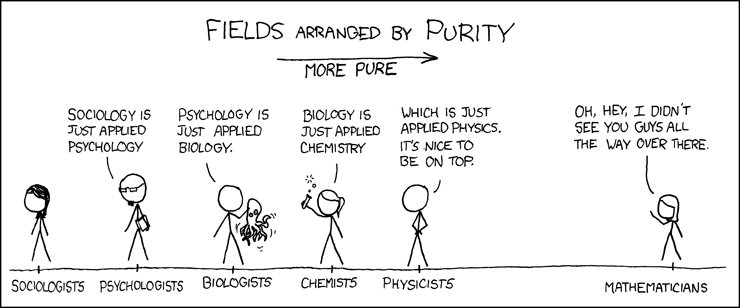
From this perspective, science is supposed to be free of political or social agendas. This is supposed to be the great strength of science. And a lot of work goes into eliminating perceived bias from scientific work. Unfortunately, this perception of science is a lie. One need only look at all the times throughout history when “science!” has been the authority used to denigrate and oppress people based on the colour of their skin, the relative size of their skulls, etc. Science is a human endeavour, and therefore like any human endeavour, it is inherently political and biased.
As a basic concept, this notion is easy to understand and wasn’t difficult for me to accept. Yet I remained wary. When I read Feminism: Issues and Arguments, one chapter concerned philosopher of science Sandra Harding’s arguments regarding our need for a new subjectivity in science, a science as a social construct. I rejected that type of argument—I don’t know if it’s because of how it was framed (the book is back in Canada and I am not, at the moment) or if I simply wasn’t ready to acknowledge that this is really what science needs to be.
So in this sense, Wertheim’s detailled, historically-focused analysis of the exclusion of women from physics has provided a better argument to persuade me about subjectivity in science. It’s essentially given me the framework to let me say, “Ah, yeah, I’ve known this for a while—but now I understand why.”
Beginning with the eponymous Pythagoras (who, actually, wore robes and not trousers, it turns out), Wertheim establishes how, throughout history, the male powers-that-be in physics have established cults of personality and faith within their domains of knowledge. I particularly enjoyed how she deconstructs some of the myths behind well-known, oft-invoked examples of scientists who rebel against society—the Galileos and Brunos of history. Of the latter, she says:
This resonated with me because the martyr narrative is exactly how Bruno is portrayed in the Neil de Grasse Tyson remake of Cosmos. Bruno was a light shining in the darkness perpetuated by the Church, when actually he was a man with an interesting idea that didn’t have much in the way of evidence behind it at the time.
Don’t get me wrong, watching Cosmos has been a pleasure. I wasn’t born when Carl Sagan hosted the first version of the series, so I’m pleased that someone so eminent as de Grasse Tyson has resurrected the format to introduce a whole new generation to the wonders of science and the imagination. Cosmos joins Bill Nye the Science Guy and The Magic School Bus on my list of shows that help kids realize that they can ask questions about the world around them and, more importantly, they might even be able to answer them.
But if we want to be honest with ourselves, it behoves us to critically examine the narratives we tell about science. I love the interesting anecdotes about figures in the history of science—but at the same time, I don’t like how it perptuates the idea that science has been driven by “great men” (and women), geniuses who are somehow singular in their abilities. It’s a myth/hero narrative the seems counterproductive if our goal is to motivate the ordinary, average child to go into the sciences. Children figure out pretty early on whether they are geniuses or not.
Anyway, I still love the way in which Cosmos educates about science in a way that invokes the wonder of discovery. And, to be fair, de Grasse Tyson does a good job of avoiding language that might be construed as too religious. This is the other bone that Wertheim has to pick, and it’s one that has niggled at me for a while prior to reading the book. When scientists or the media invoke God—“the face of God”, “the mind of God”, the “language of God”, “the God particle”—I cringe. In particular, it bothers me quite a bit when people start seizing upon the counterintuitive discoveries in quantum mechanics and assign New Agey interpretations to them. It’s not good to conflate science and religion. I agree with Wertheim when she argues that the two are not diametric opposites, but they should also be separate.
So it’s a dirty little bit of laundry that Wertheim airs when she argues that, throughout history, many of our celebrated scientists actually had agendas of faith. This shouldn’t come as a surprise—humans are complex, conflicted creatures, and being an atheist is not a requirement for doing science. And even scientists who claim no religion can often substitute the pursuit of science itself as a kind of faith. This is a straw-man argument often invoked by opponents of science that, alas, has a grain of truth (where they go wrong is in a supposition that all of science is based on faith, when in fact the faith portion is involved in the conjecture and discovery part of the process). It’s also not something to be ashamed of—provided it doesn’t colour a scientist’s opinion of the field to the point of rejecting other ideas without reason.
Wertheim argues that the absence of women throughout the development of physics has led to a proliferation of this physics-as-priesthood, discovery-as-religion type of thinking. It’s an imbalance caused by too much of a certain type of thinking. We need a diversity of views, a diversity of ideas, to move forward. So towards the end of the book, she argues that if we can bring more women into the conversation, then perhaps we could refocus the emphasis in research in directions more beneficial for society. She questions the worth of spending billions of dollars searching for the Higgs particle and pursuing other “big questions” like the Theory of Everything—another substitute for God.
I’m ambivalent about this part of the book. On one hand, I agree that the search for the Theory of Everything feels anticlimactic. On the other hand, I think that our pursuit of these big questions is valuable because it’s part of the human quest for knowledge. Moreover, it’s difficult to predict what avenues of exploration led to the most useful results. Perhaps our experiments in particle accelerators will lead to a better understanding of mass and gravity in such a way that allows us to invent anti-gravitation devices. Who knows?
Whatever the case, though, I can see Wertheim’s point in that too many of the same type of people can bias the pursuit of any goal, science or otherwise. Her historical overview of science as a men-only club is informative and fascinating. The style is accessible, backed up by plenty of reference to other writers in the field. Overall, Pythagoras’ Trousers is another useful installment in my reading about science, philosophy, history, and gender. If you like these topics, then you really need to pick up a copy.
If that’s tl;dr, then allow me to reiterate the main thrust of the review: science is fucking awesome. Got it?
Margaret Wertheim would agree with me, but in Pythagoras’ Trousers she explores how the general absence of women from mainstream scientific endeavours has affected the development of the sciences—specifically, physics—in the West. In particular, Wertheim argues that the dominance of men in physics resulted in the field becoming like a “priesthood”, and that this has created a feedback loop in which physics as an institution continues to exclude women despite advances in gender equity elsewhere in society.
This book pushes all the right buttons for me. I’m interested in gender issues, and as an educator, I’m specifically concerned about gender gaps in math (my speciality) and the sciences. On a broader level, I’m interested in the philosophy of science and examining critically the way we currently do science versus how we might do science better. In this sense, Pythagoras’ Trousers is the latest milestone in an ongoing personal journey of mine as my attitude towards science develops and changes over time. Like most children, my first ideas about science were very monolithic and certain. Thanks in part to my privileged position as a white male, this opinion hasn’t changed much until recently—and that’s exactly Wertheim’s point. Even with the best of intentions, it’s difficult to reflect critically on a discipline biased in favour of people like oneself.
We are fed this line that science is something objective, with physics being the most objective science of them all. The xkcd comic “Purity” reinforces this in a way that I, as a mathematician, appreciate:
From this perspective, science is supposed to be free of political or social agendas. This is supposed to be the great strength of science. And a lot of work goes into eliminating perceived bias from scientific work. Unfortunately, this perception of science is a lie. One need only look at all the times throughout history when “science!” has been the authority used to denigrate and oppress people based on the colour of their skin, the relative size of their skulls, etc. Science is a human endeavour, and therefore like any human endeavour, it is inherently political and biased.
As a basic concept, this notion is easy to understand and wasn’t difficult for me to accept. Yet I remained wary. When I read Feminism: Issues and Arguments, one chapter concerned philosopher of science Sandra Harding’s arguments regarding our need for a new subjectivity in science, a science as a social construct. I rejected that type of argument—I don’t know if it’s because of how it was framed (the book is back in Canada and I am not, at the moment) or if I simply wasn’t ready to acknowledge that this is really what science needs to be.
So in this sense, Wertheim’s detailled, historically-focused analysis of the exclusion of women from physics has provided a better argument to persuade me about subjectivity in science. It’s essentially given me the framework to let me say, “Ah, yeah, I’ve known this for a while—but now I understand why.”
Beginning with the eponymous Pythagoras (who, actually, wore robes and not trousers, it turns out), Wertheim establishes how, throughout history, the male powers-that-be in physics have established cults of personality and faith within their domains of knowledge. I particularly enjoyed how she deconstructs some of the myths behind well-known, oft-invoked examples of scientists who rebel against society—the Galileos and Brunos of history. Of the latter, she says:
The irony is that today Giordano Bruno is often portrayed by scientists as a martyr—a man who paid with his life for supporting heliocentric cosmology. However, as historian Francis Yates has shown, it was not his views about science that were the problem. The “genuine” physicists of his own time were as much opposed to his ideas as the clerics themselves.
This resonated with me because the martyr narrative is exactly how Bruno is portrayed in the Neil de Grasse Tyson remake of Cosmos. Bruno was a light shining in the darkness perpetuated by the Church, when actually he was a man with an interesting idea that didn’t have much in the way of evidence behind it at the time.
Don’t get me wrong, watching Cosmos has been a pleasure. I wasn’t born when Carl Sagan hosted the first version of the series, so I’m pleased that someone so eminent as de Grasse Tyson has resurrected the format to introduce a whole new generation to the wonders of science and the imagination. Cosmos joins Bill Nye the Science Guy and The Magic School Bus on my list of shows that help kids realize that they can ask questions about the world around them and, more importantly, they might even be able to answer them.
But if we want to be honest with ourselves, it behoves us to critically examine the narratives we tell about science. I love the interesting anecdotes about figures in the history of science—but at the same time, I don’t like how it perptuates the idea that science has been driven by “great men” (and women), geniuses who are somehow singular in their abilities. It’s a myth/hero narrative the seems counterproductive if our goal is to motivate the ordinary, average child to go into the sciences. Children figure out pretty early on whether they are geniuses or not.
Anyway, I still love the way in which Cosmos educates about science in a way that invokes the wonder of discovery. And, to be fair, de Grasse Tyson does a good job of avoiding language that might be construed as too religious. This is the other bone that Wertheim has to pick, and it’s one that has niggled at me for a while prior to reading the book. When scientists or the media invoke God—“the face of God”, “the mind of God”, the “language of God”, “the God particle”—I cringe. In particular, it bothers me quite a bit when people start seizing upon the counterintuitive discoveries in quantum mechanics and assign New Agey interpretations to them. It’s not good to conflate science and religion. I agree with Wertheim when she argues that the two are not diametric opposites, but they should also be separate.
So it’s a dirty little bit of laundry that Wertheim airs when she argues that, throughout history, many of our celebrated scientists actually had agendas of faith. This shouldn’t come as a surprise—humans are complex, conflicted creatures, and being an atheist is not a requirement for doing science. And even scientists who claim no religion can often substitute the pursuit of science itself as a kind of faith. This is a straw-man argument often invoked by opponents of science that, alas, has a grain of truth (where they go wrong is in a supposition that all of science is based on faith, when in fact the faith portion is involved in the conjecture and discovery part of the process). It’s also not something to be ashamed of—provided it doesn’t colour a scientist’s opinion of the field to the point of rejecting other ideas without reason.
Wertheim argues that the absence of women throughout the development of physics has led to a proliferation of this physics-as-priesthood, discovery-as-religion type of thinking. It’s an imbalance caused by too much of a certain type of thinking. We need a diversity of views, a diversity of ideas, to move forward. So towards the end of the book, she argues that if we can bring more women into the conversation, then perhaps we could refocus the emphasis in research in directions more beneficial for society. She questions the worth of spending billions of dollars searching for the Higgs particle and pursuing other “big questions” like the Theory of Everything—another substitute for God.
I’m ambivalent about this part of the book. On one hand, I agree that the search for the Theory of Everything feels anticlimactic. On the other hand, I think that our pursuit of these big questions is valuable because it’s part of the human quest for knowledge. Moreover, it’s difficult to predict what avenues of exploration led to the most useful results. Perhaps our experiments in particle accelerators will lead to a better understanding of mass and gravity in such a way that allows us to invent anti-gravitation devices. Who knows?
Whatever the case, though, I can see Wertheim’s point in that too many of the same type of people can bias the pursuit of any goal, science or otherwise. Her historical overview of science as a men-only club is informative and fascinating. The style is accessible, backed up by plenty of reference to other writers in the field. Overall, Pythagoras’ Trousers is another useful installment in my reading about science, philosophy, history, and gender. If you like these topics, then you really need to pick up a copy.

Two people recommended this book to me on two separate occasions, so I was eager to read it. While the book turned out to be as thought-provoking as I had hoped, the writing left something to be desired.
Jared Diamond has a compelling thesis and offers good arguments to support it, including numerous figures, charts, maps, and dates. However, in his zeal for such statistics, he often forgets about the coherency of the writing, and it suffers. The book reads more like lengthy scientific essay than a non-fiction book aimed at the general public. That doesn't mean it needs to be dumbed down either--the tone and coherence of the writing just needs work. I found much of the book repetitive and dull enough that I just wanted to skip ahead until I found a "more interesting" section.
For instance, I realize that the uneven distribution of domesticable animals and plants is a major part of Diamond's thesis. However, he reiterates this point to the extent that he is beating a dead horse (or, if in South America, a dead llama). He also fixates much on the Austronesian islands, such as New Guinea, and I wonder if part of that comes from a bias having spent much time researching there.
Other portions of the book are interesting and eye-opening, however. I particularly liked the section on the development of writing (Chapter 12) and the detail he went into there. The part on the origins of various diseases was also fascinating. Even the chapter where he discusses the racial distribution of Africa and compares various languages is great, if you can gloss over some of the technical aspects of the discussion.
Diamond raises some points that I had never before considered, such as the major axes of the continents--it makes sense, in retrospect, that it's easy to transport crops across longitude, because the climate does not change as much as transporting crops across latitude. That makes sense.
Overall, Guns, Germs, and Steel is a worthy book. Those heavily-inclined toward academics could do worse. It suffers somewhat from the heavy-handed writing style of the author, but this is not going to stop me from reading another one of his books (I think I'll try [b:Collapse|18756610|The Perseid Collapse (The Perseid Collapse, #1)|Steven Konkoly|https://images.gr-assets.com/books/1451333487s/18756610.jpg|26648901] next).
Jared Diamond has a compelling thesis and offers good arguments to support it, including numerous figures, charts, maps, and dates. However, in his zeal for such statistics, he often forgets about the coherency of the writing, and it suffers. The book reads more like lengthy scientific essay than a non-fiction book aimed at the general public. That doesn't mean it needs to be dumbed down either--the tone and coherence of the writing just needs work. I found much of the book repetitive and dull enough that I just wanted to skip ahead until I found a "more interesting" section.
For instance, I realize that the uneven distribution of domesticable animals and plants is a major part of Diamond's thesis. However, he reiterates this point to the extent that he is beating a dead horse (or, if in South America, a dead llama). He also fixates much on the Austronesian islands, such as New Guinea, and I wonder if part of that comes from a bias having spent much time researching there.
Other portions of the book are interesting and eye-opening, however. I particularly liked the section on the development of writing (Chapter 12) and the detail he went into there. The part on the origins of various diseases was also fascinating. Even the chapter where he discusses the racial distribution of Africa and compares various languages is great, if you can gloss over some of the technical aspects of the discussion.
Diamond raises some points that I had never before considered, such as the major axes of the continents--it makes sense, in retrospect, that it's easy to transport crops across longitude, because the climate does not change as much as transporting crops across latitude. That makes sense.
Overall, Guns, Germs, and Steel is a worthy book. Those heavily-inclined toward academics could do worse. It suffers somewhat from the heavy-handed writing style of the author, but this is not going to stop me from reading another one of his books (I think I'll try [b:Collapse|18756610|The Perseid Collapse (The Perseid Collapse, #1)|Steven Konkoly|https://images.gr-assets.com/books/1451333487s/18756610.jpg|26648901] next).

So you solved Hell’s labour problems, foiled a fake kidnapping plot, and have successfully become a crimefighting superhero with the help of a demon. Oh, and you got the girl! What’s next? Try stopping your mother’s new lover from bringing about the end of the world (and the start of a new one) by writing the next draft of the book that is our lives! Costume Not Included hews pretty closely to its predecessor, The Damned Busters, but benefits from tighter pacing and much more interesting character development. As Chesney Arnstruther and his girlfriend, Melda, contemplate how to stop the world from ending, the righteous Lieutenant Denby and his superiors are closing in on the mysterious Actionary. Oh, and Satan is involved.
I was fairly ambivalent towards The Damned Busters. To be honest, Costume Not Included does very little to improve my opinion of the series. It shares many flaws with the first book. Notably, the opening section is slow and dull, with a lot of exposition covering the developments of the first book. While I understand that Matthew Hughes needs to bring new readers up to speed, there must have been better ways to integrate this information. Likewise, a great deal of the plot developments in this book occur as a result of pages of intensive dialogue between characters.
These structural critiques aside, I did enjoy this sequel more than the first book. Hughes’ writing is more comfortable now that I don’t have to spend so much time getting to know Chesney (whom I still don’t like that much). I enjoyed reading his relationship with Melda, and how that is affecting his relationship with his mother. I enjoyed his conversations with Joshua/Jesus about being a prophet and the effects that has on ordinary people. And, once again, he stands up to Satan and does an end run around the Infernal Prince’s gambit. Bravo.
Hughes also takes a gamble when it comes to the antagonist. In the first book, he gave us Nat Blowdell as a clear bad guy, complete with the climactic confrontation in Hell. Here, the conflict is subtler. Billy Lee Hardacre, labour lawyer turned televangelist, is still exulting over confirmation of his pet theory that the world is a book being written by God to figure out good and evil. He’s overdosing on the pride pills, and the angel helping him work on a new gospel (the Book of Chesney) isn’t helping in that respect. When Chesney refuses to be a prophet—but finds a suitable substitute—Billy Lee’s fascination slips into obsession.
Billy Lee’s descent from ally to antagonist is the most fascinating thing about Costume Not Included. I loved watching him justify manipulating and lying for the greater good. He is someone who genuinely believes he is doing the Lord’s work, and hence what he is doing is acceptable; the possibility that bringing about the end of the world could all be a Satanic plot never occurs to him! Meanwhile, the actuary who has demonic superpowers is actually pretty grounded.
Another rising star of this series is Lieutenant (now Captain) Denby. Ordered by his corrupt superiors to expose the Actionary however possible, Denby gets pretty close to uncovering the truth. I’m dissatisfied by how easily Denby seems to develop the time travel theory—Hughes doesn’t spend enough time fleshing out Denby’s character for me to gauge how realistic his reaction is, but my mental picture of Denby at that point didn’t seem consistent with this Denby who believes in time travel. But, what can you do? I did enjoy the detente between Denby and Chesney that resulted in their tenuous alliance.
Costume Not Included plays off the best and the worst of The Damned Busters, but I would say it’s a definite improvement. I can’t quite get excited enough to recommend or hype this book. The premise is cool, and the characters and story are competently done, but there isn’t something I can point to and say, “That! That is why you need to read this book.” Without that essential spark, Costume Not Included joins all the other barely-memorable but enjoyable books I’ve read over the years, doomed to be forgotten until I dust off this review and re-read it prior to reading the next one. And I will read the next one, which is something!
My reviews of To Hell & Back:
← The Damned Busters | Hell to Pay →
I was fairly ambivalent towards The Damned Busters. To be honest, Costume Not Included does very little to improve my opinion of the series. It shares many flaws with the first book. Notably, the opening section is slow and dull, with a lot of exposition covering the developments of the first book. While I understand that Matthew Hughes needs to bring new readers up to speed, there must have been better ways to integrate this information. Likewise, a great deal of the plot developments in this book occur as a result of pages of intensive dialogue between characters.
These structural critiques aside, I did enjoy this sequel more than the first book. Hughes’ writing is more comfortable now that I don’t have to spend so much time getting to know Chesney (whom I still don’t like that much). I enjoyed reading his relationship with Melda, and how that is affecting his relationship with his mother. I enjoyed his conversations with Joshua/Jesus about being a prophet and the effects that has on ordinary people. And, once again, he stands up to Satan and does an end run around the Infernal Prince’s gambit. Bravo.
Hughes also takes a gamble when it comes to the antagonist. In the first book, he gave us Nat Blowdell as a clear bad guy, complete with the climactic confrontation in Hell. Here, the conflict is subtler. Billy Lee Hardacre, labour lawyer turned televangelist, is still exulting over confirmation of his pet theory that the world is a book being written by God to figure out good and evil. He’s overdosing on the pride pills, and the angel helping him work on a new gospel (the Book of Chesney) isn’t helping in that respect. When Chesney refuses to be a prophet—but finds a suitable substitute—Billy Lee’s fascination slips into obsession.
Billy Lee’s descent from ally to antagonist is the most fascinating thing about Costume Not Included. I loved watching him justify manipulating and lying for the greater good. He is someone who genuinely believes he is doing the Lord’s work, and hence what he is doing is acceptable; the possibility that bringing about the end of the world could all be a Satanic plot never occurs to him! Meanwhile, the actuary who has demonic superpowers is actually pretty grounded.
Another rising star of this series is Lieutenant (now Captain) Denby. Ordered by his corrupt superiors to expose the Actionary however possible, Denby gets pretty close to uncovering the truth. I’m dissatisfied by how easily Denby seems to develop the time travel theory—Hughes doesn’t spend enough time fleshing out Denby’s character for me to gauge how realistic his reaction is, but my mental picture of Denby at that point didn’t seem consistent with this Denby who believes in time travel. But, what can you do? I did enjoy the detente between Denby and Chesney that resulted in their tenuous alliance.
Costume Not Included plays off the best and the worst of The Damned Busters, but I would say it’s a definite improvement. I can’t quite get excited enough to recommend or hype this book. The premise is cool, and the characters and story are competently done, but there isn’t something I can point to and say, “That! That is why you need to read this book.” Without that essential spark, Costume Not Included joins all the other barely-memorable but enjoyable books I’ve read over the years, doomed to be forgotten until I dust off this review and re-read it prior to reading the next one. And I will read the next one, which is something!
My reviews of To Hell & Back:
← The Damned Busters | Hell to Pay →

Disclaimer: I received this book for free from the author in exchange for a review. Loves me the free books!
So, I don’t necessarily do steampunk. I understand the appeal (I think) of speculating about what would have happened had the Victorians taken the Industrial Revolution to the next level. But I think that steampunk often runs aground, for me, as resembling too much both science fiction and fantasy. I like my science fiction scientific, with machines and strange sounds and new inventions. And I like my fantasy fantastic, with strange creatures and ineffable magical effects. I’m fine with urban fantasy, but steampunk’s mechanical-style fantasy tends to leave me cold.
Still, I’m always on the lookout for steampunk done well. Bronze Gods was such a novel; its effortless approach to steampunk-as-setting really entertained me last summer. The Glass Sealing reminds me a lot of that feeling. Like Bronze Gods, it is set in a world that is different from our own, not so much alternative history as different dimension. The steampunk nature of this world is a little more in the foreground, with a nebulous miasma known as the Dark Cloud hovering over the city of Southwatch like a malevolent London smog.
It’s worth pointing out here that Southwatch is a shared world owned by the publisher, and that Hudson’s is the third novel set in this world. None of this is evident from the book itself—it’s only after a little research that I figured this out. As far as I can tell, all the main and majority of minor characters are Hudson’s creation, and he’s just working within the bounds of the world as set out by its creators. As with steampunk, I don’t go out of my way to read shared-world stuff—I just find it uneven—but it’s hardly noticeable here.
Into this world Andrew Leon Hudson projects a plot that seems tailor-made for steampunk: workers’ rights and union struggles. If steampower and clockwork are automating all the factories, where are the jobs for labourers? I am a union man myself, being a teacher, but I also feel ambivalent about the types of workers movements portrayed here: I’m not sure I can approve of people fighting for the right to such hard and dangerous labour when it can be performed better and more safely by machines. That’s OK, though. Hudson presents perspectives on both side of the debate, and it’s interesting to see the characters change as the worker issue evolves over the course of years.
Southwatch also reminds me a little of New Crobuzon, albeit without much of the trademark Miévillesque weirdness to its denizens. It’s more traditionally human, with the notable exception of the enigmatic Skipjack, a strike-breaking robot that seems to possess consciousness, and a mysterious “fae” being that possesses power tied to the omnipresent Dark Cloud. I’m not sure how much of this is Hudson’s creation and how much is indigenous to the world, which would explain why he doesn’t go into as much detail with some of these beings as I would like. But there’s more than enough going on in Southwatch to keep a reader interested.
The story follows a basic dualistic structure between Arthur Singleton and Jocelyn Duville, with brief forays into the perspectives of other characters. I like this structure, and I like that Hudson has the story advance considerably in time so that we can watch Singleton and Jocelyn change a great deal. However, the chapters are very long—it’s a reasonably-sized novel with only about seven chapters, and while there are plenty of scene breaks within each chapter, it still makes for awkward reading in smaller chunks like I’m forced to do during the week.
These cumbersome divisions mirror the somewhat lumbering pace of the plot itself. A lot happens in The Glass Sealing … but it also seems like not that much happens at the same time. Hudson is always moving the goalposts, so just when you feel like you’ve settled into the rhythm of the book, suddenly he introduces something new that upsets the balance. This is not inherently a bad thing; it’s good for a book to keep me on my toes, keep surprising me in new ways. But I never quite felt comfortable with The Glass Sealing; reading it was always more interrogative than collaborative.
Still, the story itself is good enough that despite those issues of pace, I seldom wanted to stop reading or put the book down. Hudson makes me care about the plight of the citizens of Southwatch, and he deftly mines the class and social mobility issues of Victorian England for a sturdy social backdrop to the story. I simultaneously wanted Jocelyn to succeed and to fail: she is a protagonist and an antagonist, depending on one’s point of view. Her idea of the ceiling/sealing (hah) is just so phenomenally bad for the majority of people in Southwatch, and the fact that no one in her sphere of influence even voices that opinion shows how far gone the elite are in terms of their relationship with the lower class.
The moral ambiguity and shades of grey in this book are its most intriguing quality. Just as Jocelyn’s goals are not exactly laudable, Singleton’s own actions leave much to be desired. His experience with the fae leaves him … messianic. And so his new role as leader of a strange, cult-like worker’s revolution is bad news. Hence, Hudson has a talent for creating conflict and stoking the fires ever so gradually until they lead to an unstoppable and terrifying conflagration of a climax.
The Glass Sealing is a good first novel. It’s a story with a powerful central struggle and characters who are not so much at odds as they are at acute angles. Southwatch is a city where everyone has their own interests at heart, but those interests are shaped and warped by an upbringing heavily influenced by the level where one has grown up. Into this society, Hudson projects a powerful plot in which characters conspire to break the chains of their class or leave their mark on the city’s history.
It’s not going to change your mind about steampunk. I’m not finding myself in urgent need of another steampunk infusion; I’m not even all that enthusiastic about checking out more of the Darkside Codex. But that’s OK—The Glass Sealing works as a standalone novel. I’d be interested to see what Hudson has planned next, whether it’s something else in this world or a world of his own. While The Glass Sealing doesn’t exactly break many barriers or expand many boundaries in terms of genre or quality, it does showcase the possibilities of a fertile imagination combined with a well-structured world.

So, I don’t necessarily do steampunk. I understand the appeal (I think) of speculating about what would have happened had the Victorians taken the Industrial Revolution to the next level. But I think that steampunk often runs aground, for me, as resembling too much both science fiction and fantasy. I like my science fiction scientific, with machines and strange sounds and new inventions. And I like my fantasy fantastic, with strange creatures and ineffable magical effects. I’m fine with urban fantasy, but steampunk’s mechanical-style fantasy tends to leave me cold.
Still, I’m always on the lookout for steampunk done well. Bronze Gods was such a novel; its effortless approach to steampunk-as-setting really entertained me last summer. The Glass Sealing reminds me a lot of that feeling. Like Bronze Gods, it is set in a world that is different from our own, not so much alternative history as different dimension. The steampunk nature of this world is a little more in the foreground, with a nebulous miasma known as the Dark Cloud hovering over the city of Southwatch like a malevolent London smog.
It’s worth pointing out here that Southwatch is a shared world owned by the publisher, and that Hudson’s is the third novel set in this world. None of this is evident from the book itself—it’s only after a little research that I figured this out. As far as I can tell, all the main and majority of minor characters are Hudson’s creation, and he’s just working within the bounds of the world as set out by its creators. As with steampunk, I don’t go out of my way to read shared-world stuff—I just find it uneven—but it’s hardly noticeable here.
Into this world Andrew Leon Hudson projects a plot that seems tailor-made for steampunk: workers’ rights and union struggles. If steampower and clockwork are automating all the factories, where are the jobs for labourers? I am a union man myself, being a teacher, but I also feel ambivalent about the types of workers movements portrayed here: I’m not sure I can approve of people fighting for the right to such hard and dangerous labour when it can be performed better and more safely by machines. That’s OK, though. Hudson presents perspectives on both side of the debate, and it’s interesting to see the characters change as the worker issue evolves over the course of years.
Southwatch also reminds me a little of New Crobuzon, albeit without much of the trademark Miévillesque weirdness to its denizens. It’s more traditionally human, with the notable exception of the enigmatic Skipjack, a strike-breaking robot that seems to possess consciousness, and a mysterious “fae” being that possesses power tied to the omnipresent Dark Cloud. I’m not sure how much of this is Hudson’s creation and how much is indigenous to the world, which would explain why he doesn’t go into as much detail with some of these beings as I would like. But there’s more than enough going on in Southwatch to keep a reader interested.
The story follows a basic dualistic structure between Arthur Singleton and Jocelyn Duville, with brief forays into the perspectives of other characters. I like this structure, and I like that Hudson has the story advance considerably in time so that we can watch Singleton and Jocelyn change a great deal. However, the chapters are very long—it’s a reasonably-sized novel with only about seven chapters, and while there are plenty of scene breaks within each chapter, it still makes for awkward reading in smaller chunks like I’m forced to do during the week.
These cumbersome divisions mirror the somewhat lumbering pace of the plot itself. A lot happens in The Glass Sealing … but it also seems like not that much happens at the same time. Hudson is always moving the goalposts, so just when you feel like you’ve settled into the rhythm of the book, suddenly he introduces something new that upsets the balance. This is not inherently a bad thing; it’s good for a book to keep me on my toes, keep surprising me in new ways. But I never quite felt comfortable with The Glass Sealing; reading it was always more interrogative than collaborative.
Still, the story itself is good enough that despite those issues of pace, I seldom wanted to stop reading or put the book down. Hudson makes me care about the plight of the citizens of Southwatch, and he deftly mines the class and social mobility issues of Victorian England for a sturdy social backdrop to the story. I simultaneously wanted Jocelyn to succeed and to fail: she is a protagonist and an antagonist, depending on one’s point of view. Her idea of the ceiling/sealing (hah) is just so phenomenally bad for the majority of people in Southwatch, and the fact that no one in her sphere of influence even voices that opinion shows how far gone the elite are in terms of their relationship with the lower class.
The moral ambiguity and shades of grey in this book are its most intriguing quality. Just as Jocelyn’s goals are not exactly laudable, Singleton’s own actions leave much to be desired. His experience with the fae leaves him … messianic. And so his new role as leader of a strange, cult-like worker’s revolution is bad news. Hence, Hudson has a talent for creating conflict and stoking the fires ever so gradually until they lead to an unstoppable and terrifying conflagration of a climax.
The Glass Sealing is a good first novel. It’s a story with a powerful central struggle and characters who are not so much at odds as they are at acute angles. Southwatch is a city where everyone has their own interests at heart, but those interests are shaped and warped by an upbringing heavily influenced by the level where one has grown up. Into this society, Hudson projects a powerful plot in which characters conspire to break the chains of their class or leave their mark on the city’s history.
It’s not going to change your mind about steampunk. I’m not finding myself in urgent need of another steampunk infusion; I’m not even all that enthusiastic about checking out more of the Darkside Codex. But that’s OK—The Glass Sealing works as a standalone novel. I’d be interested to see what Hudson has planned next, whether it’s something else in this world or a world of his own. While The Glass Sealing doesn’t exactly break many barriers or expand many boundaries in terms of genre or quality, it does showcase the possibilities of a fertile imagination combined with a well-structured world.