Take a photo of a barcode or cover
2.05k reviews by:
tachyondecay


—Celaena intrigues me as a character. I’m not sure I like her that much…. I very much respect an author who can create an unlikable protagonist and make me enjoy their journey and their story, and that is the case here. I didn’t necessarily like Celaena as a person, but I cared what happened to her.—
—I also liked the positive female friendship between Celaena and Nehemia.—
—As much as I liked the friendship, the romance part of the book did little for me … it seemed superfluous—you could have cropped out the romance elements here and still have a fine book.—
—at the very end of the book, we learn he has a much deeper game. He’s much more involved in what is happening in Erilea and in the supernatural aspects of the story, and I really liked this glimpse. It leaves me even more excited to read the next book—I’m not picking it up right away, but obviously it’ll be sometime soon.
And now, the continuation.
(Switch back to your normal “I am reading Kara’s review” voice now.)
“Sometime soon” has arrived four months on, which is actually very fast in Kara reading terms for carrying on with your typical series. I have to say I started to hesitate. In the elapsed time I’ve seen some criticism of Sarah J. Maas and her handling of portrayals of sexuality, etc., more so in the latest books of her other fantasy series. Still, I did buy … all … the books … so I figured I should keep going, at least for now.
Crown of Midnight picks up a few months after Throne of Glass ends. Celaena Sardothien is now firmly entrenched as the King of Adarlan’s royal assassin, aka King’s Champion. She is supposed to be killing his enemies. Is she? Don’t be silly. She’s trying to figure out his endgame, trying to connect the dots between his successful conquest of most of Erilea and the disappearance of magic. She’s trying to be a scholar and a warrior and a mage and a rogue, like a one-person DnD party, and it’s not working out for her. Along the way, there is also some smooching and some murder. Maybe not in that order. And some fairly predictable high fantasy shenanigans.
Here’s a quick summary of how I feel about this sequel versus the first book. I still like Celaena a lot as the main character and protagonist. I still enjoy much of Maas’ writing and characterization. However, I am less excited by the overall story and its arc.
I’m starting to see why Maas and her protege Susan Dennard are building such a die-hard fanbase and taking parts of the fantasy readership by storm. They remind me a lot of Brandon Sanderson (to whose Mistborn series I also came late and have, to some extent, similarly soured upon). They’re writing in a way that recapitulates a lot of the high and epic fantasy tropes that are the bedrock of this corner of the genre. My first fantasy love was really Eddings’ Belgariad, chased with Modesitt, Jr.’s Recluce saga. While some newcomers to the field have sought to deconstruct, play with, and really innovate these tropes, plenty of newcomers, including heavyweights like Rothfuss, are trying to find new ways to tape into fantasy fans’ yearning for these faux-medieval fairytales.
I’m not here to pass a value judgement on these differing approaches, mind you. I’ve enjoyed books from both schools, and from the various schools elsewhere in the fantasy galaxy. As much as I love some of the clever and questioning work coming from avant-garde authors, I freely admit that I’m spending a lot of time trying to find new releases that chase that old-school fantasy dragon. Yet even when authors like Maas and Dennard give me something I like, there’s something holding me back from truly loving it. It just doesn’t necessarily ring new.
So, Crown of Midnight ticks so many boxes. Magic system? Check. Inter-kingdom warfare? Check. Complex plots involving a mixture of prophecy versus free will and a Big Bad playing a Xanatos Gambit with an unclear endgame? Hella check. If the first book felt a little too much like setting up the universe, this one pays off a lot in terms of transforming the story into a more epic adventure. Although Celaena doesn’t really live the capital in this book, her actions and the reactions to what she does have repercussions felt across the continent. The ending, too, demonstrates that Maas is not afraid to shake everything up in order to advance the plot and deliver something fresh for the next book.
And yet … I feel like I’ve seen this all before.
This is the main problem I had with Crown of Midnight. I feel like, if I were coming to this series much younger, as a very new fantasy fan, then I would be in love with it. This would be my Belgariad. It certainly has those elements to it. So it isn’t so much that these books are bad per se, as I am much more jaded. I’m not trying to sound hipster here, just pragmatic. We all come to a genre with certain stories that of our time, in the same way that a certain demographic grew up with Harry Potter and then discovered Narnia. I saw most of the twists here coming, whether it was what happened with Chaol, and his ultimate decisions regarding his father, or the secret of Celaena’s identity. The writing is (in the case of the Wyrdmarks, literally) on the wall. None of this detracts from the quality of the book, but it did detract from my personal enjoyment. Crown of Midnight is a very nice work of fantasy from a technical perspective, but as a reader I came away yawning.
My reviews of the Throne of Glass series:
← Throne of Glass

It’s the last Megamorphs entry, and Back to Before closes this series-within-a-series with a bang. Pushed to the breaking point by yet another horrifically gruesome battle, Jake succumbs to the temptation presented by Crayak’s minion, the Drode. He agrees to let the Drode rewrite time so that Jake, Cassie, Marco, Rachel, and Tobias never walk through that construction site, never acquire morphing abilities, never meet Elfangor or Ax or learn about Yeerks. Yep, this is the Animorphs series’ alternative timeline “what if?” (TVTropes) episode, as contractually required by International Literary Law (look it up). And it is chilling.
Let’s talk about each Animorph’s experience in this alternative timeline. Back to Before contains almost no morphing in it, obviously, and very little Yeerk-fighting. So what we get instead is a refreshing look at the Animorphs’ relationships to each other and the people and world around them. I feel like more recent books in the series have distanced themselves from these things, focusing more on the grand battle. This is a nice chance—albeit through a reset—to remind us who these characters are.
Jake is no longer the leader of the Animorphs. Actually, he never was, which is important. This book reminds us we’ve seen so much character growth over the course of this series. In this timeline, Jake never had to make any of the tough decisions that have changed him, made him harder and craftier. He’s still just a kid. His innate leadership skills are there, as particularly evidenced towards the end where everything starts to fall apart. But his confidence and clarity have been wiped away along with his fatigue.
Rachel is once more a shopping-obsessed teenage girl, forced to fend off Marco’s overt advances and educate her friend Cassie about fashion. As with Jake, seeing this regression is a bit of a shock. Rachel’s warrior attitude has come to dominate her characterization in recent books; it has been a long time since we thought about her family life, her interests outside of fighting as part of the Animorphs. Yet when Marco draws her back into things when he believes he has spotted his mother, Rachel naturally leaps into action: she wants to do something, take a stand, even if she isn’t sure it’s the right thing.
Cassie is a shy, very passionate girl. Oh, and she loves Jake. And he loves her, in that sweet will-they-or-won’t-they teenage way. Although Applegate has continued to develop their romantic feelings over the series, this book is a more intense reminder of it, and it shows how much fighting the Yeerks has warped the Animorphs’ otherwise adolescent priorities.
Ax provides a lot of comic relief here. He has to escape from the sunken Andalite dome ship on his own. Then, when he starts to integrate into human society, he has a much tougher time of it than when he had the other Animorphs’ help. Mostly, though, what we see here is Ax without a prince to follow. He isn’t all that bad at taking initiative and coming up with his own plans, actually—but there is a loneliness to him, an edge that he doesn’t have in the original timeline. We realize how much he has come to belong with the other Animorphs.
Arguably, though Back to Before shines most brightly when it comes to Marco and Tobias’ stories.
Marco see his mom, Visser One, and all hell breaks loose. She just appears in public in front of him, resulting in a dramatic chase sequence until she disappears again. These “glitches” become more frequent until the end of the book. (The whole excuse of Cassie being “sub-temporally grounded” is a very clunky way to break up this new timeline, but I’m willing to overlook it. Every temporary reset book needs one.) Marco’s sudden desperation to find his mother after spotting her is such a kick to the gut given recent events with Visser One and the way it has altered Marco, both as a son and as a character in general.
Finally, Tobias. Poor, poor Tobias. Is there anyone in the series who gets beat up as much as Tobias? He’s such a woobie (TVTropes). And it’s such a delicious irony that his life is not better now that he is a human instead of a hawk. Instead, he gets a first-hand look at how the Sharing recruits vulnerable youth and turns them into Controllers. Although the Sharing’s procedures have been intimated in the past, this is the first time we really get a glimpse of them from the inside. Applegate draws heavily from real-life fascist recruitment tactics here: an older mentor/role model, targeting dispossessed and otherwise downtrodden youth, and giving them a taste of affection and empowerment. It’s devious and nefarious and, for Tobias, entirely too effective until it’s too late.
Although I can get over the sub-temporal grounding MacGuffin, this book once again reminds us in general how the Animorphs (via Tobias in particular) seem wrapped up in a game of cosmic destiny between Crayak and the Ellimist. I’m always ambivalent about stories like this that start with seemingly-random heroes and then retcon it to reveal that they were destined to be heroes all along. Like … why? Why can’t we have books where the forces of the universe aren’t conspiring to make someone a viewpoint character?
Such philosophical quibbles about literature aside, though, Back to Before is an important instalment in the series at this pivotal point where the fatigue is becoming too much and there seems to be no end in sight. It is a signal for us to take a deep breath. There are fourteen more books to go—that seems like a lot, but things start happening quickly now.
My reviews of Animorphs:
← #40: The Other | #41: The Familiar →

Let’s talk about each Animorph’s experience in this alternative timeline. Back to Before contains almost no morphing in it, obviously, and very little Yeerk-fighting. So what we get instead is a refreshing look at the Animorphs’ relationships to each other and the people and world around them. I feel like more recent books in the series have distanced themselves from these things, focusing more on the grand battle. This is a nice chance—albeit through a reset—to remind us who these characters are.
Jake is no longer the leader of the Animorphs. Actually, he never was, which is important. This book reminds us we’ve seen so much character growth over the course of this series. In this timeline, Jake never had to make any of the tough decisions that have changed him, made him harder and craftier. He’s still just a kid. His innate leadership skills are there, as particularly evidenced towards the end where everything starts to fall apart. But his confidence and clarity have been wiped away along with his fatigue.
Rachel is once more a shopping-obsessed teenage girl, forced to fend off Marco’s overt advances and educate her friend Cassie about fashion. As with Jake, seeing this regression is a bit of a shock. Rachel’s warrior attitude has come to dominate her characterization in recent books; it has been a long time since we thought about her family life, her interests outside of fighting as part of the Animorphs. Yet when Marco draws her back into things when he believes he has spotted his mother, Rachel naturally leaps into action: she wants to do something, take a stand, even if she isn’t sure it’s the right thing.
Cassie is a shy, very passionate girl. Oh, and she loves Jake. And he loves her, in that sweet will-they-or-won’t-they teenage way. Although Applegate has continued to develop their romantic feelings over the series, this book is a more intense reminder of it, and it shows how much fighting the Yeerks has warped the Animorphs’ otherwise adolescent priorities.
Ax provides a lot of comic relief here. He has to escape from the sunken Andalite dome ship on his own. Then, when he starts to integrate into human society, he has a much tougher time of it than when he had the other Animorphs’ help. Mostly, though, what we see here is Ax without a prince to follow. He isn’t all that bad at taking initiative and coming up with his own plans, actually—but there is a loneliness to him, an edge that he doesn’t have in the original timeline. We realize how much he has come to belong with the other Animorphs.
Arguably, though Back to Before shines most brightly when it comes to Marco and Tobias’ stories.
Marco see his mom, Visser One, and all hell breaks loose. She just appears in public in front of him, resulting in a dramatic chase sequence until she disappears again. These “glitches” become more frequent until the end of the book. (The whole excuse of Cassie being “sub-temporally grounded” is a very clunky way to break up this new timeline, but I’m willing to overlook it. Every temporary reset book needs one.) Marco’s sudden desperation to find his mother after spotting her is such a kick to the gut given recent events with Visser One and the way it has altered Marco, both as a son and as a character in general.
Finally, Tobias. Poor, poor Tobias. Is there anyone in the series who gets beat up as much as Tobias? He’s such a woobie (TVTropes). And it’s such a delicious irony that his life is not better now that he is a human instead of a hawk. Instead, he gets a first-hand look at how the Sharing recruits vulnerable youth and turns them into Controllers. Although the Sharing’s procedures have been intimated in the past, this is the first time we really get a glimpse of them from the inside. Applegate draws heavily from real-life fascist recruitment tactics here: an older mentor/role model, targeting dispossessed and otherwise downtrodden youth, and giving them a taste of affection and empowerment. It’s devious and nefarious and, for Tobias, entirely too effective until it’s too late.
Although I can get over the sub-temporal grounding MacGuffin, this book once again reminds us in general how the Animorphs (via Tobias in particular) seem wrapped up in a game of cosmic destiny between Crayak and the Ellimist. I’m always ambivalent about stories like this that start with seemingly-random heroes and then retcon it to reveal that they were destined to be heroes all along. Like … why? Why can’t we have books where the forces of the universe aren’t conspiring to make someone a viewpoint character?
Such philosophical quibbles about literature aside, though, Back to Before is an important instalment in the series at this pivotal point where the fatigue is becoming too much and there seems to be no end in sight. It is a signal for us to take a deep breath. There are fourteen more books to go—that seems like a lot, but things start happening quickly now.
My reviews of Animorphs:
← #40: The Other | #41: The Familiar →

Second reading, addendum: September 5, 2017
It has, coincidentally, been exactly 3 years since I first read The Count of Monte Cristo. I bought a house this summer; I have my very own deck now. I decided that on my week off I wanted to sit outside and work my way through this classic behemoth during what might be our last nice days before the autumn chill kicks in. I was, for the most part, successful in this goal. Reading this book was every bit as pleasurable, diverting, and moving as it was the first time; everything reaffirms my original sentiments regarding this book’s place in history and Dumas’ talents as a storyteller, if not perhaps as a writer.
I don’t have anything substantive to add to my first review, below. If I were to attempt a new review, I’d basically recapitulate what I said already: this is the real deal, one of those timeless stories. What makes The Count of Monte Cristo so amazing is the sheer breadth of human experience that Dumas includes in his story, even as he focuses with laser sharpness on the effects of obsession with revenge on Edmond Dantès. If you can get past the sheer weight of words and the cumbersome phrasing in the writing style, this is a magnificent emotional experience with all the highs and lows of great art. This is an opera in literary form.
I hesitate to name Desert Island Books, because I love so many books. Why choose?? Seriously, though, The Count of Monte Cristo wouldn’t just be on the list; it would be my top pick for such a book. There is so much variety in here, so many different stories, that I could read it in bits and pieces, even out of order, and remain inspired and entertained for a long time.
First review: September 17, 2014
I didn’t plan on reading The Count of Monte Cristo so soon after The Three Musketeers. But on my first visit to the Thunder Bay library after my return from the UK, I saw this lovely edition with an introduction by Umberto Eco, one of my favourite authors. The introduction isn’t much to talk about—it’s short, which is actually a point in its favour; and it’s informative but not quite insightful. I gave The Three Musketeers five stars and a glowing review.
The Three Musketeers has nothing on The Count of Monte Cristo. This is indubitably superior to the former work in all respects. It is an amazing tour de force of a text that was well worth the 10 days it took me to read it. Whereas T3M has achieved immortality as a dashing adventure romance, TCMC is the revenge plot done up in the finest of clothing and served with the most sumptuous of (cold) repasts. Alexandre Dumas delivers one of the most detailled and compelling stories I have ever experienced.
Sure, the novel starts slowly, introducing the young Edmond Dantes, so buoyant with hope. He’s about to become captain of a trading vessel and marry a pretty Catalan girl who is madly in love with him. He’ll be able to provide for his old, infirm father. Life is good. Slowly, Dumas arrays the forces of jealousy and envy against him, in the form of the villains Danglars and Fernand. I can easily forgive a reader who finds the first few chapters of TCMC stultifying in their boredom; the plot doesn’t really begin to thicken until Edmond is imprisoned, and the pace doesn’t take off until he escapes and reinvents himself as Monte Cristo.
The beginning is slow, but it provides essential contrast to Edmond’s later conduct as the Count. Young Edmond is almost stupidly naive. Despite some careful warnings from Caderousse and others, he ignores the ill will emanating from Danglars and Fernand. He is cavalier about a trip to Elba during a time when even the whiff of Bonapartism was a good way to get thrown in jail. Dumas goes out of his way to make Edmond as innocent as possible. And just when it seems like Fernand’s scheme will fall through, Edmond falls victim, through no fault of his own, to the intrigue of Villefort. Edmond is an innocent, a good man. He doesn’t deserve what happens to him—unlike the three against whom he exacts his revenge.
But the Count of Monte Cristo? Ah, the Count is not a good man. But he is a great one. The Count of Monte Cristo is basically the Most Interesting Man in the World:
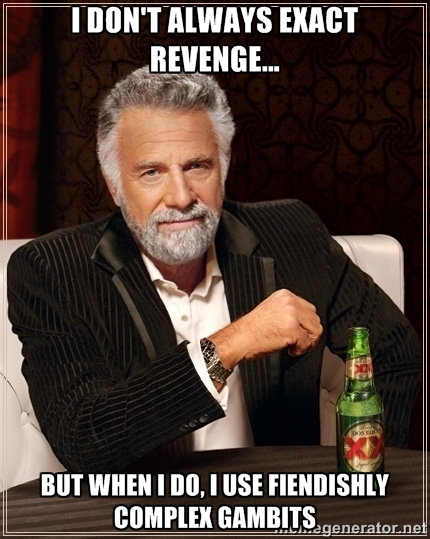
The Count of Monte Cristo has been everywhere, done everything, seen it all. He is absurdly, fabulously rich—and, more interestingly, very good at spending his riches. He plays Xanatos Speed Chess blindfolded (TVTropes). His servants and entourage are devoted to him. Everyone in Parisian society becomes infatuated with him. The Count of Monte Cristo isn’t badass; he is the badassest.
When he descends upon Paris, two decades have elapsed since the betrayal that led to his imprisonment. No one recognizes him. Danglars, Villefort, and Fernand have risen to important titles in Parisian society. But the Count doesn’t take revenge quickly. Oh no. He totally buys the whole “best served cold” part of the adage. Months pass as the Count integrates himself into Parisian high society, attending operas and throwing lavish dinner parties and generally charming the pants off everyone. He enacts a series of increasingly fiendish and increasingly complex plots to place his enemies in financial or social difficulty. Even when unforeseen circumstances arise to throw off his otherwise intricate planning, the Count rises to the occasion and improvises with aplomb. He seems, in short, unstoppable.
It’s awesome, watching it all unfold. No CGI explosions. No explicit sex scenes. Just one amazing character on a mission of revenge.
I read the unabridged version, because I like to suffer when I read classic literature. I hear there are abridged versions out there (did I mention this book is in the public domain?). I assume they cut out the hundreds of pages of digressions and backstories of secondary characters. In the introduction to this edition, Eco discusses the paradox of Dumas’ terrible writing yet enduring brilliance: TCMC is simultaneously a poorly-written book yet an incredible feat of storytelling. Its wordiness makes Dickens look concise. It took me ten days to read when the similarly-thick The Wise Man’s Fear took less than half that. I enjoyed it all the same … but I’m willing to admit that there are some things that could have been cut. Maybe. So I won’t blame you if you read the abridged version. You really should read this, somehow.
TCMC’s length reminds me of another epic classic, War and Peace. The similarity doesn’t end there, however. Much like Tolstoy’s epic, TCM has oodles and oodles of characters. Wikipedia has chart of the various relationships in the novel. Keep in mind that Dumas serialized this thing, and it really does read like a weird, nineteenth-century French soap opera. There’s something very fulfilling about coming across a character first mentioned hundreds of pages ago and realizing their new importance to the plot. And as with Tolstoy’s story, there is so much more happening here than Edmond’s revenge. Every one of the secondary characters has their own intricate history (which Dumas never fails to recount) accompanied by a complex set of motivations and goals that impact the Count’s plans. Truly, egregious purple prose aside, TCMC is one of the most masterful examples of plotting in literature.
The Count of Monte Cristo is like War and Peace but with a more uplifting ending. The ending is rather inevitable, and it’s where the earlier depiction of early Edmond becomes so important. Having succeeded in getting his revenge, the Count sails off into the sunset in search of further adventure. There’s no other way to end it. He was a character devoted entirely to one goal: once he achieved it, what was he supposed to do? Then again, he is more than a man. He’s a myth, a self-made myth in the style of Jay Gatsby, whose very existence is sustained by the stories and rumours that swirl around him. Edmond’s enemies managed to transform him into something he could never have become on his own—but his quest for revenge is not one that leaves him unscathed. And it’s an open question whether Edmond has managed to break the cycle of revenge or merely extend it for another generation.
This is a novel that doesn’t pull punches. Dumas ruthlessly explores the extent to which obsession and desire can chart the course of someone’s life and alter the lives of all those around him. Yet he manages to do so with wit and persuasive charm. It is no wonder that like T3M, The Count of Monte Cristo has inspired so many adaptations and looser works based on its themes … but there is no substitute for the original.
It has, coincidentally, been exactly 3 years since I first read The Count of Monte Cristo. I bought a house this summer; I have my very own deck now. I decided that on my week off I wanted to sit outside and work my way through this classic behemoth during what might be our last nice days before the autumn chill kicks in. I was, for the most part, successful in this goal. Reading this book was every bit as pleasurable, diverting, and moving as it was the first time; everything reaffirms my original sentiments regarding this book’s place in history and Dumas’ talents as a storyteller, if not perhaps as a writer.
I don’t have anything substantive to add to my first review, below. If I were to attempt a new review, I’d basically recapitulate what I said already: this is the real deal, one of those timeless stories. What makes The Count of Monte Cristo so amazing is the sheer breadth of human experience that Dumas includes in his story, even as he focuses with laser sharpness on the effects of obsession with revenge on Edmond Dantès. If you can get past the sheer weight of words and the cumbersome phrasing in the writing style, this is a magnificent emotional experience with all the highs and lows of great art. This is an opera in literary form.
I hesitate to name Desert Island Books, because I love so many books. Why choose?? Seriously, though, The Count of Monte Cristo wouldn’t just be on the list; it would be my top pick for such a book. There is so much variety in here, so many different stories, that I could read it in bits and pieces, even out of order, and remain inspired and entertained for a long time.
First review: September 17, 2014
I didn’t plan on reading The Count of Monte Cristo so soon after The Three Musketeers. But on my first visit to the Thunder Bay library after my return from the UK, I saw this lovely edition with an introduction by Umberto Eco, one of my favourite authors. The introduction isn’t much to talk about—it’s short, which is actually a point in its favour; and it’s informative but not quite insightful. I gave The Three Musketeers five stars and a glowing review.
The Three Musketeers has nothing on The Count of Monte Cristo. This is indubitably superior to the former work in all respects. It is an amazing tour de force of a text that was well worth the 10 days it took me to read it. Whereas T3M has achieved immortality as a dashing adventure romance, TCMC is the revenge plot done up in the finest of clothing and served with the most sumptuous of (cold) repasts. Alexandre Dumas delivers one of the most detailled and compelling stories I have ever experienced.
Sure, the novel starts slowly, introducing the young Edmond Dantes, so buoyant with hope. He’s about to become captain of a trading vessel and marry a pretty Catalan girl who is madly in love with him. He’ll be able to provide for his old, infirm father. Life is good. Slowly, Dumas arrays the forces of jealousy and envy against him, in the form of the villains Danglars and Fernand. I can easily forgive a reader who finds the first few chapters of TCMC stultifying in their boredom; the plot doesn’t really begin to thicken until Edmond is imprisoned, and the pace doesn’t take off until he escapes and reinvents himself as Monte Cristo.
The beginning is slow, but it provides essential contrast to Edmond’s later conduct as the Count. Young Edmond is almost stupidly naive. Despite some careful warnings from Caderousse and others, he ignores the ill will emanating from Danglars and Fernand. He is cavalier about a trip to Elba during a time when even the whiff of Bonapartism was a good way to get thrown in jail. Dumas goes out of his way to make Edmond as innocent as possible. And just when it seems like Fernand’s scheme will fall through, Edmond falls victim, through no fault of his own, to the intrigue of Villefort. Edmond is an innocent, a good man. He doesn’t deserve what happens to him—unlike the three against whom he exacts his revenge.
But the Count of Monte Cristo? Ah, the Count is not a good man. But he is a great one. The Count of Monte Cristo is basically the Most Interesting Man in the World:
The Count of Monte Cristo has been everywhere, done everything, seen it all. He is absurdly, fabulously rich—and, more interestingly, very good at spending his riches. He plays Xanatos Speed Chess blindfolded (TVTropes). His servants and entourage are devoted to him. Everyone in Parisian society becomes infatuated with him. The Count of Monte Cristo isn’t badass; he is the badassest.
When he descends upon Paris, two decades have elapsed since the betrayal that led to his imprisonment. No one recognizes him. Danglars, Villefort, and Fernand have risen to important titles in Parisian society. But the Count doesn’t take revenge quickly. Oh no. He totally buys the whole “best served cold” part of the adage. Months pass as the Count integrates himself into Parisian high society, attending operas and throwing lavish dinner parties and generally charming the pants off everyone. He enacts a series of increasingly fiendish and increasingly complex plots to place his enemies in financial or social difficulty. Even when unforeseen circumstances arise to throw off his otherwise intricate planning, the Count rises to the occasion and improvises with aplomb. He seems, in short, unstoppable.
It’s awesome, watching it all unfold. No CGI explosions. No explicit sex scenes. Just one amazing character on a mission of revenge.
I read the unabridged version, because I like to suffer when I read classic literature. I hear there are abridged versions out there (did I mention this book is in the public domain?). I assume they cut out the hundreds of pages of digressions and backstories of secondary characters. In the introduction to this edition, Eco discusses the paradox of Dumas’ terrible writing yet enduring brilliance: TCMC is simultaneously a poorly-written book yet an incredible feat of storytelling. Its wordiness makes Dickens look concise. It took me ten days to read when the similarly-thick The Wise Man’s Fear took less than half that. I enjoyed it all the same … but I’m willing to admit that there are some things that could have been cut. Maybe. So I won’t blame you if you read the abridged version. You really should read this, somehow.
TCMC’s length reminds me of another epic classic, War and Peace. The similarity doesn’t end there, however. Much like Tolstoy’s epic, TCM has oodles and oodles of characters. Wikipedia has chart of the various relationships in the novel. Keep in mind that Dumas serialized this thing, and it really does read like a weird, nineteenth-century French soap opera. There’s something very fulfilling about coming across a character first mentioned hundreds of pages ago and realizing their new importance to the plot. And as with Tolstoy’s story, there is so much more happening here than Edmond’s revenge. Every one of the secondary characters has their own intricate history (which Dumas never fails to recount) accompanied by a complex set of motivations and goals that impact the Count’s plans. Truly, egregious purple prose aside, TCMC is one of the most masterful examples of plotting in literature.
The Count of Monte Cristo is like War and Peace but with a more uplifting ending. The ending is rather inevitable, and it’s where the earlier depiction of early Edmond becomes so important. Having succeeded in getting his revenge, the Count sails off into the sunset in search of further adventure. There’s no other way to end it. He was a character devoted entirely to one goal: once he achieved it, what was he supposed to do? Then again, he is more than a man. He’s a myth, a self-made myth in the style of Jay Gatsby, whose very existence is sustained by the stories and rumours that swirl around him. Edmond’s enemies managed to transform him into something he could never have become on his own—but his quest for revenge is not one that leaves him unscathed. And it’s an open question whether Edmond has managed to break the cycle of revenge or merely extend it for another generation.
This is a novel that doesn’t pull punches. Dumas ruthlessly explores the extent to which obsession and desire can chart the course of someone’s life and alter the lives of all those around him. Yet he manages to do so with wit and persuasive charm. It is no wonder that like T3M, The Count of Monte Cristo has inspired so many adaptations and looser works based on its themes … but there is no substitute for the original.

One of the benefits of deciding to request books from NetGalley is that it exposes me to more academic science writing than I might otherwise find. Thanks to Columbia University Press for letting me read this. I’m really fascinated by the study of religion, from a sociological and anthropological perspective. I love to learn about the history of religions, and also about how we know what we know. Evolving Brains, Emerging Gods looks at the origins of gods—in the sense of anthropomorphic beings with discrete identities and roles—from the perspective of evolutionary neuroscience. E. Fuller Torrey traces the cognitive development of the human brain over time and attempts to link the advent of specific capabilities—increased intelligence, self-awareness, theory of mind, introspection, and autobiographical memory—to the development of the concept of gods. The result is an interesting mixture of evolution, cognitive neuroscience, and religious anthropology, although it’s probably heavier on the first two.
Discussion of religion aside, I found this book very clearly debunks some of the myths and pitfalls that crop up when thinking, as a lay person, about evolution. For example, during the introduction, Torrey explains that, when discussing when certain cognitive developments occurred is always going to be a vague thing:
Evolution doesn’t have clear dividing lines. Torrey reminds us throughout the book that our record is scattered, incomplete, and biased (in terms of what types of materials are likely to be preserved and where we are likely to find them). The study of evolution and human prehistory, then, is fraught with all the complications that this imperfect picture of the past must create. Ultimately, we have to accept that there are some things we just may never know for certain, even if we can come up with a few very compelling, albeit competing, theories.
I also like how Torrey nudges us away from the simplistic picture of the evolutionary ladder. For those of us fortunate enough to actually learn about evolution in schools, sometimes we get the mistaken impression that it was a discrete and one-dimensional progression, from Australopithecus to H. habilis to H. erectus and so on. And indeed, at one point this might have been the thinking—but science changes, even as our schools and textbooks are slow to adapt:
Additionally, Torrey does a good job communicating the impressive spans of time at work here. H. habilis and H. erectus lived side by side for 500,000 years! That’s longer than we’ve been around as a species and about 100 times longer than we’ve had writing.
On a related note, you really do get a sense of how human development seems to have accelerated dramatically over the past 100,000 years. We went from nascent tribal groupings to civilizations to spaceflight in what is practically an evolutionary blink of an eye. Each cognitive development, whatever spurred it on, made it easier for the next development to happen. Evolution is somewhat random, but it is also a series of intense feedback cycles.
I also appreciate how Torrey links cognitive development so explicitly to technological and cultural innovation. This might seem self-evident, but we forget this and tend to project our own, current cognitive capacity backwards. So it wasn’t just a case of, for X thousands of years, no human ever noticed something or tried whatever it was that led to an invention or a new idea. As Torrey illustrates, it might have been that, for that long, we were neurologically incapable of noticing or of having that idea or of doing whatever was required to make that leap.
It’s just so weird and wonderful to think about how the structures in our brains literally make us who we are and determine how we can think!
Torrey goes into great detail explaining human evolutionary history. As you can see, this is what stuck with me most. For better or worse, the actual thesis—how we developed ideas of gods—sometimes felt like it was lurking in the background, waiting in the wings for us to get far enough along in history for Torrey to really talk about the evidence at hand. It isn’t until the penultimate chapter or so that we actually talk much about gods per se. I don’t think this is a fault of the book’s structure itself so much as, you know, the facts available to us. Just be aware, going in, that this is more so a book about evolution and neuroscience that just so happens to talk a lot about gods and beliefs.
The last chapter very briefly examines some of the other theories, most of them sociological, that have been proposed to explain gods. I don’t want to be too harsh here, because Torrey up front notes that this is about as short of a survey as you can get and still call it a survey. Still, it is very concise. Of Julian Jaynes’ famous bicameral mind theory, Torrey sums up his dismissal in a single sentence: “Jaynes’s thesis is at odds with almost everything known about the evolution of the human brain”. Although I lol'd at such treatment, I was hoping for a bit more of a takedown. I guess that’s what the 40% of the book that’s endnotes are for? (No joke, I love a book that is significantly composed of endnotes.)
Anyone who has a basic scientific understanding of human evolution (i.e., you won’t find the language in here too difficult) will probably enjoy improving the depth of their understanding here. If, like me, you want to learn a lot about the history of religion, you’re not necessarily going to learn as much as you might think, but there’s still some good stuff here. In the end, Torrey succeeds in showing me how the gradual evolution of the human brain played an integral role in our ability to conceive of and use gods, whatever they might be.
Discussion of religion aside, I found this book very clearly debunks some of the myths and pitfalls that crop up when thinking, as a lay person, about evolution. For example, during the introduction, Torrey explains that, when discussing when certain cognitive developments occurred is always going to be a vague thing:
Arguing that a specific cognitive skill is associated with a specific stage of hominin evolution of course does not mean that this skill developed only at that time.
Evolution doesn’t have clear dividing lines. Torrey reminds us throughout the book that our record is scattered, incomplete, and biased (in terms of what types of materials are likely to be preserved and where we are likely to find them). The study of evolution and human prehistory, then, is fraught with all the complications that this imperfect picture of the past must create. Ultimately, we have to accept that there are some things we just may never know for certain, even if we can come up with a few very compelling, albeit competing, theories.
I also like how Torrey nudges us away from the simplistic picture of the evolutionary ladder. For those of us fortunate enough to actually learn about evolution in schools, sometimes we get the mistaken impression that it was a discrete and one-dimensional progression, from Australopithecus to H. habilis to H. erectus and so on. And indeed, at one point this might have been the thinking—but science changes, even as our schools and textbooks are slow to adapt:
Previously, it was thought that Homo erectus had descended from Homo habilis, but recent archeological research suggests that Homo habilis and Homo erectus lived side by side in what is now northern Kenya “for almost half a million years,” making this evolutionary sequence less likely.
Additionally, Torrey does a good job communicating the impressive spans of time at work here. H. habilis and H. erectus lived side by side for 500,000 years! That’s longer than we’ve been around as a species and about 100 times longer than we’ve had writing.
On a related note, you really do get a sense of how human development seems to have accelerated dramatically over the past 100,000 years. We went from nascent tribal groupings to civilizations to spaceflight in what is practically an evolutionary blink of an eye. Each cognitive development, whatever spurred it on, made it easier for the next development to happen. Evolution is somewhat random, but it is also a series of intense feedback cycles.
I also appreciate how Torrey links cognitive development so explicitly to technological and cultural innovation. This might seem self-evident, but we forget this and tend to project our own, current cognitive capacity backwards. So it wasn’t just a case of, for X thousands of years, no human ever noticed something or tried whatever it was that led to an invention or a new idea. As Torrey illustrates, it might have been that, for that long, we were neurologically incapable of noticing or of having that idea or of doing whatever was required to make that leap.
It’s just so weird and wonderful to think about how the structures in our brains literally make us who we are and determine how we can think!
Torrey goes into great detail explaining human evolutionary history. As you can see, this is what stuck with me most. For better or worse, the actual thesis—how we developed ideas of gods—sometimes felt like it was lurking in the background, waiting in the wings for us to get far enough along in history for Torrey to really talk about the evidence at hand. It isn’t until the penultimate chapter or so that we actually talk much about gods per se. I don’t think this is a fault of the book’s structure itself so much as, you know, the facts available to us. Just be aware, going in, that this is more so a book about evolution and neuroscience that just so happens to talk a lot about gods and beliefs.
The last chapter very briefly examines some of the other theories, most of them sociological, that have been proposed to explain gods. I don’t want to be too harsh here, because Torrey up front notes that this is about as short of a survey as you can get and still call it a survey. Still, it is very concise. Of Julian Jaynes’ famous bicameral mind theory, Torrey sums up his dismissal in a single sentence: “Jaynes’s thesis is at odds with almost everything known about the evolution of the human brain”. Although I lol'd at such treatment, I was hoping for a bit more of a takedown. I guess that’s what the 40% of the book that’s endnotes are for? (No joke, I love a book that is significantly composed of endnotes.)
Anyone who has a basic scientific understanding of human evolution (i.e., you won’t find the language in here too difficult) will probably enjoy improving the depth of their understanding here. If, like me, you want to learn a lot about the history of religion, you’re not necessarily going to learn as much as you might think, but there’s still some good stuff here. In the end, Torrey succeeds in showing me how the gradual evolution of the human brain played an integral role in our ability to conceive of and use gods, whatever they might be.

Cory Doctorow is Doctorowing it up again, by which I mean writing intense polemics thinly veiled as science-fiction stories that give you a hell of a philosophical rush. Walkaway is about the decline of capitalism after we can print most of the things we need. It’s about people attempting to check out of “default”—but what if default is more like the Hotel California? As with all of Doctorow’s books, this is dense and steeped with big ideas. It’s a great trip. Unlike all his books, though, this one left me more unsettled than stimulated. I actually kind of regret reading it. And it’s not that it’s bad, but it left me in a bad head-space.
There are a lot of interesting science fiction premises here, but the one that really captivates me is the mind scanning/uploading (or “backup” as one of the characters summarizes it). Science fiction has long been wrestling with the consequences of being able to upload human minds and run them, either as disembodied “sims” or by copying them into cloned or robot bodies. And I should say that I don’t think any one book can adequately cover all of the various philosophical positions and concerns surrounding this issue. That’s the value of the science fiction genre as a whole: it is this massive, sprawling, decades-long conversation in which different books cover overlapping ground. You can’t just read one, and you can’t physically read them all, but you can read enough to understand the discussion.
Philosophy of mind has long intrigued me. I’ve spent a lot of time thinking about brains in jars and upload and reading all sorts of science fiction that deals with it. Although I find the superhuman abilities that often accompany upload very appealing, I can’t shake the conviction that you are not you without your meat-body. (Doctorow engages with this by pointing out one could simulate feedback to one’s autonomic nervous system to mimic having a body, but I’m still not sold.) Anyway, that’s why this aspect of Walkaway grabbed at me even more than the post-scarcity politics amidst the death throes of late-stage capitalism.
Doctorow’s characters grapple deeply with all these thorny questions of identity and consciousness when talking upload. Their solution to the idea that you wouldn’t be you is just to tweak the “parameters” of your simulation until you are just enough not-you to be OK with the idea of being a brain in a jar. It’s an intriguing idea, I admit, and a clever solution that also acknowledges that, essentially, uploading opens us up to editing. The related torture broached in the book—the idea that anyone could boot a copy of you and torture you for all eternity, with no way for you to ever turn yourself off or ignore the torture—is, uh … yeah, that freaks me out.
And so I wonder if uploading is one of those things that just means we’re done. I mean, Dollhouse is fairly adamant and chilling in that regard.
Then again, maybe I’m just a simulation as it is … hmm.
But I digress.
Like I said above, Walkaway is one of those books I almost wish I hadn’t read, not because it’s bad, but because it bummed me out. It isn’t even a particularly pessimistic or cynical book, but there is a strong element of pragmatism to counter Doctorow’s techno-utopian ideas. This is what will happen if innovation drags the 1% kicking and screaming into the future. And, spoiler alert, it doesn’t turn out well for anyone, in any category.
I’m not saying I need my science fiction to always be uplifting or hopeful. That being said, I also don’t think this was a mood thing—I was in a pretty good mood going into Walkaway and looking forward to my annual dose of Doctorow, but the book just tasted sour. Maybe it’s just the current political climate; maybe this just hits too close to home. It feels too near future, uploading and fabricators aside, too realistically an extrapolation of what our society might be like given where we’re at now.
I think it also doesn’t help that none of the characters particularly interested me. They were fine, in their way. I felt sympathy for Natalie/Iceweasel’s confinement and torture; I cheered when Limpopo stood up to the authorities to the bitter end. But none of the characters stood out for me and became someone I could say I admired. Maybe this is Doctorow’s intention; maybe he wants you to see that these are all just “people like us” who are struggling to get by.
Finally, I wasn’t a huge fan of the vignette nature of the narrative. It’s almost a series of short stories in the way it’s divided up. This probably contributed to not feeling connected to the characters.
So Walkaway is one of those novels that I admire for its sheer audacity of thought but that, as a story, I don’t particularly like. I expect Doctorow’s storytelling to err on the side of didactic, but this goes beyond that. It’s a little bit me, and I don’t want to whine too much about it. But this just lacks the narrative grace that makes something as disconcerting as Lilith’s Brood so amazing. There are moments of brilliance to it—there’s this whole diatribe about how governments prefer calling people “taxpayers” instead of “citizens” to emphasize the transactional nature of the relationship. Alas, these float between vast sections of potent yet unsatisfying philosophical narrative.
There are a lot of interesting science fiction premises here, but the one that really captivates me is the mind scanning/uploading (or “backup” as one of the characters summarizes it). Science fiction has long been wrestling with the consequences of being able to upload human minds and run them, either as disembodied “sims” or by copying them into cloned or robot bodies. And I should say that I don’t think any one book can adequately cover all of the various philosophical positions and concerns surrounding this issue. That’s the value of the science fiction genre as a whole: it is this massive, sprawling, decades-long conversation in which different books cover overlapping ground. You can’t just read one, and you can’t physically read them all, but you can read enough to understand the discussion.
Philosophy of mind has long intrigued me. I’ve spent a lot of time thinking about brains in jars and upload and reading all sorts of science fiction that deals with it. Although I find the superhuman abilities that often accompany upload very appealing, I can’t shake the conviction that you are not you without your meat-body. (Doctorow engages with this by pointing out one could simulate feedback to one’s autonomic nervous system to mimic having a body, but I’m still not sold.) Anyway, that’s why this aspect of Walkaway grabbed at me even more than the post-scarcity politics amidst the death throes of late-stage capitalism.
Doctorow’s characters grapple deeply with all these thorny questions of identity and consciousness when talking upload. Their solution to the idea that you wouldn’t be you is just to tweak the “parameters” of your simulation until you are just enough not-you to be OK with the idea of being a brain in a jar. It’s an intriguing idea, I admit, and a clever solution that also acknowledges that, essentially, uploading opens us up to editing. The related torture broached in the book—the idea that anyone could boot a copy of you and torture you for all eternity, with no way for you to ever turn yourself off or ignore the torture—is, uh … yeah, that freaks me out.
And so I wonder if uploading is one of those things that just means we’re done. I mean, Dollhouse is fairly adamant and chilling in that regard.
Then again, maybe I’m just a simulation as it is … hmm.
But I digress.
Like I said above, Walkaway is one of those books I almost wish I hadn’t read, not because it’s bad, but because it bummed me out. It isn’t even a particularly pessimistic or cynical book, but there is a strong element of pragmatism to counter Doctorow’s techno-utopian ideas. This is what will happen if innovation drags the 1% kicking and screaming into the future. And, spoiler alert, it doesn’t turn out well for anyone, in any category.
I’m not saying I need my science fiction to always be uplifting or hopeful. That being said, I also don’t think this was a mood thing—I was in a pretty good mood going into Walkaway and looking forward to my annual dose of Doctorow, but the book just tasted sour. Maybe it’s just the current political climate; maybe this just hits too close to home. It feels too near future, uploading and fabricators aside, too realistically an extrapolation of what our society might be like given where we’re at now.
I think it also doesn’t help that none of the characters particularly interested me. They were fine, in their way. I felt sympathy for Natalie/Iceweasel’s confinement and torture; I cheered when Limpopo stood up to the authorities to the bitter end. But none of the characters stood out for me and became someone I could say I admired. Maybe this is Doctorow’s intention; maybe he wants you to see that these are all just “people like us” who are struggling to get by.
Finally, I wasn’t a huge fan of the vignette nature of the narrative. It’s almost a series of short stories in the way it’s divided up. This probably contributed to not feeling connected to the characters.
So Walkaway is one of those novels that I admire for its sheer audacity of thought but that, as a story, I don’t particularly like. I expect Doctorow’s storytelling to err on the side of didactic, but this goes beyond that. It’s a little bit me, and I don’t want to whine too much about it. But this just lacks the narrative grace that makes something as disconcerting as Lilith’s Brood so amazing. There are moments of brilliance to it—there’s this whole diatribe about how governments prefer calling people “taxpayers” instead of “citizens” to emphasize the transactional nature of the relationship. Alas, these float between vast sections of potent yet unsatisfying philosophical narrative.

When Dimple Met Rishi is just plain adorable. It shouldn’t work, but it does.
I picked this up on a whim while at Chapters, because it was in a display of new releases and I’d heard a little but of buzz about it from Twitter. I needed something nice and “light” compared to, say, Walkaway, but obviously didn’t want to go so far as to read a book that didn’t start with W or didn’t have an orange-themed cover. So this was the logical choice.
Sandhya Menon has created what is essentially a very formulaic YA romantic comedy, yet she has imbued with so much genuine humour and clever characterization that it just feels good. This isn’t the most original or even the best-written book I’ve read lately, but it’s definitely one of the most enjoyable. It has all the feels, in the best possible way.
I was surprised, when I went to read other reviews, how many people hate Dimple. I guess I grok it, but to me she’s just … human. She’s young and headstrong but also inexperienced; she has these very intense, focused goals, and when she discovers she wants something (romance) that she had told herself she wasn’t looking for at this moment, she struggles to process and integrate this into her life. So of course she’s going to make mistakes.
I didn’t actually care about the romance all that much. This might be an odd thing to say for a book that is literally romance, but, well, that’s generally how I roll with these books anyway. I couldn’t care less whether they end up together. The whole app competition was much more interesting for me, and I do wish we had seen more of that. The structure of the romance, its various reversals, etc., felt pretty standard and easy to anticipate. That’s not bad, of course, but if you are looking for something that is going to have you on the edge of the seat with twists and turns you won’t see coming … When Dimple Met Rishi is not it.
Instead, this book is heartwarming. It doesn’t offer easy answers—despite Dimple and Rishi seemingly being fated to be together, given all the various events that conspire to push them in that direction, Menon offers us no promises about whether they will remain together. This is a message I’m seeing more and more in YA books, and I’m liking it. I’m liking the acknowledgement that 17- and 18-year-olds don’t need their whole life sorted out and the recognition that it’s possible the person you’re dating and/or attracted to at this age is not your soulmate or the person you’re going to spend the majority of your life with. Dimple and Rishi have some good conversations about these types of things, as they dance around whether or not they should try being together in the face of the reasons they shouldn’t—and it’s these conversations, rather than the standard plot points that bookend them, that I find so good.
There’s this moment prior to the climax where everything blows up. I won’t spoil it, but basically Dimple has a false epiphany and pushes Rishi away, as one half of the love interests are wont to do in these things. The resulting fallout might seem a little contrived, but the entire process of Dimple’s false epiphany makes so much sense to me. She isn’t have a crisis about whether or not she loves Rishi. When you construct your sense of self around being one thing, and then someone comes along and shows you that you might want something that is not part of that identity, it’s really a crisis of self. (I suppose Rishi went through something similar, but to be honest, even though he shared the narration of the book, I never felt as close to him as I did to Dimple.)
I said at the opening of this review that When Dimple Met Rishi shouldn’t work, but it does. That’s because the more I think about it, the more I can recognize the formula at work here. Normally that would detract from my experience. So when I keep highlighting that here, it isn’t criticism—it’s praise that in spite of this, Menon’s writing and characterization captivates and entertains. This is how you breathe new life into old tropes. I can’t comment on the representation of Indian culture or of being the children of immigrants from India, but I like that characters with these backgrounds at least show up in this type of story. I also really like that Menon attempts to give Dimple a female friendship that is resilient despite numerous rough patches.
When Dimple Met Rishi energized me. It refreshed me. There’s things that it could have done better, parts that could be smoother or better constructed. It’s not necessarily the right book forever, but it was the right book for right now, and sometimes that matters most.
I picked this up on a whim while at Chapters, because it was in a display of new releases and I’d heard a little but of buzz about it from Twitter. I needed something nice and “light” compared to, say, Walkaway, but obviously didn’t want to go so far as to read a book that didn’t start with W or didn’t have an orange-themed cover. So this was the logical choice.
Sandhya Menon has created what is essentially a very formulaic YA romantic comedy, yet she has imbued with so much genuine humour and clever characterization that it just feels good. This isn’t the most original or even the best-written book I’ve read lately, but it’s definitely one of the most enjoyable. It has all the feels, in the best possible way.
I was surprised, when I went to read other reviews, how many people hate Dimple. I guess I grok it, but to me she’s just … human. She’s young and headstrong but also inexperienced; she has these very intense, focused goals, and when she discovers she wants something (romance) that she had told herself she wasn’t looking for at this moment, she struggles to process and integrate this into her life. So of course she’s going to make mistakes.
I didn’t actually care about the romance all that much. This might be an odd thing to say for a book that is literally romance, but, well, that’s generally how I roll with these books anyway. I couldn’t care less whether they end up together. The whole app competition was much more interesting for me, and I do wish we had seen more of that. The structure of the romance, its various reversals, etc., felt pretty standard and easy to anticipate. That’s not bad, of course, but if you are looking for something that is going to have you on the edge of the seat with twists and turns you won’t see coming … When Dimple Met Rishi is not it.
Instead, this book is heartwarming. It doesn’t offer easy answers—despite Dimple and Rishi seemingly being fated to be together, given all the various events that conspire to push them in that direction, Menon offers us no promises about whether they will remain together. This is a message I’m seeing more and more in YA books, and I’m liking it. I’m liking the acknowledgement that 17- and 18-year-olds don’t need their whole life sorted out and the recognition that it’s possible the person you’re dating and/or attracted to at this age is not your soulmate or the person you’re going to spend the majority of your life with. Dimple and Rishi have some good conversations about these types of things, as they dance around whether or not they should try being together in the face of the reasons they shouldn’t—and it’s these conversations, rather than the standard plot points that bookend them, that I find so good.
There’s this moment prior to the climax where everything blows up. I won’t spoil it, but basically Dimple has a false epiphany and pushes Rishi away, as one half of the love interests are wont to do in these things. The resulting fallout might seem a little contrived, but the entire process of Dimple’s false epiphany makes so much sense to me. She isn’t have a crisis about whether or not she loves Rishi. When you construct your sense of self around being one thing, and then someone comes along and shows you that you might want something that is not part of that identity, it’s really a crisis of self. (I suppose Rishi went through something similar, but to be honest, even though he shared the narration of the book, I never felt as close to him as I did to Dimple.)
I said at the opening of this review that When Dimple Met Rishi shouldn’t work, but it does. That’s because the more I think about it, the more I can recognize the formula at work here. Normally that would detract from my experience. So when I keep highlighting that here, it isn’t criticism—it’s praise that in spite of this, Menon’s writing and characterization captivates and entertains. This is how you breathe new life into old tropes. I can’t comment on the representation of Indian culture or of being the children of immigrants from India, but I like that characters with these backgrounds at least show up in this type of story. I also really like that Menon attempts to give Dimple a female friendship that is resilient despite numerous rough patches.
When Dimple Met Rishi energized me. It refreshed me. There’s things that it could have done better, parts that could be smoother or better constructed. It’s not necessarily the right book forever, but it was the right book for right now, and sometimes that matters most.

I didn’t know how I felt after finishing Truth and Beauty, and to be honest, I still don’t know. This book made me feel a lot of complex and conflicting feelings. I guess that’s good? But I’m not sure I can articulate everything in the manner to which I’ve become accustomed.
A friend gave this to me as a kind of housewarming present after I tweeted that “I wish we talked more about friendship the way we talk about romance”. I love it when people pick books for me tailored on something they know about me (as opposed to “lol dawg I heard you like books”), and I was excited when I received this. Plus, Ann Patchett’s Bel Canto was one of my favourite books of 2012, and re-reading my review makes me just want to read it again. So I embarked on Truth and Beauty, though maybe some of my subsequent discontent is a result of reading it during the busy start of the school year rather than a more meditative, relaxing point in time.
My tweet was commenting on the way that our society generally prioritizes romance above platonic relationships. We have a “friendzone” that precludes romance, and we have to clarify when someone is “just a friend” as opposed to “more than friends”. We have a hierarchy that posits romance (and, generally, monogamous romance) as superior to everyday companionship, sexual or otherwise. I’ve been taught from an early age that friendship is all well and good, but in general, most of the people I get close to in life will probably one day find the “special someone” who then becomes the number 1 person for them. So even when your alloromantic friends are good people, sometimes they can’t help but make you feel more alone.
Anyway, although this book didn’t provide the boost or reaffirmation that I think it was intended to, I definitely see why my friend gave it to me on the strength of that one tweet. In Truth and Beauty, Patchett recounts what is essentially a queerplatonic relationship with Lucy Grealy. Having met and roomed together in college, Ann and Lucy remain friends for life, even when living on different continents. They talk to each other all the time, comment on each other’s love lives and writing ambitions—and talk about Lucy’s health. Lucy’s bout of cancer as a child has left her with facial deformities and a bone structure that doesn’t accept the numerous grafts her surgeons keep trying on her. Unable to eat much and self-conscious of her stand-out appearance, Lucy deals with this situation by adopting the persona of an adventurous, promiscuous, happy-go-lucky waif. Yet Ann is one of the members of her inner circle of friends who see beyond her aura to the spectre of depression that looms constantly over Lucy.
On the one hand, parts of this book could be reassuring when considered separately. Ann and Lucy do remain friends for life, despite often being separated by great distances. This was in a time before Skype, even, so if they could do it, I can do it. The first section, where Patchett intersperses her writing with Lucy’s (roughly contemporaneous) letters, is great. It shows two women striking out into the world of adulthood and trying to negotiate their individual understandings of what this means. I really like the glimpse that Patchett provides into how they talked with each other, what they talked about, and their differing attitudes towards writing, romance, and sex.
On the other hand, the relationship Patchett describes is not a healthy one. Lucy does not seem to give much back in this friendship, unless it’s just that Ann needed to be needed. For example, Patchett recalls how Lucy would, when out with a group, jump into Ann’s lap and ask her if she still loves Lucy the most, a way of centering attention on Lucy and also reaffirming their mutual affection. Patchett presents it as supposedly sweet and adorable behaviour, but it’s manipulative. Lucy is a manipulator, a charmer of doctors and a collector of friends. It’s hard to tell how much of her behaviour is calculated (either consciously or unconsciously), of course, from only Patchett’s obviously biased perspective, and how much just appears manipulative.
Should I be judgmental? Isn’t the point of friendship that it’s this wonderful state of being between two people, and they negotiate its parameters the way they like it, and if Ann wants to be there for Lucy, 100 per cent of the time, no matter what, no matter how little an effort Lucy makes to be there for her or even for herself, isn’t that between them? Yes and no. I think my discomfort comes from how Patchett never really comments much during the book about her feelings about this relationship (though, to be fair, she essentially lowers the boom on herself at the very end). I respect that she refuses to clean up her friendship for the page—yet at the same time, she seems to gloss over the periods of obvious tumult and recession. There’s a flat affect to this book, with Ann going through the motions of her life, waiting for the next “Lucy-sode” to intrude. And that might be part of it, too: Patchett mentions just enough autobiographical details to ground us in the context of events, but we seldom get to see more of her own personal life. What were her other friendships like? Did she have someone she could turn to like Lucy could turn to her? It’s hard to know.
Moreover, I suppose I’m weirded out by Ann and Lucy’s relationship because it is an extreme version of the kind of friendship I could see myself getting into. I take it as a cautionary tale, if you will. I enjoy helping people, and I actively base a lot of my ego on helping people. If you want to get me to do something, the easiest way is just to frame it in such a way that it would seem like I’m really helping you out. I don’t know why I’m like this, and I’m not saying it’s a bad thing—but I recognize that my desire to feel helpful can, when carried to extremes, be unhealthy for myself. There are times when you have to say “no” to someone, because to say “yes” would burden you to an unhealthy extent. For whatever reason, I have been lucky enough up until now not to be at the fulcrum of someone’s crisis moment and expected to react swiftly and decisively (and if I go my whole life without such a moment, that would be just fine). So Ann and Lucy’s friendship makes me worry, more than anything.
There is definitely Truth, and there is Beauty, to this memoir. Patchett’s writing occasionally reminds me of that lyrical and incisive author of Bel Canto:
That’s beautiful, and true, I think, and I wish I could have seen more of that in this book. But if Patchett concludes her memoir by describing her mistake, then this, here, is Lucy’s: this obsession, again, with romantic love as the end-all, be-all of human relationships, when she has so many vibrant friendships (it seems) and a particularly good one with Ann.
I guess I knew from the beginning that the book would end with Lucy’s death (though I didn’t know the particulars). And I’m far from opposed to books with downer endings. I like them—when I am in the right mood. Maybe reading this right after When Dimple Met Rishi was a bad call, or maybe I should have saved it for a week off or something.
Maybe it’s just that truth is often less satisfying than fiction; there is no redemption arc here. Maybe my problem is not with the book itself but with the whole form, an my preference for fiction is not merely that of an addict’s sweet-tooth but a preference for the neatness of fictional lives. John and Aeryn fighting the Peacekeepers. Kim and Ron stopping Dr. Drakken. Adama and Roslyn attempting to keep a fractious group of survivors together. These are the stories that move me, while real life, I guess, is just too real sometimes.
(Speaking of Kim Possible, sometimes I just wish life were like a superhero cartoon and I could have a nemesis. This is clearly the most superior form of relationship, beyond friendship, romance, or anything else.)
If the measure of a book’s greatness is entirely based on how much makes one think and feel, then Truth and Beauty is obviously a great book. Yet if we factor in satisfaction, even the type to be found in reading about sadness, then it misses the mark for me by a wide margin.
A friend gave this to me as a kind of housewarming present after I tweeted that “I wish we talked more about friendship the way we talk about romance”. I love it when people pick books for me tailored on something they know about me (as opposed to “lol dawg I heard you like books”), and I was excited when I received this. Plus, Ann Patchett’s Bel Canto was one of my favourite books of 2012, and re-reading my review makes me just want to read it again. So I embarked on Truth and Beauty, though maybe some of my subsequent discontent is a result of reading it during the busy start of the school year rather than a more meditative, relaxing point in time.
My tweet was commenting on the way that our society generally prioritizes romance above platonic relationships. We have a “friendzone” that precludes romance, and we have to clarify when someone is “just a friend” as opposed to “more than friends”. We have a hierarchy that posits romance (and, generally, monogamous romance) as superior to everyday companionship, sexual or otherwise. I’ve been taught from an early age that friendship is all well and good, but in general, most of the people I get close to in life will probably one day find the “special someone” who then becomes the number 1 person for them. So even when your alloromantic friends are good people, sometimes they can’t help but make you feel more alone.
Anyway, although this book didn’t provide the boost or reaffirmation that I think it was intended to, I definitely see why my friend gave it to me on the strength of that one tweet. In Truth and Beauty, Patchett recounts what is essentially a queerplatonic relationship with Lucy Grealy. Having met and roomed together in college, Ann and Lucy remain friends for life, even when living on different continents. They talk to each other all the time, comment on each other’s love lives and writing ambitions—and talk about Lucy’s health. Lucy’s bout of cancer as a child has left her with facial deformities and a bone structure that doesn’t accept the numerous grafts her surgeons keep trying on her. Unable to eat much and self-conscious of her stand-out appearance, Lucy deals with this situation by adopting the persona of an adventurous, promiscuous, happy-go-lucky waif. Yet Ann is one of the members of her inner circle of friends who see beyond her aura to the spectre of depression that looms constantly over Lucy.
On the one hand, parts of this book could be reassuring when considered separately. Ann and Lucy do remain friends for life, despite often being separated by great distances. This was in a time before Skype, even, so if they could do it, I can do it. The first section, where Patchett intersperses her writing with Lucy’s (roughly contemporaneous) letters, is great. It shows two women striking out into the world of adulthood and trying to negotiate their individual understandings of what this means. I really like the glimpse that Patchett provides into how they talked with each other, what they talked about, and their differing attitudes towards writing, romance, and sex.
On the other hand, the relationship Patchett describes is not a healthy one. Lucy does not seem to give much back in this friendship, unless it’s just that Ann needed to be needed. For example, Patchett recalls how Lucy would, when out with a group, jump into Ann’s lap and ask her if she still loves Lucy the most, a way of centering attention on Lucy and also reaffirming their mutual affection. Patchett presents it as supposedly sweet and adorable behaviour, but it’s manipulative. Lucy is a manipulator, a charmer of doctors and a collector of friends. It’s hard to tell how much of her behaviour is calculated (either consciously or unconsciously), of course, from only Patchett’s obviously biased perspective, and how much just appears manipulative.
Should I be judgmental? Isn’t the point of friendship that it’s this wonderful state of being between two people, and they negotiate its parameters the way they like it, and if Ann wants to be there for Lucy, 100 per cent of the time, no matter what, no matter how little an effort Lucy makes to be there for her or even for herself, isn’t that between them? Yes and no. I think my discomfort comes from how Patchett never really comments much during the book about her feelings about this relationship (though, to be fair, she essentially lowers the boom on herself at the very end). I respect that she refuses to clean up her friendship for the page—yet at the same time, she seems to gloss over the periods of obvious tumult and recession. There’s a flat affect to this book, with Ann going through the motions of her life, waiting for the next “Lucy-sode” to intrude. And that might be part of it, too: Patchett mentions just enough autobiographical details to ground us in the context of events, but we seldom get to see more of her own personal life. What were her other friendships like? Did she have someone she could turn to like Lucy could turn to her? It’s hard to know.
Moreover, I suppose I’m weirded out by Ann and Lucy’s relationship because it is an extreme version of the kind of friendship I could see myself getting into. I take it as a cautionary tale, if you will. I enjoy helping people, and I actively base a lot of my ego on helping people. If you want to get me to do something, the easiest way is just to frame it in such a way that it would seem like I’m really helping you out. I don’t know why I’m like this, and I’m not saying it’s a bad thing—but I recognize that my desire to feel helpful can, when carried to extremes, be unhealthy for myself. There are times when you have to say “no” to someone, because to say “yes” would burden you to an unhealthy extent. For whatever reason, I have been lucky enough up until now not to be at the fulcrum of someone’s crisis moment and expected to react swiftly and decisively (and if I go my whole life without such a moment, that would be just fine). So Ann and Lucy’s friendship makes me worry, more than anything.
There is definitely Truth, and there is Beauty, to this memoir. Patchett’s writing occasionally reminds me of that lyrical and incisive author of Bel Canto:
Lucy thought that all she needed was one person, the right person, and all that empty space would be taken away from her. But there was no one in the world who was big enough for that. She believed that if she had a jaw that was like everyone else’s jaw, she would have found that person by now. She was trapped in a roomful of mirrors, and every direction she looked in, she saw herself, her face, her loneliness. She couldn’t see that no one else was perfect either, and that so much of love was the work of it. She had worked on everything else. Love would have to be charmed.
That’s beautiful, and true, I think, and I wish I could have seen more of that in this book. But if Patchett concludes her memoir by describing her mistake, then this, here, is Lucy’s: this obsession, again, with romantic love as the end-all, be-all of human relationships, when she has so many vibrant friendships (it seems) and a particularly good one with Ann.
I guess I knew from the beginning that the book would end with Lucy’s death (though I didn’t know the particulars). And I’m far from opposed to books with downer endings. I like them—when I am in the right mood. Maybe reading this right after When Dimple Met Rishi was a bad call, or maybe I should have saved it for a week off or something.
Maybe it’s just that truth is often less satisfying than fiction; there is no redemption arc here. Maybe my problem is not with the book itself but with the whole form, an my preference for fiction is not merely that of an addict’s sweet-tooth but a preference for the neatness of fictional lives. John and Aeryn fighting the Peacekeepers. Kim and Ron stopping Dr. Drakken. Adama and Roslyn attempting to keep a fractious group of survivors together. These are the stories that move me, while real life, I guess, is just too real sometimes.
(Speaking of Kim Possible, sometimes I just wish life were like a superhero cartoon and I could have a nemesis. This is clearly the most superior form of relationship, beyond friendship, romance, or anything else.)
If the measure of a book’s greatness is entirely based on how much makes one think and feel, then Truth and Beauty is obviously a great book. Yet if we factor in satisfaction, even the type to be found in reading about sadness, then it misses the mark for me by a wide margin.

This is one of those tough books to rate and review, because anything I say is going to feel too harsh. Bad Girls from History is not a bad book by any means; I think there is a sizable audience out there for whom this could be an interesting and informative read. I’m just not a member of that audience. Dee Gordon’s dive into presenting 100 women who misbehaved is a little too encylopaedic, a little too dry, for me.
This book reminds me of A Strange Wilderness, in which Amir D. Aczel presents mini-biographies of many great mathematicians. I enjoyed that book, for he puts a lot of passion and enthusiasm into discussing math through these people’s lives, but I still struggled with his choice of format. The same goes for Bad Girls from History. It is definitely researched and informative; Gordon has clearly laboured over her choices of women and how to discuss them.
It just lacks that little spark, that hook, to bind everything together for me. But I can easily see that not being a problem for a different reader, so I don’t want to damn this book with faint praise.
Basically: if you want something that you can dip into, maybe read about one or two “Bad Girls” a night for a while, this book will work for you. It might give you ideas for women you could learn more about from dedicated biographies, if one exists. If you’re looking for detailed commentary that links these women’s lives into more coherent threads, or if you’re looking for analysis with a bigger picture, then you won’t find that here. Again, not necessarily a bad thing, just not quite what I was hoping for.
This book reminds me of A Strange Wilderness, in which Amir D. Aczel presents mini-biographies of many great mathematicians. I enjoyed that book, for he puts a lot of passion and enthusiasm into discussing math through these people’s lives, but I still struggled with his choice of format. The same goes for Bad Girls from History. It is definitely researched and informative; Gordon has clearly laboured over her choices of women and how to discuss them.
It just lacks that little spark, that hook, to bind everything together for me. But I can easily see that not being a problem for a different reader, so I don’t want to damn this book with faint praise.
Basically: if you want something that you can dip into, maybe read about one or two “Bad Girls” a night for a while, this book will work for you. It might give you ideas for women you could learn more about from dedicated biographies, if one exists. If you’re looking for detailed commentary that links these women’s lives into more coherent threads, or if you’re looking for analysis with a bigger picture, then you won’t find that here. Again, not necessarily a bad thing, just not quite what I was hoping for.

A Criminal Magic hooked me from the start. A friend gave this to me for my birthday (apparently it was on my to-read list, not that I’d remember). I started it on Saturday, and 25 pages in I texted her to let her know she had picked well. Lee Kelly’s story of sorcerers labouring under a magic Prohibition in an alternative 1926 is just captivating. From parallel plot-lines to a careful, judicious use of magic, Kelly tells a story that is about love but isn’t necessarily a romance, a story that is about loss but isn’t necessarily about revenge, a story that is about rolling with the punches when you realize the universe is going to keep knocking you down.
The story opens with Joan Kendrick, an eighteen-year-old who has recently lost her mother. We learn more about the circumstances of her mother’s death, and why Joan feels so guilty, fairly soon into the book. For now, though, Joan reluctantly picks up the mantle of her magic and heads into Washington, D.C. with a stranger who is almost certainly a mobster because this is her family’s last chance to make enough money to avoid losing their house. Joan soon finds herself in a competition and experiment to narrow down 15 candidates into a circle of 7 sorcerers—all for the purpose of making better shine, of course.
Because in Kelly’s alternative 1926, it isn’t booze that’s illegal: it’s sorcery, and the intoxicating byproduct sorcerer’s shine. I love this premise. I also love that Kelly doesn’t spend too much time explaining how her magic works. We learn enough to understand plot points (magic doesn’t last longer than a day) and receive tantalizing hints that there is much more to learn, that magic is a far deeper and more intense phenomenon than this story can explore. Rather than falling down the rabbithole, however, and providing too much exposition or tangents that don’t make sense, Kelly wisely reins herself in and keeps things focused on the action.
The other protagonist, Alex Danfrey, is also a sorcerer down on his luck. With his father imprisoned for smuggling, Alex joins the Federal Prohibition Unit to use his skills for the government. But he has a chip on his shoulder and an ego to match, and he soon gets in trouble and gets manoeuvred into taking an undercover job. He finds himself infiltrating the same gang that Joan is working with. They don’t meet until well into the novel, and even then their lives only cross occasionally for another few chapters—but the payoff is great.
Sometimes, when an author splits the story equally across two characters and (eventually intersecting) plots like this, I’m not happy. I end up preferring one story to another and resenting the author for switching gears on me. That’s not the case here: I was always happy to return to the other’s story, with Kelly leaving me just enough from the previous protagonist to feel worried but not so much that I was resentful.
Kelly’s gangsters and mobsters are not lovable scoundrels, nor are they cartoon villains. They are dark, twisted, often violent people. Gunn comes across as so tightly-wound in his malevolence, with the long game he is playing and the way his interactions with Joan feel like he can barely contain an envy-inspired rage. Yet I appreciate, and frankly, am relieved, that Kelly never resorts to cheap devices (read: coercion, sexual violence, needlessly killing a character) just to demonstrate someone’s villainy. The same goes for Boss McEvoy, who enters the story with a reputation as a kingpin but whose role shifts markedly as we learn more about his operation.
Just when I thought I had this book figured out and could predict the ending, Kelly throws a few twists in there. I expected the sting not to go off as planned, of course. What I didn’t expect, though, was the way in which Joan so brilliantly comes into her own. This was totally my mistake, because Kelly foreshadows it so plainly in the first act of the novel when she is competing against/with other sorcerers! She reprises this crowning moment of awesome in the climax, seizing control of the moment when no one else will and making snap decisions with far-reaching consequences. If you had to make me choose between the two protagonists, Joan would be my favourite, hands down.
Though this book has elements of romance to it, I wouldn’t necessarily say that’s its principal component. I don’t want to go into spoilers for the end, so let’s just say that I’m pleased by the way Kelly resolves Joan and Alex’s situation. It’s a less conventional, though by no means an original, solution, and I like the tension that it creates. She sets us up for a sequel, which I’d happily read—yet if no sequel is ever forthcoming, I would still be satisfied with this book as a standalone.
In the end, I suspect that some people will see the magic or the plot or the characters here as somewhat shallow. I get those objections. Kelly’s narration and dialogue don’t always make the scene come alive. Yet I can’t deny that I was hooked from the get-go, and any flaws I can see in this book I was happy to ignore for the duration of reading it. A Criminal Magic is just a delightful, suspenseful story of mobs and magic and making hard choices not because you’re hard but because you’re only trying to survive.
The story opens with Joan Kendrick, an eighteen-year-old who has recently lost her mother. We learn more about the circumstances of her mother’s death, and why Joan feels so guilty, fairly soon into the book. For now, though, Joan reluctantly picks up the mantle of her magic and heads into Washington, D.C. with a stranger who is almost certainly a mobster because this is her family’s last chance to make enough money to avoid losing their house. Joan soon finds herself in a competition and experiment to narrow down 15 candidates into a circle of 7 sorcerers—all for the purpose of making better shine, of course.
Because in Kelly’s alternative 1926, it isn’t booze that’s illegal: it’s sorcery, and the intoxicating byproduct sorcerer’s shine. I love this premise. I also love that Kelly doesn’t spend too much time explaining how her magic works. We learn enough to understand plot points (magic doesn’t last longer than a day) and receive tantalizing hints that there is much more to learn, that magic is a far deeper and more intense phenomenon than this story can explore. Rather than falling down the rabbithole, however, and providing too much exposition or tangents that don’t make sense, Kelly wisely reins herself in and keeps things focused on the action.
The other protagonist, Alex Danfrey, is also a sorcerer down on his luck. With his father imprisoned for smuggling, Alex joins the Federal Prohibition Unit to use his skills for the government. But he has a chip on his shoulder and an ego to match, and he soon gets in trouble and gets manoeuvred into taking an undercover job. He finds himself infiltrating the same gang that Joan is working with. They don’t meet until well into the novel, and even then their lives only cross occasionally for another few chapters—but the payoff is great.
Sometimes, when an author splits the story equally across two characters and (eventually intersecting) plots like this, I’m not happy. I end up preferring one story to another and resenting the author for switching gears on me. That’s not the case here: I was always happy to return to the other’s story, with Kelly leaving me just enough from the previous protagonist to feel worried but not so much that I was resentful.
Kelly’s gangsters and mobsters are not lovable scoundrels, nor are they cartoon villains. They are dark, twisted, often violent people. Gunn comes across as so tightly-wound in his malevolence, with the long game he is playing and the way his interactions with Joan feel like he can barely contain an envy-inspired rage. Yet I appreciate, and frankly, am relieved, that Kelly never resorts to cheap devices (read: coercion, sexual violence, needlessly killing a character) just to demonstrate someone’s villainy. The same goes for Boss McEvoy, who enters the story with a reputation as a kingpin but whose role shifts markedly as we learn more about his operation.
Just when I thought I had this book figured out and could predict the ending, Kelly throws a few twists in there. I expected the sting not to go off as planned, of course. What I didn’t expect, though, was the way in which Joan so brilliantly comes into her own. This was totally my mistake, because Kelly foreshadows it so plainly in the first act of the novel when she is competing against/with other sorcerers! She reprises this crowning moment of awesome in the climax, seizing control of the moment when no one else will and making snap decisions with far-reaching consequences. If you had to make me choose between the two protagonists, Joan would be my favourite, hands down.
Though this book has elements of romance to it, I wouldn’t necessarily say that’s its principal component. I don’t want to go into spoilers for the end, so let’s just say that I’m pleased by the way Kelly resolves Joan and Alex’s situation. It’s a less conventional, though by no means an original, solution, and I like the tension that it creates. She sets us up for a sequel, which I’d happily read—yet if no sequel is ever forthcoming, I would still be satisfied with this book as a standalone.
In the end, I suspect that some people will see the magic or the plot or the characters here as somewhat shallow. I get those objections. Kelly’s narration and dialogue don’t always make the scene come alive. Yet I can’t deny that I was hooked from the get-go, and any flaws I can see in this book I was happy to ignore for the duration of reading it. A Criminal Magic is just a delightful, suspenseful story of mobs and magic and making hard choices not because you’re hard but because you’re only trying to survive.


So … this is a proof copy from the publisher via NetGalley (tanks), and I have to just put it out there that I didn’t actually see any maps in this version. I don’t know if that’s by design or simply that they hadn’t been set into the book at the type this version was exported. It seems a little silly to me that a book called A History of Canada in Ten Maps does not, in fact, include any pictures of maps. Adam Shoalts’ writing is definitely engaging and edifying, so I wouldn’t say that the lack of maps is a dealbreaker. It’s just odd considering the premise of the book.
When I first started writing this review, I said I had “somewhat mixed feelings” about this book. The more I write the review, though, and process the implications of Shoalts’ writing, the more I’m convinced this book is trash.
Taken at face value, A History of Canada in Ten Maps, aside from the not-having-maps thing, is what it says on the cover: ten stories. Starting with the Viking visitations a millennium ago and ending with Dr. Richardson’s mapping of the Arctic, Shoalts examines what he considers pivotal moments in our comprehension of the geography of this land. Basically, his thesis is the history of Canada may be understood through the history of those who explored it. His writing is, for the most part, quite entertaining and holds one’s interest (though I have a few qualms, which we’ll get to presently).
So why the long face and low rating? Put simply, Shoalts’ entire approach to Canadian history is an uncomplicated, uncritical narrative that appropriates and patronizes Indigenous cultures and histories instead of acknowledging their primacy on this land. By way of full disclaimer, I want to make it clear I’m a settler; there is no way I can adequately represent an “Indigenous perspective” of this book. But I’ve read enough trash takes on Indigenous peoples to recognize the broad strokes, and it behoves me to use my privilege as a settler to speak out about it.
Again, if we just launch into this book uncritically and take it at face value, it looks like Shoalts is acknowledging both the presence and crucial involvement of First Nations, Métis, and Inuit peoples during the European exploration (read: invasion) of the continent. He points out that the most successful explorers and surveyors were the ones who worked with the Indigenous peoples of the area. Yet he seldom examines the reasons for those explorers and surveyors being there. I wish he presented the fur trade, and entities like the Hudson’s Bay Company, in a far more critical light.
Moreover, Shoalts relies a great deal on primary source accounts of the explorers, such as their diaries, or secondary sources written from a very Eurocentric perspective. So we end up in a situation like endnote 7 of Chapter 6¸ wherein Shoalts apologizes for Hearne’s account of the way Dene chief Matonabbee treats women:
And that’s where I checked out of that note, because putting words in a historical person’s mouth, even in an attempt to paraphrase, is not a good look for a non-fiction history book. It’s doubly un-good when the person in question is Indigenous and the author is not. Whether or not Shoalts, or Hearne, or any of the scholars and sources Shoalts relies on is ultimately “correct” in their portrayal is beside the point: the point is that this shit is complicated, but Shoalts is presenting it in a very simplified, uncomplicated light.
Intentions are also beside the point. I suspect Shoalts has good intentions here. Take a look at this passage from his afterword:
On the surface, this seems very positive, very much in the spirit of reconciliation. But if you stop and think about it, Shoalts is positioning “indigenous cultures” as these treasure troves of “a vision for a [better] society”, as if they’re something we can just adopt (cough, appropriate, cough) without doing the work. He is endorsing “Indigenous knowledge” but not actually connecting that to the action needed to restore that knowledge to primacy—i.e., restoring the land.
And this is evident from the entire rest of A History of Canada in Ten Maps. Time and again, Shoalts acknowledges the existence of Indigenous people on this land but relegates them to the roles of antagonist, sidekick/ally, or bystander; the protagonists are always European. Although he never sugarcoats the treacherous nature of traversing wilderness, he romanticizes the process of exploration and colonization: these explorers are intrepid (male) heroes who brave incredible odds, might be accompanied by the “good” or “noble” Indigenous person, and challenged by the “bad” or “unwelcoming” Indigenous person. There might be an element of wish fulfillment happening here; at the end of his afterword, Shoalts talks about a solo journey across the Arctic. I have to wonder if he rather identifies with these explorers, sees them as kindred spirits, and yearns for the “simpler times” of men being real men, of going on these adventures.
Because that’s really the tone of this book: it’s a “boy’s own adventure” chronicling the exploration of this country. Again, Shoalts makes attempts to acknowledge that not everyone sees Canada as a positive thing, referring at one point in the afterword to “an unwelcome empire”. Yet these attempts are meaningless considering the grand theme of this book, the emphasis on Canada’s greatness as a product of centuries of committed exploration. Within the same paragraph as the previous quote, he claims that the “unspoiled wilderness” is “the bedrock of our country—the harsh but beautiful reality that gives meaning to our national identity”. Much eye-rolling ensued.
This kind of hyperbole recurs throughout the book. Shoalts has these weird moments where he waxes way too poetical about our country and famous people, like when he says, “In a couple of thousand years, when history has mingled with legend, [Alexander] Mackenzie might become to Canada what Odysseus is to Greece”. Or when he talks about the treatment of Pierre-Esprit Radisson at the hands of the Iroquois and says, “Fortunately, it was only an ordinary bit of torture (a few ripped-out fingernails, burnt flesh, sitcking a red-hot knife through his foot, and so on)”. That is an oddly macabre attempt at humour, and it feels so awkward and out of place.
It’s notable that not once does Shoalts engage with any of the problematic aspects of European-sanctioned map-making. There’s an entire chapter about the redrawing of the Canadian–American border after the War of 1812, focusing a great deal on the strategic and heroic efforts of figures like Brock and Drummond. But where’s the chapter on the various Treaties (particularly the numbered Treaties)? These were a series of patchwork-map land-grabs by the federal and provincial governments, well worth entire books of their own. Similarly, Shoalts could have included a chapter on the creation on Nunavut in 1999, perhaps the most successful land claim ever since colonization. That was an event that literally redrew the map of Canada within my lifetime. How about a map that shows all the residential schools across the country? But, you know, war maps are more fun, right?
This is a prime example of how it’s possible both to be progressive and yet still racist in one’s actions or writing. A History of Canada in Ten Maps commits the same error that our current federal government has done: using the right words and phrases, like reconciliation or nation-to-nation relationship, without really acting on those words and phrases. Shoalts often says the right things, or at least tries to, but ultimately, A History of Canada in Ten Maps is an extremely Eurocentric, settler-based perspective of our country’s history. It’s not that it’s poorly written or uninteresting—but we don’t really need more books like this. We absolutely do not need to mythologize the contributions of privileged white guys “taming” Canada into the country we have today. We need more Indigenous histories of this country, by Indigenous people; and we need settlers who are writing history to examine critically what they’re saying instead of just try to say what they think might be politically correct.
Not angry, just disappointed.
When I first started writing this review, I said I had “somewhat mixed feelings” about this book. The more I write the review, though, and process the implications of Shoalts’ writing, the more I’m convinced this book is trash.
Taken at face value, A History of Canada in Ten Maps, aside from the not-having-maps thing, is what it says on the cover: ten stories. Starting with the Viking visitations a millennium ago and ending with Dr. Richardson’s mapping of the Arctic, Shoalts examines what he considers pivotal moments in our comprehension of the geography of this land. Basically, his thesis is the history of Canada may be understood through the history of those who explored it. His writing is, for the most part, quite entertaining and holds one’s interest (though I have a few qualms, which we’ll get to presently).
So why the long face and low rating? Put simply, Shoalts’ entire approach to Canadian history is an uncomplicated, uncritical narrative that appropriates and patronizes Indigenous cultures and histories instead of acknowledging their primacy on this land. By way of full disclaimer, I want to make it clear I’m a settler; there is no way I can adequately represent an “Indigenous perspective” of this book. But I’ve read enough trash takes on Indigenous peoples to recognize the broad strokes, and it behoves me to use my privilege as a settler to speak out about it.
Again, if we just launch into this book uncritically and take it at face value, it looks like Shoalts is acknowledging both the presence and crucial involvement of First Nations, Métis, and Inuit peoples during the European exploration (read: invasion) of the continent. He points out that the most successful explorers and surveyors were the ones who worked with the Indigenous peoples of the area. Yet he seldom examines the reasons for those explorers and surveyors being there. I wish he presented the fur trade, and entities like the Hudson’s Bay Company, in a far more critical light.
Moreover, Shoalts relies a great deal on primary source accounts of the explorers, such as their diaries, or secondary sources written from a very Eurocentric perspective. So we end up in a situation like endnote 7 of Chapter 6¸ wherein Shoalts apologizes for Hearne’s account of the way Dene chief Matonabbee treats women:
… on the other hand, if we try to set aside twenty-first-century perspectives and examine things from the context of the 1770s, Matonabbe’s views can be seen in another light. Matonabbee was in essence saying to Hearne…
And that’s where I checked out of that note, because putting words in a historical person’s mouth, even in an attempt to paraphrase, is not a good look for a non-fiction history book. It’s doubly un-good when the person in question is Indigenous and the author is not. Whether or not Shoalts, or Hearne, or any of the scholars and sources Shoalts relies on is ultimately “correct” in their portrayal is beside the point: the point is that this shit is complicated, but Shoalts is presenting it in a very simplified, uncomplicated light.
Intentions are also beside the point. I suspect Shoalts has good intentions here. Take a look at this passage from his afterword:
Perhaps the revival of indigenous cultures provides a vision for a society that gets us past seeing the natural world in terms of dollars and cents, gross domestic product, a means to an end. Indigenous knowledge holds out the hope that we’ll recognize Canada’s remaining wild lands and wildlife for the irreplaceable gifts that they are.
On the surface, this seems very positive, very much in the spirit of reconciliation. But if you stop and think about it, Shoalts is positioning “indigenous cultures” as these treasure troves of “a vision for a [better] society”, as if they’re something we can just adopt (cough, appropriate, cough) without doing the work. He is endorsing “Indigenous knowledge” but not actually connecting that to the action needed to restore that knowledge to primacy—i.e., restoring the land.
And this is evident from the entire rest of A History of Canada in Ten Maps. Time and again, Shoalts acknowledges the existence of Indigenous people on this land but relegates them to the roles of antagonist, sidekick/ally, or bystander; the protagonists are always European. Although he never sugarcoats the treacherous nature of traversing wilderness, he romanticizes the process of exploration and colonization: these explorers are intrepid (male) heroes who brave incredible odds, might be accompanied by the “good” or “noble” Indigenous person, and challenged by the “bad” or “unwelcoming” Indigenous person. There might be an element of wish fulfillment happening here; at the end of his afterword, Shoalts talks about a solo journey across the Arctic. I have to wonder if he rather identifies with these explorers, sees them as kindred spirits, and yearns for the “simpler times” of men being real men, of going on these adventures.
Because that’s really the tone of this book: it’s a “boy’s own adventure” chronicling the exploration of this country. Again, Shoalts makes attempts to acknowledge that not everyone sees Canada as a positive thing, referring at one point in the afterword to “an unwelcome empire”. Yet these attempts are meaningless considering the grand theme of this book, the emphasis on Canada’s greatness as a product of centuries of committed exploration. Within the same paragraph as the previous quote, he claims that the “unspoiled wilderness” is “the bedrock of our country—the harsh but beautiful reality that gives meaning to our national identity”. Much eye-rolling ensued.
This kind of hyperbole recurs throughout the book. Shoalts has these weird moments where he waxes way too poetical about our country and famous people, like when he says, “In a couple of thousand years, when history has mingled with legend, [Alexander] Mackenzie might become to Canada what Odysseus is to Greece”. Or when he talks about the treatment of Pierre-Esprit Radisson at the hands of the Iroquois and says, “Fortunately, it was only an ordinary bit of torture (a few ripped-out fingernails, burnt flesh, sitcking a red-hot knife through his foot, and so on)”. That is an oddly macabre attempt at humour, and it feels so awkward and out of place.
It’s notable that not once does Shoalts engage with any of the problematic aspects of European-sanctioned map-making. There’s an entire chapter about the redrawing of the Canadian–American border after the War of 1812, focusing a great deal on the strategic and heroic efforts of figures like Brock and Drummond. But where’s the chapter on the various Treaties (particularly the numbered Treaties)? These were a series of patchwork-map land-grabs by the federal and provincial governments, well worth entire books of their own. Similarly, Shoalts could have included a chapter on the creation on Nunavut in 1999, perhaps the most successful land claim ever since colonization. That was an event that literally redrew the map of Canada within my lifetime. How about a map that shows all the residential schools across the country? But, you know, war maps are more fun, right?
This is a prime example of how it’s possible both to be progressive and yet still racist in one’s actions or writing. A History of Canada in Ten Maps commits the same error that our current federal government has done: using the right words and phrases, like reconciliation or nation-to-nation relationship, without really acting on those words and phrases. Shoalts often says the right things, or at least tries to, but ultimately, A History of Canada in Ten Maps is an extremely Eurocentric, settler-based perspective of our country’s history. It’s not that it’s poorly written or uninteresting—but we don’t really need more books like this. We absolutely do not need to mythologize the contributions of privileged white guys “taming” Canada into the country we have today. We need more Indigenous histories of this country, by Indigenous people; and we need settlers who are writing history to examine critically what they’re saying instead of just try to say what they think might be politically correct.
Not angry, just disappointed.