Take a photo of a barcode or cover
2.05k reviews by:
tachyondecay


Here Douglas Coupland goes again, trying to break our brains and our library cataloguing systems. Is Bit Rot fiction or non-fiction? It’s a collection of both! Oh noes! It contains short stories, including some previously published in Generation A (which I read almost 7 years ago, so I have zero recollection of any of it), and essays and assorted musings. In general, this is Coupland’s most up-to-date published writing on how we’re dealing with the rapid pace of technological progress.
I’m not going to talk about many of the specific entries in this collection, because there are so many. And, to be honest, they tend to blur together. As anyone who is familiar with Coupland’s work knows, his writing has a smooth quality to it: a little bit of prognostication, a little bit of paranoia, a little sideways weirdness. His voice and his ideas are always compelling. I think where he and I part ways, and where I often find myself disappointed, especially in his fiction, is our viewpoints on what constitutes a story or a novel. Coupland has a much looser, much more experimental attitude towards narrative—and that’s fine and valid if that’s what he likes. But it means that when his stories depart from the more conventional modes of storytelling that I enjoy, my brain has to work harder. And we wouldn’t want that, would we?
Before I talk about a few of the high points, I’ll take issue with one particular contention. This is quoted on the back of the Random House hardcover I read and comes from the essay “3 1/2 Fingers” (read it here). Coupland describes his feelings and sensations around having to rewire a handwritten-trained brain to first type on keyboards and then use touchscreen, smartphone keyboards:
Although I understand the sensation he’s identify, I have to disagree with the assertion that exchanging handwriting for Comic Sans is in any way a “bad deal”. Yes, I know it is cool to hate on Comic Sans, and I used to be one of those people. But I’ve learned that a lot of people anecdotally like Comic Sans for its readability. And more broadly, what we have gained is not just Comic Sans per se but the ability, with the touch of a button, to alter the display of any piece of writing on our screen—to change its typeface, its size, its line-, letter-, and word-spacing, etc. That’s a superpower! And to do that, all we had to exchange was handwriting? My handwriting sucks! I’m down with that.
Fortunately, there is plenty in this book that doesn’t cause typographical arguments with the reader. One of my favourite stories is the longer entry “Temp”, quite understandably about a temp, Shannon, and her involvement with a company under negotiations to be bought by Chinese investors. I just love Coupland’s portrayal of Shannon, as well as the other characters. It reminded me a lot of his novels like JPod, and it has some great lines in it, such as, “It was a Quentin Tarantino standoff, where everyone holds a gun on everyone else, except there weren’t guns, just words and emotions.” Plus, it has a genuinely upbeat ending. Many of the essays and stories in this collection, while interesting, are not things I’d like to reread. “Temp”, on the other hand, is something I could see myself revisiting.
I also very much enjoyed Coupland’s musings on the economic angle of technology. Some of his writing about paper money and “flushing out” old money is a little absurd. But “World War $”, which you can read in its original form on the Financial Times website, is a succinct summary of how digital capitalism has broken money:
Coupland is talking with reference to the 2008 financial crisis, and he is absolutely right here. Traders have hacked money to make more … well, money … and now this house of cards is crashing down. We shored it up 8 years ago, but that doesn’t mean we made the structure any less fragile.
In at least two instances, Coupland also belies our desire to perceive technology as alien or Other. He reminds us that technology, being by definition a creation of humans, is itself an expression of our humanity—all of it, the good and the bad qualities. So technology is not alien but instead one of the most human things in existence. I really like this perspective and this reminder, since it is very tempting to view technology as a black box or a dehumanizing force.
This is perhaps why I continue to return to Coupland as a writer despite occasionally finding his novels bizarre or less than enjoyable. Unlike some technology writers, Coupland does not evangelize, nor does his condemn. Coupland is not sounding the warning bells, but he hasn’t drunk the Kool-Aid either. He is just a tourist in the 21st century—like a man woken from cryogenic sleep being introduced to new ideas far ahead of his time. Coupland possesses a refreshing mixture of cynicism and optimism that makes his analysis feel very genuine and thought-provoking.
I received access to a copy of this from NetGalley, because apparently Blue Rider Press is publishing this on March 7. However, it has been out in hardcover already (in Canada, at least) for a while, and I received a physical copy for Christmas (thanks, Dad!). So I actually read the physical copy. But I appreciate the ARC, if that’s what you would call it, as well!

I’m not going to talk about many of the specific entries in this collection, because there are so many. And, to be honest, they tend to blur together. As anyone who is familiar with Coupland’s work knows, his writing has a smooth quality to it: a little bit of prognostication, a little bit of paranoia, a little sideways weirdness. His voice and his ideas are always compelling. I think where he and I part ways, and where I often find myself disappointed, especially in his fiction, is our viewpoints on what constitutes a story or a novel. Coupland has a much looser, much more experimental attitude towards narrative—and that’s fine and valid if that’s what he likes. But it means that when his stories depart from the more conventional modes of storytelling that I enjoy, my brain has to work harder. And we wouldn’t want that, would we?
Before I talk about a few of the high points, I’ll take issue with one particular contention. This is quoted on the back of the Random House hardcover I read and comes from the essay “3 1/2 Fingers” (read it here). Coupland describes his feelings and sensations around having to rewire a handwritten-trained brain to first type on keyboards and then use touchscreen, smartphone keyboards:
But I can see that our species’ entire relationship with words, and their mode of construction, is clearly undergoing a massive rewiring. I bridge an era straddling handwriting and heavy smartphone usage. Young people like my friend’s daughter with her emoticons and rampant acronyms are blessed in having no cursive script to unlearn – with the bonus of having no sense of something having been lost. That’s a kind of freedom, and I’m jealous. Part of accepting the future is acknowledging that some things must be forgotten, and it’s always an insult because it’s always the things you love. We lost handwriting and got Comic Sans in return. That’s a very bad deal.
Although I understand the sensation he’s identify, I have to disagree with the assertion that exchanging handwriting for Comic Sans is in any way a “bad deal”. Yes, I know it is cool to hate on Comic Sans, and I used to be one of those people. But I’ve learned that a lot of people anecdotally like Comic Sans for its readability. And more broadly, what we have gained is not just Comic Sans per se but the ability, with the touch of a button, to alter the display of any piece of writing on our screen—to change its typeface, its size, its line-, letter-, and word-spacing, etc. That’s a superpower! And to do that, all we had to exchange was handwriting? My handwriting sucks! I’m down with that.
Fortunately, there is plenty in this book that doesn’t cause typographical arguments with the reader. One of my favourite stories is the longer entry “Temp”, quite understandably about a temp, Shannon, and her involvement with a company under negotiations to be bought by Chinese investors. I just love Coupland’s portrayal of Shannon, as well as the other characters. It reminded me a lot of his novels like JPod, and it has some great lines in it, such as, “It was a Quentin Tarantino standoff, where everyone holds a gun on everyone else, except there weren’t guns, just words and emotions.” Plus, it has a genuinely upbeat ending. Many of the essays and stories in this collection, while interesting, are not things I’d like to reread. “Temp”, on the other hand, is something I could see myself revisiting.
I also very much enjoyed Coupland’s musings on the economic angle of technology. Some of his writing about paper money and “flushing out” old money is a little absurd. But “World War $”, which you can read in its original form on the Financial Times website, is a succinct summary of how digital capitalism has broken money:
How is money damaged? It is damaged because me having photons faster than yours by a few millionths of a second is enough to make me appallingly rich – again, for doing absolutely nothing except hacking into money itself. It’s hard to have respect for this kind of system. Often the latency issue is presented to the public as a “Wow, isn’t this cool!” moment when, in fact, it’s sickening, and is partially why the world began to feel one-percent-ish five years ago. Reasonably smart people inhabiting the Age of Latency are milking those still stuck in the pre-latent era.
Coupland is talking with reference to the 2008 financial crisis, and he is absolutely right here. Traders have hacked money to make more … well, money … and now this house of cards is crashing down. We shored it up 8 years ago, but that doesn’t mean we made the structure any less fragile.
In at least two instances, Coupland also belies our desire to perceive technology as alien or Other. He reminds us that technology, being by definition a creation of humans, is itself an expression of our humanity—all of it, the good and the bad qualities. So technology is not alien but instead one of the most human things in existence. I really like this perspective and this reminder, since it is very tempting to view technology as a black box or a dehumanizing force.
This is perhaps why I continue to return to Coupland as a writer despite occasionally finding his novels bizarre or less than enjoyable. Unlike some technology writers, Coupland does not evangelize, nor does his condemn. Coupland is not sounding the warning bells, but he hasn’t drunk the Kool-Aid either. He is just a tourist in the 21st century—like a man woken from cryogenic sleep being introduced to new ideas far ahead of his time. Coupland possesses a refreshing mixture of cynicism and optimism that makes his analysis feel very genuine and thought-provoking.
I received access to a copy of this from NetGalley, because apparently Blue Rider Press is publishing this on March 7. However, it has been out in hardcover already (in Canada, at least) for a while, and I received a physical copy for Christmas (thanks, Dad!). So I actually read the physical copy. But I appreciate the ARC, if that’s what you would call it, as well!

It’s the penultimate read for the Banging Book Club! Arguably the most well-known of this year’s selections and easily the most controversial from the moment of its release, Lolita is definitely complex and not an easy book to read.
Lolita reminds me of Lullabies for Little Criminals, one of my favourite books and one that I revisited this year in preparation for teaching it to my adult learners (I’ve since taught it twice, to good reception). Both books deal with the sexual abuse of a pubescent girl. Whereas Lolita is abused by her stepfather, Baby, the 13-year-old protagonist of Lullabies for Little Criminals, falls in with a twenty-year-old pimp because her father is negligent, and she has sex with him in addition to prostituting herself for him. Both girls are victims of circumstance and the men who take advantage of that circumstance, although both also seem intrigued by their role in these relationships.
What strikes me as the key difference between the two books, however, is the narration. Baby narrates Lullabies for Little Criminals, so everything we learn is from her perspective. We understand why she finds Alphonse an attractive option, both as a replacement kind of father figure and as a romantic/sexual mentor. Lolita, in contrast, comes to us as the ramblings of Humbert. Reliability of his recall and honesty aside, Humbert doesn’t truly know what Lolita was thinking or feeling. So it’s interesting that Nabokov chooses to tell the story this way, to objectify Lolita so totally. Despite its title, Lolita is not really about Lolita at all. It’s about Humbert, and Humbert’s dark obsession.
I’m glad now that we read Perv: The Sexual Deviant in All of Us back in the summer. Thanks to Jesse Bering, I can use the proper term for Humbert’s attraction to Lolita: hebephilia, rather than pedophilia. It doesn’t make the attraction any better or less squicky, but it’s nice to be accurate here, it helps us better understand how Humbert operates. Humbert isn’t turned on by infants or very young children; he is specifically attracted to pubescent girls, or “nymphets” as he designates them. Vladimir Nabokov does not go into much depth regarding why Humbert might have this attraction, and indeed, despite Humbert’s numerous stays in sanatoriums, little reference is provided for the psychological status of hebephilia in that time. Instead, Nabokov chooses to focus on the depths to which Humbert sinks in pursuit of his perversion.
I started reading this book with a hesitant mindset. Did I want to read this? Was I going to get squicked out and have to stop halfway through? It’s not dirty in the same way that, say, Lady Chatterley’s Lover is. But it is really creepy. Nabokov is creepy good at writing a creepy character, and while I don’t agree with the people who banned (and even seized at the border, in the UK!) this book when it was first published, I understand why some people are happy to give it a miss forever. If I hadn’t been reading this for the Banging Book Club I’m not sure when, if ever, I would have picked it up.
After Humbert meets Charlotte Haze and begins his relationship with her, first as lodger then as lover, I began to find the book more tolerable. Oh, his descriptions of his attraction to Lolita were still creepy—but there is something fascinating about Humbert as a character. Like any good villain, the act of exposing his thought process gives us a glimpse at the darkness within all of us as human beings. Though not everyone is attracted to pubescent children like Humbert is, we all have some measure of personality that we dislike or find shameful. Humbert, however, has clearly embraced this aspect of his personality even if he acknowledges that society disapproves of it, and he produces endless rationalizations for it.
There is so much more to Humbert’s darkness than his abuse of Lolita, too. He is a narcissistic man whose first reaction to every event is how it could affect him. Long before he engages in the act of murder, he contemplates it in cold blood—and merely as a device for getting someone out of the way so he can get closer to his target. He is misogynistic, as seen in his treatment of his first wife. In general, he’s just not a nice dude. The narrative reads like Humbert attempting to convince us that his lust after nymphets is, if not acceptable, excusable. Yet by his own admission, he does terrible things to secure his dalliance with Lolita. And he knows that what he does is wrong, for he is constantly paranoid that the state is going to find out and put him in jail. I’m not just talking about the sex either—I’m talking about the negligence in his role as Lolita’s de facto guardian.
There is a gulf between action and intent. We can decry the creepiness of hebephilia all we want, but if Humbert had only gawked at Lolita from afar and told us over and over about how attractive he finds pubescent girls, he would not be a monster. It’s his actions that matter in the book, not his desires, which is why it is so telling that he tries to focus the reader on the latter as if they excuse the former. Humbert’s attraction to Lolita is not the issue—it’s the length to which he blows up her life to act on that attraction. (Although Lolita’s untimely expiration is a requirement to have this memoir published so soon after the events it chronicles, I also feel like Lolita dying in childbirth is a huge cop-out on Nabokov’s part. Once again it emphasizes that this book is not about her, and in the end she was simply a loose thread that needed snipping. The book is always about Humbert, and how events affect him.)
It’s also worth examining how the semiotics of Lolita have changed given our culture’s changing attitudes towards sex over the past 50 years. Lolita gained its controversial label for its depiction not just of Humbert’s sexual appetites but of any sexual appetites whatsoever. Nowadays, the depiction of a diversity of sexual appetites is so commonplace that it is literally more accessible to millions of people than, say, healthcare. My, oh my, how things have changed.
I’m reading Trainwreck, by Sady Doyle, at the time of writing this review. In one chapter, Doyle describes Britney Spears’ first magazine cover, Rolling Stone April 1999, when Spears was seventeen:
Those last two sentences though. I can’t underscore Doyle’s observation enough: our current society doesn’t just sell sex; it sells an ideal of sex embodied by the titillating appeal of youthful (female) bodies. While it’s reductive to view the 1950s as a less sexually-permissive time than our own, this shift in attitudes towards sex and what the media promote as “sexy” is clear. In the aftermath of the sexual revolution of the latter half of the 20th century, sex has become an endlessly packaged commodity, one sold primarily to (presumed straight) men—or to (presumed straight) women in the form of messaging about how to “get a man”. And entire industries make billions selling ephebophilic visions of barely-legal women hovering on the cusp of adulthood—not quite nymphets, then, strictly speaking in chronological terms, but culturally close enough to offer that hint of forbiddenness without all the messy moralizing.
And it’s not like this is a huge secret. Indeed, to bring this experience full circle, on the next page of Trainwreck Doyle quotes Britney Spears from her 2000 interview with Rolling Stone, where Spears says, “I don’t want to be part of someone’s Lolita thing. It kind of freaks me out.” Just as mainstream culture has regrettably reduced Pride & Prejudice to a mere romance novel, so too has Lolita suffered that ignominious fate of the literary classic and become a synecdoche of itself. But the irony is that in many ways our society is much closer to validating Humbert than it is to rejecting him these days.
Humbert’s lack of appeal, as a character, is both intentional and regrettable. Towards the end of the book, it got harder to read again. The narrative starts to become unhinged as Humbert searches for Lolita in vain, then discovers what has happened to her and decides to exact revenge on Quilty. It was not as tense as it should have been—and not just because we know that he is a murderer, thanks to the prologue and Humbert’s own foreshadowing. But there is also very little drama in Humbert’s confrontation with Quilty. It is too scripted, too stulted, because both men are irredeemable asses. I’m reminded of two hosts in Westworld having the same scripted conversation over and over before shooting each other as the conclusion to their loop.
Nabokov states in his afterword that there is no moral to be found here. I disagree. There are no heroes in Lolita. That’s the moral.
Russians, huh?
I can see why some people love this book. I can see why others hate it. For me, it just puts the focus too much on the wrong things—on the villain rather than the victim, on the nihilism of the abuse rather than the society that enables it. Some of this I can lay at Nabokov’s feet, and some of it is simply where I’m coming from, in 2016, with my perspective on social justice and gender issues. Lolita is every bit as polarizing and complicated as I thought. It is an interesting look and somewhat thought-provoking. It’s not a must-read classic, though, and I think there are many more recent books written since that tackle these ideas with more relevant approaches.
Lolita reminds me of Lullabies for Little Criminals, one of my favourite books and one that I revisited this year in preparation for teaching it to my adult learners (I’ve since taught it twice, to good reception). Both books deal with the sexual abuse of a pubescent girl. Whereas Lolita is abused by her stepfather, Baby, the 13-year-old protagonist of Lullabies for Little Criminals, falls in with a twenty-year-old pimp because her father is negligent, and she has sex with him in addition to prostituting herself for him. Both girls are victims of circumstance and the men who take advantage of that circumstance, although both also seem intrigued by their role in these relationships.
What strikes me as the key difference between the two books, however, is the narration. Baby narrates Lullabies for Little Criminals, so everything we learn is from her perspective. We understand why she finds Alphonse an attractive option, both as a replacement kind of father figure and as a romantic/sexual mentor. Lolita, in contrast, comes to us as the ramblings of Humbert. Reliability of his recall and honesty aside, Humbert doesn’t truly know what Lolita was thinking or feeling. So it’s interesting that Nabokov chooses to tell the story this way, to objectify Lolita so totally. Despite its title, Lolita is not really about Lolita at all. It’s about Humbert, and Humbert’s dark obsession.
I’m glad now that we read Perv: The Sexual Deviant in All of Us back in the summer. Thanks to Jesse Bering, I can use the proper term for Humbert’s attraction to Lolita: hebephilia, rather than pedophilia. It doesn’t make the attraction any better or less squicky, but it’s nice to be accurate here, it helps us better understand how Humbert operates. Humbert isn’t turned on by infants or very young children; he is specifically attracted to pubescent girls, or “nymphets” as he designates them. Vladimir Nabokov does not go into much depth regarding why Humbert might have this attraction, and indeed, despite Humbert’s numerous stays in sanatoriums, little reference is provided for the psychological status of hebephilia in that time. Instead, Nabokov chooses to focus on the depths to which Humbert sinks in pursuit of his perversion.
I started reading this book with a hesitant mindset. Did I want to read this? Was I going to get squicked out and have to stop halfway through? It’s not dirty in the same way that, say, Lady Chatterley’s Lover is. But it is really creepy. Nabokov is creepy good at writing a creepy character, and while I don’t agree with the people who banned (and even seized at the border, in the UK!) this book when it was first published, I understand why some people are happy to give it a miss forever. If I hadn’t been reading this for the Banging Book Club I’m not sure when, if ever, I would have picked it up.
After Humbert meets Charlotte Haze and begins his relationship with her, first as lodger then as lover, I began to find the book more tolerable. Oh, his descriptions of his attraction to Lolita were still creepy—but there is something fascinating about Humbert as a character. Like any good villain, the act of exposing his thought process gives us a glimpse at the darkness within all of us as human beings. Though not everyone is attracted to pubescent children like Humbert is, we all have some measure of personality that we dislike or find shameful. Humbert, however, has clearly embraced this aspect of his personality even if he acknowledges that society disapproves of it, and he produces endless rationalizations for it.
There is so much more to Humbert’s darkness than his abuse of Lolita, too. He is a narcissistic man whose first reaction to every event is how it could affect him. Long before he engages in the act of murder, he contemplates it in cold blood—and merely as a device for getting someone out of the way so he can get closer to his target. He is misogynistic, as seen in his treatment of his first wife. In general, he’s just not a nice dude. The narrative reads like Humbert attempting to convince us that his lust after nymphets is, if not acceptable, excusable. Yet by his own admission, he does terrible things to secure his dalliance with Lolita. And he knows that what he does is wrong, for he is constantly paranoid that the state is going to find out and put him in jail. I’m not just talking about the sex either—I’m talking about the negligence in his role as Lolita’s de facto guardian.
There is a gulf between action and intent. We can decry the creepiness of hebephilia all we want, but if Humbert had only gawked at Lolita from afar and told us over and over about how attractive he finds pubescent girls, he would not be a monster. It’s his actions that matter in the book, not his desires, which is why it is so telling that he tries to focus the reader on the latter as if they excuse the former. Humbert’s attraction to Lolita is not the issue—it’s the length to which he blows up her life to act on that attraction. (Although Lolita’s untimely expiration is a requirement to have this memoir published so soon after the events it chronicles, I also feel like Lolita dying in childbirth is a huge cop-out on Nabokov’s part. Once again it emphasizes that this book is not about her, and in the end she was simply a loose thread that needed snipping. The book is always about Humbert, and how events affect him.)
It’s also worth examining how the semiotics of Lolita have changed given our culture’s changing attitudes towards sex over the past 50 years. Lolita gained its controversial label for its depiction not just of Humbert’s sexual appetites but of any sexual appetites whatsoever. Nowadays, the depiction of a diversity of sexual appetites is so commonplace that it is literally more accessible to millions of people than, say, healthcare. My, oh my, how things have changed.
I’m reading Trainwreck, by Sady Doyle, at the time of writing this review. In one chapter, Doyle describes Britney Spears’ first magazine cover, Rolling Stone April 1999, when Spears was seventeen:
Inside the magazine, you could find her posing in a cheerleader outfit, coyly pulling the skirt up toward her hips, or posing in that doll-stuffed bedroom in underwear and high heels, or shot from behind, walking a pink tricycle, wearing short-shorts with the word “BABY” emblazoned in rhinestones on one ass-check. Men were supposed to want to sleep with Britney, that was clear enough. But they were supposed to want it specifically because she was a child.
Those last two sentences though. I can’t underscore Doyle’s observation enough: our current society doesn’t just sell sex; it sells an ideal of sex embodied by the titillating appeal of youthful (female) bodies. While it’s reductive to view the 1950s as a less sexually-permissive time than our own, this shift in attitudes towards sex and what the media promote as “sexy” is clear. In the aftermath of the sexual revolution of the latter half of the 20th century, sex has become an endlessly packaged commodity, one sold primarily to (presumed straight) men—or to (presumed straight) women in the form of messaging about how to “get a man”. And entire industries make billions selling ephebophilic visions of barely-legal women hovering on the cusp of adulthood—not quite nymphets, then, strictly speaking in chronological terms, but culturally close enough to offer that hint of forbiddenness without all the messy moralizing.
And it’s not like this is a huge secret. Indeed, to bring this experience full circle, on the next page of Trainwreck Doyle quotes Britney Spears from her 2000 interview with Rolling Stone, where Spears says, “I don’t want to be part of someone’s Lolita thing. It kind of freaks me out.” Just as mainstream culture has regrettably reduced Pride & Prejudice to a mere romance novel, so too has Lolita suffered that ignominious fate of the literary classic and become a synecdoche of itself. But the irony is that in many ways our society is much closer to validating Humbert than it is to rejecting him these days.
Humbert’s lack of appeal, as a character, is both intentional and regrettable. Towards the end of the book, it got harder to read again. The narrative starts to become unhinged as Humbert searches for Lolita in vain, then discovers what has happened to her and decides to exact revenge on Quilty. It was not as tense as it should have been—and not just because we know that he is a murderer, thanks to the prologue and Humbert’s own foreshadowing. But there is also very little drama in Humbert’s confrontation with Quilty. It is too scripted, too stulted, because both men are irredeemable asses. I’m reminded of two hosts in Westworld having the same scripted conversation over and over before shooting each other as the conclusion to their loop.
Nabokov states in his afterword that there is no moral to be found here. I disagree. There are no heroes in Lolita. That’s the moral.
Russians, huh?
I can see why some people love this book. I can see why others hate it. For me, it just puts the focus too much on the wrong things—on the villain rather than the victim, on the nihilism of the abuse rather than the society that enables it. Some of this I can lay at Nabokov’s feet, and some of it is simply where I’m coming from, in 2016, with my perspective on social justice and gender issues. Lolita is every bit as polarizing and complicated as I thought. It is an interesting look and somewhat thought-provoking. It’s not a must-read classic, though, and I think there are many more recent books written since that tackle these ideas with more relevant approaches.

Michael Chabon owns his writing style in a way that few authors have the guts to do. His style breathes life into his characters and their surroundings. When reading a Michael Chabon book, you don't just feel like you're there with the characters; you feel like you're experiencing it as the characters. In an era when the novel is being dominated by straightforward, cinematic narratives, Chabon's excelling at creating chilling and compelling tales.
The book is steeped in Judaism (what did you expect?), and as a non-Jew, I'm extremely glad that it provided a glossary. For the uninitiated, I imagine it's a different type of book than those who are more familiar with the Jewish faith.
Religion aside (I realize those are two big words in this case), the main character is one with whom any reader, Jew or not, can identify. Landsman is an alcoholic detective, divorced, somewhat down on his luck. About to lose his job. And dead set on solving a murder that just gets weirder and weirder. Oh, and there's chess involved.
Parts of the plot--the mystery parts, not the religious parts--are rather predictable. But the religious part adds flavour and keeps you guessing. Landsman can seem like a bit of an unpredictable loose cannon, and the ending may seem anticlimactic. But that's the thing. It never was about the mystery. It's about Landsman, his friends and family, and the fate of the Jews of the Sitka District, who are once again finding themselves exiled from yet another promised land. Chabon builds an alternate universe, stocks it with an entire world of round characters, and then proceeds to lead us through a theological exploration of a man's soul.
The book is steeped in Judaism (what did you expect?), and as a non-Jew, I'm extremely glad that it provided a glossary. For the uninitiated, I imagine it's a different type of book than those who are more familiar with the Jewish faith.
Religion aside (I realize those are two big words in this case), the main character is one with whom any reader, Jew or not, can identify. Landsman is an alcoholic detective, divorced, somewhat down on his luck. About to lose his job. And dead set on solving a murder that just gets weirder and weirder. Oh, and there's chess involved.
Parts of the plot--the mystery parts, not the religious parts--are rather predictable. But the religious part adds flavour and keeps you guessing. Landsman can seem like a bit of an unpredictable loose cannon, and the ending may seem anticlimactic. But that's the thing. It never was about the mystery. It's about Landsman, his friends and family, and the fate of the Jews of the Sitka District, who are once again finding themselves exiled from yet another promised land. Chabon builds an alternate universe, stocks it with an entire world of round characters, and then proceeds to lead us through a theological exploration of a man's soul.

So, God Stalk is the first book in a series by P.C. Hodgell that seems to have a cult following but otherwise is shrouded in obscurity. I can’t remember where I first saw it mentioned, but it sounded interesting. I read the omnibus edition of the first two books.
It seems like God Stalk is a book that provokes one of two reactions: either one loves its rich, evocative characters and environment, or one hates the confusing and vague style of writing that leaves one constantly feeling like one is missing important chunks of the story. Alas, I fall into the latter camp. As much as I can recognize the imagination behind this book, I found reading it more of a chore than anything resembling pleasure—and unlike many books that are, perhaps rightfully, chore-like in their reading, this one did not reward me with much in the way of substantive, thought-provoking themes.
There is so much going on here that it’s difficult to examine the book without slipping into summary mode. I’ll restrict myself to two things: Tai-tastigon and the Kencyrath. In these Hodgell creates some of the best examples of a fantasy city and a fantasy culture that I’ve seen in a while.
Tai-tastigon is the city in which Jame finds herself after she stumbles out of Perimal Darkling and flees the Haunted Lands. She falls in with the owners/inhabitants of a local tavern, the House of the Luck-Bringers. Eventually she becomes a thief, which is a paradoxical position for a Kencyr who values honour above all things. But even thieving in Tai-tastigon isn’t straightforward. There’s a complex system of guilds and guilt to make it all work, just as there are formalized systems for having guild wars and trade wars and religious wars while keeping the city largely intact and functional.
Fantasy cities are hard to do right without slipping into medieval tropes, and Hodgell does a good job here. Tai-tastigon is fantastic enough that it shouldn’t really exist—it’s a cosmopolitan mish-mash of temples to all sorts of gods and a maze of streets that would never work in reality. Yet this very liveliness is an important part of the plot; it’s what allows Jame, as an outsider, to make such a distinctive mark on the life of the city.
Jame is a Kencyr, one of a group of three peoples who are not indigenous to the world of Rathillien. The Kencyrath came to this world from a parallel one, fleeing the expansion of Perimal Darkling. Jame believes herself at first to be Kendar, a warrior, but gradually recovers memories that reveal her to be a Highborn—a different caste entirely. And as she remembers more of her life within Perimal Darkling, Jame wonders whether she is on the right path. She believes she should reunite with her long-lost twin brother, bring him a book and a sword she recovered from the dark—but the more she learns about what has happened on Rathillien, the less she likes it. So she spends God Stalk living in Tai-tastigon, taking in the local culture, and learning to be a thief.
Hodgell’s attempts to juxtapose Jame’s Kencyr honour and honesty with her newfound apprenticeship didn’t work for me. This is just one example of an uneasy balance between humour and deadly self-righteous seriousness (on Jame’s part) that makes God Stalk difficult to enjoy. Every time I think I’m just about to sink into the culture of the city and enjoy the absurdity of it, Jame lapses into another one of her serious moments where she meditates upon the seriousness of all the serious things that are going to happen. Seriously.
I can see why other people laud this book for its depth and detail. Yet these are the reasons it doesn’t hold much appeal for me. There is too much detail, to the point where I regularly found myself getting lost and having to re-read page-by-page because I thought I had missed something (I hadn’t). In this respect the narrative resembles something like Dhalgren in its confusing tendency to introduce twist after twist without much in the way of foreshadowing or warning.
God Stalk is incredibly clever and definitely original. It’s a shame it’s so obscure. But I don’t feel all that enriched for having unearthed a copy and taken the time to read it. Though I went on to trudge through The Dark of the Moon, I’m ambivalent about investing any additional time in this series. For ongoing stories like Jame’s, it’s all about the characters—and I just don’t feel like spending much time with these ones.

It seems like God Stalk is a book that provokes one of two reactions: either one loves its rich, evocative characters and environment, or one hates the confusing and vague style of writing that leaves one constantly feeling like one is missing important chunks of the story. Alas, I fall into the latter camp. As much as I can recognize the imagination behind this book, I found reading it more of a chore than anything resembling pleasure—and unlike many books that are, perhaps rightfully, chore-like in their reading, this one did not reward me with much in the way of substantive, thought-provoking themes.
There is so much going on here that it’s difficult to examine the book without slipping into summary mode. I’ll restrict myself to two things: Tai-tastigon and the Kencyrath. In these Hodgell creates some of the best examples of a fantasy city and a fantasy culture that I’ve seen in a while.
Tai-tastigon is the city in which Jame finds herself after she stumbles out of Perimal Darkling and flees the Haunted Lands. She falls in with the owners/inhabitants of a local tavern, the House of the Luck-Bringers. Eventually she becomes a thief, which is a paradoxical position for a Kencyr who values honour above all things. But even thieving in Tai-tastigon isn’t straightforward. There’s a complex system of guilds and guilt to make it all work, just as there are formalized systems for having guild wars and trade wars and religious wars while keeping the city largely intact and functional.
Fantasy cities are hard to do right without slipping into medieval tropes, and Hodgell does a good job here. Tai-tastigon is fantastic enough that it shouldn’t really exist—it’s a cosmopolitan mish-mash of temples to all sorts of gods and a maze of streets that would never work in reality. Yet this very liveliness is an important part of the plot; it’s what allows Jame, as an outsider, to make such a distinctive mark on the life of the city.
Jame is a Kencyr, one of a group of three peoples who are not indigenous to the world of Rathillien. The Kencyrath came to this world from a parallel one, fleeing the expansion of Perimal Darkling. Jame believes herself at first to be Kendar, a warrior, but gradually recovers memories that reveal her to be a Highborn—a different caste entirely. And as she remembers more of her life within Perimal Darkling, Jame wonders whether she is on the right path. She believes she should reunite with her long-lost twin brother, bring him a book and a sword she recovered from the dark—but the more she learns about what has happened on Rathillien, the less she likes it. So she spends God Stalk living in Tai-tastigon, taking in the local culture, and learning to be a thief.
Hodgell’s attempts to juxtapose Jame’s Kencyr honour and honesty with her newfound apprenticeship didn’t work for me. This is just one example of an uneasy balance between humour and deadly self-righteous seriousness (on Jame’s part) that makes God Stalk difficult to enjoy. Every time I think I’m just about to sink into the culture of the city and enjoy the absurdity of it, Jame lapses into another one of her serious moments where she meditates upon the seriousness of all the serious things that are going to happen. Seriously.
I can see why other people laud this book for its depth and detail. Yet these are the reasons it doesn’t hold much appeal for me. There is too much detail, to the point where I regularly found myself getting lost and having to re-read page-by-page because I thought I had missed something (I hadn’t). In this respect the narrative resembles something like Dhalgren in its confusing tendency to introduce twist after twist without much in the way of foreshadowing or warning.
God Stalk is incredibly clever and definitely original. It’s a shame it’s so obscure. But I don’t feel all that enriched for having unearthed a copy and taken the time to read it. Though I went on to trudge through The Dark of the Moon, I’m ambivalent about investing any additional time in this series. For ongoing stories like Jame’s, it’s all about the characters—and I just don’t feel like spending much time with these ones.

This is what I knew about vaccines prior to reading this book:
* Vaccines work by delivering a killed or live, but weakened, version of a virus into the body, stimulating the body’s immune system into producing antibodies without actually causing an infection.
* Edward Jenner gets a lot of credit for using cowpox to vaccinate against smallpox, though he wasn’t the first to think about this.
* Vaccines are responsible for preventing death, disability, and disfigurement due to such diseases as smallpox, polio, measles, and even the flu. Indeed, we’ve eradicated smallpox and almost completely eradicated polio!
* Vaccines do not cause autism.
I love reading books like The Vaccine Race, because they make me realize how much I didn’t know that I don’t know about things! In this case, while I knew what vaccines were, I realized that I didn’t actually know how we make vaccines, the process used to kill or weaken the virus. Meredith Wadman explains this, along with all sorts of related developments in the science of vaccination. The title of this book is somewhat inaccurate, or at least too narrow: The Vaccine Race is really the story of virology and immunology in the 20th century. After all, the central character of this story is Leonard Hayflick, who does not himself develop vaccines but rather a critical line of “normal” human tissue cells that become integral to many vaccine efforts. This story goes far beyond the creation of vaccines, touching broadly on issues of biological research and human health.
This is a story, albeit one supported heavily by research. Wadman begins from Hayflick’s earliest days as a scientist, chronicling his studies and start at the Wistar Institute. Along the way, she takes us on digressions to talk about other important figures and the vaccines they worked on. I love the amount of detail that Wadman goes into with regards to the science being done; equally, though, this is not just a book about science but a book about history. Wadman sets out to examine how social conditions and politics in the United States influenced vaccine development, and vice versa.
The history herein is a mixed bag, and Wadman tries to celebrate the progressive aspects while acknowledging the shameful, harmful parts. She does not ignore the fact that vaccines were often tested on poor children and orphans, intellectually disabled people, prisoners, and military personnel. In so doing, she doesn’t just highlight the ethical problems with this, but the way they were embedded within the society of the time:
Wadman makes it clear here that Dr. Hilary Koprowski didn’t just happen along some intellectually disabled children—they were warehoused, making them ideal for his experiment. Of course, it’s difficult for me to say that things have gotten any better in the present day, considering we incarcerate our mentally ill when we should be helping them…. Anyway, I think the way that Wadman presents these dubious aspects of vaccine development is an important reminder that science is a human endeavour and therefore vulnerable to human flaws.
It is impossible, in fact, to separate science and politics. We must push back against people who insist this is possible, people who think that scientists have no business commenting on public policy, that the existence of global warming has no bearing on how we conduct our lives. The Vaccine Race is a potent primer on science, but it’s an even better look into the political framework in which science was done in the 20th century United States. The scientists in this book lived and died by funding, which often came in the form of grants from government institutions like the National Institute of Health. Moreover, scientists in positions of power were not above using their influence to spin things their way:
The scientific facts were that the SV40 virus existed and that it could potentially survive the vaccine-making progress—but the potential for harm that this posed was still up in the air, and as you can see, Koprowski was willing to change his tune if he thought he could benefit. Someone who was a brilliant scientist—or, more notably perhaps, had a talent for recognizing, grooming, and enabling the brilliance of other scientists—nevertheless keenly acted in his own self-interests when he should have been safeguarding the public good.
The officials in charge of government institutions could also play a huge role in aiding or standing in the way of progress. Wadman discusses how the Department of Biological Standards dragged its feet on allowing vaccines made with WI-38 cells to be licensed in the US, but the rest of the world wasn’t so conservative:
I appreciate that, although largely about the US vaccine industry, the book acknowledges the global scope of medical research. In many cases, crucial advances in vaccines happened because of testing in other countries, or the participation of scientists from other countries—as is the case of Mrs. X and her aborted fetus shipped from Sweden to Hayflick to donate the cells that would become WI-38. Similarly, Wadman reminded me of the importance of scientific conferences—what might seem like a social occasion is really a chance for scientists to recombine ideas and find new, interesting avenues of exploration. If it weren’t for a meeting at a conference, Elizabeth Blackburn might not have heard of Alexei Olovnikov’s little-known theory of cellular aging and connected them to her work on telomeres. Crazy.
Much of The Vaccine Race’s political treatment emphasizes the ways in which scientific and medical research’s evolution into an industry has shaped that research, for better or for worse. The pressure on scientists to secure lucrative grants, make big discoveries, and then patent those discoveries is intense. Post-secondary institutions have essentially turned into patent machines, in a sense, and this can often have an adverse effect on the quality of teaching and learning at that institution, not to mention the actual science being done and the mental health of the scientists doing it.
Still, while I have been and remain critical of the pharmaceutical industry’s power, influence, and actions, I appreciate how Wadman shows the positive effects of nascent Big Pharma’s embrace of vaccines. At the risk of arguing counterfactually, I’m not sure how effective vaccination would be if it were not for the vaccine production industry. And I have no doubts that vaccines are good. At 27, I am old enough not to have been vaccinated with chicken pox (I have vivid memories of that itch when I was a kid, and then three occurrences of what might have been shingles in my early 20s). But I am too young to remember any kind of developed world scarred by polio, rubella, and measles:
Just think about that. It boggles my mind, those numbers—they are approximate, because physicians weren’t keeping track! And that was for one epidemic among a recurring cycle of epidemics every 5 years or so! Vaccines have saved literally millions of people from death or needless suffering, and The Vaccine Race is an up-front reminder of how fortunate we are for these discoveries.
The Vaccine Race is a first-rate example of science communication. Wadman is detailed but clear in her writing. I could have done without some of that detail, I think—she loves to tell me all about the backstories of every minor character in the book, and at points my eyes glazed over—but I love this blending of science and history. Moreover, this book is meticulously research, and it shows! In addition to numerous primary and secondary print sources, Wadman interviewed any key players who were still alive (a benefit to writing about recent history!). As a result, she can provide a comprehensive and intimate look at the topic, while remaining somewhat more journalistic than a book written by someone directly involved, such as Hayflick himself. I learned so many interesting things in here. I am quite thankful for NetGalley and Viking making a copy of this book available to me to review.
* Vaccines work by delivering a killed or live, but weakened, version of a virus into the body, stimulating the body’s immune system into producing antibodies without actually causing an infection.
* Edward Jenner gets a lot of credit for using cowpox to vaccinate against smallpox, though he wasn’t the first to think about this.
* Vaccines are responsible for preventing death, disability, and disfigurement due to such diseases as smallpox, polio, measles, and even the flu. Indeed, we’ve eradicated smallpox and almost completely eradicated polio!
* Vaccines do not cause autism.
I love reading books like The Vaccine Race, because they make me realize how much I didn’t know that I don’t know about things! In this case, while I knew what vaccines were, I realized that I didn’t actually know how we make vaccines, the process used to kill or weaken the virus. Meredith Wadman explains this, along with all sorts of related developments in the science of vaccination. The title of this book is somewhat inaccurate, or at least too narrow: The Vaccine Race is really the story of virology and immunology in the 20th century. After all, the central character of this story is Leonard Hayflick, who does not himself develop vaccines but rather a critical line of “normal” human tissue cells that become integral to many vaccine efforts. This story goes far beyond the creation of vaccines, touching broadly on issues of biological research and human health.
This is a story, albeit one supported heavily by research. Wadman begins from Hayflick’s earliest days as a scientist, chronicling his studies and start at the Wistar Institute. Along the way, she takes us on digressions to talk about other important figures and the vaccines they worked on. I love the amount of detail that Wadman goes into with regards to the science being done; equally, though, this is not just a book about science but a book about history. Wadman sets out to examine how social conditions and politics in the United States influenced vaccine development, and vice versa.
The history herein is a mixed bag, and Wadman tries to celebrate the progressive aspects while acknowledging the shameful, harmful parts. She does not ignore the fact that vaccines were often tested on poor children and orphans, intellectually disabled people, prisoners, and military personnel. In so doing, she doesn’t just highlight the ethical problems with this, but the way they were embedded within the society of the time:
In 1950 Koprowski began testing his vaccine on intellectually disabled children at Letchworth Village, a filthy, overcrowded institution for people with physical and mental disabilities in the tiny town of Thiells, New York.
Wadman makes it clear here that Dr. Hilary Koprowski didn’t just happen along some intellectually disabled children—they were warehoused, making them ideal for his experiment. Of course, it’s difficult for me to say that things have gotten any better in the present day, considering we incarcerate our mentally ill when we should be helping them…. Anyway, I think the way that Wadman presents these dubious aspects of vaccine development is an important reminder that science is a human endeavour and therefore vulnerable to human flaws.
It is impossible, in fact, to separate science and politics. We must push back against people who insist this is possible, people who think that scientists have no business commenting on public policy, that the existence of global warming has no bearing on how we conduct our lives. The Vaccine Race is a potent primer on science, but it’s an even better look into the political framework in which science was done in the 20th century United States. The scientists in this book lived and died by funding, which often came in the form of grants from government institutions like the National Institute of Health. Moreover, scientists in positions of power were not above using their influence to spin things their way:
Koprowski had minimized the SV40 monkey virus problem only four months earlier, when his own monkey kidney–based polio vaccine was still in the running for U.S. approval. Now, with Sabin’s vaccine rolling quickly toward being licensed, he sounded more alarmed.
The scientific facts were that the SV40 virus existed and that it could potentially survive the vaccine-making progress—but the potential for harm that this posed was still up in the air, and as you can see, Koprowski was willing to change his tune if he thought he could benefit. Someone who was a brilliant scientist—or, more notably perhaps, had a talent for recognizing, grooming, and enabling the brilliance of other scientists—nevertheless keenly acted in his own self-interests when he should have been safeguarding the public good.
The officials in charge of government institutions could also play a huge role in aiding or standing in the way of progress. Wadman discusses how the Department of Biological Standards dragged its feet on allowing vaccines made with WI-38 cells to be licensed in the US, but the rest of the world wasn’t so conservative:
If the WI-38 cells were ignored in the United States, abroad they were increasingly embraced.… It was a sign of the esteem in which Hayflick’s WI-38 cells were held that the British vaccine authorities … decided, perhaps as a matter of national pride, to derive their own analogous normal, noncancerous human diploid cells.
I appreciate that, although largely about the US vaccine industry, the book acknowledges the global scope of medical research. In many cases, crucial advances in vaccines happened because of testing in other countries, or the participation of scientists from other countries—as is the case of Mrs. X and her aborted fetus shipped from Sweden to Hayflick to donate the cells that would become WI-38. Similarly, Wadman reminded me of the importance of scientific conferences—what might seem like a social occasion is really a chance for scientists to recombine ideas and find new, interesting avenues of exploration. If it weren’t for a meeting at a conference, Elizabeth Blackburn might not have heard of Alexei Olovnikov’s little-known theory of cellular aging and connected them to her work on telomeres. Crazy.
Much of The Vaccine Race’s political treatment emphasizes the ways in which scientific and medical research’s evolution into an industry has shaped that research, for better or for worse. The pressure on scientists to secure lucrative grants, make big discoveries, and then patent those discoveries is intense. Post-secondary institutions have essentially turned into patent machines, in a sense, and this can often have an adverse effect on the quality of teaching and learning at that institution, not to mention the actual science being done and the mental health of the scientists doing it.
Still, while I have been and remain critical of the pharmaceutical industry’s power, influence, and actions, I appreciate how Wadman shows the positive effects of nascent Big Pharma’s embrace of vaccines. At the risk of arguing counterfactually, I’m not sure how effective vaccination would be if it were not for the vaccine production industry. And I have no doubts that vaccines are good. At 27, I am old enough not to have been vaccinated with chicken pox (I have vivid memories of that itch when I was a kid, and then three occurrences of what might have been shingles in my early 20s). But I am too young to remember any kind of developed world scarred by polio, rubella, and measles:
In the end, the rubella epidemic that swept the United States in 1964 and 1965 infected an estimated 12.5 million people, or 1 in 15 Americans. More than 159,000 of these infections included joint pain or arthritis, typically in women. Roughly 2,100 people developed encephalitis, a brain inflammation with a 20 percent mortality rate.
Some 6,250 pregnancies ended in miscarriages or stillbirths. An estimated 5,000 women chose to get abortions. Still another 2,100 babies were born, and survived, with congenital rubella syndrome. Of these, more than 8,000 were deaf; nearly 4,000 were both deaf and blind; and 1,800 were intellectually disabled. About 6,600 babies had other manifestations of congenital rubella, most typically heart defects. Often babies were born with several of these disabilities.
These numbers are, at the very best, approximations. They come from a 1969 CDC report whose authors stressed that it was not until 1966 that physicians were required to report rubella cases to authorities.
Just think about that. It boggles my mind, those numbers—they are approximate, because physicians weren’t keeping track! And that was for one epidemic among a recurring cycle of epidemics every 5 years or so! Vaccines have saved literally millions of people from death or needless suffering, and The Vaccine Race is an up-front reminder of how fortunate we are for these discoveries.
The Vaccine Race is a first-rate example of science communication. Wadman is detailed but clear in her writing. I could have done without some of that detail, I think—she loves to tell me all about the backstories of every minor character in the book, and at points my eyes glazed over—but I love this blending of science and history. Moreover, this book is meticulously research, and it shows! In addition to numerous primary and secondary print sources, Wadman interviewed any key players who were still alive (a benefit to writing about recent history!). As a result, she can provide a comprehensive and intimate look at the topic, while remaining somewhat more journalistic than a book written by someone directly involved, such as Hayflick himself. I learned so many interesting things in here. I am quite thankful for NetGalley and Viking making a copy of this book available to me to review.

Books should help us be our best selves, and I think A Quiet Kind of Thunder hits that mark with room to spare.
This is a quick read, and a bit of a light read and a fluffy read in some senses—yet Sara Barnard delivers characters with such compassion and compelling personalities that I was loath to tear myself away. There is a heartwarming quality to this book that would be dull if it weren’t so unapologetically genuine. There were times when I was practically yelling at the book to give me more conflict, give me more drama! Yet Barnard stubbornly refused to yield to my crass expectations, preferring instead the slow burn of well-intentioned mistakes and the missteps of teen romance. And in so doing, in casting aside that temptation for high-octane hair-pulling and dramatic prom-night scenes and other drama, she asks the reader to exist instead in the stillness of Steffi’s life.
The back cover copy of this book is short and almost perfect, but I’ll summarize a bit anyway. Steffi Brons is in sixth form (senior high school for the non-UK crowd). While growing up, Steffi had selective mutism, speaking to her parents and friends when she was alone but having a lot of difficulty speaking in groups or with strangers. Although Steffi’s situation improved slightly over the years—and she has just started medication this year—she still doesn’t talk much outside of her friends and family. Related, Steffi knows British Sign Language, so her head of year pairs her with a new student who is deaf. Steffi and Rhys get along famously, “falling” for each other as one might say.
So what’s the problem? Where’s the conflict? Well that’s the thing—for much of the book, there isn’t much conflict, at least not explicitly on the page. It’s present in the form of subtext and foreshadowing and all the things that go unsaid—and I really love the depth of this—rather than being flashy. I’ll talk about this more in a bit, but first I need to talk about Barnard’s style.
Rhys comments early on in his conversations with Steffi that he loves her voice. He isn’t complimenting her oral communication, because she doesn’t talk much and he, obviously, can’t hear her. Rather, he is talking about how she speaks (writes), the way she uses language. And I have to agree with him. I love her voice too. Passages like this one made me certain I’d enjoy this book from the very beginning:
First off, hell yes a Buffy reference! That show might be 20 years old this year, but it is still so fantastic. Secondly, I love the humour here. I love Steffi’s self-deprecating self-confidence. It’s easy to assume that people who don’t talk much must by shy, must lack self-confidence. Thanks to this first-person narration, Barnard can show us that isn’t the case. Steffi is a confident teenager; I’d say she’s probably better-adjusted and prepared for life outside of school than many of her peers, arguably (because we don’t see that much of them).
The bold emphasis on the text is A Quiet Kind of Thunder’s way of denoting sign language speech. It works well, especially because Barnard does similar things for other non-speaking modes of communication. When Rhys and Steffi write back and forth, the typeface becomes more like handwriting (for Steffi) or printing (for Rhys). Sometimes, they interchange methods of communication within one conversation, leading to some interesting juxtaposition that I can’t do justice to without a picture (click to embiggen):
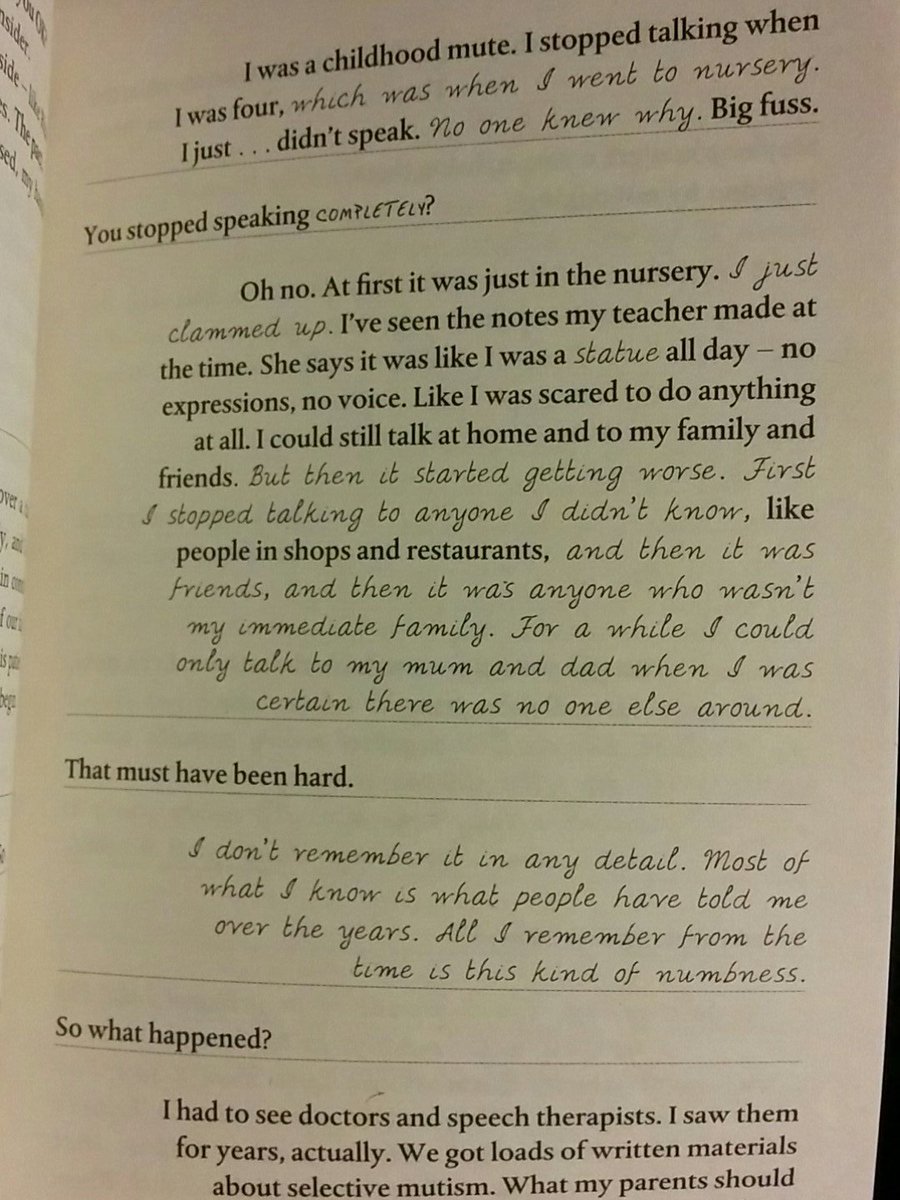
This kind of thing can be gimmicky, but it really works here. The same goes for the way that Steffi and Rhys’ texting and jackbytes conversations are laid out. In these, their voices as teenagers really shine. Steffi and Rhys talk the way teenagers talk, and it’s just so comfortable to read that kind of accurate representation.
Representation matters, and it’s everywhere here. Beyond the two main characters dealing with disabilities and mental health issues, Barnard infuses diversity into her cast without making it feel like tokenism. There’s one scene in particular that sticks with me: Steffi and Tem are at the park with their respective younger siblings Bel and Davey. Bel is happily prancing around in her fairy get-up, and Davey is upset because he also wants to be a fairy. When Tem alerts Steffi to this fact, she intercedes with Bel, who grants Davey her wings so they can both be fairies:
This is a totally superfluous scene; it has nothing to do with the main plot at all—but it is so important. It’s a small but significant example of how we need to challenge the gender binary and gender stereotypes. Maybe Davey is gay. Maybe Davey is trans. Maybe Davey is straight but just wants to be a fairy. We can’t make assumptions, because assumptions are bullshit—but at the end of the day, boys should be able to be fairies if they want to, and they shouldn’t be judged or shamed because of that.
On a related note, I love Steffi and Tem’s friendship, and the way that Steffi is oblivious to her more outgoing friend’s struggle until it all falls down on her.
And that brings me back to conflict in A Quiet Kind of Thunder. There is a fantastic essay in the Women Destroy SF issue of Lightspeed called “The Status Quo Cannot Hold”. In it, Tracie Welser describes her experience at a feminist science fiction symposium and quotes what other notable women authors said, including:
I remember wanting to unpack that remark the first time I read it, and I’ve been exposed to similar ideas since. We’re taught from an early age that conflict is a necessary ingredient in a story. And notice that Gloss isn’t saying we should get rid of conflict altogether—rather, she is saying it doesn’t necessarily have to be central. A Quiet Kind of Thunder is the first book I’ve read in a long time that helps me to understand what Gloss means by this.
There isn’t really an antagonist here. I mean, Steffi’s mother is probably the closest a character comes to such a role (I think she is a little less fully-realized than some of the other characters, but this is a minor quibble). But there is no character or group of characters out to ruin Steffi’s life. The antagonists are her own mental health, her anxiety and uncertainty over being in a relationship. The antagonists are the mistakes that she and Rhys make that are perfectly natural and expected of two teenagers in love for the first time.
As someone for whom romance does little, in literature or in life, I did find trying to follow these dimensions of conflict a little boring. The back-and-forth of Steffi or Rhys apologizing to one another for something they did or said wrongly just isn’t something I get? Or at least, it’s one of those inscrutable parts of a relationship that I am glad I don’t have to deal with, if only because I don’t get it. That being said, I feel like Barnard does a good job avoiding any overly-contrived situations the kind of which show up too often in a romantic comedy.
A Quiet Kind of Thunder is romantic, and it is comedic, but it is not a romantic comedy. Owing to my own particular comedy of errors (ahem, someone—me—ordered the wrong book) I didn’t read February’s Banging Book Club pick, Nina is Not OK. From the podcast discussion, however, I gather that it was fairly intense. This book is probably a welcome change of pace. Although it deals with important issues in a sensitive way, it is also light-hearted and quite upbeat, especially at the end.
This is a quick read, and a bit of a light read and a fluffy read in some senses—yet Sara Barnard delivers characters with such compassion and compelling personalities that I was loath to tear myself away. There is a heartwarming quality to this book that would be dull if it weren’t so unapologetically genuine. There were times when I was practically yelling at the book to give me more conflict, give me more drama! Yet Barnard stubbornly refused to yield to my crass expectations, preferring instead the slow burn of well-intentioned mistakes and the missteps of teen romance. And in so doing, in casting aside that temptation for high-octane hair-pulling and dramatic prom-night scenes and other drama, she asks the reader to exist instead in the stillness of Steffi’s life.
The back cover copy of this book is short and almost perfect, but I’ll summarize a bit anyway. Steffi Brons is in sixth form (senior high school for the non-UK crowd). While growing up, Steffi had selective mutism, speaking to her parents and friends when she was alone but having a lot of difficulty speaking in groups or with strangers. Although Steffi’s situation improved slightly over the years—and she has just started medication this year—she still doesn’t talk much outside of her friends and family. Related, Steffi knows British Sign Language, so her head of year pairs her with a new student who is deaf. Steffi and Rhys get along famously, “falling” for each other as one might say.
So what’s the problem? Where’s the conflict? Well that’s the thing—for much of the book, there isn’t much conflict, at least not explicitly on the page. It’s present in the form of subtext and foreshadowing and all the things that go unsaid—and I really love the depth of this—rather than being flashy. I’ll talk about this more in a bit, but first I need to talk about Barnard’s style.
Rhys comments early on in his conversations with Steffi that he loves her voice. He isn’t complimenting her oral communication, because she doesn’t talk much and he, obviously, can’t hear her. Rather, he is talking about how she speaks (writes), the way she uses language. And I have to agree with him. I love her voice too. Passages like this one made me certain I’d enjoy this book from the very beginning:
“… Steffi, what’s the sign for assembly?”
I’m about to obediently make the sign when a spark of mischief lights from nowhere in my mind. I turn to Rhys, keep my expression completely deadpan, then sign Welcome to the hellmouth. Rhys’ whole face lights up into a surprised grin. Oh yeah, strange new boy. The silent girl is FUNNY. Who knew?
First off, hell yes a Buffy reference! That show might be 20 years old this year, but it is still so fantastic. Secondly, I love the humour here. I love Steffi’s self-deprecating self-confidence. It’s easy to assume that people who don’t talk much must by shy, must lack self-confidence. Thanks to this first-person narration, Barnard can show us that isn’t the case. Steffi is a confident teenager; I’d say she’s probably better-adjusted and prepared for life outside of school than many of her peers, arguably (because we don’t see that much of them).
The bold emphasis on the text is A Quiet Kind of Thunder’s way of denoting sign language speech. It works well, especially because Barnard does similar things for other non-speaking modes of communication. When Rhys and Steffi write back and forth, the typeface becomes more like handwriting (for Steffi) or printing (for Rhys). Sometimes, they interchange methods of communication within one conversation, leading to some interesting juxtaposition that I can’t do justice to without a picture (click to embiggen):
This kind of thing can be gimmicky, but it really works here. The same goes for the way that Steffi and Rhys’ texting and jackbytes conversations are laid out. In these, their voices as teenagers really shine. Steffi and Rhys talk the way teenagers talk, and it’s just so comfortable to read that kind of accurate representation.
Representation matters, and it’s everywhere here. Beyond the two main characters dealing with disabilities and mental health issues, Barnard infuses diversity into her cast without making it feel like tokenism. There’s one scene in particular that sticks with me: Steffi and Tem are at the park with their respective younger siblings Bel and Davey. Bel is happily prancing around in her fairy get-up, and Davey is upset because he also wants to be a fairy. When Tem alerts Steffi to this fact, she intercedes with Bel, who grants Davey her wings so they can both be fairies:
“Go on,” Tem coaxes, jiggling her brother in her arms. “Fairy it up.” As Davey reaches a tentative hand out to take the wings—purple and sparkly—she grins at me over the top of his little fuzzy head.
This is a totally superfluous scene; it has nothing to do with the main plot at all—but it is so important. It’s a small but significant example of how we need to challenge the gender binary and gender stereotypes. Maybe Davey is gay. Maybe Davey is trans. Maybe Davey is straight but just wants to be a fairy. We can’t make assumptions, because assumptions are bullshit—but at the end of the day, boys should be able to be fairies if they want to, and they shouldn’t be judged or shamed because of that.
On a related note, I love Steffi and Tem’s friendship, and the way that Steffi is oblivious to her more outgoing friend’s struggle until it all falls down on her.
And that brings me back to conflict in A Quiet Kind of Thunder. There is a fantastic essay in the Women Destroy SF issue of Lightspeed called “The Status Quo Cannot Hold”. In it, Tracie Welser describes her experience at a feminist science fiction symposium and quotes what other notable women authors said, including:
Molly Gloss expressed the need for not only new ways of thinking about character, but narrative itself, saying, “We need stories where conflict doesn’t feature as central to story.”
I remember wanting to unpack that remark the first time I read it, and I’ve been exposed to similar ideas since. We’re taught from an early age that conflict is a necessary ingredient in a story. And notice that Gloss isn’t saying we should get rid of conflict altogether—rather, she is saying it doesn’t necessarily have to be central. A Quiet Kind of Thunder is the first book I’ve read in a long time that helps me to understand what Gloss means by this.
There isn’t really an antagonist here. I mean, Steffi’s mother is probably the closest a character comes to such a role (I think she is a little less fully-realized than some of the other characters, but this is a minor quibble). But there is no character or group of characters out to ruin Steffi’s life. The antagonists are her own mental health, her anxiety and uncertainty over being in a relationship. The antagonists are the mistakes that she and Rhys make that are perfectly natural and expected of two teenagers in love for the first time.
As someone for whom romance does little, in literature or in life, I did find trying to follow these dimensions of conflict a little boring. The back-and-forth of Steffi or Rhys apologizing to one another for something they did or said wrongly just isn’t something I get? Or at least, it’s one of those inscrutable parts of a relationship that I am glad I don’t have to deal with, if only because I don’t get it. That being said, I feel like Barnard does a good job avoiding any overly-contrived situations the kind of which show up too often in a romantic comedy.
A Quiet Kind of Thunder is romantic, and it is comedic, but it is not a romantic comedy. Owing to my own particular comedy of errors (ahem, someone—me—ordered the wrong book) I didn’t read February’s Banging Book Club pick, Nina is Not OK. From the podcast discussion, however, I gather that it was fairly intense. This book is probably a welcome change of pace. Although it deals with important issues in a sensitive way, it is also light-hearted and quite upbeat, especially at the end.
.jpg)
Every so often I read a book that I wish I had written. Right there, in those pages, is a universe that I don’t just enjoy but that I’m actively envious of. Three Parts Dead is not quite one of these books, but it comes close. It’s the kind of book I could see a me from a parallel universe not too far away could have written. It satisfies my current hunger for fantasy that is urban fantasy but not relentlessly focused on the paranormal or supernatural aspects of our contemporary society. It caters to a craving for fantasy in far-off lands, with magic and murder and mystery. It reminds me a lot of Scott Lynch’s The Lies of Locke Lamora or Lisa Shearin’s Raine Benares series. Most importantly, Max Gladstone uses all of this to fashion a solid mystery with a strong ensemble cast. The net result: not only did I want to keep reading this book, but immediately upon finishing it, I wanted to start the next.
Whatever Three Parts Dead might be, a bildungsroman it is not. Gladstone makes the gutsy decision to start as in media res as he possible can: Tara, the primary protagonist, is falling out of the sky. She has been literally expelled from the Hidden Schools, floating cloud castles of learning and study; only her knowledge of Craft (which got her into this trouble) allows her to survive, just barely. After struggling to eke out an existence as a hedge wizard in her hometown village, Tara discovers she doesn’t really belong there, and she willingly falls in with Elayne Kevarian, a partner in the firm of Kelethres, Albrecht, and Ao, and soon to be her harsh mentor.
As Tara and Elayne make their way to Alt Coulumb to deal with the fact that the city’s god, Kos the Everburning, has … well, died … we learn a little bit about this world. Gods? Totally real, in the “more prayers = more power” sense (TVTropes), but dressed up with a nice evolutionary biology gloss. The relationship is symbiotic rather than parasitic, though—gods must provide services in return for their prayer power, and if they pay out more than they receive, they die. Oops. The Craft, Gladstone’s magic system, is in fact the way humans manifest god-like abilities, powered by starlight and soulstuff. Gladstone uses the languages of contract law and economics to furnish most of his jargon for describing the Craft and god-powers.
About fifty years prior to the book, the God Wars concluded. They are pretty much what one might expect from a cataclysmic conflict called “the God Wars”: gods fought, gods died. Elayne and a handful of her fellow Craftspeople were around to witness the end to this conflict; they have no desire to relive it. Many cities have stopped associating with gods much these days as the Craft rises in prominence; Alt Coulumb is a bit of a holdout in that respect—and look where it got them.
Gladstone plunks us down in the middle of a very complex society with very little in the way of introduction or exposition. (Later in the book he often uses Abelard or Cat as the Watson (TVTropes) to allow Tara to drop some mad exposition beats, or Tara serves a similar role with Elayne.) The effect might be maddening for some, who would prefer to learn more about Tara’s past, her life in the Hidden Schools, and her run-in with Alexander Denovo. I totally understand that, because most of fantasy has raised us to expect that early chapter in the hero’s journey. The fact that Gladstone has skipped that, has waved his hands and said, “There was a war, it fucked everybody up, and by the way Tara stood up to her abusive, megalomaniac, mad-scientist professor and got expelled from school” might be disappointing. That’s why it’s a gutsy move.
It works, though, because Gladstone has a good story to tell here and now. And, yeah, there were a few times when I felt a little lost amidst the dialogue and description—but I rolled with it, and it all worked out fine in the end. Authors walk a fine line in trying to establish unique worlds while also keeping their readers sane, and Gladstone might have walked a finer line than most, but he mostly manages to stay on track.
The story itself is a whodunit wrapped up in a larger conflict regarding the city of Alt Coulumb itself. There is no question that someone is going to resurrect Kos, but the question of which parties (the creditors or the Church, the debtors) get the most influence in that process still must be settled in court. Instead of lawyers in wigs and robes, Gladstone gives us Craftspeople fighting metaphorical battles of the mind. Craft is used to interpret and render the higher-plane reality of a god’s existence in ways that a human mind can understand. There is almost a posthuman, science-fictional edge to this part of the story, and I really enjoyed seeing Gladstone do that using magic instead of computers and nanotechnology. Same soup, different seasoning.
So Tara and Elayne are desperately trying to make sure that the Church can bring Kos back as much as himself as possible. On the other side? None other than Denovo, with whom both of them have a sordid past. In order to resolve the dispute, it looks more likely that they will have to answer the question of what (who) killed Kos. The murder of a judge Elayne knows also seems to be part of the bigger picture, particularly because someone went to the trouble of framing a gargoyle for doing it. (The gargoyles being Alt Coulumb’s police force until their goddess got herself killed in the God Wars, and Denovo and Elayne resurrected her as a machine-like entity called Justice—see what I mean about all this complex, embedded history?)
Tara is an excellent protagonist. Though this is technically a mystery and that technically makes a detective, she lacks the smartass voice that, while delightful, is just so common in urban fantasy these days. She’s more empathetic, more unsure of herself—though this isn’t a coming-of-age novel, one might argue that this is Tara’s “debut” as a real adult. She isn’t quite as hardened and cynical as she might want you to believe. And though she is fairly capable when it comes to the Craft, all that amount of Craft can’t help the fact that she almost gets caught up in the lies she has to tell people while she’s trying to sort everything out.
I loved the tension created when Cat discovers that Tara is the one who has been hiding Shale’s face from Justice and resolves to track down Tara and make her pay. Gladstone uses the multiple, limited third-person viewpoints to great effect, doling out enough dramatic irony to keep us interested in what is going to happen next.
The climax and resolution are every bit as gripping as they need to be in a fantasy mystery like this. There’s a final showdown, during which the fortunes of our heroes fluctuate rapidly as Tara, Elayne, Cat, and Abelard all muster their respective talents in an attempt to take down the villains. I suppose that, technically, the ending is a deus ex machina in the most literal sense, so my hat off to Gladstone for creating a plot in which that is not only acceptable but inevitable.
I do have to take issue with the ending, in which Tara expresses her amazement at how Elayne manipulated events and reveals everything we hadn’t already figured out. I get the sense that Gladstone has been trying to establish Elayne as a kind of Holmesian character throughout the book—she routinely engages Tara in Socratic dialogue, drawing out Tara’s reasoning along lines she has already traversed. It doesn’t quite work, though, because he tends to keep us at arm’s length form her as a character, with a few notable exceptions. (I also found it a little weird that he continued to refer to her as “Ms. Kevarian” throughout the book, while everyone else got to go by their first name. Again, it seems like he can’t quite make up his mind whether to humanize her or retain her aura of mystery, so he splits the difference and comes up empty.)
Still, I overwhelmingly enjoyed Three Parts Dead. I’m still on a bit of a high, tingling from it despite having finished it two days ago. This is one of the best, original fantasy novels I’ve read this year (and I’ve read some pretty good fantasy this year). I’m very much looking forward to the next story Gladstone wants to tell.
My reviews of the Craft Sequence:
Two Serpents Rise →
Whatever Three Parts Dead might be, a bildungsroman it is not. Gladstone makes the gutsy decision to start as in media res as he possible can: Tara, the primary protagonist, is falling out of the sky. She has been literally expelled from the Hidden Schools, floating cloud castles of learning and study; only her knowledge of Craft (which got her into this trouble) allows her to survive, just barely. After struggling to eke out an existence as a hedge wizard in her hometown village, Tara discovers she doesn’t really belong there, and she willingly falls in with Elayne Kevarian, a partner in the firm of Kelethres, Albrecht, and Ao, and soon to be her harsh mentor.
As Tara and Elayne make their way to Alt Coulumb to deal with the fact that the city’s god, Kos the Everburning, has … well, died … we learn a little bit about this world. Gods? Totally real, in the “more prayers = more power” sense (TVTropes), but dressed up with a nice evolutionary biology gloss. The relationship is symbiotic rather than parasitic, though—gods must provide services in return for their prayer power, and if they pay out more than they receive, they die. Oops. The Craft, Gladstone’s magic system, is in fact the way humans manifest god-like abilities, powered by starlight and soulstuff. Gladstone uses the languages of contract law and economics to furnish most of his jargon for describing the Craft and god-powers.
About fifty years prior to the book, the God Wars concluded. They are pretty much what one might expect from a cataclysmic conflict called “the God Wars”: gods fought, gods died. Elayne and a handful of her fellow Craftspeople were around to witness the end to this conflict; they have no desire to relive it. Many cities have stopped associating with gods much these days as the Craft rises in prominence; Alt Coulumb is a bit of a holdout in that respect—and look where it got them.
Gladstone plunks us down in the middle of a very complex society with very little in the way of introduction or exposition. (Later in the book he often uses Abelard or Cat as the Watson (TVTropes) to allow Tara to drop some mad exposition beats, or Tara serves a similar role with Elayne.) The effect might be maddening for some, who would prefer to learn more about Tara’s past, her life in the Hidden Schools, and her run-in with Alexander Denovo. I totally understand that, because most of fantasy has raised us to expect that early chapter in the hero’s journey. The fact that Gladstone has skipped that, has waved his hands and said, “There was a war, it fucked everybody up, and by the way Tara stood up to her abusive, megalomaniac, mad-scientist professor and got expelled from school” might be disappointing. That’s why it’s a gutsy move.
It works, though, because Gladstone has a good story to tell here and now. And, yeah, there were a few times when I felt a little lost amidst the dialogue and description—but I rolled with it, and it all worked out fine in the end. Authors walk a fine line in trying to establish unique worlds while also keeping their readers sane, and Gladstone might have walked a finer line than most, but he mostly manages to stay on track.
The story itself is a whodunit wrapped up in a larger conflict regarding the city of Alt Coulumb itself. There is no question that someone is going to resurrect Kos, but the question of which parties (the creditors or the Church, the debtors) get the most influence in that process still must be settled in court. Instead of lawyers in wigs and robes, Gladstone gives us Craftspeople fighting metaphorical battles of the mind. Craft is used to interpret and render the higher-plane reality of a god’s existence in ways that a human mind can understand. There is almost a posthuman, science-fictional edge to this part of the story, and I really enjoyed seeing Gladstone do that using magic instead of computers and nanotechnology. Same soup, different seasoning.
So Tara and Elayne are desperately trying to make sure that the Church can bring Kos back as much as himself as possible. On the other side? None other than Denovo, with whom both of them have a sordid past. In order to resolve the dispute, it looks more likely that they will have to answer the question of what (who) killed Kos. The murder of a judge Elayne knows also seems to be part of the bigger picture, particularly because someone went to the trouble of framing a gargoyle for doing it. (The gargoyles being Alt Coulumb’s police force until their goddess got herself killed in the God Wars, and Denovo and Elayne resurrected her as a machine-like entity called Justice—see what I mean about all this complex, embedded history?)
Tara is an excellent protagonist. Though this is technically a mystery and that technically makes a detective, she lacks the smartass voice that, while delightful, is just so common in urban fantasy these days. She’s more empathetic, more unsure of herself—though this isn’t a coming-of-age novel, one might argue that this is Tara’s “debut” as a real adult. She isn’t quite as hardened and cynical as she might want you to believe. And though she is fairly capable when it comes to the Craft, all that amount of Craft can’t help the fact that she almost gets caught up in the lies she has to tell people while she’s trying to sort everything out.
I loved the tension created when Cat discovers that Tara is the one who has been hiding Shale’s face from Justice and resolves to track down Tara and make her pay. Gladstone uses the multiple, limited third-person viewpoints to great effect, doling out enough dramatic irony to keep us interested in what is going to happen next.
The climax and resolution are every bit as gripping as they need to be in a fantasy mystery like this. There’s a final showdown, during which the fortunes of our heroes fluctuate rapidly as Tara, Elayne, Cat, and Abelard all muster their respective talents in an attempt to take down the villains. I suppose that, technically, the ending is a deus ex machina in the most literal sense, so my hat off to Gladstone for creating a plot in which that is not only acceptable but inevitable.
I do have to take issue with the ending, in which Tara expresses her amazement at how Elayne manipulated events and reveals everything we hadn’t already figured out. I get the sense that Gladstone has been trying to establish Elayne as a kind of Holmesian character throughout the book—she routinely engages Tara in Socratic dialogue, drawing out Tara’s reasoning along lines she has already traversed. It doesn’t quite work, though, because he tends to keep us at arm’s length form her as a character, with a few notable exceptions. (I also found it a little weird that he continued to refer to her as “Ms. Kevarian” throughout the book, while everyone else got to go by their first name. Again, it seems like he can’t quite make up his mind whether to humanize her or retain her aura of mystery, so he splits the difference and comes up empty.)
Still, I overwhelmingly enjoyed Three Parts Dead. I’m still on a bit of a high, tingling from it despite having finished it two days ago. This is one of the best, original fantasy novels I’ve read this year (and I’ve read some pretty good fantasy this year). I’m very much looking forward to the next story Gladstone wants to tell.
My reviews of the Craft Sequence:
Two Serpents Rise →
.jpg)
I often use the idea of stories that “grab” me, often elaborating on that by then saying they “don’t let go”. Sometimes, though, I should be talking about whether or not I was able to grab onto a story. Sometimes, as with The Star-Touched Queen, stories or parts of them elude me and leave me feeling dissatisfied, even if I’m not sure why.
Roshani Chokshi delivers an Indian mythology–infused story of a princess doomed to be close to death and destruction. Maya is a strong-willed young woman not all that enthused about her father’s plans for marrying her off in the name of “peace”. The man she finds herself married to, Amar, is stranger still, and soon Maya finds herself in a kingdom of fairytales and magic the likes of which she was used to telling her younger half-sister about for bedtime stories. But her new husband is keeping a secret from her, and in typical paternalistic fashion, he refuses to tell her anything specific or useful and then strictly forbids her not to go exploring even though he simultaneously tells her she is free to go anywhere in the palace. Mixed messages much?
I like Maya! I like that she sees a life for herself beyond harem politics and marrying and having children (not that there is anything wrong with those occupations if they are what satisfy you in life). When she talks about how she had envisioned growing into an old maid just reading and studying texts for her entire life … oh man, I can identify. That sounds like heaven. And when she gets frustrated with Amar’s reluctance to reveal more about their new life together in Akaran, I totally understand where she is coming from. She is tired of the nature of her existence being predicated on the whim of some man, whether it’s her father or her new husband. Amar is a dolt and he does not deserve Maya, whether it’s this iteration or any previous or future iteration thereof….
As I said at the start of this review, I just had trouble getting a hold on this book’s story though. In keeping with the styles of magical realism, Chokshi plays fast and loose with things like the relative passage of time in Akaran versus the mortal realm. I had a hard time following exactly what was happening, who was doing what, how things were progressing. So much about the book’s setting feels generic. Maya’s kingdom has a name—but what of it? Beyond that, what makes it special, other than it happening to be her homeland? Her father is just a generic Raja; her family is generic pseudo-Indian royalty. I also have some reservations with the way the romance itself is portrayed, the way Maya seems to fall for Amar in a love-at-first-sight kind of way, even though from the very beginning he is pushy and demanding yet evasive.
Sometimes after leaving a book to marinate for a few days in my head before I write my review I can come back to it with a different perspective. In this case, it feels even more forgettable. The Star-Touched Queen is not bad, just meh.
Roshani Chokshi delivers an Indian mythology–infused story of a princess doomed to be close to death and destruction. Maya is a strong-willed young woman not all that enthused about her father’s plans for marrying her off in the name of “peace”. The man she finds herself married to, Amar, is stranger still, and soon Maya finds herself in a kingdom of fairytales and magic the likes of which she was used to telling her younger half-sister about for bedtime stories. But her new husband is keeping a secret from her, and in typical paternalistic fashion, he refuses to tell her anything specific or useful and then strictly forbids her not to go exploring even though he simultaneously tells her she is free to go anywhere in the palace. Mixed messages much?
I like Maya! I like that she sees a life for herself beyond harem politics and marrying and having children (not that there is anything wrong with those occupations if they are what satisfy you in life). When she talks about how she had envisioned growing into an old maid just reading and studying texts for her entire life … oh man, I can identify. That sounds like heaven. And when she gets frustrated with Amar’s reluctance to reveal more about their new life together in Akaran, I totally understand where she is coming from. She is tired of the nature of her existence being predicated on the whim of some man, whether it’s her father or her new husband. Amar is a dolt and he does not deserve Maya, whether it’s this iteration or any previous or future iteration thereof….
As I said at the start of this review, I just had trouble getting a hold on this book’s story though. In keeping with the styles of magical realism, Chokshi plays fast and loose with things like the relative passage of time in Akaran versus the mortal realm. I had a hard time following exactly what was happening, who was doing what, how things were progressing. So much about the book’s setting feels generic. Maya’s kingdom has a name—but what of it? Beyond that, what makes it special, other than it happening to be her homeland? Her father is just a generic Raja; her family is generic pseudo-Indian royalty. I also have some reservations with the way the romance itself is portrayed, the way Maya seems to fall for Amar in a love-at-first-sight kind of way, even though from the very beginning he is pushy and demanding yet evasive.
Sometimes after leaving a book to marinate for a few days in my head before I write my review I can come back to it with a different perspective. In this case, it feels even more forgettable. The Star-Touched Queen is not bad, just meh.

There’s a clever tweet going around out there advocating for a moratorium on words like “throne” and “crown” in YA book titles, and I totally get why. A Crown of Wishes is one of those densely generic titles that does a terrible job at hinting about the contents of the book. In this particular case, it is at least appropriate, in that the book does feature both crowns (metaphorical and literal) and wishes (um … metaphorical and literal?). This book just came out last week, and I received an ebook through NetGalley thanks to St. Martin’s Press. I’m glad that it is a standalone companion to The Star-Touched Queen, because after that experience I wasn’t keen on continuing Maya’s story.
For those who have read Maya’s book, this one follows her half-sister Gauri. Maya makes a small appearance much later. Some of the setting and mythical beings are similar. That’s about all you need to know.
Adult now, Gauri has failed in an attempt to usurp the throne of Bharata from her brother Skanda, who is a cruel and negligent ruler. Exiled to be executed in a foreign kingdom, Gauri instead finds herself swept up into a supernatural “Tournament of Wishes” as the partner of Prince Vikram, who is determined to find a way to claim true power for his throne instead of being a puppet for Ujijain’s council. This tournament takes Gauri and Vikram to Alaka, a supernatural domain ruled by Lord Kubera and Lady Kauveri, who preside capriciously over the tournament.
Gauri and Vikram have diametrically opposed personalities, of course, in the kind of way that makes them great complements to each other, especially in a tournament that is mostly a battle of wits. It is blatantly obvious from the start that this is a romance, that they are meant to be together, no matter how many obstacles Roshani Chokshi throws in their way. This setup does feel a little clichéd in that sense, just because everything is so obvious, right down to the best friend teasing Gauri about being so obstinate and resistant to what’s right in front of her face. Nevertheless, compared to Maya and Amar’s “romance” from the first book, this one is at least more gradual and organic within the story. Gauri doesn’t suddenly get a feeling that she is meant to be with Vikram; they have to build trust and earn each other’s respect.
I liked Gauri. She is so strong but also so inflexible; she would break rather than bend, and it’s this brittleness that is embodied later in the glass … well, no spoilers. This Tournament of Wishes is, as with any wish-powered fairytale, all about learning what you should really be wishing for (if you should really wish at all). Gauri has spent her entire existence, such as it is so far, growing up with certain ideals of strength, influenced by her harem and Mother Dhina, as well as stories from Maya, and her companion, Nalini. She has mastered the arts of cosmetics and clothing to enhance and broadcast her beauty when necessary; she will also fight and kill as required. And I like that when the story begins, Gauri is alone, defeated. She played the game of thrones, if you will, and is about to encounter the “die” outcome rather than the win. She is a determined person, but she was not successful—until Vikram happens.
On the other hand, Vikram is self-assured almost to a fault. He is so confident in his intelligence and wit that he continually places himself and Gauri in harm’s way, sure that he can figure out a dodge. It’s going to get them killed one day, but until then, I suppose he is a very interesting character to live with. I want to say I liked him, sure, but as you can tell from the relative lengths of these two paragraphs, I find him much less interesting. He’s a smart dolt with a heart of gold, but beyond that … meh. Gauri could do better.
The setting and substance of A Crown of Wishes is once again fantastic and mythological. Chokshi brings in quite a nicely diverse set of beings to populate Alaka and threaten or aid our protagonist. She is very good at conjuring that fairytale-like atmosphere in which the correct course of action is not always the obvious one, that kind of atmosphere where riddles abound and confidence is often all it takes to win the day. I remember getting pretty frustrated with the magical realism of The Star-Touched Queen—less so here. However, the prose continues to shade towards a definite indigo, if not outright purple, in a way that doesn’t appeal to me.
My only dissatisfaction around the plot is really just that it feels too familiar. Not in the particulars, the characters or myths that Chokshi uses on the page, but in the overall themes and outcomes. Like the hero’s journey, the wishing-quest structure is an old and honourable one—but Chokshi doesn’t do much to stretch its boundaries or plumb its depths.
A Crown of Wishes, then, is a predictable tale of magic and romance told with competent and interesting characters. I liked it more than The Star-Touched Queen but not enough to jump up and down about it (and yes, for some books, that’s literally how I express my excitement while reading them).
For those who have read Maya’s book, this one follows her half-sister Gauri. Maya makes a small appearance much later. Some of the setting and mythical beings are similar. That’s about all you need to know.
Adult now, Gauri has failed in an attempt to usurp the throne of Bharata from her brother Skanda, who is a cruel and negligent ruler. Exiled to be executed in a foreign kingdom, Gauri instead finds herself swept up into a supernatural “Tournament of Wishes” as the partner of Prince Vikram, who is determined to find a way to claim true power for his throne instead of being a puppet for Ujijain’s council. This tournament takes Gauri and Vikram to Alaka, a supernatural domain ruled by Lord Kubera and Lady Kauveri, who preside capriciously over the tournament.
Gauri and Vikram have diametrically opposed personalities, of course, in the kind of way that makes them great complements to each other, especially in a tournament that is mostly a battle of wits. It is blatantly obvious from the start that this is a romance, that they are meant to be together, no matter how many obstacles Roshani Chokshi throws in their way. This setup does feel a little clichéd in that sense, just because everything is so obvious, right down to the best friend teasing Gauri about being so obstinate and resistant to what’s right in front of her face. Nevertheless, compared to Maya and Amar’s “romance” from the first book, this one is at least more gradual and organic within the story. Gauri doesn’t suddenly get a feeling that she is meant to be with Vikram; they have to build trust and earn each other’s respect.
I liked Gauri. She is so strong but also so inflexible; she would break rather than bend, and it’s this brittleness that is embodied later in the glass … well, no spoilers. This Tournament of Wishes is, as with any wish-powered fairytale, all about learning what you should really be wishing for (if you should really wish at all). Gauri has spent her entire existence, such as it is so far, growing up with certain ideals of strength, influenced by her harem and Mother Dhina, as well as stories from Maya, and her companion, Nalini. She has mastered the arts of cosmetics and clothing to enhance and broadcast her beauty when necessary; she will also fight and kill as required. And I like that when the story begins, Gauri is alone, defeated. She played the game of thrones, if you will, and is about to encounter the “die” outcome rather than the win. She is a determined person, but she was not successful—until Vikram happens.
On the other hand, Vikram is self-assured almost to a fault. He is so confident in his intelligence and wit that he continually places himself and Gauri in harm’s way, sure that he can figure out a dodge. It’s going to get them killed one day, but until then, I suppose he is a very interesting character to live with. I want to say I liked him, sure, but as you can tell from the relative lengths of these two paragraphs, I find him much less interesting. He’s a smart dolt with a heart of gold, but beyond that … meh. Gauri could do better.
The setting and substance of A Crown of Wishes is once again fantastic and mythological. Chokshi brings in quite a nicely diverse set of beings to populate Alaka and threaten or aid our protagonist. She is very good at conjuring that fairytale-like atmosphere in which the correct course of action is not always the obvious one, that kind of atmosphere where riddles abound and confidence is often all it takes to win the day. I remember getting pretty frustrated with the magical realism of The Star-Touched Queen—less so here. However, the prose continues to shade towards a definite indigo, if not outright purple, in a way that doesn’t appeal to me.
My only dissatisfaction around the plot is really just that it feels too familiar. Not in the particulars, the characters or myths that Chokshi uses on the page, but in the overall themes and outcomes. Like the hero’s journey, the wishing-quest structure is an old and honourable one—but Chokshi doesn’t do much to stretch its boundaries or plumb its depths.
A Crown of Wishes, then, is a predictable tale of magic and romance told with competent and interesting characters. I liked it more than The Star-Touched Queen but not enough to jump up and down about it (and yes, for some books, that’s literally how I express my excitement while reading them).

Company Town, while a book I definitely wanted to read, is not a book I had intended to read right now. This is how it came to me:
100% accurate retelling.
I’m quite surprised this is a selection for Canada Reads. It’s very science fiction, and not literary-acceptable science fiction by a juggernaut like Margaret Atwood. Madeline Ashby name-checks concepts like the Singularity and, without going too far towards spoiler territory, includes some temporally-challenging timeline/artificial intelligence/nanomachine stuff in this book.
Trigger warning in the book for violence against women and, specifically, sex workers, and rape threats. There is a serial killer at work and some of the scenes get gruesome. I’m not going into details in this review, though.
Company Town is about twenty-two-year-old Go Jung-hwa. A high school drop-out, Hwa makes a living as a bodyguard for the United Sex Workers of Canada union members on the New Arcadia oil rig. She stands out because she is completely unaugmented in a genetic and cybernetic sense. She makes up for this with tenacity and rigorous training, tenets she intends to pass on to her charge, the fifteen-year-old son and heir apparent of the company that buys New Arcadia.
Make no mistake: though this book is set in the near future and filled with technology only now in its infancy, Company Town is about the present day in the best sense of science fiction. Ashby’s portrayal of Hwa, the sex workers she protects, and the corporate machinations that threaten the existence and stability of New Arcadia are all very real and pressing people and issues in the present day. By removing them into a hypothetical future with robots and virtual reality Ashby just has a few more degrees of freedom to explore where we might be heading as a society—and I say “we”, since this book is actually set in Canada!
One of those degrees of freedom is in Ashby’s depiction of unionized sex work. This is a hot topic right now, with several high-profile court cases happening recently in Canada. It isn’t clear specifically if sex work is legalized or decriminalized in this future (the difference is an important one to sex workers), but the point is that it’s not underground any more. That doesn’t eliminate the need for protection, as Hwa’s job at the start of the novel demonstrates—but even the positing of a future with unionized sex work is in some ways a positive move towards social justice. For all the economic oppression and violence that happens in this book, there is at least this hopeful dimension to this future.
Still, much of Hwa’s experience will seem familiar to contemporary readers. Her world still searches for clean energy solutions, and the vice of fossil fuels has continued to squeeze corporations into constructing bigger, more dangerous oil rigs that are essentially cities. These environments have their own laws, and with a new owner, new rules come into play. It’s notable that Hwa does not call the police when her former colleagues start dying: she investigates on her own, using the resources available in her new position, because she does not trust the police to protect women. And Ashby does an excellent job explaining, in a visceral way, so that male readers in particular might get an inkling of why that’s the case. In addition to the more graphic scenes, there’s a disgusting chat conversation Hwa eavesdrops on halfway through the book. While reading it, all I can think is, “this is how a lot of men talk today”. It’s how the President of the United States has talked, on record, about treating women. Company Town is set in the future, but nothing about its treatment of women is science fictional.
I love how Ashby shows Hwa’s colleagues pushing her away after she leaves the United Sex Workers to go work for Lynch, Ltd. It’s not very subtly done, but that makes it all the more potent: they see her as a traitor, a sell-out. Worse, they don’t trust her anymore, making it all the more difficult for her to help them—which is the main reason she stays with Lynch even after the job goes sideways, fast. But you really quickly understand that, in a world where everyone else is against them, trying to get something from them or possibly planning violence against them, they have to stick together. And they interpret Hwa’s action as abandonment, even if it is potentially a good decision for her on a personal level.
I also appreciate the relationship between Hwa and her charge, young Joel. Although he’s a self-described genius, he’s not annoying. He is fifteen, and it shows, both the quirky confidence fifteen-year-old boys have and the moments of excruciating self-doubt. This is amplified, of course, by his obvious responsibilities as heir to the privately-held Lynch company. But I love how he goes to bat for Hwa, how he comes to trust her and help her, and how he starts to question certain aspects of his father’s business. Their relationship feels the most real and reaffirming of all the ones in this book, in contrast to, say, Hwa’s relationship with Daniel, which I could never really place in terms of whether it was supposed to be messy romantic tension or just programmed corporate espionage.
(I also headcanon Joel as asexual. He reassures Hwa he has no desire to have sex with her. It’s true, of course, that part of Hwa’s characterization is physical disfigurement that renders her conventionally unattractive. Still, a couple of times he mentions how he finds the whole prospect of sex unpalatable, gross, perhaps “even painful.” And I’m like, “Dude, fifteen-year-old me totally gets where you’re coming from here. Stick with your generation ship designs and your VR books and science club.” So there’s that.)
If the first half of this book is our introduction to Hwa and her world, then the second half is an intense thriller and mystery. As Hwa’s involvement in the Lynch corporation’s plans for New Arcadia gets deeper and deeper, she has to question her identity and her allegiances and even her ideology about what the future should hold. It’s philosophically complex but also intense because of the physical action sequences, the detective legwork and chase scenes that Hwa participates in. For the majority of the time, I was enjoying this book at about the same level that I did vN or iD: hey, this is a cool science-fiction novel. Then a switch flipped, and I can’t quite remember where, and I realized that this book is a big deal. Like, I get now why it was chosen for Canada Reads.
Me: *spots book on living room table, evidently purchased by Dad* You read this yet?
Dad: No.
Me: *takes book* Let me know when you want it back. *drops smoke screen*
100% accurate retelling.
I’m quite surprised this is a selection for Canada Reads. It’s very science fiction, and not literary-acceptable science fiction by a juggernaut like Margaret Atwood. Madeline Ashby name-checks concepts like the Singularity and, without going too far towards spoiler territory, includes some temporally-challenging timeline/artificial intelligence/nanomachine stuff in this book.
Trigger warning in the book for violence against women and, specifically, sex workers, and rape threats. There is a serial killer at work and some of the scenes get gruesome. I’m not going into details in this review, though.
Company Town is about twenty-two-year-old Go Jung-hwa. A high school drop-out, Hwa makes a living as a bodyguard for the United Sex Workers of Canada union members on the New Arcadia oil rig. She stands out because she is completely unaugmented in a genetic and cybernetic sense. She makes up for this with tenacity and rigorous training, tenets she intends to pass on to her charge, the fifteen-year-old son and heir apparent of the company that buys New Arcadia.
Make no mistake: though this book is set in the near future and filled with technology only now in its infancy, Company Town is about the present day in the best sense of science fiction. Ashby’s portrayal of Hwa, the sex workers she protects, and the corporate machinations that threaten the existence and stability of New Arcadia are all very real and pressing people and issues in the present day. By removing them into a hypothetical future with robots and virtual reality Ashby just has a few more degrees of freedom to explore where we might be heading as a society—and I say “we”, since this book is actually set in Canada!
One of those degrees of freedom is in Ashby’s depiction of unionized sex work. This is a hot topic right now, with several high-profile court cases happening recently in Canada. It isn’t clear specifically if sex work is legalized or decriminalized in this future (the difference is an important one to sex workers), but the point is that it’s not underground any more. That doesn’t eliminate the need for protection, as Hwa’s job at the start of the novel demonstrates—but even the positing of a future with unionized sex work is in some ways a positive move towards social justice. For all the economic oppression and violence that happens in this book, there is at least this hopeful dimension to this future.
Still, much of Hwa’s experience will seem familiar to contemporary readers. Her world still searches for clean energy solutions, and the vice of fossil fuels has continued to squeeze corporations into constructing bigger, more dangerous oil rigs that are essentially cities. These environments have their own laws, and with a new owner, new rules come into play. It’s notable that Hwa does not call the police when her former colleagues start dying: she investigates on her own, using the resources available in her new position, because she does not trust the police to protect women. And Ashby does an excellent job explaining, in a visceral way, so that male readers in particular might get an inkling of why that’s the case. In addition to the more graphic scenes, there’s a disgusting chat conversation Hwa eavesdrops on halfway through the book. While reading it, all I can think is, “this is how a lot of men talk today”. It’s how the President of the United States has talked, on record, about treating women. Company Town is set in the future, but nothing about its treatment of women is science fictional.
I love how Ashby shows Hwa’s colleagues pushing her away after she leaves the United Sex Workers to go work for Lynch, Ltd. It’s not very subtly done, but that makes it all the more potent: they see her as a traitor, a sell-out. Worse, they don’t trust her anymore, making it all the more difficult for her to help them—which is the main reason she stays with Lynch even after the job goes sideways, fast. But you really quickly understand that, in a world where everyone else is against them, trying to get something from them or possibly planning violence against them, they have to stick together. And they interpret Hwa’s action as abandonment, even if it is potentially a good decision for her on a personal level.
I also appreciate the relationship between Hwa and her charge, young Joel. Although he’s a self-described genius, he’s not annoying. He is fifteen, and it shows, both the quirky confidence fifteen-year-old boys have and the moments of excruciating self-doubt. This is amplified, of course, by his obvious responsibilities as heir to the privately-held Lynch company. But I love how he goes to bat for Hwa, how he comes to trust her and help her, and how he starts to question certain aspects of his father’s business. Their relationship feels the most real and reaffirming of all the ones in this book, in contrast to, say, Hwa’s relationship with Daniel, which I could never really place in terms of whether it was supposed to be messy romantic tension or just programmed corporate espionage.
(I also headcanon Joel as asexual. He reassures Hwa he has no desire to have sex with her. It’s true, of course, that part of Hwa’s characterization is physical disfigurement that renders her conventionally unattractive. Still, a couple of times he mentions how he finds the whole prospect of sex unpalatable, gross, perhaps “even painful.” And I’m like, “Dude, fifteen-year-old me totally gets where you’re coming from here. Stick with your generation ship designs and your VR books and science club.” So there’s that.)
If the first half of this book is our introduction to Hwa and her world, then the second half is an intense thriller and mystery. As Hwa’s involvement in the Lynch corporation’s plans for New Arcadia gets deeper and deeper, she has to question her identity and her allegiances and even her ideology about what the future should hold. It’s philosophically complex but also intense because of the physical action sequences, the detective legwork and chase scenes that Hwa participates in. For the majority of the time, I was enjoying this book at about the same level that I did vN or iD: hey, this is a cool science-fiction novel. Then a switch flipped, and I can’t quite remember where, and I realized that this book is a big deal. Like, I get now why it was chosen for Canada Reads.