Take a photo of a barcode or cover

.jpg)
Bear is never not good and her future is clever and compelling and fun to inhabit and, of course, I appreciate a good murder mystery.
This was just a really fun short read.
This was just a really fun short read.
.png)
I wanted to enjoy this book so much more than I did.
Some of it is that this felt very much like a filler story to get from the first book to the third book. Some of it is that I remembered NOTHING from the first book so was not at all attached to this character I was clearly supposed to know.
Some of it was that I really disliked how the romance was handled. Meh.
Some of it is that this felt very much like a filler story to get from the first book to the third book. Some of it is that I remembered NOTHING from the first book so was not at all attached to this character I was clearly supposed to know.
Some of it was that I really disliked how the romance was handled. Meh.

2.5 but rounded down because I'm in a snit.
So this was my horse book. I think it's Judith Tarr who talks about how it feels to read fantasy novels once you've spent time with horses and know them well and anticipate how they act and then horses in novels are like...horse-shaped amalgams of everyone's dream of what a horse ought to be.
This isn't as bad as horses, not by a long shot, but there was a lot in this book that I am more than familiar with and so anything that looked like a mistake was grating. Okay, this is petty so I'm spoiler-ing itLike, the timeline between the Besht and when this story takes place was condensed and that threw me off. The transliteration that was only half yiddishized. The use of the word boyfriend. And so on.
And on the one hand, I really do believe that narratives in general and own voices narratives in particular ought not be gate-kept by other people going "but my tradition is slightly different so this is terrible" because the narcissism of small differences is absurd and also it completely yoinked me out of the narrative every time it happened.
I kind of understood what Rossner was going for with Laya's narrative style, but it evokes Rossetti's original just enough to make me wish she'd actually riffed on the poem instead of just doing odd line breaks. At the end of the day, this book is based in 19th century Jewish life, Christina Rossetti's "Goblin Market" and, to less of a degree, Jane Austen's Sense and Sensibility and I am really snippy about all of them.
Lest you think this is entirely a snit (just like 50%), I also HATED the way the swan thing was handled. It was one of those moments where the text speaks out against something (ona'at ger) and then does the thing it speaks out against. The text itself calls into question Adel's conversion and loyalty and crafts a narrative that feels very grounded in blood and legacy, rather than choice and conversion, as markers of fate. Can people really enter into our community, it asks. It would have been so much more powerful if Laya and Liba's inheritances were opposite. The way it is now, it maps religion and selected family onto the non-human and magical and thus immutable lineage of fairy tales. And that's a very uncomfortable way to see Judaism.

Which is why it gets knocked down to a 2. Rossner has an interesting story here and, by the end, I was pretty caught up in it, but I seriously considered putting it down for the first 100 pages because of how bothered I was by it.
So this was my horse book. I think it's Judith Tarr who talks about how it feels to read fantasy novels once you've spent time with horses and know them well and anticipate how they act and then horses in novels are like...horse-shaped amalgams of everyone's dream of what a horse ought to be.
This isn't as bad as horses, not by a long shot, but there was a lot in this book that I am more than familiar with and so anything that looked like a mistake was grating. Okay, this is petty so I'm spoiler-ing it
And on the one hand, I really do believe that narratives in general and own voices narratives in particular ought not be gate-kept by other people going "but my tradition is slightly different so this is terrible" because the narcissism of small differences is absurd and also it completely yoinked me out of the narrative every time it happened.
I kind of understood what Rossner was going for with Laya's narrative style, but it evokes Rossetti's original just enough to make me wish she'd actually riffed on the poem instead of just doing odd line breaks. At the end of the day, this book is based in 19th century Jewish life, Christina Rossetti's "Goblin Market" and, to less of a degree, Jane Austen's Sense and Sensibility and I am really snippy about all of them.
Lest you think this is entirely a snit (just like 50%), I also HATED the way the swan thing was handled. It was one of those moments where the text speaks out against something (ona'at ger) and then does the thing it speaks out against. The text itself calls into question Adel's conversion and loyalty and crafts a narrative that feels very grounded in blood and legacy, rather than choice and conversion, as markers of fate. Can people really enter into our community, it asks. It would have been so much more powerful if Laya and Liba's inheritances were opposite. The way it is now, it maps religion and selected family onto the non-human and magical and thus immutable lineage of fairy tales. And that's a very uncomfortable way to see Judaism.
Which is why it gets knocked down to a 2. Rossner has an interesting story here and, by the end, I was pretty caught up in it, but I seriously considered putting it down for the first 100 pages because of how bothered I was by it.

You know that book everyone is talking about as being really good?
It's really good.
Westover is an exquisitely good writer--literally so good that it hurts--and she understands how to write within the mind of her earlier self while still making observations and speaking to the reader, but without coloring how she would have seen the world then. It's gorgeous, it's agonizing, it's...a hell of a book and I understand why everyone is reading it.
And she's my age, which made the entire reading experience ever so slightly surreal because I could map my timeline onto hers with almost no effort.
It's really good.
Westover is an exquisitely good writer--literally so good that it hurts--and she understands how to write within the mind of her earlier self while still making observations and speaking to the reader, but without coloring how she would have seen the world then. It's gorgeous, it's agonizing, it's...a hell of a book and I understand why everyone is reading it.
And she's my age, which made the entire reading experience ever so slightly surreal because I could map my timeline onto hers with almost no effort.
.jpg)
Welp, you can always rely on the tor.com novellas for that atmospheric wtfery without which the world of SF narrative would be that much poorer.
Thompson picked the right length for this. Too short and it would feel unfulfilling. And longer and it would stop being about the horror and experience and engage with the plot. Like so many good novellas, this isn’t about the plot.
Also, the novella length gives Thompson the space to think about life giving and murder and women without needing to...go anywhere with it. I think I have to think more about this.
Thompson picked the right length for this. Too short and it would feel unfulfilling. And longer and it would stop being about the horror and experience and engage with the plot. Like so many good novellas, this isn’t about the plot.
Also, the novella length gives Thompson the space to think about life giving and murder and women without needing to...go anywhere with it. I think I have to think more about this.

This book.
It's like someone wrote an epic fantasy and left (almost) all the fantasy out, but kept the scope and the number of characters and the sheer everything-ness of it.
It VERY much worked for me and also kind of makes me hate humans.
It's like someone wrote an epic fantasy and left (almost) all the fantasy out, but kept the scope and the number of characters and the sheer everything-ness of it.
It VERY much worked for me and also kind of makes me hate humans.

I was entertained by this book, although I think it suffered a bit from "what even happened in the last book and do I remember anything?"
On the one hand, Scalzi does a good job with the intrigue and the suspense and the stuff happening. On the other hand, I've been reading a lot of space opera that thinks deeply about the science and the way that culture would and would not change based on what is available. And this, while fun, felt shallow. That if I jumped in and dug further, I wouldn't find much there there.
Moral of the story is don't read other space opera after reading Bujold, apparently.
On the one hand, Scalzi does a good job with the intrigue and the suspense and the stuff happening. On the other hand, I've been reading a lot of space opera that thinks deeply about the science and the way that culture would and would not change based on what is available. And this, while fun, felt shallow. That if I jumped in and dug further, I wouldn't find much there there.
Moral of the story is don't read other space opera after reading Bujold, apparently.

I read this book because it was overdue back to the library and it was a 3 day yomtov so I couldn't return it until yomtov was over and, anyway, it was fine but probably would have benefited from an enthusiastic reader.
Two main issues - I'm just really tired of the Romeo and Juliet model of YA relationships. They come from opposite worlds, they hate each other...but then fate throws them together. There's usually a terrible secret involved. Can't people just like each other? Also, and I think this may be a growing-up thing, why do all the main characters have to be so prickly??
Second issue - The villain was...cartoonish and unappealing and not worth...rooting against because she felt utterly preposterous. So I wasn't invested in the struggle to beat her because she felt so shallow and uninteresting. Meh - Ursula deserved better.
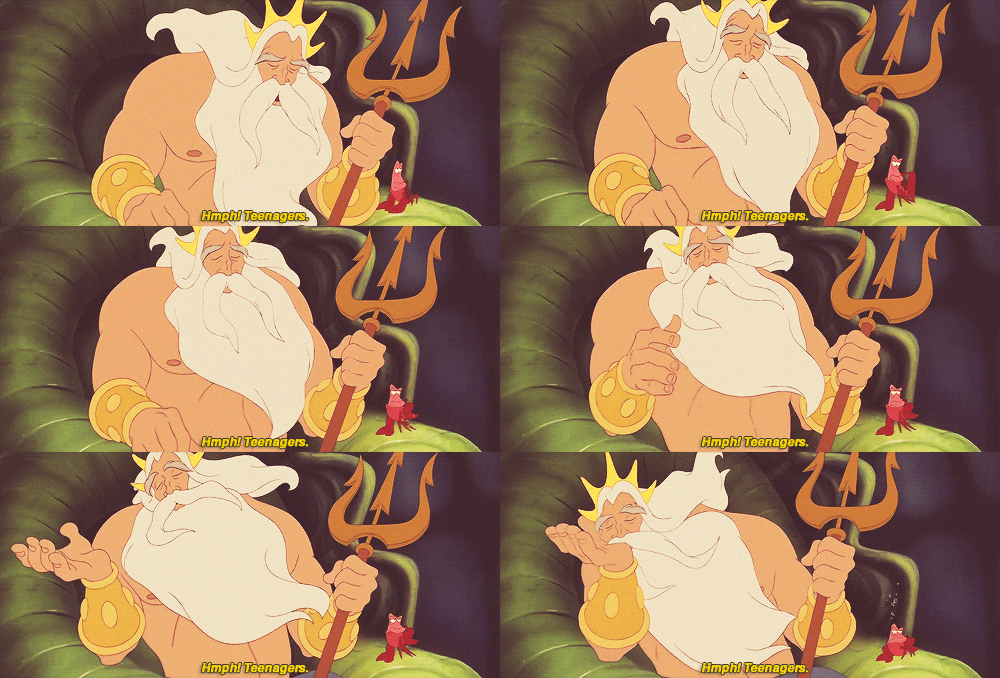
But I finished it and it was fine and I don't regret the time I spent on it. But also I probably shouldn't attempt any YA for a while because my current mood seems to be
Two main issues - I'm just really tired of the Romeo and Juliet model of YA relationships. They come from opposite worlds, they hate each other...but then fate throws them together. There's usually a terrible secret involved. Can't people just like each other? Also, and I think this may be a growing-up thing, why do all the main characters have to be so prickly??
Second issue - The villain was...cartoonish and unappealing and not worth...rooting against because she felt utterly preposterous. So I wasn't invested in the struggle to beat her because she felt so shallow and uninteresting. Meh - Ursula deserved better.
But I finished it and it was fine and I don't regret the time I spent on it. But also I probably shouldn't attempt any YA for a while because my current mood seems to be

This has the feel of a brilliant arrow aimed at a target who is not me. I can tell how good it is and how compelling the characters are and I realized about 1/4 of the way through that whatever narrative arc it intended to draw was not the one I wanted it to draw. I wish I was more into the slow, creeping, existential drama Oh wanted to tell instead of...I don’t know what I wanted.

I am coming to realize that the question is not “how much did I like this retelling of beauty and the beast” but rather “how similar is this retelling to Robin McKinley’s two iconic versions”.
And the answer is...pretty close, so I liked it. Shallcross gets the enchanted servants thing and the sense of the house itself as magical and the beast’s messy relationship with his own home. And, thank goodness, she makes Beauty’s sisters good people and the story is infinitely better when the sisters aren’t awful. (Like, I said, McKinley.)
There are, however, two things that rubbed me the wrong way and while I think one is a thing that could have been done well and wasn’t...the other just can’t.
1) the beast’s motivations for punishing beauty’s father for the rose and his contrivance make very little sense from the perspective inside the beast’s head. There’s a line between flailing and premeditation and this beast tries to write his story as if he’s the former when the results look too close to the latter. This is when the Disney approach actually works in your favor - change the story.
Also, I really really REALLY hate any attempts to justify what the fairy did. This book tries. I am not sold on it and it soured me at the end because I think this story only works when the fairy lives outside the moral framework under which everyone else operates. Bring her in and she’s evil. Justify her actions and I revolt.
God, I’m such a pain. But I did enjoy the book and, more than anything else, Shallcross got the style right and I love that.
And the answer is...pretty close, so I liked it. Shallcross gets the enchanted servants thing and the sense of the house itself as magical and the beast’s messy relationship with his own home. And, thank goodness, she makes Beauty’s sisters good people and the story is infinitely better when the sisters aren’t awful. (Like, I said, McKinley.)
There are, however, two things that rubbed me the wrong way and while I think one is a thing that could have been done well and wasn’t...the other just can’t.
1) the beast’s motivations for punishing beauty’s father for the rose and his contrivance make very little sense from the perspective inside the beast’s head. There’s a line between flailing and premeditation and this beast tries to write his story as if he’s the former when the results look too close to the latter. This is when the Disney approach actually works in your favor - change the story.
Also, I really really REALLY hate any attempts to justify what the fairy did. This book tries. I am not sold on it and it soured me at the end because I think this story only works when the fairy lives outside the moral framework under which everyone else operates. Bring her in and she’s evil. Justify her actions and I revolt.
God, I’m such a pain. But I did enjoy the book and, more than anything else, Shallcross got the style right and I love that.