You need to sign in or sign up before continuing.
Take a photo of a barcode or cover
1.44k reviews by:
emberology


So she was burnt, with all her clothes,
And arms, and hands, and eyes, and nose;
Till she had nothing more to lose
Except her little scarlet shoes;
And nothing else but these was found
Among her ashes on the ground.
That's something you don't see very often these days in a children's book. Struwwelpeter has a bit of a reputation of being macabre, but there are actually only three stories where misbehaving children end up dead or mutilated. Doesn't sound very fun, you say? Well, the rhymes make the stories appear more light-hearted, and compared with some of the modern children's books that underestimate children horrifically, I'd rather recommend Hoffmann's wacky story anyday. No matter how hard you scream and misbehave, you're not entitled to break the rules or do what you want. Actions have consequences (the gravity of them you'll never know beforehand), and there's no better way of showing it than through a bit of unpleasantness in a children's book that's read in a safe environment.
The illustrations are part of the fun. I don't usually go for this kind of style, but the bright colours are beautiful and occasional hilarity comes from the expressions of the people and the animals. Crying cats, racist kids dipped in ink, a tailor dashing to cut some thumbs off, and - my favourite - a rabbit turning against a hunter.
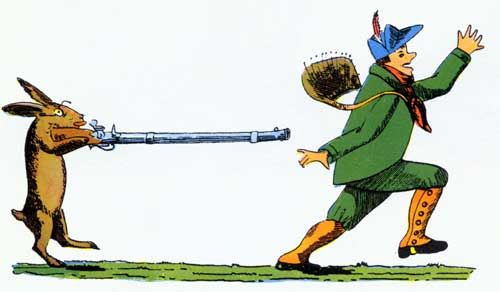
This might also get me to brush up my German. I read the story aloud both in English and in German, and the original definitely sounded better. It has a nice rhythm and clang to it, but it also sounds more fun and playful.
And arms, and hands, and eyes, and nose;
Till she had nothing more to lose
Except her little scarlet shoes;
And nothing else but these was found
Among her ashes on the ground.
That's something you don't see very often these days in a children's book. Struwwelpeter has a bit of a reputation of being macabre, but there are actually only three stories where misbehaving children end up dead or mutilated. Doesn't sound very fun, you say? Well, the rhymes make the stories appear more light-hearted, and compared with some of the modern children's books that underestimate children horrifically, I'd rather recommend Hoffmann's wacky story anyday. No matter how hard you scream and misbehave, you're not entitled to break the rules or do what you want. Actions have consequences (the gravity of them you'll never know beforehand), and there's no better way of showing it than through a bit of unpleasantness in a children's book that's read in a safe environment.
The illustrations are part of the fun. I don't usually go for this kind of style, but the bright colours are beautiful and occasional hilarity comes from the expressions of the people and the animals. Crying cats, racist kids dipped in ink, a tailor dashing to cut some thumbs off, and - my favourite - a rabbit turning against a hunter.
This might also get me to brush up my German. I read the story aloud both in English and in German, and the original definitely sounded better. It has a nice rhythm and clang to it, but it also sounds more fun and playful.


"There was fear deep down in their hearts. Their desires shuddered. They were leaning on each other, in a way, as though above an abyss whose horror enticed them; they hunched together over their existence, clinging on speechless while a searingly voluptuous vertigo made their limbs droop and gave them a crazed sensation of falling."
Le Figaro described this as "putrid". I know they meant it as a negative, but it's a perfect description and wouldn't deter me. The Vintage cover is such a great choice: delicate lace with a few drops of blood and the title hovering over a black hole. That's what this is: a bleak black hole of two souls entwined, not out of love but out of lust, passion, boredom, and obsession.
After the foreseeable happens, it becomes a horrible fleshy nightmare where two people are stuck in their tombs but still alive (some of the imagery is almost Poe-esque and some very graphic for its time). It's also incredible writing (and Adam Thorpe's translation is flawless).
The 1953 movie
Although I'm a stickler for faithful book adaptations, I like when the changes form a cohesive vision instead of changing things for no apparent reason. In this case, it's a move to a more straightforward noir-ish film which, as a noir fan, makes it easier for me to like it. Not the best Carné I've seen, but still excellent.

"The corridor, filled with girls—she saw suddenly how it appeared to him. How it was like the grandest candy counter in the finest department store in town. A candy counter packed fat with brassy blond nougats and licorice-whip brunettes and auburn twists of taffy with round cinnamon-button cheeks, honey-faced brickle with sweet dimpled legs powder sweet as marshmallow, jellied lips of every color, with mouths red and glossy and waiting for him."
Without spoiling anything, Bury Me Deep is very loosely based on the 1930s "Trunk Murders" case, where two bodies were discovered from trunks transported to the Los Angeles Central Station. It was highly sensationalized in the newspapers, and a certain degree of mystery still remains about what really happened.
Abbott fills in the blanks nicely (her writing is lush and gorgeous as always), but her story also stands on its own because it's largely a fictionalized account, and she uses it to tell the story of innocence lost (or was their innocence in the first place?) and characters she has created. You don't need to know anything about the case, but there's a short recap at the end, and now I want to read more about it.

3,5 stars
I had been saving my Megan Abbott noirs for a rainy day for a long time. Sadly, finishing them all had to happen at some point. The Song Is You is probably the most well-known of the four, but it was my least favorite. That doesn't mean it was bad by any means, but it somehow seemed more... sedate? Less luscious? Or maybe the protagonist just wasn't as interesting, I don't know.
I still enjoyed it, mostly because it was based on an interesting true story: actress Jean Spangler's disappearance into thin air in 1949. She was on her way to meet her ex-husband before work (at least that's what she told her sister-in-law), was last seen at a grocery store, and two days later, her purse was found at a park. Abbott's version of the events is very believable, but most of all, it's another gripping and beautifully written noir with just the right amount of seediness.
I had been saving my Megan Abbott noirs for a rainy day for a long time. Sadly, finishing them all had to happen at some point. The Song Is You is probably the most well-known of the four, but it was my least favorite. That doesn't mean it was bad by any means, but it somehow seemed more... sedate? Less luscious? Or maybe the protagonist just wasn't as interesting, I don't know.
I still enjoyed it, mostly because it was based on an interesting true story: actress Jean Spangler's disappearance into thin air in 1949. She was on her way to meet her ex-husband before work (at least that's what she told her sister-in-law), was last seen at a grocery store, and two days later, her purse was found at a park. Abbott's version of the events is very believable, but most of all, it's another gripping and beautifully written noir with just the right amount of seediness.

"Where would a twenty-two-year-old kid rather be? Setting the table for a corned beef and cabbage dinner with her old man, forks scraping, moths fluttering against the window, the briny smell from the kitchen sinking into my skin with each tock of the imitation grandfather clock? Or gliding my way through the fuzzy dark of the Tee Hee, vibrating with low, slow jazz, clusters of juniper-breathed men and women touching, hands on lapels, fingers on silk nylons, cigarettes releasing willowy clouds into every acid green banquette?"
Whereas Die a Little was a bit like a domestic noir à la Mildred Pierce (1941), Queenpin is glamorous 70s Cher dressed in a skin-tight dress and packs a sharp punch. That's great too, just in a different way. High heels for sauntering around casinos, low-heeled shoes for burying bodies.
There's roughness in the bedroom and outside the bedroom, and when the unnamed narrator slowly descends into the sewers fully aware of what is going to happen, she does it wrapped around a man (a classic male narrator would get into trouble because of a femme fatale). The sex is implied but one scene in particular is brutally violent, and Abbott's writing and use of slang just makes the story extra convincing. As always, there's no redemption because the dark side is too alluring.

"They watch her when she comes to City Hall, they watch her at social events, they watch the way she walks, hips rolling with no suggestion of provocation but with every sense that she knows more than any of the rest. - - - Their wives come from Orange County, they come from Minnesota or Dallas or St. Louis. - - - They have sisters, sisters with more babies, babies with sweet saliva hanging and more appliances and with husbands with better salaries and two cars and club membership. They iron in housedresses in front of the television set or by the radio, steam rising, matting their faces, as the children with the damp necks cling to them, sticky-handed. They are this. And Alice..."
I've had a feeling about Megan Abbott's books for a while, even before I read any. It was when I read her short Bibliomystery story The Little Men that I knew we'd get along just fine.
Die a Little is just as good as any 40s or 50s noir: a school teacher's brother gets married, and it's evident that the new wife, working in Hollywood as a wardrobe assistant, doesn't fit the suburban lifestyle. She does her best by organizing parties with delicious treats and colorful tiki lights, but her energy has a feverish quality. Soon worlds will collide and the conventional-minded protagonist is in danger to be tainted by the seedy side of LA.
Not only is this a fantastic debut novel, but being focused on the women of the story, it's also a nice change for me after spending so many years focused on Jim Thompson, Raymond Chandler etc. Maybe this will be my gateway to Vera Caspary and her contemporaries.

Imagine coming home from work without a couple of fingers because you didn't take your hand from under the saw quickly enough. Or lying in your hospital bed without a testicle because the surgeon made a "small" mistake during your leg amputation. Awkward.
The story of 19th-century surgery told in parallel with the professional and personal life of Joseph Lister is predictably gruesome but also fascinating. The hygiene practices of today weren't even a thought in most surgeons' minds, and Lister was ridiculed when he published his ideas. With his persistent experimentation and persuasion of other surgeons (who, in the first decades of the 1800s, progressed from uneducated and sometimes illiterate technicians to modern specialists), he proved that reducing infection and death rates was possible by using carbolic acid as an antiseptic.
I was already following Fitzharris on Instagram, and last January, I finally got around to reading her book. It was just as good as I expected, and then some. Although medicine isn't a familiar field to me, Fitzharris's debut is a meticulously researched pageturner. I definitely need a paper copy of this and her second book about the beginnings of plastic surgery.
The story of 19th-century surgery told in parallel with the professional and personal life of Joseph Lister is predictably gruesome but also fascinating. The hygiene practices of today weren't even a thought in most surgeons' minds, and Lister was ridiculed when he published his ideas. With his persistent experimentation and persuasion of other surgeons (who, in the first decades of the 1800s, progressed from uneducated and sometimes illiterate technicians to modern specialists), he proved that reducing infection and death rates was possible by using carbolic acid as an antiseptic.
I was already following Fitzharris on Instagram, and last January, I finally got around to reading her book. It was just as good as I expected, and then some. Although medicine isn't a familiar field to me, Fitzharris's debut is a meticulously researched pageturner. I definitely need a paper copy of this and her second book about the beginnings of plastic surgery.