Take a photo of a barcode or cover
1.44k reviews by:
emberology


Just like horror movie anthologies, British Library's Tales of the Weird series proves that a well-constructed story doesn't necessarily need much room to be effective. I picked Evil Roots as my first read back in November (review of my December read is a couple of posts back), because I'd never thought "botanical gothic" was a thing and it seemed so intriguing. All I could think of was the Finnish Moomin TV show that has a creepy plant attacking the characters. Short stories, though? Crickets.
As this collection shows, dangerous plants that seem to have a life of their own and people who make use of the deadly properties of plants are excellent material for horror and gothic. Butcher gets a little spoiler-y in the introductions, so I recommend reading the stories first, but I can't recall that any of the stories weren't worth the read. My favorites:
The Ash Tree by M. R. James (1904): Sir Richard Fell inherits a house with a dark past and a creepy tree. Made me feel itchy.
The Voice in the Night by William Hope Hodgson (1906): On a dark night, a rowboat approaches a schooner asking help. The man in the boat can't be seen, but he sounds strange when he starts telling his story.
Professor Jonkin's Cannibal Plant by Howard R. Garis (1905): I have a thing for meat-eater plants. I had a thriving venus flytrap a couple of years ago, but then I went on holiday and my mom accidentally killed it; RIP George. Garis is best known as a children's author, and although this story has a more comical bent to it and simply has a gigantic pitcher plant, I really liked it.
The Moaning Lily by Emma Vane (1935): The protagonist enters flower shows and becomes obsessed with a lily that has a mouth and moans. Bizarre and a little body horror-ish which is always nice.
The Flowering of the Strange Orchid by H. G. Wells (1894): Tackles the topic of exotic plant collecting and didn't change my opinion about orchids being creepy (my parents have orchids; should I warn them?).
As this collection shows, dangerous plants that seem to have a life of their own and people who make use of the deadly properties of plants are excellent material for horror and gothic. Butcher gets a little spoiler-y in the introductions, so I recommend reading the stories first, but I can't recall that any of the stories weren't worth the read. My favorites:
The Ash Tree by M. R. James (1904): Sir Richard Fell inherits a house with a dark past and a creepy tree. Made me feel itchy.
The Voice in the Night by William Hope Hodgson (1906): On a dark night, a rowboat approaches a schooner asking help. The man in the boat can't be seen, but he sounds strange when he starts telling his story.
Professor Jonkin's Cannibal Plant by Howard R. Garis (1905): I have a thing for meat-eater plants. I had a thriving venus flytrap a couple of years ago, but then I went on holiday and my mom accidentally killed it; RIP George. Garis is best known as a children's author, and although this story has a more comical bent to it and simply has a gigantic pitcher plant, I really liked it.
The Moaning Lily by Emma Vane (1935): The protagonist enters flower shows and becomes obsessed with a lily that has a mouth and moans. Bizarre and a little body horror-ish which is always nice.
The Flowering of the Strange Orchid by H. G. Wells (1894): Tackles the topic of exotic plant collecting and didn't change my opinion about orchids being creepy (my parents have orchids; should I warn them?).


What does it take for a movie to become more successful and memorable than the book it was adapted from? If the writing duo Boileau-Narcejac's The Living and the Dead is talked about today, it is rarely without a mention of Alfred Hitchcock's Vertigo (1958) (also applies to another great movie based on a Boileau-Narcejac novel, Les Diaboliques [1955]). Where the former's first half meanders tediously and overall never takes flight as a psychological story or a mystery story or whatever it wants to be, the latter is a powerful tale about obsession and has the most gorgeous (and meaningful!) use of color I have ever seen. I could never imagine that I would like the less cynical version more, but it seems that most people on Goodreads disagree with me, so maybe from an objective point of view the book should deserve more attention?

I remember liking it but I have to read it again to review it properly.
American Psycho (1991) is a novel that is a force, and I doubt there are that many people who feel indifferent about it. I recognized its genius, but I think I wasn't ready for its overwhelming effect. It was nothing like I had ever read before, and I just pushed it into the back of my mind and let it simmer in there.
Now, Ellis has started to draw me back into his world, and I thought his debut novel Less Than Zero would be both a soft(er) landing and an interesting glimpse into his early years and where he came from. At first the trip wasn't successful. I kept wondering why I'd ever liked this guy. Then... Something clicked. I got used to the clipped style and at some point I realized I had slowly but surely been seduced.
Coke, omnipresent blondes, glimmering turquoise swimming pools, dark silhouettes of palm trees rustling in the soft night air. Sudden flashes of violence à la American Psycho tear bloody wounds in the seemingly calm exterior, but mostly Less Than Zero feels like you've been in its grasp forever. It's a place where everything looks like a slowed down and a distorted version of the real world. Something's off, and you're not entirely sure what. Los Angeles is like one of those purgatory-like nightmares, where images want to strangle you in your sleep, leaving you heaving and rolling in cold sweat.
Then it all melts into an ending that is brilliant in all its understatedness.
My decision to read this in English turned out to be a good idea, by the way. I have to remember that next time, because Ellis can write about boredom and vapidity in a way that leaves you disoriented and mesmerized. He doesn't explain much, his characters don't know what the hell they're doing on this Earth, and his subtle black humor pops up in the most unexpected places.
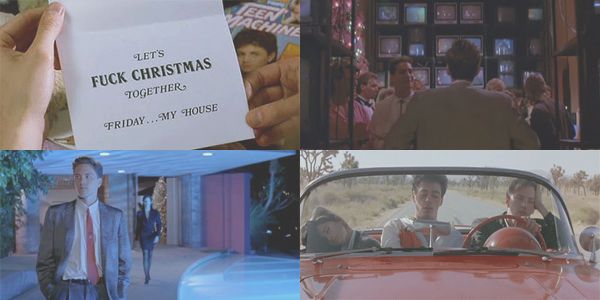
Now, the movie on the other hand is less successful in portraying the lost generation of the 20th century. I admit, it's probably hard to capture the mood of the novel, but when the focus is shifted to something entirely different and everything that made the novel into what it is has been taken away, it creates something else. Another story, another nightmare, and less captivating.
It's not entirely hopeless, though, because the colors are great, the 80s aesthetic almost always makes everything look better, James Spader is oddly fascinating in everything he does etc. But, the entire thing might be worth the watch just for the amazing performance of Robert Downey Jr. He might not be the Julian of the novel, but he's the Julian that everyone should see, even if it's just for that tennis court scene alone.
Now, Ellis has started to draw me back into his world, and I thought his debut novel Less Than Zero would be both a soft(er) landing and an interesting glimpse into his early years and where he came from. At first the trip wasn't successful. I kept wondering why I'd ever liked this guy. Then... Something clicked. I got used to the clipped style and at some point I realized I had slowly but surely been seduced.
Coke, omnipresent blondes, glimmering turquoise swimming pools, dark silhouettes of palm trees rustling in the soft night air. Sudden flashes of violence à la American Psycho tear bloody wounds in the seemingly calm exterior, but mostly Less Than Zero feels like you've been in its grasp forever. It's a place where everything looks like a slowed down and a distorted version of the real world. Something's off, and you're not entirely sure what. Los Angeles is like one of those purgatory-like nightmares, where images want to strangle you in your sleep, leaving you heaving and rolling in cold sweat.
Then it all melts into an ending that is brilliant in all its understatedness.
My decision to read this in English turned out to be a good idea, by the way. I have to remember that next time, because Ellis can write about boredom and vapidity in a way that leaves you disoriented and mesmerized. He doesn't explain much, his characters don't know what the hell they're doing on this Earth, and his subtle black humor pops up in the most unexpected places.
Now, the movie on the other hand is less successful in portraying the lost generation of the 20th century. I admit, it's probably hard to capture the mood of the novel, but when the focus is shifted to something entirely different and everything that made the novel into what it is has been taken away, it creates something else. Another story, another nightmare, and less captivating.
It's not entirely hopeless, though, because the colors are great, the 80s aesthetic almost always makes everything look better, James Spader is oddly fascinating in everything he does etc. But, the entire thing might be worth the watch just for the amazing performance of Robert Downey Jr. He might not be the Julian of the novel, but he's the Julian that everyone should see, even if it's just for that tennis court scene alone.
'I don't want to care. If I care about things, it'll just be worse, it'll just be another thing to worry about. It's less painful if I don't care.'

My criterion for a good ghost story is that it needs to cause a visceral reaction: goosebumps, chills down my spine, tingling neck, icy veins etc. Dark Matter did very well. There were nights when I just didn't want to go to sleep yet, so I ended up grabbing my Kindle in the dark and didn't stop reading until I started flinching at my own shadow on the wall.
As far as remote locations go, The Thing (1982) has a different approach, but that and Dark Matter represent two sides of the horror coin that I've grown to love equally. When the latter's protagonist goes to work as a wireless operator on an Artic expedition, it's all about the quiet, subtle atmosphere, and what you don't see or what sees you. Paver slowly sets up the scene, letting the eeriness gradually seep through the cracks and the isolation grip your heart, so when Jack finally encounters the thing that walks in the shadows, you feel trapped. Add to that the lack of daylight, stillness, and coldness, and you have a lovely winter hell right there.
As far as remote locations go, The Thing (1982) has a different approach, but that and Dark Matter represent two sides of the horror coin that I've grown to love equally. When the latter's protagonist goes to work as a wireless operator on an Artic expedition, it's all about the quiet, subtle atmosphere, and what you don't see or what sees you. Paver slowly sets up the scene, letting the eeriness gradually seep through the cracks and the isolation grip your heart, so when Jack finally encounters the thing that walks in the shadows, you feel trapped. Add to that the lack of daylight, stillness, and coldness, and you have a lovely winter hell right there.

