Take a photo of a barcode or cover
967 reviews by:
elementarymydear


I was very aware while reading this that this was A Good Piece Of Literature. It was award-winning, about an important period of history, and well-known. But not only was it dull, it was also actually difficult to read. It was very hard to keep track of who was talking, because Mantel seems unable to use Thomas Cromwell's name at all, and speech marks appeared to be randomly missing, to the point that sometimes a sentence would contain two pieces of speech; one with speech marks, one without. And then there's be an internal thought that was impossible to distinguish. It also just feels lazy to start a paragraph with a time of year and then a colon, and it interrupts the narrative.
I gave up (about halfway through) when I realised that a) I dreaded the thought of having to go back and read some more and b) I knew nothing about the main character. I knew the facts, like his name, his family, but nothing about his personality, who he was as a person.
I know that lots of people really like this book, and I can sort of see why, but it just really isn't for me. I couldn't get into it, I found it a struggle, and for that reason I gave up.
I gave up (about halfway through) when I realised that a) I dreaded the thought of having to go back and read some more and b) I knew nothing about the main character. I knew the facts, like his name, his family, but nothing about his personality, who he was as a person.
I know that lots of people really like this book, and I can sort of see why, but it just really isn't for me. I couldn't get into it, I found it a struggle, and for that reason I gave up.

I'm sorry, I just couldn't force myself to read any further. I had no idea what was going on, the characterisation was all over the shop, and there was no Janto to take the edge off. I'm now off to AO3. Sorry.

There are no words as to how absolutely fantastic this book is. Every single sentence is perfectly crafted, the plot brilliantly balanced, and just so jam-packed with stuff that I want to spend hours and hours unpacking it all and talking and writing about it, but I don't even know where to start.
What Isherwood has created is a character that is brutally human; to use the usual 'realistic' or 'flawed' would be an understatement and a disservice. George is a person dealing with a silent grief that he's unable to share, almost revelling in his detachment from the world and his deep loneliness. One of the most heartbreaking (and human) moments for me was his sadness when he forgave Doris, simply because moving on from his hatred for her meant one less thing that connected his world to Jim.
This was a perfect example of a book finding you at the right time. The book had been on my radar pretty much since the film came out (I was 14 at the time, so I don't feel bad that I found out about it via billboards for a movie) and has been bumped up my reading list in the last few months or so. For starters, many of the themes tackled are extraordinarily relevant today - the way George talks about attitudes towards minorities, for instance, seemed almost uncomfortably modern, and in many ways highlights how little progress has been made in the last 50 years. (And sorry to break it to you, Mr Isherwood, but people are still writing endless stories about heterosexuals.) As a Brit currently at university in the states, still revelling in this new experience of being 'out', it was definitely a case of the-right-book-at-the-right-time.
And then the end? The end?!
I won't reveal it, because I don't want to spoil it, but it was just... perfect. I can't quite comprehend how it managed to be so wrong and so right at the same time, so fulfilling and yet one of the saddest things I've ever read.
In short: a true work of art, and a hugely valuable contribution to queer literature.
What Isherwood has created is a character that is brutally human; to use the usual 'realistic' or 'flawed' would be an understatement and a disservice. George is a person dealing with a silent grief that he's unable to share, almost revelling in his detachment from the world and his deep loneliness. One of the most heartbreaking (and human) moments for me was his sadness when he forgave Doris, simply because moving on from his hatred for her meant one less thing that connected his world to Jim.
This was a perfect example of a book finding you at the right time. The book had been on my radar pretty much since the film came out (I was 14 at the time, so I don't feel bad that I found out about it via billboards for a movie) and has been bumped up my reading list in the last few months or so. For starters, many of the themes tackled are extraordinarily relevant today - the way George talks about attitudes towards minorities, for instance, seemed almost uncomfortably modern, and in many ways highlights how little progress has been made in the last 50 years. (And sorry to break it to you, Mr Isherwood, but people are still writing endless stories about heterosexuals.) As a Brit currently at university in the states, still revelling in this new experience of being 'out', it was definitely a case of the-right-book-at-the-right-time.
And then the end? The end?!
I won't reveal it, because I don't want to spoil it, but it was just... perfect. I can't quite comprehend how it managed to be so wrong and so right at the same time, so fulfilling and yet one of the saddest things I've ever read.
In short: a true work of art, and a hugely valuable contribution to queer literature.

THE JANTO
THE JANTO
OH THE JANTO
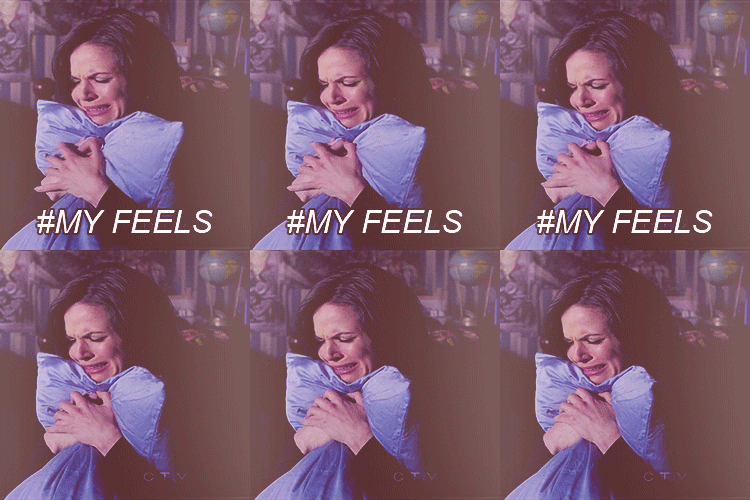
I JUST HAVE A LOT OF FEELINGS
LIKE, A LOT OF FEELINGS
AND I JUST
UGH
I had heard that this was the emotional one. That this was almost, if not more, painful than Children of Earth and House of the Dead.
I just... okay, the first half was hilarious and I loved it for being just so brilliant and making me giggle. Just the thought of Ianto whizzing round the Torchwood Hub on a wheelie chair shouting 'wheeeeee' and the description of Jack as being like a 'gay shampoo advert'... It was all wonderful.
But then we got to the second part. In which Jack is in his own personal hell. And I can safely say that, not only was this Jack's personal hell, this was EVERY TORCHWOOD FAN'S PERSONAL HELL. I mean, what?! The feelings!!!!!!! I mean, it was just like someone had taken my heart and danced round it while setting it on fire.
And then the end! As if I wasn't already a heap in the floor, drowning in the horrific Janto feels, the end happened.
Every time I think that I've felt enough feelings, that the Torchwood writing team can surely think of nothing worse to give to me, I am proven wrong. Which would be a problem if I didn't fall for it every time and love it SO MUCH.
THE JANTO
OH THE JANTO
I JUST HAVE A LOT OF FEELINGS
LIKE, A LOT OF FEELINGS
AND I JUST
UGH
I had heard that this was the emotional one. That this was almost, if not more, painful than Children of Earth and House of the Dead.
I just... okay, the first half was hilarious and I loved it for being just so brilliant and making me giggle. Just the thought of Ianto whizzing round the Torchwood Hub on a wheelie chair shouting 'wheeeeee' and the description of Jack as being like a 'gay shampoo advert'... It was all wonderful.
But then we got to the second part. In which Jack is in his own personal hell. And I can safely say that, not only was this Jack's personal hell, this was EVERY TORCHWOOD FAN'S PERSONAL HELL. I mean, what?! The feelings!!!!!!! I mean, it was just like someone had taken my heart and danced round it while setting it on fire.
And then the end! As if I wasn't already a heap in the floor, drowning in the horrific Janto feels, the end happened.
Every time I think that I've felt enough feelings, that the Torchwood writing team can surely think of nothing worse to give to me, I am proven wrong. Which would be a problem if I didn't fall for it every time and love it SO MUCH.


The thing about this book was that not only was it a good book in its own right, it also actually made the previous two books, retrospectively. Characters such as Willis Linsay, Douglas Black and, in particular, Roberta Golding, make a lot more sense after reading this. It was gripping from the first page, and a brilliant read!

